Active vs. Inactive vs. Lost: Definitions Matter
Optimized Marketing to Capture Fixed Operations Customers
Customer Segmentation in Fixed Operations Marketing
Data-Driven Decisions in Fixed Ops
Forecasting Service Revenue When Car Sales Fluctuate
Try Pulling the Right DMS Reports
Dealership Service Departments Recall Management
Service & Parts Loyalty Programs: Helpful or Headache?
Service Department Revenue: Slow Months
Striking a Fixed Ops Marketing Balance
Fixed Operations Marketing Budget Allocation
12 KPIs for Fixed Ops Directors
The Overlooked Service-to-Sales Handoff
Forecasting Service Revenue When Car Sales Fluctuate
Share:
LinkedInWhen vehicle sales fluctuate, the effects don’t stop at the showroom. Fewer vehicles sold today can mean fewer warranty visits, scheduled maintenance appointments, and customer-pay repair orders down the road.
For fixed ops directors, that relationship creates a challenge: How do you build an accurate service revenue forecast when one of your primary sources of future customers constantly changes?
The answer starts by shifting the focus from vehicle sales to the factors dealerships can actually measure and influence.
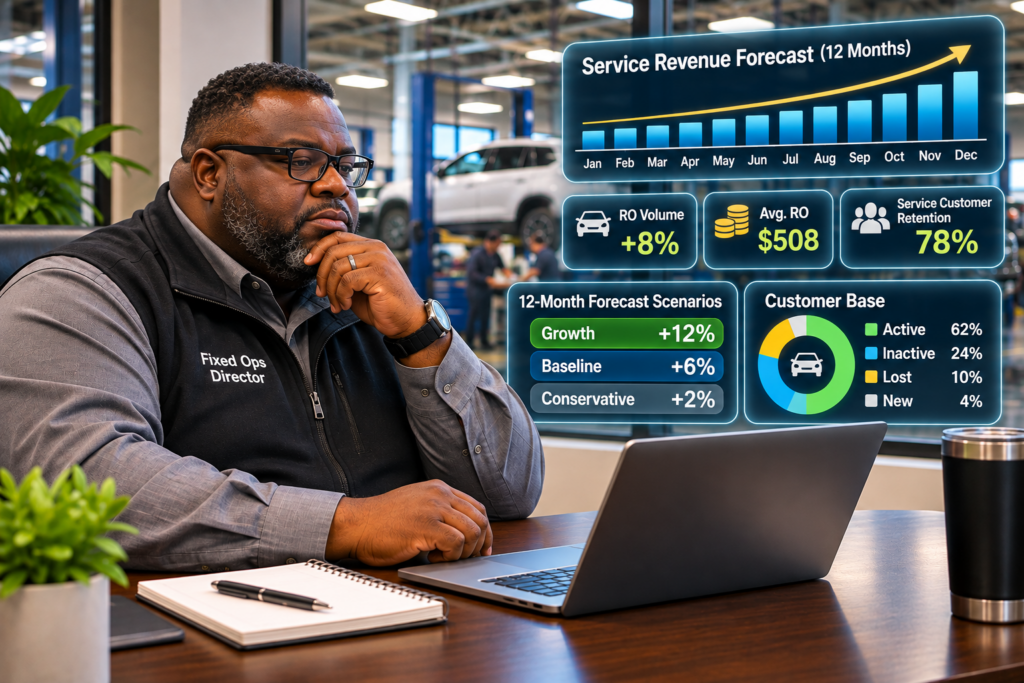
Forecasting service revenue begins with understanding what’s driving your current numbers. Always measure your historical and forecasted business by day, including but not limited to: Average ROs and Average Revenue. This is an important equalizer since every month has a varying number of operating days. When forecasting future months, be sure to start by taking out the calendar and counting the number of operating days.
A dealership might report increasing service revenue while experiencing a decline in repair order counts. Higher labor rates, parts prices, and average repair order values can temporarily mask a shrinking customer base.
According to the National Automobile Dealers Association’s June 2026 Data Report, new-vehicle dealership franchises generated nearly $83 billion in service and parts sales while writing more than 136 million repair orders during the first half of 2026.
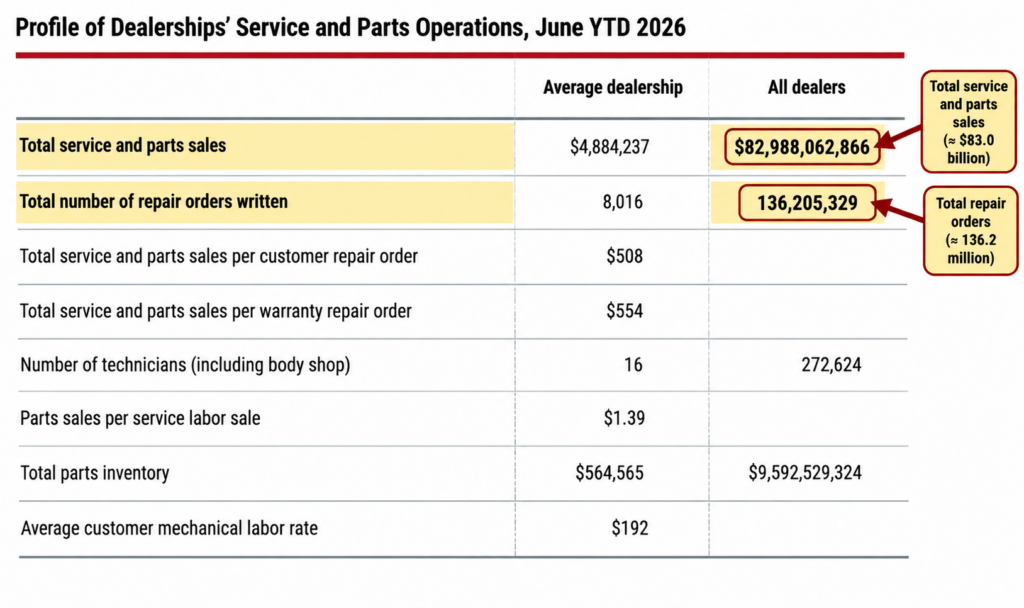
These figures highlight the significant revenue potential of fixed operations, but accurately forecasting service revenue requires dealerships to look beyond industry trends and evaluate the metrics driving their own performance.
Start by reviewing:
In his TVI MarketPro3 interview, From Raw DMS Data to Revenue: How Elite Stores Make Data Actionable, Ken Pletcher discusses how successful dealerships transform DMS data into actionable business decisions.
That same approach applies to forecasting. Historical performance establishes the baseline, while customer behavior and operational trends help determine what comes next.
Declining vehicle sales don’t automatically translate into declining service opportunities.
According to S&P Global Mobility, the average age of vehicles on American roads reached 12.8 years in 2025, with approximately 289 million light vehicles in operation. For dealerships, this represents an opportunity to generate customer-pay revenue from vehicles that may be well beyond their original warranty coverage.
When forecasting service revenue, fixed ops directors should evaluate the data provided by their OEM regarding Units in Operation (UIO) within the dealership’s Primary Market Area (PMA), particularly vehicles approaching major maintenance milestones or exceeding seven years of age. These customers represent opportunities to offset declining warranty traffic, provided the dealership has a strategy to reach and retain them.
One of the most overlooked components of service revenue forecasting is the dealership’s existing customer database. Every active, inactive, and lost customer represents a different level of potential future service activity.
In the TVI MarketPro3 interview TVI MarketPro3 and Scott Kelford, Kelford emphasizes the importance of dealership relationships, transparency, and growing repair order counts through informed marketing strategies.
For forecasting purposes, customer segments should be evaluated separately:
By combining historical response rates with expected repair order values, dealerships can develop more realistic projections for customer-pay growth.
A reliable forecast shouldn’t depend on one optimistic revenue target.
Instead, develop three projected scenarios to revisit monthly:
Pay particular attention to changes in technician capacity, appointment availability, labor productivity, and customer-pay repair order counts. If those indicators begin moving in the wrong direction, leadership can adjust marketing investments and operational strategies before revenue suffers.
Forecasting service revenue isn’t about predicting every market shift. It’s about understanding which factors drive dealership service demand and building a strategy that adapts as conditions change.
Vehicle sales will rise and fall. Consumer spending will fluctuate. Repair needs will evolve. Dealerships that understand their customer base, monitor their KPIs, and consistently work to grow service traffic are better positioned to maintain predictable fixed operations revenue.
TVI MarketPro3 helps dealerships turn customer data into measurable service department growth through strategic acquisition, retention, and reactivation marketing. Connect with our team to build a stronger foundation for your next 12 months.
Let's get moving. Get your customized marketing plan today.
01
Dealership Information

Internal and Counter Parts Sales
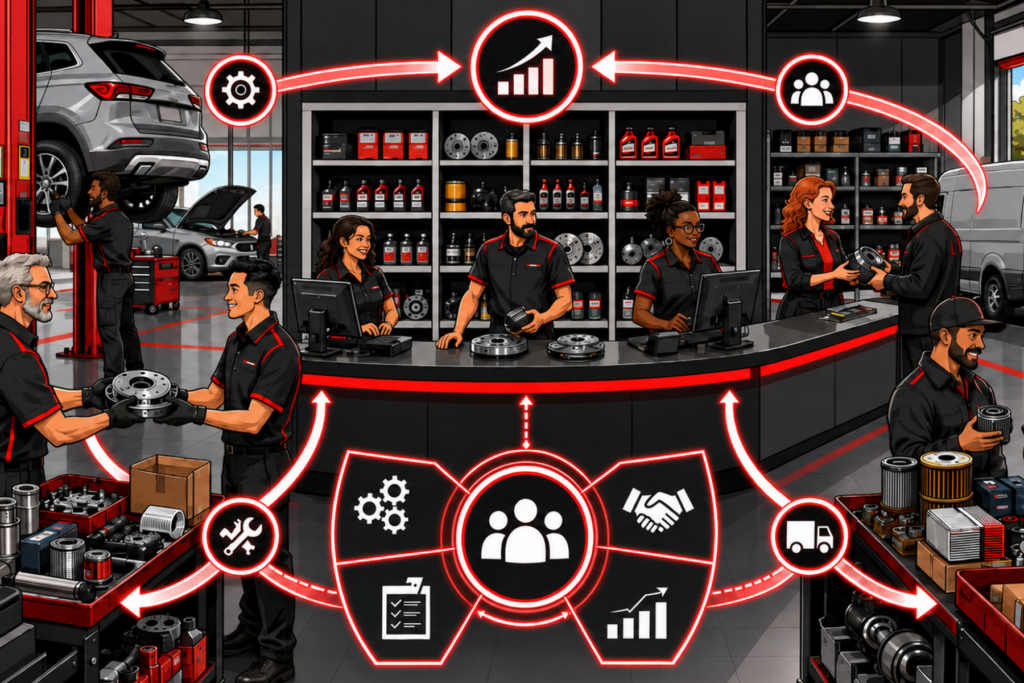
A thriving parts department is the heartbeat of a successful service drive, expertly balancing the needs of two distinct customer bases. Internally, they prioritize the speed, availability, and reliability that the technicians, reconditioning, and collision teams need to keep production moving. Externally, they deliver the accuracy, competitive pricing, and expertise that turn retail owners, fleets, and wholesale accounts into loyal partners. While these channels occasionally vie for the same resources, they shouldn’t be at odds. By establishing clear operational rules, defined ownership, and ambitious performance expectations, dealerships can eliminate friction and transform both channels into powerful engines for dealership growth. Understand the Role of Each Sales Channel Internal sales drive the service engine, keeping technicians productive, reconditioning moving, and vehicles hitting the lot faster. Meanwhile, counter and wholesale channels unlock massive potential by building loyalty with local shops and fleets, turning every interaction into a growth opportunity. The key? Recognizing that both are vital, and neither should automatically take a back seat. Washington Area New Automobile Dealers Association (WANADA)’s Service and Parts: A Profitable Relationship, drawing from National Automobile Dealers Association (NADA)’s dealership management guidance, describes service and parts as mutually dependent and notes that the service department is often the parts department’s largest customer. It also warns dealerships against automatically discounting internal parts sales, because weak gross retention in internal, warranty, or counter sales can pull down the entire department. That means internal pricing should be a leadership decision, not something that changes from one repair order to another. Dealership leaders should establish: ~An approved internal pricing formula~Who can authorize discounts~Whether used-car recon and new-car internal work follow the same ~pricing policy~Wholesale and retail pricing levels~Special-order and return policies~How each channel’s results will be reported Discounting internal work may make another department’s numbers look stronger, but leadership should evaluate profitability from the perspective of the entire dealership. Create Clear Workflows Before Channels Compete Many parts conflicts are operational rather than financial. Consider a common situation: a technician needs the last available unit to complete a customer-pay repair while a counter customer has already been quoted the same part. Who gets it? Without an established process, the answer may depend on which employee asks first—or more loudly. Leadership should instead define inventory priorities and ownership. Employees should know who handles back-counter requests, retail counter customers, wholesale accounts, special orders, reconditioning needs, and escalations. Service expectations should also be clear. Internal standards might include quote response times, technician updates, emergency order cutoffs, and reconditioning status updates. Counter standards might cover phone response, quote turnaround, special-order follow-up, pickup notifications, and delivery schedules. NCM Associates recommends integrating parts personnel into shop and advisor meetings, making the parts manager visible in the service drive, setting measurable goals, and helping employees understand how the parts department contributes to shop production. That cross-department communication becomes especially important as demand changes. Service personnel should communicate upcoming promotions, maintenance menu changes, recurring repair patterns, campaigns, and recalls. Parts personnel should communicate backorders, supply constraints, supersessions, stocking limitations, and expected arrival dates. Measure Growth Without Creating Internal Competition Compensation and KPIs can either reinforce collaboration or create channel conflict. A counter employee rewarded solely for external sales may naturally prioritize a wholesale call over a technician waiting for a part. On the other hand, focusing only on the overall department gross may fail to reveal poor customer response, inventory problems, or missed growth opportunities. A better approach is to monitor channel-specific results alongside the department's overall performance. One Parts Department, One Goal Internal and counter sales do not inherently compete. They begin competing when pricing is inconsistent, inventory commitments are unclear, priorities are undocumented, and employees are measured in ways that reward channel conflict. Both department channels should have defined ownership, consistent pricing, accurate inventory information, measurable service standards, and shared operational goals. When parts, service, reconditioning, and counter sales teams operate from the same playbook, the dealership can grow parts revenue without sacrificing technician productivity, customer response, or departmental trust. A coordinated parts and service process also helps dealerships capture more value from every repair opportunity. TVI MarketPro3 helps dealerships use DMS and market data to reach the right customers, generate additional service traffic, and support sustainable fixed-operations growth. Reach out today to discuss your service department’s marketing strategy.
Aug 14, 2026 | 3 minute read

Closing Service Approvals Faster: Texting vs. Calling
There’s a time and place for a phone call, but today's customers don't always answer. Service departments often lose time waiting for callbacks before repairs can begin, and sometimes customers ignore the call if they don’t recognize the number. The question isn't whether dealerships should stop calling customers. The real question is: Which communication channel delivers the information customers need when they need it? It’s imperative for today’s fixed ops leaders to use both texting and calling strategically. According to a 2026 Missive article, open rates for text messages exceed 90% across most industries, with a generally faster response time than waiting for a callback. Customers increasingly prefer text communication, and faster response times reduce repair delays and improve the customer experience. The Hidden Cost of Waiting for a Callback Let’s consider the cycle of phone call communications. The advisor leaves a detailed voicemail, but the vehicle often sits waiting for authorization. Even if the customer calls back promptly, there’s still a good chance they won’t be able to reach their busy service advisor. Let the annoying and inefficient game of phone tag begin. The trickle-down impact includes delays in parts ordering, technicians waiting to work, and increased repair cycle times. A recent TVI MarketPro3 article stresses the impact of dealership service response times and their impact on customer retention. The same can be true of slow customer response times. Delayed responses on either end of the line affect repair approvals, customer satisfaction, repair order (RO) throughput, and retention. Simply put, slow communication creates friction. Why Customers Are Responding to Text Messages If you think about a day in the life of a busy customer, it’s easy to see why answering a phone call isn’t always an option. Customers are working, perhaps in a meeting. They may not be near their phone when it rings, or have it on silent. Busy parents are chasing after their kids and balancing household tasks. A text allows them to review and digest information at their convenience, perhaps more easily than during a phone call. They can then follow up with a more decisive response than a call, which can leave them with more questions than answers. TVI Unotifi Automated Text Message Marketing Customers increasingly expect multiple communication channels rather than relying solely on phone calls. Unotifi specializes in giving customers multiple ways to connect with the dealership, and the platform centers on texting to bring customers into the service drive and retain them through efficient communication. Texting Doesn't Replace Trust—It Supports It Texting alone doesn't sell repairs. Personal communication still matters, especially for bringing customers back time and again. They need compassion, understanding, and connections, not just notifications. Texting is also most effective when it complements other forms of technical communication; for example, video with text creates transparency. Texts deliver information quickly, while video helps establish credibility, and the advisors are available to provide context and explanation. The Most Effective Approach Isn't Texting OR Calling There’s a time and place for each means of communication, and knowing the difference sets top-performing dealerships apart from average stores. Texting works best with: Status updatesMPI deliveryRepair approvalsParts updatesAppointment confirmations Calling still matters with: Large repair estimatesComplex repairsDeclined recommendationsUpset customersRelationship-building opportunities Technology Should Support the Conversation, Not Replace It The most successful service departments don't force customers into a single communication channel—they meet customers where they're most comfortable. Some customers prefer the convenience of a quick text, while others still want the reassurance of a personal phone conversation before making a decision. This is where solutions like Unotifi help dealerships create a more flexible customer experience. Rather than treating texting and calling as competing strategies, Unotifi allows dealerships to integrate both into a cohesive communication process. Advisors can use text messaging to deliver updates, photos, videos, and repair recommendations quickly, while still being able to pick up the phone when a situation requires additional explanation, empathy, or trust-building. The goal isn't to replace human interaction with automation. It's to remove communication barriers so advisors can spend less time chasing customers and more time helping them make informed decisions. When customers can communicate on their terms—and advisors have the tools to respond appropriately—dealerships create a more convenient, transparent, and customer-friendly service experience that drives both approvals and long-term retention. Conclusion In today's service environment, speed and convenience matter, but so does the human connection that builds trust and loyalty. The dealerships seeing the strongest results aren't choosing between texting and calling—they're using both strategically. By leveraging text messaging for quick updates and approvals while reserving phone conversations for more complex or relationship-driven interactions, service departments can reduce delays, improve the customer experience, and keep repair orders moving. The goal isn't simply better communication—it's creating a seamless experience that earns customer confidence and keeps them coming back.
Jul 13, 2026 | 4 minute read

Advisor Pay Plans That Drive Sales Without Creating Toxic Pressure
Service advisor compensation may be one of the most debated topics in fixed operations. Ask ten operators how advisors should be paid, and you’ll likely get ten different answers. Flat commission. Salary plus bonus. Gross profit. CSI. Hours per RO. Team incentives. Retention bonuses. Every pay plan is designed to motivate performance. The problem? Poorly designed compensation structures can unintentionally reward the wrong behaviors. Overselling. Burnout. Internal competition. High turnover. Damaged customer trust. In an industry already facing pressure to grow customer-pay business, compete with independents, retain talent, and improve profitability, dealerships can’t afford compensation systems that create short-term gains at the expense of long-term health. The question isn’t whether advisor pay matters. The question is: How do you build advisor compensation plans that increase performance while encouraging trust, retention, and sustainable growth? The Hidden Cost of Incentivizing the Wrong Behaviors Service advisors sit at one of the hardest intersections in a dealership. They’re expected to: Deliver excellent customer experiencesSell needed maintenance and repair workManage upset customersCoordinate with techniciansHandle warranty complexitiesMaintain CSIDrive profitability Nick Shaffer, TVI MarketPro3’s Vice President of Sales, notes in his recent interview with Bruce Daugherty, Owner and President of ADO Consulting: “Being a service advisor… is one of the most valuable and also one of the most difficult jobs in the car dealership… [they] play a huge role in the customer experience, the client retention, the store profitability… and the technician retention.” When compensation only rewards dollars sold, predictable problems emerge: Advisors focus on immediate sales over educationCustomers feel pressured instead of informedCSI suffersTrust declinesAdvisors burn outTurnover rises Bruce Daugherty puts it bluntly: “It’s the most important, hardest job in the store, and we’re trying to work people for three to five grand… No wonder you can’t get great advisors.” Underpaying advisors while expecting world-class performance creates a cycle: Stress → Turnover → Emergency Hiring → Inconsistent Customer Experience → Reduced Retention Common Advisor Pay Structures: What Works—and What Can Go Wrong There’s no universal advisor pay plan. The “right” structure depends on factors such as franchise requirements, state labor laws, manufacturer incentives, and dealership goals. However, after decades of leading high-performing service operations, Bruce Daugherty argues that how compensation is designed matters far more than simply choosing a category. Salary Only Bruce’s take: Strongly against it. “Salary only is a big no, regardless of the store, brand, franchise, location, state, or anything. I would never do only a salary.” His concern is simple: Without performance incentives, there’s little motivation to maximize customer experience, efficiency, or sales performance. As Bruce explains: “The problem with that is there's no incentives. There's no reason to… kill a bear every day…” Potential downside: Reduced motivationLimited performance differentiationDifficulty attracting high performers Salary + Commission Bruce’s take: Potentially strong—but design matters. “A salary plus commission… as a base concept is great, but then how do you design the commission is the big question.” The real issue becomes: What behaviors are being rewarded? Compensation tied only to sales volume can unintentionally encourage: OversellingDiscounting to close workShort-term thinking Bruce’s philosophy focuses on rewarding multiple performance dimensions, not just one. Flat Commission / Commission-Only Plans Bruce’s take: Requires caution—and legal awareness. State laws may require minimum salary or hourly components. For example: “In California, the average hourly component equates to almost $36,000 a year in base pay just to show up and do nothing.” His broader concern: Commission structures become problematic when incentives only reward volume. Gross Profit–Based Compensation Bruce’s take: Dangerous if used alone. He warns against pure gross-based systems: “I would not ever just say gross only or sales only, either one…” Why? Because compensation based solely on gross can create what Bruce calls “Repair order hustlers.” These advisors may: Cherry-pick lucrative repair ordersAvoid difficult customersCreate internal competitionPrioritize paycheck over consistency Bruce explains: “You can just write up a bunch of repair orders… maybe write 30–40% more than everybody else… or cherry pick the right cars, and all of a sudden, you've got a great paycheck…” The result: High production on paper, but potentially weaker culture and inconsistent customer experiences. Hours per RO Incentives Bruce’s take: Essential. Unlike gross-only systems, Bruce strongly supports hours per RO (HPRO) as one component of advisor compensation. “[You] absolutely have to pay on hours per RO, no matter what the brand, no matter where you are.” However, he recommends tiered structures, typically with three levels. Example: Tier 1: 2.6–2.8 HPROTier 2: 2.81–3.0 HPROTier 3: 3.1+ HPRO These benchmarks should vary by brand and store type. His reasoning: Hours per RO helps measure whether advisors maximize opportunities with the traffic the dealership already has. Team-Based Incentives Bruce’s take: Only for CSI. Bruce supports team incentives selectively: “The only thing I've ever agreed on with team-based incentives is around CSI.” Why? Because CSI reflects shared effort. When someone is out sick or on vacation: “…everybody else is willing to pick up the phones, answer, follow up [on] his work…” However, Bruce avoids applying team incentives to: SalesHours per ROEffective labor rateGross profit CSI-Based Bonuses Bruce’s take: Mandatory. His position is clear: “You gotta have it.” Why? “If we want happy customers to keep coming back… we have to have some way to measure.” However, CSI compensation requires careful oversight. Potential pitfalls: Survey manipulationUnfair penalties for technician issuesManufacturer scoring complexity Bruce notes: “You gotta be careful how you manage it…” He often prefers monthly measurement with leadership discretion to adjust for unusual situations. Retention / Repeat Visit Bonuses Bruce’s take: Usually redundant. Rather than paying separately for customer retention, Bruce often incorporates loyalty into CSI. “I think that kind of goes with CSI already… I just prefer the overall CSI score…” Manufacturer programs may require loyalty metrics, but his preference is simplicity where possible. Bruce Daugherty’s Preferred Advisor Pay Philosophy Rather than rewarding one metric, Bruce builds compensation around multiple controllable outcomes: Typically including: Customer-pay RO average (CPRO)Effective labor rate (ELR)Hours per RO (HPRO)CSICustomer-pay growth His goal: “You want a guy that's not discounting work… You want the best of both worlds.” And ultimately: “That’s a guy that’s selling everything, and he’s selling it for top dollar…” Not through pressure, but through consistency, customer experience, and disciplined execution. Why Some of the Best Pay Plans Reward More Than Sales Bruce describes one of the most successful compensation structures he implemented: “I finally migrated… to what I called a 50-50 pay program. Half of it was CSI, and the other half was customer-pay averages.” Notably: “I did not pay a percentage of the warranty write-up at all.” And: “What I want [advisors] to do is give the client a world-class experience, and I want them to sell the maintenance and the customer-pay work…” His philosophy? Reward advisors for: Taking care of customersSelling needed work ethically Not simply maximizing transactions. The results? “We went to 4.2 hours an RO… and then we finished first in the nation… with CSI.” His conclusion: “You want to be highly focused and take care of customers and selling work. The only two things that really matter. We built a pay program around that.” Education Sells Better Than Pressure High-performing advisors don’t simply quote prices. They educate. Bruce explains: “90% of the time, it’s advisors. 90% of the time, it’s poor communication.” Industry studies reinforce this. Effective advisor communication strongly influences customer satisfaction, loyalty, and repeat business. Training and advisor development improve both profitability and retention. Similarly, industry data shows customers increasingly trust advisors who explain repairs clearly and communicate proactively. In one large customer study, 80% of customers said their service advisor earned their trust by the end of the visit. Trust is not a soft metric. Trust drives retention. The Best Pay Plans Don’t Just Drive Revenue Dealerships face growing pressure: Customer-pay growthStaffing shortagesCompetition from independentsRising operational costsIncreasing customer expectations Compensation matters more than ever. The strongest advisor pay plans don’t merely reward sales. They create: ✔ Consistency✔ Customer trust✔ Retention✔ Sustainable performance✔ Stronger teams✔ Healthier culture Because the highest-performing advisors aren’t simply the ones who sell the most; they’re the ones customers trust enough to come back to. Check out TVI MarketPro3 for more fixed ops expert insights.
Jun 9, 2026 | 6 minute read
Idle Bay Syndrome
How to Spot It Before Payroll Eats You Alive Your Shop Isn’t Full—Even If Your Schedule Is At a glance, everything looks healthy: the schedule is booked, advisors are moving, and cars are coming in. Take a walk through the shop, though, and you’ll see it—empty bays, technicians waiting, work stalled. Your shop isn’t full—even if your schedule is. Industry experts often discuss the issue of “Idle Bay Syndrome,” and it’s one of the greatest profit killers in fixed operations. In a recent interview with Nick Shaffer, Bruce Daugherty, President of A.D.O. Consulting Group, stresses, “Every empty stall you have is roughly $30,000 to $40,000.” What Is Idle Bay Syndrome? Idle Bay Syndrome happens when you have the capacity to produce, but you’re not producing. Your bays are open with technicians clocked in, but you’re not generating billable hours. This showcases the most important distinction in your service department: busy does not mean productive. You can have a full calendar and still leave hours on the table every single day. The Hidden Causes of Idle Bays Idle bays don’t happen because of one big issue—they’re the result of breakdowns across your entire operation. Inconsistent Car Count When your car flow is unpredictable, your shop becomes reactive. One day, you’re overloaded. The next day, you’re scrambling to fill the board. This usually traces back to: Poor marketing alignmentWeak customer retentionLack of consistent outreach Without a steady pipeline, your bays will never run at full capacity. Bottlenecks in Your Process Even when cars are in the building, work doesn’t always move. Idle time in most shops isn’t a labor issue—it’s a workflow issue. Technicians get stuck waiting on: Advisor approvalsParts availabilityDispatch direction These small delays stack up fast. And every minute spent waiting is a minute not producing. Low MPI Completion Every vehicle that comes through your shop is an opportunity. But when multi-point inspections (MPIs) aren’t completed consistently—or aren’t communicated effectively—you miss work that’s already in front of you. That means: Fewer approved servicesLower hours per ROMore unused capacity You don’t always need more cars—you need to do more with the ones you already have. Inefficient Scheduling Too many service departments operate in peaks and valleys. Mornings are slammed. Afternoons slow down. Certain days are overloaded, while others are wide open. Without intentional scheduling, you create: Technician downtimeDispatch bottlenecksUneven workload distribution Consistency—not volume—is what drives productivity. A Winning Strategy Idle Bay Syndrome doesn’t start in the shop—it starts with how you generate and manage demand. With the right strategy in place, you can stabilize your workflow and eliminate the peaks and valleys that create downtime. Database segmentation ensures you’re reaching the right customers at the right time.Campaign timing helps fill slow days before they happen.Recall and reactivation efforts create predictable, consistent demand. When your inflow is controlled, your shop becomes efficient. Visit TVI MarketPro3 for more expert insights.
May 6, 2026 | 3 minute read

OEM Warranty Expiration: The Window You’re Probably Missing
Most dealerships obsess over client acquisition. Unfortunately, many fail to master retention, and very few are fully capitalizing on one of the most predictable, high-value opportunity windows in fixed operations: the 90 days before and after OEM warranty expiration. This is the moment your customer decides whether they’re staying with you—or leaving for good. Why the Warranty Expiration Moment Matters The data is clear: dealership retention is slipping, and the warranty milestone is a major inflection point. In 2025, a Cox Automotive Study found: * Only 54% of customers with vehicles 2 years old or newer returned to the selling dealership for service, down sharply from 72% just two years prior* Dealerships now handle 12% fewer service visits than in 2018, with many customers shifting to independent garages* Customers who do stay in the service lane are 74% more likely to buy their next vehicle from that dealership That last statistic is the kicker. Losing a service customer isn’t just losing maintenance revenue. It’s losing your next vehicle sale, and warranty expiration is when that loss often happens. The Behavioral Shift at Warranty Expiration During the OEM warranty period, customers are conditioned to return: * Repairs are covered (or perceived to be)* Trust is anchored in the manufacturer* Risk feels low However, the moment that warranty expires, the psychology flips: * “Now I have to pay for everything.”* “Maybe I should shop around.”* “The dealership is probably more expensive.” This is exactly when independent shops step in—and win. In fact, many customers leave dealerships specifically after their warranty ends, contributing to already low retention rates across the industry The Window Most Dealers Miss Here’s where the opportunity lives. The decision to stay or leave doesn’t happen at expiration. It happens in the months surrounding it. The Timeline That Matters 2-3 months before expiration, the customer is still * Engaged* Returning for service* Trusting your process At expiration * Uncertainty peaks* Price sensitivity increases* Competitors begin targeting aggressively 2-3 months after expiration * New habits form* If they try an independent shop once… you’ve likely lost them This is the window where retention is either secured—or permanently broken. Why Most Dealerships Lose This Moment It’s not due to a lack of data. OEMs regularly provide warranty timelines and retention reporting. The breakdown is operational: No Proactive Communication: Customers aren’t told what happens after the warranty ends, so they assume the relationship is over. No Transition Strategy: Some dealerships treat warranty and customer-pay repairs as two separate worlds—when they should be one continuous experience. No Value Reframing: When coverage disappears, value must increase. Many stores never reposition themselves beyond “we fix cars.” A Different Approach Rather than waiting for the warranty to expire, dealerships must guide the customer through the transition. Start Before Expiration Communicate early and clearly: * What’s changing* What’s not changing* Why staying with the dealership still makes sense This reduces the fear of the unknown—a big driver of defection. Reframe Value (Not Price) Customers leave because of perceived cost, not actual cost. The same Cox Automotive study shows dealership repairs can actually be less expensive than the average independent shop, yet customers still defect due to perception and communication gaps A winning strategy focuses on: * Transparency* Inspection documentation* Advisor communication Building customer trust drives retention over discounts. Use the MPI as a Retention Tool A strong multi-point inspection does more than identify work: * It shows the vehicle’s condition* It builds credibility* It creates continuity post-warranty When customers see what’s needed, they’re far less likely to shop for it. Lock in the Next Visit Retention isn’t about this visit—it’s about the next one. Be sure to: * Pre-schedule future maintenance* Set expectations for upcoming needs* Create a service roadmap beyond warranty This prevents the “I’ll figure it out later” moment… where competitors often have a leg up. The Financial Impact of Getting This Right Retention isn’t just a KPI. It’s a profit engine. * Service drives up to 49% of dealership gross profit despite a smaller share of revenue* Increasing retention by just 5% can boost profits significantly* Retained customers generate predictable revenue and lower acquisition costs And it all compounds. Every retained service customer increases: * Lifetime value* Future vehicle sales* Referral opportunities The Bottom Line The warranty expiration point isn’t just a milestone. It’s a decision point. A winning strategy is one that controls the transition from warranty to customer-pay, and if you don’t catch the out-of-warranty vehicles, someone else will. Check out TVI MarketPro3 for more expert insights.
Apr 3, 2026 | 4 minute read
Multi-Point Inspection Completion Rates
Every vehicle that enters your service lane represents more than the work written on the RO. It represents potential: safety issues, maintenance needs, and future service opportunities. Yet many dealerships fail to consistently capture that opportunity because they don’t aggressively manage one critical metric: multipoint inspection completion rate. Car count and gross get attention. Inspection discipline often doesn’t. What Multi-Point Inspection Completion Rate Actually Measures Multi-point inspection (MPI) completion rate measures the percentage of repair orders that receive a full inspection. Not a quick glance. Not a partial checklist. A documented, consistent inspection. If your shop writes 1,000 repair orders in a month and only 650 receive a completed MPI, your completion rate is 65%. That means 35% of vehicles are left without a proper inspection to identify additional needs. In fixed ops, that’s not just a process gap. It’s a revenue gap. Why MPI Completion Matters More Than Most Leaders Realize Every vehicle that enters your service drive has: Wear componentsMaintenance needsFuture service requirementsSafety considerations Without a consistent inspection process, those needs go unidentified or even undocumented altogether. The MPI is not about selling harder. It’s about identifying legitimate needs and communicating them clearly. When inspections are consistent: Advisors have documented talking points.Customers see transparency.Trust increases.Approval rates improve. When inspections are inconsistent, advisors are forced to rely on memory or guesswork. Why Most Stores Fail MPI Completion Many service departments don’t perform complete inspections on every vehicle that comes through the door, even though a robust MPI process can uncover more revenue and trust opportunities. In fact, some industry commentators note that about 80% of service departments only provide thorough inspections on some vehicles—far from the ideal of near-100% coverage. Here’s why: 1. Technician Resistance Flat-rate environments create time pressure. If inspections aren’t built into the workflow and compensation structure, technicians may see them as unpaid labor. Without leadership reinforcement, completion slips. 2. No Real-Time Accountability Many stores only review inspection performance monthly—if at all. But the completion rate should be reviewed: Daily by advisorsWeekly by techniciansMonthly by departments What gets reviewed consistently improves. What doesn’t tends to decline. 3. Weak Advisor Reinforcement Even when inspections are completed, they are not always: Properly documentedClearly presentedAccompanied by photos or video If advisors aren’t consistently presenting MPI results to customers, technicians lose motivation to complete them thoroughly. The process breaks down. The Financial Impact of Missed Inspections Let’s run conservative numbers: 1,000 ROs per month30% not inspectedAverage additional recommended work per inspected RO: $250 That’s 300 vehicles per month leaving without a documented opportunity for additional service. 300 × $250 = $75,000 in potential recommended work per month. Even if only a portion would convert, the profit potential is too substantial to ignore. And that doesn’t account for the impact on long-term retention: inspections don’t just drive revenue today. They drive future appointments. Final Thought While more cars would be helpful, they aren’t necessary to grow service revenue. Multi-point inspection completion is not glamorous. It’s not flashy. It doesn’t generate headlines. But it quietly determines how much opportunity your service department captures—or misses. Visit TVI MarketPro3 for more expert insights on fixed ops.
Mar 10, 2026 | 3 minute read
NADA Show 2026: What Fixed Ops Leaders Must Prioritize in the Year Ahead
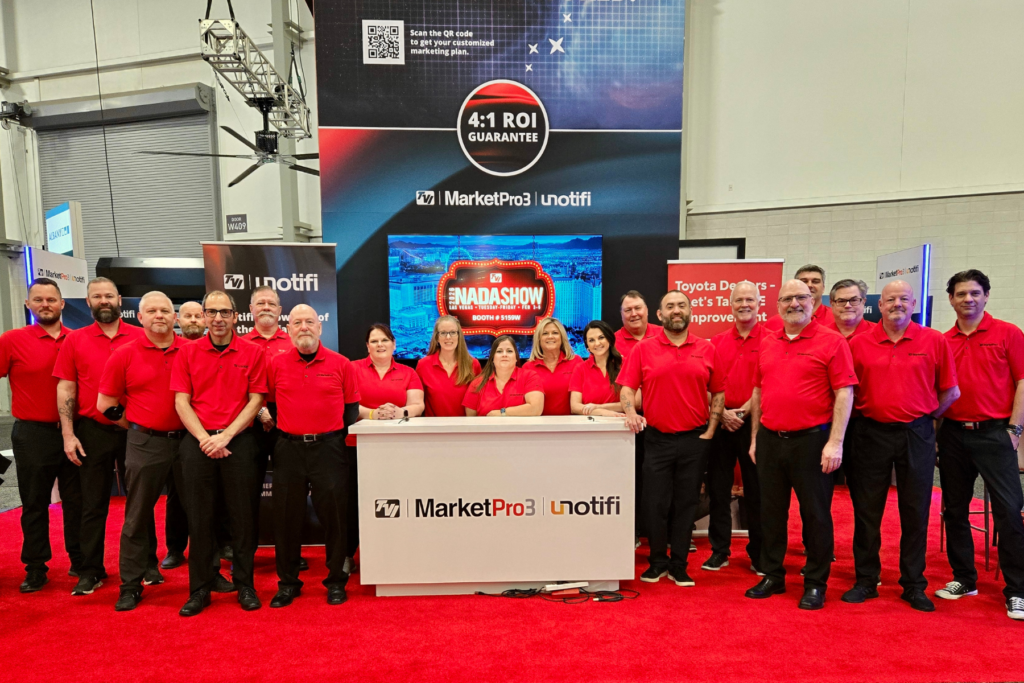
NADA Show 2026 was packed with technology, bold claims, and the loudest buzzword in automotive right now: AI. But when you step back and listen carefully to the conversations happening between dealer leaders, OEM executives, trainers, digital strategists, and fixed operations specialists, an even clearer theme emerges: 2026 will reward precision, process, and customer experience—not just new tools. Across our interviews with industry leaders, six dominant fixed ops themes stood out. 1. Retention Is the Growth Strategy For years, fixed ops growth rode the wave of strong vehicle sales. That cushion is gone. Fewer new vehicles means fewer natural service opportunities. Every retained customer matters more. As David Willard explained, “The new cars sold in America have gone down for the last five years… so you have less at-bats. Each individual retained customer is more important to you now than ever before.” Corey Smith from EasyCare elaborated further: “Everyone’s talking about a 70% retention rate. But is that because they have to come to you… or because they want to?” That distinction matters. True retention isn’t warranty-driven. It’s relationship-driven. TVI MarketPro3’s Scott Kelford summarized the biggest retention killers simply: -Time-Price perception-Treatment Willard added that price often isn’t the real issue. “Since COVID, I don’t think independents give you a price advantage at all… It’s the perception.” Retention in 2026 isn’t about discounts. It’s about consistency, communication, and experience. 2. The 12-Year Opportunity: Aging Vehicles Are the Revenue Engine The average vehicle on the road is now nearly 12–13 years old, yet many dealerships still focus their marketing energy on 7- to 10-year-old vehicles, depending on the focus parameters of their OEM performance metrics. TVI Unotifi’s Lauren Marzella pointed out that the average age of cars on the road is higher now than at any other time in history. TVI MarketPro3’s Steve Coad shared real-world examples of targeting 7+ year-old trucks and SUVs during specific seasons—leading to differential service, brake work, suspension repairs, and strong customer pay. Across the industry, the results extend even further. Dealers are seeing 15- and 20-year-old vehicles returning for $2,000–$3,000 repairs when engaged correctly. Ketan Bhatia, Lincoln Regional Manager for Ford Motor Company, emphasized, “The biggest Rolodex is right there at the dealer’s hands… It’s their DMS.” Instead of blanket campaigns, dealers are now using: -Mileage segmentation-Recall reactivation-Declined service follow-up-Ownership verification Marzella summed it up: “Intelligent marketing isn’t one-size-fits-all… it evolves as we learn customer behavior.” The opportunity lies in how well you communicate with the customers you already have. 3. AI Is Everywhere—But It’s Not the Easy Button AI dominated this year’s NADA conversations, but the most grounded discussions were about balance. TVI Unotifi’s Michael Lopez warned, “AI definitely [shouldn’t become a crutch.” Dealers are exploring: -AI phone answering-AI text automation-AI scheduling-AI-driven marketing optimization However, without process oversight, AI won’t fix broken systems. It will automate them. Michael Waltrip, Vice President of Fixed Operations with Auto Services Unlimited, put it bluntly: “Every customer just wants someone to answer the phone.” He also acknowledged that advisors are busy, “They’ve got a guest in front of them.” AI can help fill those gaps—especially after hours—but Waltrip also offered a critical perspective: “AI is only what you put into it… There is no easy button.” The most productive AI application emerging from NADA? Freeing up BDC teams. Lopez explained, “If they’re trying to develop business, they can’t do that if they’re taking inbound phone calls all day.” AI handling overflow scheduling allows BDC agents to focus on: -Recalls-Declined services-Maintenance follow-up-Lost customer reactivation AI works when it enhances the human experience—not replaces it. 4. Digital Marketing Must Drive Revenue, Not Just Clicks Fixed ops digital marketing has historically been an afterthought. Ian Favre, Digital Marketing Director with TVI MarketPro3, challenged that model: “Fixed operations digital marketing spend is usually the afterthought from most big box agencies.” Instead of generic service ads, granular campaigns are outperforming: -Toyota transmission repair-Brake service near me-Model-specific service queries More importantly, dealers are demanding true ROI tracking. Favre says, “Impressions and clicks don’t matter if they don’t turn into money.” The shift is toward tying:Keyword → Click → Phone Call → Closed RO → Revenue Meta advertising (Facebook and Instagram) is also becoming more precise. Instead of spraying broad audiences, campaigns are built directly from DMS data—active, inactive, or lost customers—eliminating waste. In 2026, digital advertising isn’t about visibility. It’s about measurable service revenue. 5. Process and Experience Win the Retention Game If there was one consistent undercurrent in every conversation, it was process discipline. Easy Care’s National Fixed Operations Training Director, Corey Smith, emphasized, “If you don’t have a playbook in service, you’re not going to win this retention game.” He described the difference between transactional service and experience-driven service: “If they feel good at the end, no matter how much they spent, they’re going to come back.” He also introduced a powerful mindset shift: Instead of asking, “When do you want to pick it up?” Ask, “What does your day look like today?” That subtle change reframes expectations and builds trust, along with a few other built-in procedures: Scheduling pickups, walking customers to their vehicle, setting next appointments, and treating oil change customers like engine replacement customers. Smith noted, “If I’m dropping off my $50,000 baby and I don’t hear from you, I feel like you’ve forgotten about me.” Ford Motor Company’s Lincoln Regional Manager, Ketan Bhatia, echoed the same principle from an OEM luxury perspective, “The basics of any business is communication.” Whether it’s Lincoln-level pickup and delivery or a high-volume Toyota store, the core differentiator remains consistent communication and convenience. 6. Creative Thinking Will Separate Winners Tyler Parker, TVI MarketPro3 Regional Sales Manager, and Joe Castellino, Vice President of Fixed Operations at American Motors Group, highlighted something deeper: the definition of successful service departments. Castellino says it’s all in “how we’re thinking.” Every aspect of customer outreach matters: -Converting orphan customers.-Targeting underserved markets.-Leveraging mobile service.-Reactivating lapsed owners. Growth in 2026 requires a proactive strategy, not passive reliance on legacy traffic. The Big Takeaway from NADA 2026 When you combine every interview, one truth becomes clear: The future of fixed ops is not about chasing trends. It’s about executing fundamentals with precision. -Retention over reaction-Segmentation over saturation-Efficiency over hype-Revenue over vanity metrics-Process over chaos-Experience over transactions AI will evolve. Digital tools will improve. Marketing channels will shift. But dealerships that build disciplined processes, prioritize communication, and treat every customer like they have a choice—because they do—will protect and grow fixed ops profitability in 2026 and beyond. Hear more from the experts at TVI MarketPro3.com
Feb 16, 2026 | 5 minute read

Creating a Friction-Free Fixed Ops Experience
Nobody wakes up intending to lose service customers due to a poor fixed ops experience. But every day, minor process breakdowns quietly do the damage—missed calls, slow responses, unclear handoffs, disconnected systems. Not dramatic failures, just enough friction to make customers hesitate, delay, or disappear. Across fixed operations, the message from the experts is consistent: friction is where profit leaks out. It Starts Before the Car Ever Arrives Nick Shaffer, Vice President of Sales for TVI MarketPro3, doesn’t talk about friction in abstract terms. He points to where it first appears: in the data. “Show rates and appointment lead time… are really good indicators to identify what your friction points are and improve your customer satisfaction.” In other words, friction isn’t theoretical. It’s measurable. Longer lead times. Lower show rates. Cancellations that never rebook. These aren’t customer behavior problems—they’re signals that something in the process is getting in the way. And often, that “something” has nothing to do with price. When Friction Hides Inside the BDC Lauren Marzella, VP of Growth & Client Success with TVI-Unotifi, sees friction most clearly when dealerships lack visibility into how work is actually being done. “Having a software tool that allows you the ability to look at really specific KPIs is something that is invaluable.” Without that visibility, friction hides in plain sight: Calls answered too lateTexts responded to inconsistentlyAppointments set, but never shown Lauren points out that modern systems make it possible to see exactly where breakdowns occur—down to individual performance. “And we, with our Unotifi software, are able to actually look at each of the agents' productivity… what the show rate is for those appointments, and then subsequently what the dollar amounts are that are associated with those repair orders.” Friction thrives when no one can identify it. Measurement exposes it. Busy Stores Create Invisible Barriers Tyler Parker, Regional Sales Manager with TVI MarketPro3, describes a reality every service department recognizes: stores get busy, and customers feel it. That busyness becomes friction the moment a customer can’t get addressed quickly. Missed calls. Delayed callbacks. Appointments that should have been scheduled—but weren’t. That’s why Tyler consistently comes back to immediacy and a great use of AI tools: “Sometimes it’s just easier for a text-messaged AI system to be able to answer all their questions and actually push them through to get an appointment.” Speed isn’t about rushing—it’s about removing obstacles. The longer a customer waits, the easier it becomes for them to choose an alternative option. Friction Lives in the Handoffs One of the most costly forms of friction doesn’t happen in a single department—it happens between them. Marketing generates interest. BDC engages the customer. Advisors are supposed to close the loop. When those handoffs aren’t clean, customers fall into gaps that no report can fully capture because friction hides where no one is fully accountable. Remove Friction, and the Rest Follows Nick returns to fundamentals—not technology, not tactics, but how the customer is treated. “Profits rise when we protect our hours and remove friction points. So I think that you can improve the customer experience and preserve profitability if you focus on investing in either people or technology or both that are intended to remove friction points for the customer or for inefficiencies in your own internal processes.” It’s a simple recipe of consistency, speed, clarity, and follow-through. When systems support the team instead of slowing them down, customers feel it immediately. That’s not a slogan. It’s the opposite of friction. The Quiet Truth About Profit Pricing gets attention. Technology gets headlines. However, friction is what determines whether customers ever return in the first place. When friction goes down: Show rates improveResponse times shrinkAppointments stickCustomers return Remove friction, and profit follows—not because you charged more, but because you made it easier to say yes. Explore these solutions to reduce fixed ops friction.
Jan 5, 2026 | 3 minute read

Fixed Ops Marketing That Works
As dealerships head into a more competitive and operationally demanding 2026, one thing is clear: a service department’s success no longer depends on a single marketing channel or technology. It depends on balance. It depends on consistency. And more than ever, it depends on human connection supported by smart automation. To understand fixed ops marketing that works, we spoke with Steve Coad and Tyler Parker, two industry experts and Regional Sales Managers at TVI MarketPro3, whose daily work with top-performing service departments provides a unique, ground-level view of what truly drives results. Their message? High-performing fixed ops marketing strategies blend traditional outreach, digital channels, and innovative AI tools, all while maintaining the human touch. A True Multichannel Foundation: Mail + Email (Yes, Both Still Matter) For years, many dealers assumed direct mail was fading as digital options rose. Even Steve Coad once thought so, until real dealership outcomes proved otherwise. “I used to think mail was something we really didn’t need,” Steve shared. “I said to [TVI President] Will Allen that I wanted to start selling email only because mail was unimportant. He told me I was an idiot, and he was right.” He even tested an email-only strategy with a Hendrick Automotive Group store: “What I learned was that, no, we were both wrong… You have to have both to make it work.” Industry data backs this up: Direct mail has an open rate of 80-90% compared to 20-30% for email, according to the United States Postal Service.Integrated marketing campaigns that combine print and digital channels generate a 39% increase in store traffic, according to the USPS Future of Direct Mail study. In fixed ops, where customers must be reminded when and why to return, both channels reinforce each other. Email delivers convenience and immediacy; physical mail delivers authority, legitimacy, and retention-boosting reminders customers actually keep. Dealership-Driven Digital Strategy (Not “Set It and Forget It”) The market has undergone significant evolution since 2020. Digital channels aren’t optional, but they also aren’t self-driving. “We still need to have that base of core, but we also need to have digital marketing that goes along with it,” Steve explains. “And… the dealership has to be involved with it. They can’t just hire us and think they’re going to check back in… They have to talk to us regularly about it.” This is a critical shift happening across the industry: Digital ads and social outreach generate strong engagement, but their success depends on local relevance, timely communication, and consistent oversight.Stores that treat digital as “auto-pilot marketing” are susceptible to steadily declining results over time. High-performing service departments meet routinely with their marketing partners, review KPIs, adjust offers, monitor recall data, and update audiences dynamically. Digital evolves fast—and so must your strategy. Strong BDC and Human Support (AI Helps, But Can’t Replace Humans) AI has become a powerful tool in fixed ops marketing—especially for handling inbound questions, appointment coordination, and recall outreach. But both Steve and Tyler warn against fully replacing humans: Steve advises: “AI is great… but sometimes the most important thing you can do is have the person on the phone to talk to that client… to believe that [BDCs] don’t need people… is a recipe for failure.” A high-performing service lane has: AI tools to manage volume and efficiency.A real BDC or service coordinator to provide empathy, reassurance, and problem-solving. The winning strategy: AI first, humans always available. Balanced Outreach Across Old-School and New-School Channels Tyler Parker drives the point home: “You have to tap people with multiple channels… You can’t think that some of the old-school ways are dead… You can’t think that the new-school AI ways are going to do everything for you.” Customers don’t behave uniformly. Some respond to texts.Some rely on email.Some only respond to physical reminders.Some love quick digital scheduling.Some call in and want reassurance from a person. A high-performing strategy satisfies all of them—repeatedly, consistently, and through the channels they prefer. The takeaway: no single channel wins; everything wins together. A Partner Who Handles the Back-Channel Work You Can’t One of Tyler’s most important insights: “We can go in and help [dealerships] spread out those channels… Even if they have another person… or an AI thing they believe in, we can come in and do some of that back-channel stuff that gets other people.” But each service department should be working to ensure it is: Engaging lost customers.Connecting with recall-affected households.Re-engaging customers lost to independents.Utilizing trigger-based outreach (declined services, mileage bands, warranty expirations).Layering campaigns to maximize effective frequency. Dealers rarely have time to execute this level of segmentation. This is where a partner like TVI MarketPro3 can be of assistance. Final Fixed Ops Marketing Takeaway Going into 2026, the highest-performing service departments won’t be the ones that chase trends or abandon proven methods. They’ll be the ones that build a multichannel, human-powered strategy and execute it consistently. Visit TVI MarketPro3 for more insights into fixed ops marketing.
Dec 4, 2025 | 4 minute read

Prepaid Maintenance Plans: Revenue Protection or Margin Erosion?
Prepaid maintenance plans can look like an easy win for dealership fixed operations: lock in future service visits, generate predictable revenue, and give customers a reason to return rather than defect to an independent repair facility. But there is another side to the equation. A poorly structured dealership prepaid maintenance plan can discount future labor, parts, and fluids years before those costs are incurred. If the program is priced too aggressively, marketed incorrectly, or poorly administered, the dealership may secure the customer while unintentionally surrendering margin. That makes the real question for fixed operations leaders less about whether prepaid maintenance works and more about whether it protects enough long-term customer value to justify the short-term cost. The Real Value Is Retention—Not the Initial Maintenance Sale The strongest argument for prepaid maintenance is customer retention. J.D. Power notes that dealerships use prepaid maintenance programs to create a steady flow of customers into the service department and develop relationships that can carry into future vehicle purchases. For customers, the appeal includes discounted maintenance, predictable ownership costs, and convenience. That closely aligns with TVI MarketPro3's previous analysis of prepaid maintenance packages. TVI identified predictable revenue and customer loyalty as two of the primary potential advantages of these programs while emphasizing that their greater value may come from long-term customer relationships rather than from the profitability of the package itself. That distinction matters. The oil change included in a prepaid plan may generate limited gross revenue on its own. But that same appointment brings the vehicle back into the dealership, where the service team can: ~ Perform a multi-point inspection~ Identify legitimate maintenance and repair needs~ Maintain an accurate service history~ Build the advisor-customer relationship~ Create future customer-pay opportunities Every vehicle entering the service drive carries potential maintenance, safety, and future service needs. A consistent MPI process helps dealerships capture opportunities that otherwise go unidentified. Margin Erosion Begins with Poor Plan Design The financial risk arises when a dealership focuses so heavily on retention that it ignores the package's economics. TVI previously warned that pricing for prepaid maintenance packages becomes complicated because maintenance requirements vary by vehicle, including oil type, oil capacity, recommended service schedules, and other variables. There is also a timing problem. A dealership sells a plan based on today's labor, oil, and parts costs, but may perform some of those services years later. TVI points out that while the customer benefits from effectively purchasing future maintenance at earlier prices, the dealership still has to absorb the actual cost of performing that maintenance when the vehicle returns. That creates potential fixed operations margin erosion when pricing does not sufficiently account for: Plan price → future parts cost → future labor cost → administrative cost = actual plan margin The equation should not stop there, however. Leaders should also measure the downstream value generated by retained customers. A lower-margin prepaid oil change can still make financial sense if the program consistently leads to profitable maintenance, repair, tire, alignment, brake, or other customer-pay work later in the ownership cycle. The mistake is assuming retention automatically equals profitability. Utilization and Service Execution Determine the Outcome Selling the prepaid maintenance plan is only the beginning. Dealerships need to know whether customers actually redeem the services and whether those visits create a positive experience. TVI's article, Boosting Dealership Service Department Retention, highlights prepaid maintenance as a retention opportunity and suggests that dealerships consider offering such plans not only during vehicle sales but also to first-time service customers. The strategy gives customers an incentive to return for future routine maintenance. But locking a customer into future visits does not guarantee loyalty. Customers who have already paid for future service may have even less tolerance for a frustrating experience. Poor communication, excessive wait times, scheduling problems, or confusing plan exclusions can turn a retention tool into a source of dissatisfaction. That is why prepaid maintenance utilization should be managed alongside customer experience. The goal is not simply to sell more plans. It is to determine whether the plans are creating profitable retained customers. Protect the Revenue With Better Communication and Segmentation A surprisingly simple problem can undermine prepaid maintenance profitability: marketing services that customers have already purchased. Dealerships need to accurately identify prepaid maintenance customers and share that information with their marketing partners. Otherwise, a customer may receive an oil change coupon or a discounted maintenance offer for a service already included in the plan. That does more than waste marketing dollars. It can make the customer question the value of the plan they purchased. Instead, dealership service marketing segmentation should recognize the prepaid customer's status and address the relationship differently. Measure Lifetime Value, Not Just Package Gross So, are prepaid maintenance plans revenue protection or margin erosion? They can be either. When plans are priced without regard for future costs, discounted too deeply, or poorly administered, they can compress fixed operations margins. But when strategically designed around dealership customer retention, service frequency, multi-point inspections, targeted service marketing, and future customer-pay opportunities, prepaid maintenance can help keep vehicles—and customers—within the dealership's ecosystem.

Fixed Ops Retention Strategy Beyond 50K Miles
For years, dealership service retention has revolved around familiar maintenance intervals: oil changes, tire rotations, inspections, and factory-recommended service. But once a vehicle moves beyond the earliest stages of ownership, the retention strategy needs to evolve. Vehicles between 50,000 and 100,000 miles represent one of the most important opportunities in automotive fixed operations. These customers are entering the period when scheduled maintenance becomes more significant, wear items require attention, factory warranty coverage may be ending, and they begin deciding whether the dealership will remain their trusted service provider. Americans are holding onto their vehicles longer than ever. According to S&P Global Mobility, the average age of vehicles on U.S. roads reached a record 12.8 years in 2025, creating an expanding opportunity for dealership service departments to retain customers well beyond the early ownership years. For fixed operations leaders, the goal should no longer be simply getting the next repair order. The goal should be to create a five-year dealership customer retention strategy that keeps the customer connected through 100,000 miles and beyond. Treat 50K Miles as a Retention Milestone, Not Just a Service Interval Around 50,000 miles, the dealership-customer relationship begins to change. Warranty protection may be disappearing, maintenance needs are increasing, and customers often become more price-conscious. This is also when independent repair facilities, tire stores, quick-lube chains, and other aftermarket competitors become increasingly attractive. TVI MarketPro3 previously identified the months surrounding OEM warranty expiration as a critical retention window. The decision to remain with the dealership often starts before the warranty actually ends. Dealers that communicate proactively can reposition themselves from the place customers had to visit under warranty to the place they choose to visit afterward. That means the 50K customer should enter a structured retention journey built around: ~ Upcoming factory-recommended maintenance~ Vehicle age and mileage~ Previous service history~ Declined recommendations~ Wear item replacement cycles~ Warranty status~ Customer communication preferences Instead of sending another generic oil change offer, dealerships can begin telling the customer what the next several years of vehicle ownership may look like. Turn MPIs Into a Long-Term Service Roadmap A strong multi-point inspection process may be one of the most effective tools for retaining higher-mileage vehicles. At 50,000 miles and beyond, the MPI should do more than uncover additional work for today's repair order. It should establish a documented vehicle health history to help the dealership and customer anticipate future service needs. TVI MarketPro3's article on why some service departments resist video MPI emphasizes that customer communication should continue even when work is declined. Video documentation can help support follow-up, future repairs, and customer retention. Current J.D. Power research reinforces that strategy. In its 2026 U.S. Customer Service Index Study, 64% of customers said they prefer photo or video evidence with their MPI results, yet only 26% of mass-market customers reported receiving it. J.D. Power also found notably higher service advisor satisfaction when photo or video evidence was provided. For dealership service departments, that creates an opportunity. A customer who declined brakes today should not disappear from the DMS until the next generic service blast. That recommendation should be incorporated into a personalized follow-up strategy. For example: ~ Today: Front brakes measure 5mm.~ Next visit: Reinspect and update the customer.~ Future communication: Remind the customer when a replacement becomes necessary. That moves the dealership from selling repairs to managing vehicle ownership. Win the Years Between Major Repairs Customer retention beyond oil changes depends heavily on what happens between service events. TVI MarketPro3 has repeatedly emphasized that dealership retention is built through relationships, not simply transactions. In Strategies for Service Drive Success in 2025, TVI fixed operations specialists Sasha Savic and Pete Sidorowicz stressed the importance of advisor relationships, personalized communication, transparency, and consistent dealership-wide support for customer retention. For a 50K–100K-mile customer, retention communication should extend beyond "It's time for an oil change." Relevant messages might include: ~ Previously declined repair reminders and discounts~ Mileage-based service recommendations~ Tire or brake replacement reminders~ Seasonal vehicle checks~ Recall notifications~ Warranty-expiration communications~ “We miss you” reactivation campaigns The key is service marketing segmentation. A customer at 82,000 miles with previously declined suspension work should receive very different communication than a customer at 62,000 miles who just completed a major maintenance service. Own the Ownership Journey Vehicles are staying on the road longer, which means dealerships have more opportunities to serve customers throughout the ownership lifecycle—but also more time to lose those customers to the aftermarket. The dealerships that win 50K–100K-mile customer retention will not rely on oil change coupons alone. They will use customer data, multi-point inspections, declined service follow-up, personalized communication, warranty-expiration strategies, and strong advisor relationships to create a service experience customers do not want to leave. The question for fixed operations leaders is not just, “How do we get this customer back for their next oil change?” It is also, “How do we become their service department for the next five years?”
Dealership Parts Matrix Pricing Strategies
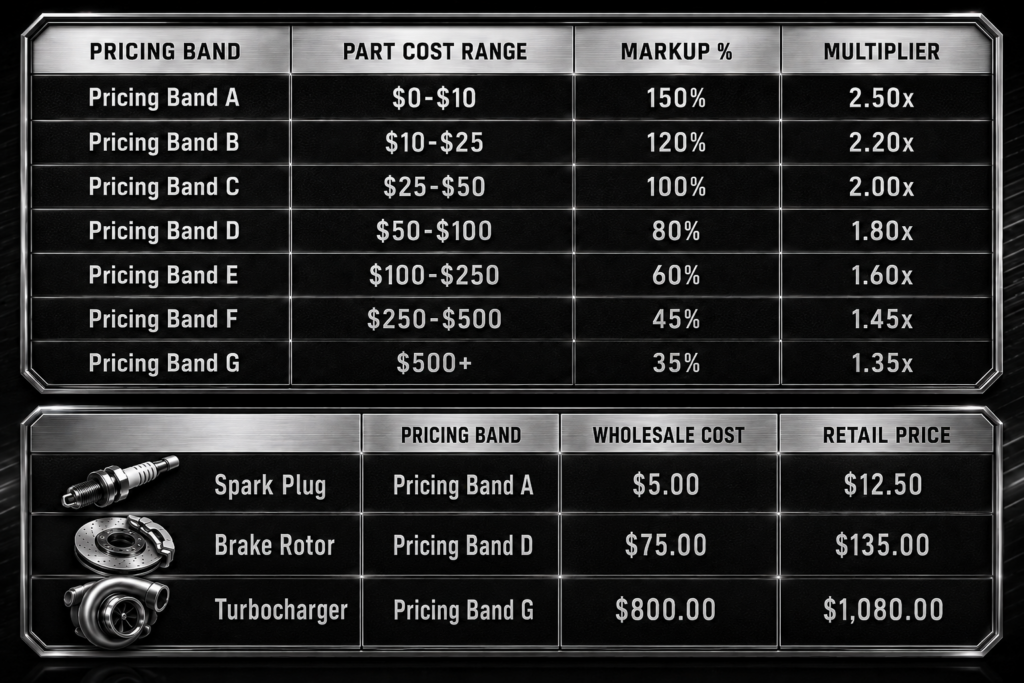
Dealership leaders often scrutinize labor rates, technician productivity, and hours per repair order while allowing hundreds of parts prices each week to default to manufacturer list, a flat markup, or an employee’s individual judgment. Losing three or four dollars on a single repair order line may not attract much attention. Across thousands of customer-pay transactions, however, those small pricing gaps can add up to a substantial annual gross-profit loss. According to a PartsTech survey of 618 automotive repair shop owners and managers, 67% of respondents were not maximizing their parts profit potential because of insufficient markup practices. Discussing that survey, Cecil Bullard, owner and CEO of The Institute for Automotive Business Excellence, estimates that many automotive repair shops leave between $40,000 and $70,000 per year on the table due to inadequate parts markups. Although those figures include independent repair facilities, they demonstrate how quickly inconsistent pricing can affect profitability. A well-designed dealership parts matrix pricing strategy is not about charging the highest possible price for every component. It is about pricing parts intentionally and consistently enough to protect gross profit while remaining competitive, transparent, and defensible. Why Flat Markups and Manufacturer List Prices Leave Gaps A dealership's parts pricing matrix is a formula that determines a part’s selling price based on factors such as its cost, category, source, pay type, competitive sensitivity, customer type, and local market conditions. A basic automotive parts pricing matrix separates parts into cost bands and assigns a different markup to each band. Lower-cost parts generally receive higher percentage markups, while higher-cost parts receive lower percentage markups. This creates a descending markup curve rather than treating every part identically. As explained in the PartsTech Parts Markup Matrix Guide, this structure is designed to produce a healthy overall margin across the full mix of parts sold—not necessarily the same margin on every individual part. Low-Cost Parts Often Become Underpriced A flat markup may not generate enough gross profit on inexpensive parts to cover the dealership’s actual cost to sell them. Every part requires some combination of: ~ Ordering and receiving~ Cataloging and stocking~ Storage and inventory control~ Handling and delivery~ Returns processing~ Warranty administration~ Parts transfers~ Employee and management time A $4 part and a $400 part do not necessarily carry identical costs to serve. Applying the same percentage markup to both can leave the low-cost item underpriced while pushing the high-dollar item beyond what the market can reasonably support. For example, applying a 50% markup to a $4 part results in a $6 retail price and only $2 in gross profit. That may not adequately compensate the department for the time and administrative effort required to source, receive, handle, and bill the part. High-Dollar Parts Can Become Uncompetitive The opposite problem appears when an aggressive flat markup is applied to a high-dollar assembly. Customers can easily compare pricing for engines, modules, batteries, accessories, and other recognizable components against: ~ Nearby dealerships~ Independent repair facilities~ Online OEM parts sellers~ Manufacturer-suggested list prices~ Retail counter and wholesale alternatives That does not mean a dealership must match the lowest price a customer finds online. The dealership provides additional value by ensuring a proper fit, providing trained technicians, offering professional installation, providing warranty protection, offering diagnostic expertise, and ensuring accountability if the repair does not resolve the concern. Nevertheless, a pricing formula that doubles the price of an expensive component without accounting for market sensitivity can create an avoidable objection before the advisor has an opportunity to communicate that added value. Audit What the Dealership Actually Charges TVI MarketPro3 consistently encourages fixed ops leaders to evaluate performance beyond total sales. In its video, Understanding Financial Health in Fixed Ops, Vice President of Sales Nick Shaffer identifies gross profit by pay type as one of the essential measurements fixed ops leaders should monitor. The TVI article Cutting Costs in the Service Department also recommends tracking parts gross-profit percentage while managing phase-in and phase-out settings to improve inventory turn rates. Protect Margin Without Sacrificing Customer Trust Improving dealership parts gross profit cannot come at the expense of customer confidence. Customers can compare prices online within seconds. When they see an OEM part listed elsewhere for less than the amount on their repair estimate, the advisor must be prepared to explain what the dealership’s price includes. That value may include: ~ OEM-quality parts~ Correct part identification and fit~ Factory-trained technicians~ Professional installation~ Diagnostic expertise~ Dealership-backed warranty coverage~ Accountability for the completed repair~ Convenience and transportation options~ A documented service history TVI MarketPro3 addresses this directly in Winning Back Dealership Service Customers: “A higher price without clear communication of higher value can drive customers away.” The article explains that dealerships must be transparent about pricing while emphasizing the long-term benefits of OEM parts, trained technicians, and quality service. Likewise, the article Objections to Dealership Service Departments and How to Overcome Them recommends detailed invoices, transparent pricing, competitive offers, OEM parts, factory-trained technicians, and warranty coverage as ways to address perceived high costs. A matrix should create consistency—not confusion. The customer should not receive significantly different prices depending on the advisor, estimator, or department involved. Quotes, menu prices, repair orders, and final invoices should align. Review Pricing as an Ongoing Process A matrix is not a one-time DMS setup. It must be monitored as parts costs, competition, customer behavior, and departmental objectives change. Monthly reviews should include: ~ Gross by pay type~ Average parts gross per customer-pay RO~ Matrix utilization~ Override frequency~ Advisor discounting~ Competitive-item pricing~ Pricing complaints PartsTech similarly recommends reviewing and adjusting a matrix monthly or quarterly based on the gross margin the business is actually producing. The dealership should monitor both financial and customer-facing indicators. No single KPI tells the complete story. A higher gross percentage may look positive until leadership discovers that price objections, declined work, or customer defection are also increasing. The goal is sustainable profitability—not a temporary increase created by indiscriminate price changes. Stop Letting Margin Disappear One Line at a Time A parts pricing matrix cannot correct poor service, inconsistent estimating, weak advisor communication, or a broken customer experience. It can, however, prevent unnecessary margin leakage and provide the dealership with a consistent pricing foundation. The right question is not, “How much more can we charge?” It is: Are we pricing every category intentionally, consistently, and profitably—or are we allowing margin to disappear one line at a time? More gross per repair order matters, but so does bringing the right repair opportunities into the lane. TVI MarketPro3 uses dealership data to identify and engage customers with the greatest potential to return for service, helping fixed ops leaders generate profitable traffic instead of relying on blanket marketing or unnecessary discounting. Reach out to a TVI MarketPro3 Fixed Operations Marketing Expert today.
Dealership Parts Obsolescence 12-Month Audit
A dealership’s parts shelves can appear full while failing to support the service drive’s needs. The problem is not simply clutter. Dealership parts obsolescence results in cash that cannot be reinvested, reduced storage capacity, slower inventory turns, and a greater risk of ordering parts that will not sell. NADA defines parts obsolescence as inventory aged more than 12 months with no demand. That makes the 12-month no-sale report an important management tool—but it should not be treated as an annual cleanup list. It should be the starting point for discovering how obsolete inventory entered the department and preventing the next wave of aging stock. What “12-Month Obsolete” Really Means A part with no demand for 12 months deserves immediate review, but age alone does not determine what should happen next. A thorough automotive parts inventory audit should consider: ~ Date of most recent sales, last stock, and last activity~ Current quantity on hand~ Monthly sales history and quarterly lost sales~ Reorder level, maximum stocking level, quantity on order, and quantity on back order~ Stock status, including whether the part is normally stocked, a special-order part, changed, or recently returned~ Return status~ Superseding and superseded part numbers~ Model-year fitment range~ Bin, shelf, and drawer location The difference between months no-sale and months no-receipt is especially important. Months no-sale shows how long it has been since customer demand occurred. Months no-receipt shows how long it has been since another unit entered inventory. Looking at both can reveal a damaging pattern: a part may not be selling, yet an automatic replenishment setting, a manual order, or an incorrect stocking level continues to bring additional units into the department. Not every 12-month no-sale part should be liquidated automatically. Legitimate exceptions may include required OEM stock, newly introduced models, safety or campaign components, low-frequency but operationally critical parts, and inventory reserved for an active repair. The audit helps determine which parts still support current or future demand. Obsolete Inventory Freezes Working Capital Consider a dealership carrying $600,000 in parts inventory. If 10% of that stock has had no demand for more than 12 months, approximately $60,000 is tied up in inventory that may no longer support current operations. That money cannot easily be used to stock faster-moving parts, upgrade equipment, train employees, expand wholesale operations, improve customer transportation, or market the service department. Obsolete inventory also weakens dealership inventory turns. It increases the average inventory investment without a proportional increase in sales, leaving the dealership’s cash sitting on the shelf longer. NADA advises dealerships to evaluate inventory quality rather than relying exclusively on a broad months-supply calculation. Its dealership parts-management guidance emphasizes prioritizing fast-moving inventory while tracking obsolete and phase-out stock through DMS reporting. The Report Shows What Happened. The Audit Reveals Why. The 12-month report tells a dealership what has already gone wrong. A disciplined audit reveals why it happened and what must change. The goal is not to maximize the number of parts on the shelf, but to have the right parts available to support current repair demand while protecting the dealership’s cash. Is your service marketing generating demand that aligns with the customers and vehicles in your market? TVI MarketPro3 uses DMS data to identify and engage inactive, lost, and new VIN customers, creating measurable opportunities throughout fixed operations. Let TVI know how we can level up your service department marketing game.

Google Reviews in Fixed Ops: Turning 3-Star Stores Into 4.6+ Machines
Your Customers Are Checking Reviews Before They Call Before a customer schedules service, visits your website, or speaks with an advisor, there's a good chance they've already checked your Google reviews. In today's digital-first environment, your Google rating has become one of the most visible indicators of your dealership's reputation. It influences customer trust, local search visibility, click-through rates, and whether customers ultimately choose your service department over a competitor. A well-managed Google Business Profile helps dealerships improve both online visibility and customer engagement. Why Google Reviews Have Become a Fixed Ops KPI Most service managers track: Repair ordersEffective labor rateCustomer-pay salesHours per RO But many overlook a metric that customers see before any of those numbers matter: Google reviews. A strong review profile impacts both consumer trust and local search rankings. Research consistently shows that the quality, quantity, and recency of reviews influence how prominently businesses appear in local search results. Customer retention increasingly depends on convenience, trust, and the overall experience customers receive throughout the service journey. Reviews serve as a public reflection of all three. What 4.6-Star Service Departments Do Differently The best-performing dealerships don't simply collect more reviews—they create better customer experiences. High-rated stores typically dedicate effort to: Consistent communicationCreating accurate expectationsFast response timesConvenient schedulingProactive service updates Customer feedback is often a direct reflection of operational consistency. In many cases, negative reviews aren't caused by repair quality—they stem from communication breakdowns, wait times, or unmet expectations. The good news? These issues are fixable. Building a Review Generation Machine Many dealerships hope satisfied customers leave reviews. Top-performing dealerships make it part of the process. That process often includes: Asking every satisfied customer for feedbackSending review requests via text or emailResponding to every review, positive or negativeMonitoring review trends monthlyRecognizing advisors who generate positive customer feedback According to Google, businesses that actively engage with reviews demonstrate responsiveness and build stronger customer trust. Consistent responses also signal to prospective customers that the dealership values feedback and the customer experience. The goal isn't simply to increase review volume—it's to create a sustainable system that continuously generates fresh, authentic customer feedback. Your Google Rating Is Telling a Story A 4.6-star service department isn't usually the result of a clever marketing campaign. It's the result of consistent execution. The dealerships with the strongest online reputations are those that communicate effectively, deliver a positive customer experience, and make it easy for satisfied customers to share their feedback. In today's fixed ops landscape, Google reviews aren't just indicators of customer satisfaction—they influence future customer decisions. The dealerships that treat reputation management as an operational priority will be better positioned to earn trust, improve retention, and grow service revenue.

The Online Service Scheduling Impact
Not long ago, dealerships viewed online service scheduling as a competitive advantage. Today, it's an expectation. Most consumers can schedule nearly every aspect of their lives online—from doctor appointments and restaurant reservations to flights and home services. Automotive service is no different. According to research from Cox Automotive, more than 76% of customers who schedule service online say they would use the option again, highlighting just how quickly digital convenience has become part of the customer experience. However, as online scheduling becomes standard across the industry, dealerships face a new challenge. The question is no longer, "Do we offer online scheduling?" Instead, it's, "Are customers actually using it?" The answer matters more than many dealerships realize. Having Online Scheduling Isn't Enough Many dealerships invest in online scheduling technology and assume the job is finished, but a quick look at service appointment data often reveals that a large percentage of appointments are still being booked over the phone. That's not necessarily because customers prefer calling. In fact, industry research compiled by Rework suggests that nearly two-thirds of customers would prefer to schedule service digitally when given the option. The issue is often adoption, not availability. A scheduler buried deep within a website, a complicated booking process, or limited appointment visibility can discourage customers from using the tool. Simply offering online scheduling does not automatically create a convenient experience. The dealerships seeing the greatest success are those that actively encourage utilization by promoting scheduling links in service reminders, retention campaigns, recall communications, email marketing, text messages, and advisor conversations. Convenience Doesn't End at 5 PM One of the biggest advantages of online scheduling is that it allows customers to engage with the dealership on their own schedule. National Automobile Dealers Association (NADA) research shows that nearly one-quarter of service appointments are scheduled outside normal business hours or when it’s simply inconvenient for the client to be on a call. Think about what that means: those customers aren't waiting until the next morning to call the dealership. They're booking appointments while watching television after dinner, during a lunch break at work, or after dropping their kids off at practice. If scheduling requires a phone call during business hours, the dealership is creating unnecessary friction in the customer journey. Every extra step increases the likelihood that a customer will postpone service—or choose a competing repair facility instead. Utilization Creates Operational Efficiency Increasing online scheduling utilization doesn't just benefit customers. It benefits the dealership as well. Every appointment scheduled online is one less inbound scheduling call that advisors or BDC agents must handle. Digital tools can help reduce administrative workload and allow dealership employees to focus on higher-value customer interactions. Rather than spending valuable time booking appointments, advisors can focus on: Building customer relationshipsExplaining repair recommendationsReviewing maintenance needsDelivering a better vehicle drop-off experienceImproving customer satisfaction Technology should not replace human interaction. It should create more opportunities for meaningful interaction. As discussed in TVI MarketPro3's article, The Core Fixed Ops Challenge in 2026, customer retention is influenced by both convenience and trust. Customers are more likely to return when scheduling is easy, communication is clear, and they have confidence in the people advising them—demonstrating that technology and human connection work best together. The Future Belongs to Convenient Dealerships Customers have more choices than ever when it comes to vehicle maintenance and repair. Independent repair facilities, quick-service chains, and competing dealerships are all fighting for the same service business. Convenience increasingly serves as the deciding factor. The dealerships that win aren't necessarily the ones with the largest facilities or biggest advertising budgets. They're the ones that make doing business easy. Online service scheduling is no longer simply a feature on a dealership website. It's a critical component of the customer experience, retention strategy, and overall service operation.
Sign up for email updates
Thanks! You're signed up!