Dealership Parts Matrix Pricing Strategies
Declined Work Recovery: The Hidden Profit Center in Your Service Lane
Effective Labor Rate vs. Door Rate
Fixed Ops Retention Strategy Beyond 50K Miles
Increase Shop Hours Without Hiring More Technicians
Prepaid Maintenance Plans: Revenue Protection or Margin Erosion?
Service Department Dispatching Models
Service Menu Pricing Strategy
The Online Service Scheduling Impact
Winning Back Lost Service Customers
The Overlooked Service-to-Sales Handoff
Internal and Counter Parts Sales
Closing Service Approvals Faster: Texting vs. Calling
Service Department Dispatching Models
Share:
LinkedInHow Workflow Control Impacts Productivity and Profitability
Walk into any service department, and you’ll see it: the board. Names, ROs, jobs, technicians. It looks operational. It feels routine.
But here’s the truth: your dispatch strategy is either feeding productivity—or starving it.
The board isn’t just a tool for organizing work. It’s one of the most underestimated profit levers in fixed operations. And how it’s controlled can determine whether your shop runs efficiently—or steadily bleeds hours every day.
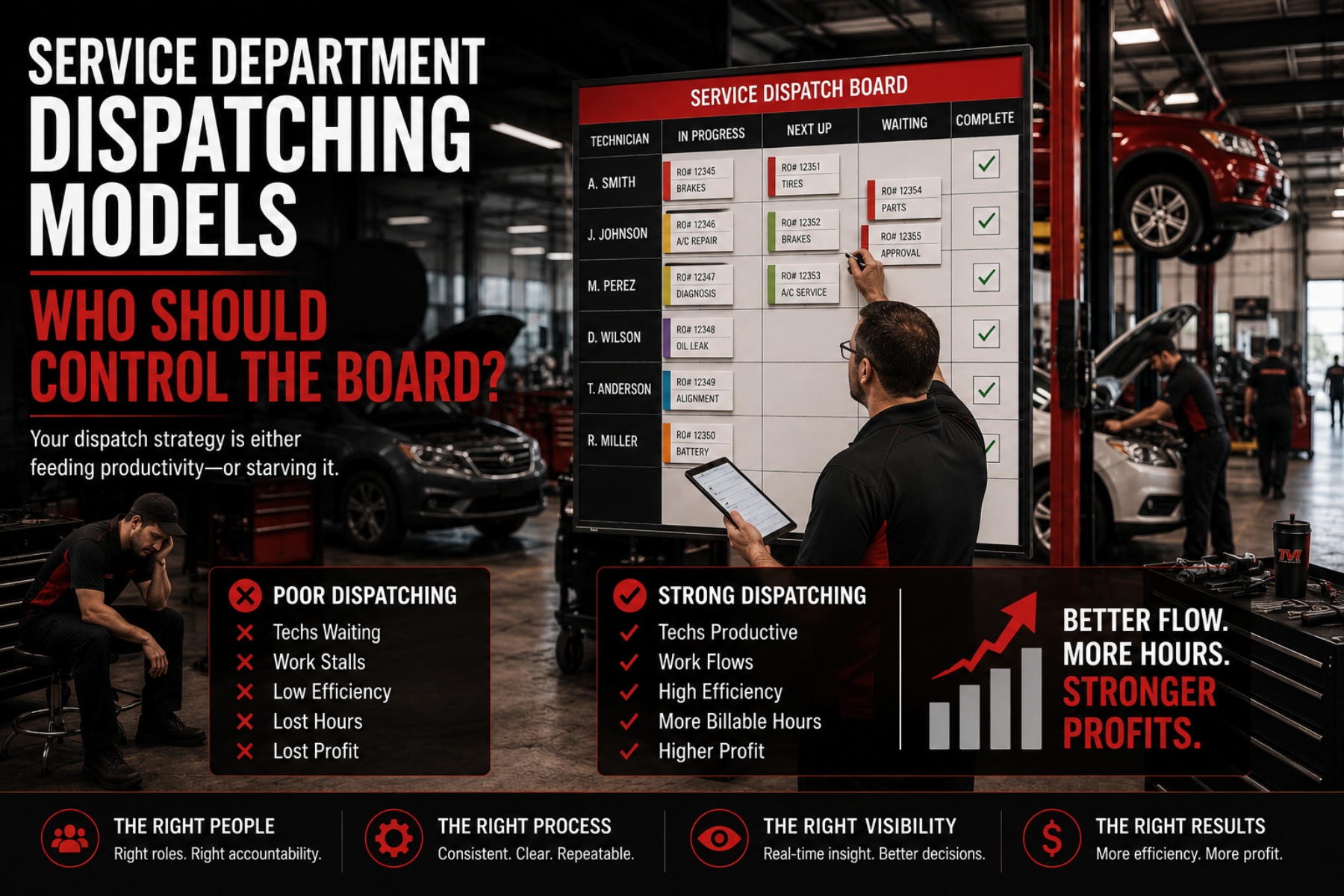
Dispatching sits at the center of everything that drives service lane performance. It directly impacts:
When dispatching is done well, technicians stay productive, workflows move consistently, and the shop operates at capacity. When it’s done poorly, technicians wait, jobs stall, and the entire system moves in slow motion, or even no motion.
And here’s the key connection most dealers miss: idle time = lost billable hours and reduced overall production. While dispatching doesn’t directly change your effective labor rate, it limits the number of billable hours your shop produces—ultimately capping your total labor revenue regardless of your pricing strategy.
Every minute a technician isn’t turning hours is a minute you can’t recover. Technician efficiency doesn’t just affect productivity—it directly impacts revenue per labor hour, making dispatching a critical driver of overall profitability.
You don’t need a report to know when your dispatching isn’t working—you can see it in the day-to-day operation.
Technicians are waiting around for work. Hours are uneven across the team. Advisors feel overwhelmed. Jobs sit idle, waiting for approvals or parts.
These aren’t isolated issues—they’re symptoms of a broken system.
Waiting, whether for approvals, parts, or direction, kills productivity and drags down overall labor performance. Small delays stack up quickly, turning into lost hours that can’t be recovered.
There’s no one-size-fits-all approach to dispatching, but in today’s service departments, most operations are trending toward two primary models, with some variation depending on shop size, technician skill level, and overall workflow.
As TVI’s Eric Hawkes explains, the goal isn’t to find the “perfect” system—it’s to find the one that best fits your operation.
In this model, the advisor writes the RO and hands it off to a Team Leader (TL)—typically an “A” technician responsible for a small group of technicians (usually 3–6).
From there, the Team Leader:
Based on those factors, the TL either:
If the TL performs the work, they’re paid for the hours spent on the RO. If they dispatch it, they receive a small override—typically $0.50–$2.00 per hour put in by the technician.
But the role goes beyond dispatching. The TL is also responsible for:
Why it works:
It creates accountability within the shop and leverages your strongest technicians to manage workflow in real time.
Where it can break down:
Without strong leadership at the TL level, it can lead to inconsistency or internal imbalance.
A growing trend—especially in high-performing stores—is for the Service Manager or Service Director to take direct control of dispatching.
In many cases, leaders are physically moving their offices closer to—or into—the shop, shifting their focus toward:
Why it works:
The trade-off:
This approach requires significant time and attention from leadership. It can “tie down” the Service Manager or Director, pulling them deeper into daily operations.
What About Hybrid or Digital Dispatching?
Many shops layer in:
But even with technology, the same truth applies:
The system only works if the process behind it is strong.
As Eric Hawkes puts it:
There is no single “best” dispatching method. The right system varies depending on:
Like so many things in fixed ops, success doesn’t come from the model—it comes from how well it’s executed.
High-performing service departments don’t get stuck debating who controls the board. They focus on something more important:
Because the real issue isn’t control—it’s execution.
It’s best to remove variability from the process. Everyone knows how work is assigned, what the priorities are, and how decisions are made.
When dispatching becomes predictable, productivity becomes scalable.
Poor dispatching doesn’t always show up clearly on a report—but it shows up in your numbers.
It leads to lower total hours produced, reduced technician efficiency, and increased payroll waste. Why? Because you’re still paying technicians for their time—whether that time is productive or not.
In fact, technician productivity is defined as the percentage of time spent on active, billable work. When technicians are waiting on work, parts, or approvals, those hours aren’t producing revenue—reducing total billable output for the shop.
In hourly or guaranteed-pay environments, this also creates direct payroll inefficiency, as the dealership is paying for time that isn’t generating income. In flat-rate environments, the cost shifts to lost production opportunity—fewer hours turned and lower overall shop output.
Workflow delays—such as poor communication, missing parts, or disorganized job flow—have been shown to directly reduce shop profitability by limiting billable output. Because labor costs are partially fixed—and often difficult to flex in real time—every unproductive minute compounds into lost revenue that can’t be recovered later.
Which leads to one unavoidable reality: Every idle minute is unrecoverable revenue.
Dispatching isn’t just about assigning work—it’s about controlling productivity. The model you choose matters. But how consistently you execute it matters more. Because when the board is managed well, everything improves—efficiency, output, and profitability. Control the board, control the outcome.
Let's get moving. Get your customized marketing plan today.
01
Dealership Information

Advisor Pay Plans That Drive Sales Without Creating Toxic Pressure
Service advisor compensation may be one of the most debated topics in fixed operations. Ask ten operators how advisors should be paid, and you’ll likely get ten different answers. Flat commission. Salary plus bonus. Gross profit. CSI. Hours per RO. Team incentives. Retention bonuses. Every pay plan is designed to motivate performance. The problem? Poorly designed compensation structures can unintentionally reward the wrong behaviors. Overselling. Burnout. Internal competition. High turnover. Damaged customer trust. In an industry already facing pressure to grow customer-pay business, compete with independents, retain talent, and improve profitability, dealerships can’t afford compensation systems that create short-term gains at the expense of long-term health. The question isn’t whether advisor pay matters. The question is: How do you build advisor compensation plans that increase performance while encouraging trust, retention, and sustainable growth? The Hidden Cost of Incentivizing the Wrong Behaviors Service advisors sit at one of the hardest intersections in a dealership. They’re expected to: Deliver excellent customer experiencesSell needed maintenance and repair workManage upset customersCoordinate with techniciansHandle warranty complexitiesMaintain CSIDrive profitability Nick Shaffer, TVI MarketPro3’s Vice President of Sales, notes in his recent interview with Bruce Daugherty, Owner and President of ADO Consulting: “Being a service advisor… is one of the most valuable and also one of the most difficult jobs in the car dealership… [they] play a huge role in the customer experience, the client retention, the store profitability… and the technician retention.” When compensation only rewards dollars sold, predictable problems emerge: Advisors focus on immediate sales over educationCustomers feel pressured instead of informedCSI suffersTrust declinesAdvisors burn outTurnover rises Bruce Daugherty puts it bluntly: “It’s the most important, hardest job in the store, and we’re trying to work people for three to five grand… No wonder you can’t get great advisors.” Underpaying advisors while expecting world-class performance creates a cycle: Stress → Turnover → Emergency Hiring → Inconsistent Customer Experience → Reduced Retention Common Advisor Pay Structures: What Works—and What Can Go Wrong There’s no universal advisor pay plan. The “right” structure depends on factors such as franchise requirements, state labor laws, manufacturer incentives, and dealership goals. However, after decades of leading high-performing service operations, Bruce Daugherty argues that how compensation is designed matters far more than simply choosing a category. Salary Only Bruce’s take: Strongly against it. “Salary only is a big no, regardless of the store, brand, franchise, location, state, or anything. I would never do only a salary.” His concern is simple: Without performance incentives, there’s little motivation to maximize customer experience, efficiency, or sales performance. As Bruce explains: “The problem with that is there's no incentives. There's no reason to… kill a bear every day…” Potential downside: Reduced motivationLimited performance differentiationDifficulty attracting high performers Salary + Commission Bruce’s take: Potentially strong—but design matters. “A salary plus commission… as a base concept is great, but then how do you design the commission is the big question.” The real issue becomes: What behaviors are being rewarded? Compensation tied only to sales volume can unintentionally encourage: OversellingDiscounting to close workShort-term thinking Bruce’s philosophy focuses on rewarding multiple performance dimensions, not just one. Flat Commission / Commission-Only Plans Bruce’s take: Requires caution—and legal awareness. State laws may require minimum salary or hourly components. For example: “In California, the average hourly component equates to almost $36,000 a year in base pay just to show up and do nothing.” His broader concern: Commission structures become problematic when incentives only reward volume. Gross Profit–Based Compensation Bruce’s take: Dangerous if used alone. He warns against pure gross-based systems: “I would not ever just say gross only or sales only, either one…” Why? Because compensation based solely on gross can create what Bruce calls “Repair order hustlers.” These advisors may: Cherry-pick lucrative repair ordersAvoid difficult customersCreate internal competitionPrioritize paycheck over consistency Bruce explains: “You can just write up a bunch of repair orders… maybe write 30–40% more than everybody else… or cherry pick the right cars, and all of a sudden, you've got a great paycheck…” The result: High production on paper, but potentially weaker culture and inconsistent customer experiences. Hours per RO Incentives Bruce’s take: Essential. Unlike gross-only systems, Bruce strongly supports hours per RO (HPRO) as one component of advisor compensation. “[You] absolutely have to pay on hours per RO, no matter what the brand, no matter where you are.” However, he recommends tiered structures, typically with three levels. Example: Tier 1: 2.6–2.8 HPROTier 2: 2.81–3.0 HPROTier 3: 3.1+ HPRO These benchmarks should vary by brand and store type. His reasoning: Hours per RO helps measure whether advisors maximize opportunities with the traffic the dealership already has. Team-Based Incentives Bruce’s take: Only for CSI. Bruce supports team incentives selectively: “The only thing I've ever agreed on with team-based incentives is around CSI.” Why? Because CSI reflects shared effort. When someone is out sick or on vacation: “…everybody else is willing to pick up the phones, answer, follow up [on] his work…” However, Bruce avoids applying team incentives to: SalesHours per ROEffective labor rateGross profit CSI-Based Bonuses Bruce’s take: Mandatory. His position is clear: “You gotta have it.” Why? “If we want happy customers to keep coming back… we have to have some way to measure.” However, CSI compensation requires careful oversight. Potential pitfalls: Survey manipulationUnfair penalties for technician issuesManufacturer scoring complexity Bruce notes: “You gotta be careful how you manage it…” He often prefers monthly measurement with leadership discretion to adjust for unusual situations. Retention / Repeat Visit Bonuses Bruce’s take: Usually redundant. Rather than paying separately for customer retention, Bruce often incorporates loyalty into CSI. “I think that kind of goes with CSI already… I just prefer the overall CSI score…” Manufacturer programs may require loyalty metrics, but his preference is simplicity where possible. Bruce Daugherty’s Preferred Advisor Pay Philosophy Rather than rewarding one metric, Bruce builds compensation around multiple controllable outcomes: Typically including: Customer-pay RO average (CPRO)Effective labor rate (ELR)Hours per RO (HPRO)CSICustomer-pay growth His goal: “You want a guy that's not discounting work… You want the best of both worlds.” And ultimately: “That’s a guy that’s selling everything, and he’s selling it for top dollar…” Not through pressure, but through consistency, customer experience, and disciplined execution. Why Some of the Best Pay Plans Reward More Than Sales Bruce describes one of the most successful compensation structures he implemented: “I finally migrated… to what I called a 50-50 pay program. Half of it was CSI, and the other half was customer-pay averages.” Notably: “I did not pay a percentage of the warranty write-up at all.” And: “What I want [advisors] to do is give the client a world-class experience, and I want them to sell the maintenance and the customer-pay work…” His philosophy? Reward advisors for: Taking care of customersSelling needed work ethically Not simply maximizing transactions. The results? “We went to 4.2 hours an RO… and then we finished first in the nation… with CSI.” His conclusion: “You want to be highly focused and take care of customers and selling work. The only two things that really matter. We built a pay program around that.” Education Sells Better Than Pressure High-performing advisors don’t simply quote prices. They educate. Bruce explains: “90% of the time, it’s advisors. 90% of the time, it’s poor communication.” Industry studies reinforce this. Effective advisor communication strongly influences customer satisfaction, loyalty, and repeat business. Training and advisor development improve both profitability and retention. Similarly, industry data shows customers increasingly trust advisors who explain repairs clearly and communicate proactively. In one large customer study, 80% of customers said their service advisor earned their trust by the end of the visit. Trust is not a soft metric. Trust drives retention. The Best Pay Plans Don’t Just Drive Revenue Dealerships face growing pressure: Customer-pay growthStaffing shortagesCompetition from independentsRising operational costsIncreasing customer expectations Compensation matters more than ever. The strongest advisor pay plans don’t merely reward sales. They create: ✔ Consistency✔ Customer trust✔ Retention✔ Sustainable performance✔ Stronger teams✔ Healthier culture Because the highest-performing advisors aren’t simply the ones who sell the most; they’re the ones customers trust enough to come back to. Check out TVI MarketPro3 for more fixed ops expert insights.
Jun 9, 2026 | 6 minute read
Idle Bay Syndrome
How to Spot It Before Payroll Eats You Alive Your Shop Isn’t Full—Even If Your Schedule Is At a glance, everything looks healthy: the schedule is booked, advisors are moving, and cars are coming in. Take a walk through the shop, though, and you’ll see it—empty bays, technicians waiting, work stalled. Your shop isn’t full—even if your schedule is. Industry experts often discuss the issue of “Idle Bay Syndrome,” and it’s one of the greatest profit killers in fixed operations. In a recent interview with Nick Shaffer, Bruce Daugherty, President of A.D.O. Consulting Group, stresses, “Every empty stall you have is roughly $30,000 to $40,000.” What Is Idle Bay Syndrome? Idle Bay Syndrome happens when you have the capacity to produce, but you’re not producing. Your bays are open with technicians clocked in, but you’re not generating billable hours. This showcases the most important distinction in your service department: busy does not mean productive. You can have a full calendar and still leave hours on the table every single day. The Hidden Causes of Idle Bays Idle bays don’t happen because of one big issue—they’re the result of breakdowns across your entire operation. Inconsistent Car Count When your car flow is unpredictable, your shop becomes reactive. One day, you’re overloaded. The next day, you’re scrambling to fill the board. This usually traces back to: Poor marketing alignmentWeak customer retentionLack of consistent outreach Without a steady pipeline, your bays will never run at full capacity. Bottlenecks in Your Process Even when cars are in the building, work doesn’t always move. Idle time in most shops isn’t a labor issue—it’s a workflow issue. Technicians get stuck waiting on: Advisor approvalsParts availabilityDispatch direction These small delays stack up fast. And every minute spent waiting is a minute not producing. Low MPI Completion Every vehicle that comes through your shop is an opportunity. But when multi-point inspections (MPIs) aren’t completed consistently—or aren’t communicated effectively—you miss work that’s already in front of you. That means: Fewer approved servicesLower hours per ROMore unused capacity You don’t always need more cars—you need to do more with the ones you already have. Inefficient Scheduling Too many service departments operate in peaks and valleys. Mornings are slammed. Afternoons slow down. Certain days are overloaded, while others are wide open. Without intentional scheduling, you create: Technician downtimeDispatch bottlenecksUneven workload distribution Consistency—not volume—is what drives productivity. A Winning Strategy Idle Bay Syndrome doesn’t start in the shop—it starts with how you generate and manage demand. With the right strategy in place, you can stabilize your workflow and eliminate the peaks and valleys that create downtime. Database segmentation ensures you’re reaching the right customers at the right time.Campaign timing helps fill slow days before they happen.Recall and reactivation efforts create predictable, consistent demand. When your inflow is controlled, your shop becomes efficient. Visit TVI MarketPro3 for more expert insights.
May 6, 2026 | 3 minute read
OEM Warranty Expiration: The Window You’re Probably Missing
Most dealerships obsess over client acquisition. Unfortunately, many fail to master retention, and very few are fully capitalizing on one of the most predictable, high-value opportunity windows in fixed operations: the 90 days before and after OEM warranty expiration. This is the moment your customer decides whether they’re staying with you—or leaving for good. Why the Warranty Expiration Moment Matters The data is clear: dealership retention is slipping, and the warranty milestone is a major inflection point. In 2025, a Cox Automotive Study found: * Only 54% of customers with vehicles 2 years old or newer returned to the selling dealership for service, down sharply from 72% just two years prior* Dealerships now handle 12% fewer service visits than in 2018, with many customers shifting to independent garages* Customers who do stay in the service lane are 74% more likely to buy their next vehicle from that dealership That last statistic is the kicker. Losing a service customer isn’t just losing maintenance revenue. It’s losing your next vehicle sale, and warranty expiration is when that loss often happens. The Behavioral Shift at Warranty Expiration During the OEM warranty period, customers are conditioned to return: * Repairs are covered (or perceived to be)* Trust is anchored in the manufacturer* Risk feels low However, the moment that warranty expires, the psychology flips: * “Now I have to pay for everything.”* “Maybe I should shop around.”* “The dealership is probably more expensive.” This is exactly when independent shops step in—and win. In fact, many customers leave dealerships specifically after their warranty ends, contributing to already low retention rates across the industry The Window Most Dealers Miss Here’s where the opportunity lives. The decision to stay or leave doesn’t happen at expiration. It happens in the months surrounding it. The Timeline That Matters 2-3 months before expiration, the customer is still * Engaged* Returning for service* Trusting your process At expiration * Uncertainty peaks* Price sensitivity increases* Competitors begin targeting aggressively 2-3 months after expiration * New habits form* If they try an independent shop once… you’ve likely lost them This is the window where retention is either secured—or permanently broken. Why Most Dealerships Lose This Moment It’s not due to a lack of data. OEMs regularly provide warranty timelines and retention reporting. The breakdown is operational: No Proactive Communication: Customers aren’t told what happens after the warranty ends, so they assume the relationship is over. No Transition Strategy: Some dealerships treat warranty and customer-pay repairs as two separate worlds—when they should be one continuous experience. No Value Reframing: When coverage disappears, value must increase. Many stores never reposition themselves beyond “we fix cars.” A Different Approach Rather than waiting for the warranty to expire, dealerships must guide the customer through the transition. Start Before Expiration Communicate early and clearly: * What’s changing* What’s not changing* Why staying with the dealership still makes sense This reduces the fear of the unknown—a big driver of defection. Reframe Value (Not Price) Customers leave because of perceived cost, not actual cost. The same Cox Automotive study shows dealership repairs can actually be less expensive than the average independent shop, yet customers still defect due to perception and communication gaps A winning strategy focuses on: * Transparency* Inspection documentation* Advisor communication Building customer trust drives retention over discounts. Use the MPI as a Retention Tool A strong multi-point inspection does more than identify work: * It shows the vehicle’s condition* It builds credibility* It creates continuity post-warranty When customers see what’s needed, they’re far less likely to shop for it. Lock in the Next Visit Retention isn’t about this visit—it’s about the next one. Be sure to: * Pre-schedule future maintenance* Set expectations for upcoming needs* Create a service roadmap beyond warranty This prevents the “I’ll figure it out later” moment… where competitors often have a leg up. The Financial Impact of Getting This Right Retention isn’t just a KPI. It’s a profit engine. * Service drives up to 49% of dealership gross profit despite a smaller share of revenue* Increasing retention by just 5% can boost profits significantly* Retained customers generate predictable revenue and lower acquisition costs And it all compounds. Every retained service customer increases: * Lifetime value* Future vehicle sales* Referral opportunities The Bottom Line The warranty expiration point isn’t just a milestone. It’s a decision point. A winning strategy is one that controls the transition from warranty to customer-pay, and if you don’t catch the out-of-warranty vehicles, someone else will. Check out TVI MarketPro3 for more expert insights.
Apr 3, 2026 | 4 minute read
Multi-Point Inspection Completion Rates
Every vehicle that enters your service lane represents more than the work written on the RO. It represents potential: safety issues, maintenance needs, and future service opportunities. Yet many dealerships fail to consistently capture that opportunity because they don’t aggressively manage one critical metric: multipoint inspection completion rate. Car count and gross get attention. Inspection discipline often doesn’t. What Multi-Point Inspection Completion Rate Actually Measures Multi-point inspection (MPI) completion rate measures the percentage of repair orders that receive a full inspection. Not a quick glance. Not a partial checklist. A documented, consistent inspection. If your shop writes 1,000 repair orders in a month and only 650 receive a completed MPI, your completion rate is 65%. That means 35% of vehicles are left without a proper inspection to identify additional needs. In fixed ops, that’s not just a process gap. It’s a revenue gap. Why MPI Completion Matters More Than Most Leaders Realize Every vehicle that enters your service drive has: Wear componentsMaintenance needsFuture service requirementsSafety considerations Without a consistent inspection process, those needs go unidentified or even undocumented altogether. The MPI is not about selling harder. It’s about identifying legitimate needs and communicating them clearly. When inspections are consistent: Advisors have documented talking points.Customers see transparency.Trust increases.Approval rates improve. When inspections are inconsistent, advisors are forced to rely on memory or guesswork. Why Most Stores Fail MPI Completion Many service departments don’t perform complete inspections on every vehicle that comes through the door, even though a robust MPI process can uncover more revenue and trust opportunities. In fact, some industry commentators note that about 80% of service departments only provide thorough inspections on some vehicles—far from the ideal of near-100% coverage. Here’s why: 1. Technician Resistance Flat-rate environments create time pressure. If inspections aren’t built into the workflow and compensation structure, technicians may see them as unpaid labor. Without leadership reinforcement, completion slips. 2. No Real-Time Accountability Many stores only review inspection performance monthly—if at all. But the completion rate should be reviewed: Daily by advisorsWeekly by techniciansMonthly by departments What gets reviewed consistently improves. What doesn’t tends to decline. 3. Weak Advisor Reinforcement Even when inspections are completed, they are not always: Properly documentedClearly presentedAccompanied by photos or video If advisors aren’t consistently presenting MPI results to customers, technicians lose motivation to complete them thoroughly. The process breaks down. The Financial Impact of Missed Inspections Let’s run conservative numbers: 1,000 ROs per month30% not inspectedAverage additional recommended work per inspected RO: $250 That’s 300 vehicles per month leaving without a documented opportunity for additional service. 300 × $250 = $75,000 in potential recommended work per month. Even if only a portion would convert, the profit potential is too substantial to ignore. And that doesn’t account for the impact on long-term retention: inspections don’t just drive revenue today. They drive future appointments. Final Thought While more cars would be helpful, they aren’t necessary to grow service revenue. Multi-point inspection completion is not glamorous. It’s not flashy. It doesn’t generate headlines. But it quietly determines how much opportunity your service department captures—or misses. Visit TVI MarketPro3 for more expert insights on fixed ops.
Mar 10, 2026 | 3 minute read
NADA Show 2026: What Fixed Ops Leaders Must Prioritize in the Year Ahead
NADA Show 2026 was packed with technology, bold claims, and the loudest buzzword in automotive right now: AI. But when you step back and listen carefully to the conversations happening between dealer leaders, OEM executives, trainers, digital strategists, and fixed operations specialists, an even clearer theme emerges: 2026 will reward precision, process, and customer experience—not just new tools. Across our interviews with industry leaders, six dominant fixed ops themes stood out. 1. Retention Is the Growth Strategy For years, fixed ops growth rode the wave of strong vehicle sales. That cushion is gone. Fewer new vehicles means fewer natural service opportunities. Every retained customer matters more. As David Willard explained, “The new cars sold in America have gone down for the last five years… so you have less at-bats. Each individual retained customer is more important to you now than ever before.” Corey Smith from EasyCare elaborated further: “Everyone’s talking about a 70% retention rate. But is that because they have to come to you… or because they want to?” That distinction matters. True retention isn’t warranty-driven. It’s relationship-driven. TVI MarketPro3’s Scott Kelford summarized the biggest retention killers simply: -Time-Price perception-Treatment Willard added that price often isn’t the real issue. “Since COVID, I don’t think independents give you a price advantage at all… It’s the perception.” Retention in 2026 isn’t about discounts. It’s about consistency, communication, and experience. 2. The 12-Year Opportunity: Aging Vehicles Are the Revenue Engine The average vehicle on the road is now nearly 12–13 years old, yet many dealerships still focus their marketing energy on 7- to 10-year-old vehicles, depending on the focus parameters of their OEM performance metrics. TVI Unotifi’s Lauren Marzella pointed out that the average age of cars on the road is higher now than at any other time in history. TVI MarketPro3’s Steve Coad shared real-world examples of targeting 7+ year-old trucks and SUVs during specific seasons—leading to differential service, brake work, suspension repairs, and strong customer pay. Across the industry, the results extend even further. Dealers are seeing 15- and 20-year-old vehicles returning for $2,000–$3,000 repairs when engaged correctly. Ketan Bhatia, Lincoln Regional Manager for Ford Motor Company, emphasized, “The biggest Rolodex is right there at the dealer’s hands… It’s their DMS.” Instead of blanket campaigns, dealers are now using: -Mileage segmentation-Recall reactivation-Declined service follow-up-Ownership verification Marzella summed it up: “Intelligent marketing isn’t one-size-fits-all… it evolves as we learn customer behavior.” The opportunity lies in how well you communicate with the customers you already have. 3. AI Is Everywhere—But It’s Not the Easy Button AI dominated this year’s NADA conversations, but the most grounded discussions were about balance. TVI Unotifi’s Michael Lopez warned, “AI definitely [shouldn’t become a crutch.” Dealers are exploring: -AI phone answering-AI text automation-AI scheduling-AI-driven marketing optimization However, without process oversight, AI won’t fix broken systems. It will automate them. Michael Waltrip, Vice President of Fixed Operations with Auto Services Unlimited, put it bluntly: “Every customer just wants someone to answer the phone.” He also acknowledged that advisors are busy, “They’ve got a guest in front of them.” AI can help fill those gaps—especially after hours—but Waltrip also offered a critical perspective: “AI is only what you put into it… There is no easy button.” The most productive AI application emerging from NADA? Freeing up BDC teams. Lopez explained, “If they’re trying to develop business, they can’t do that if they’re taking inbound phone calls all day.” AI handling overflow scheduling allows BDC agents to focus on: -Recalls-Declined services-Maintenance follow-up-Lost customer reactivation AI works when it enhances the human experience—not replaces it. 4. Digital Marketing Must Drive Revenue, Not Just Clicks Fixed ops digital marketing has historically been an afterthought. Ian Favre, Digital Marketing Director with TVI MarketPro3, challenged that model: “Fixed operations digital marketing spend is usually the afterthought from most big box agencies.” Instead of generic service ads, granular campaigns are outperforming: -Toyota transmission repair-Brake service near me-Model-specific service queries More importantly, dealers are demanding true ROI tracking. Favre says, “Impressions and clicks don’t matter if they don’t turn into money.” The shift is toward tying:Keyword → Click → Phone Call → Closed RO → Revenue Meta advertising (Facebook and Instagram) is also becoming more precise. Instead of spraying broad audiences, campaigns are built directly from DMS data—active, inactive, or lost customers—eliminating waste. In 2026, digital advertising isn’t about visibility. It’s about measurable service revenue. 5. Process and Experience Win the Retention Game If there was one consistent undercurrent in every conversation, it was process discipline. Easy Care’s National Fixed Operations Training Director, Corey Smith, emphasized, “If you don’t have a playbook in service, you’re not going to win this retention game.” He described the difference between transactional service and experience-driven service: “If they feel good at the end, no matter how much they spent, they’re going to come back.” He also introduced a powerful mindset shift: Instead of asking, “When do you want to pick it up?” Ask, “What does your day look like today?” That subtle change reframes expectations and builds trust, along with a few other built-in procedures: Scheduling pickups, walking customers to their vehicle, setting next appointments, and treating oil change customers like engine replacement customers. Smith noted, “If I’m dropping off my $50,000 baby and I don’t hear from you, I feel like you’ve forgotten about me.” Ford Motor Company’s Lincoln Regional Manager, Ketan Bhatia, echoed the same principle from an OEM luxury perspective, “The basics of any business is communication.” Whether it’s Lincoln-level pickup and delivery or a high-volume Toyota store, the core differentiator remains consistent communication and convenience. 6. Creative Thinking Will Separate Winners Tyler Parker, TVI MarketPro3 Regional Sales Manager, and Joe Castellino, Vice President of Fixed Operations at American Motors Group, highlighted something deeper: the definition of successful service departments. Castellino says it’s all in “how we’re thinking.” Every aspect of customer outreach matters: -Converting orphan customers.-Targeting underserved markets.-Leveraging mobile service.-Reactivating lapsed owners. Growth in 2026 requires a proactive strategy, not passive reliance on legacy traffic. The Big Takeaway from NADA 2026 When you combine every interview, one truth becomes clear: The future of fixed ops is not about chasing trends. It’s about executing fundamentals with precision. -Retention over reaction-Segmentation over saturation-Efficiency over hype-Revenue over vanity metrics-Process over chaos-Experience over transactions AI will evolve. Digital tools will improve. Marketing channels will shift. But dealerships that build disciplined processes, prioritize communication, and treat every customer like they have a choice—because they do—will protect and grow fixed ops profitability in 2026 and beyond. Hear more from the experts at TVI MarketPro3.com
Feb 16, 2026 | 5 minute read
Creating a Friction-Free Fixed Ops Experience
Nobody wakes up intending to lose service customers due to a poor fixed ops experience. But every day, minor process breakdowns quietly do the damage—missed calls, slow responses, unclear handoffs, disconnected systems. Not dramatic failures, just enough friction to make customers hesitate, delay, or disappear. Across fixed operations, the message from the experts is consistent: friction is where profit leaks out. It Starts Before the Car Ever Arrives Nick Shaffer, Vice President of Sales for TVI MarketPro3, doesn’t talk about friction in abstract terms. He points to where it first appears: in the data. “Show rates and appointment lead time… are really good indicators to identify what your friction points are and improve your customer satisfaction.” In other words, friction isn’t theoretical. It’s measurable. Longer lead times. Lower show rates. Cancellations that never rebook. These aren’t customer behavior problems—they’re signals that something in the process is getting in the way. And often, that “something” has nothing to do with price. When Friction Hides Inside the BDC Lauren Marzella, VP of Growth & Client Success with TVI-Unotifi, sees friction most clearly when dealerships lack visibility into how work is actually being done. “Having a software tool that allows you the ability to look at really specific KPIs is something that is invaluable.” Without that visibility, friction hides in plain sight: Calls answered too lateTexts responded to inconsistentlyAppointments set, but never shown Lauren points out that modern systems make it possible to see exactly where breakdowns occur—down to individual performance. “And we, with our Unotifi software, are able to actually look at each of the agents' productivity… what the show rate is for those appointments, and then subsequently what the dollar amounts are that are associated with those repair orders.” Friction thrives when no one can identify it. Measurement exposes it. Busy Stores Create Invisible Barriers Tyler Parker, Regional Sales Manager with TVI MarketPro3, describes a reality every service department recognizes: stores get busy, and customers feel it. That busyness becomes friction the moment a customer can’t get addressed quickly. Missed calls. Delayed callbacks. Appointments that should have been scheduled—but weren’t. That’s why Tyler consistently comes back to immediacy and a great use of AI tools: “Sometimes it’s just easier for a text-messaged AI system to be able to answer all their questions and actually push them through to get an appointment.” Speed isn’t about rushing—it’s about removing obstacles. The longer a customer waits, the easier it becomes for them to choose an alternative option. Friction Lives in the Handoffs One of the most costly forms of friction doesn’t happen in a single department—it happens between them. Marketing generates interest. BDC engages the customer. Advisors are supposed to close the loop. When those handoffs aren’t clean, customers fall into gaps that no report can fully capture because friction hides where no one is fully accountable. Remove Friction, and the Rest Follows Nick returns to fundamentals—not technology, not tactics, but how the customer is treated. “Profits rise when we protect our hours and remove friction points. So I think that you can improve the customer experience and preserve profitability if you focus on investing in either people or technology or both that are intended to remove friction points for the customer or for inefficiencies in your own internal processes.” It’s a simple recipe of consistency, speed, clarity, and follow-through. When systems support the team instead of slowing them down, customers feel it immediately. That’s not a slogan. It’s the opposite of friction. The Quiet Truth About Profit Pricing gets attention. Technology gets headlines. However, friction is what determines whether customers ever return in the first place. When friction goes down: Show rates improveResponse times shrinkAppointments stickCustomers return Remove friction, and profit follows—not because you charged more, but because you made it easier to say yes. Explore these solutions to reduce fixed ops friction.
Jan 5, 2026 | 3 minute read
Fixed Ops Marketing That Works
As dealerships head into a more competitive and operationally demanding 2026, one thing is clear: a service department’s success no longer depends on a single marketing channel or technology. It depends on balance. It depends on consistency. And more than ever, it depends on human connection supported by smart automation. To understand fixed ops marketing that works, we spoke with Steve Coad and Tyler Parker, two industry experts and Regional Sales Managers at TVI MarketPro3, whose daily work with top-performing service departments provides a unique, ground-level view of what truly drives results. Their message? High-performing fixed ops marketing strategies blend traditional outreach, digital channels, and innovative AI tools, all while maintaining the human touch. A True Multichannel Foundation: Mail + Email (Yes, Both Still Matter) For years, many dealers assumed direct mail was fading as digital options rose. Even Steve Coad once thought so, until real dealership outcomes proved otherwise. “I used to think mail was something we really didn’t need,” Steve shared. “I said to [TVI President] Will Allen that I wanted to start selling email only because mail was unimportant. He told me I was an idiot, and he was right.” He even tested an email-only strategy with a Hendrick Automotive Group store: “What I learned was that, no, we were both wrong… You have to have both to make it work.” Industry data backs this up: Direct mail has an open rate of 80-90% compared to 20-30% for email, according to the United States Postal Service.Integrated marketing campaigns that combine print and digital channels generate a 39% increase in store traffic, according to the USPS Future of Direct Mail study. In fixed ops, where customers must be reminded when and why to return, both channels reinforce each other. Email delivers convenience and immediacy; physical mail delivers authority, legitimacy, and retention-boosting reminders customers actually keep. Dealership-Driven Digital Strategy (Not “Set It and Forget It”) The market has undergone significant evolution since 2020. Digital channels aren’t optional, but they also aren’t self-driving. “We still need to have that base of core, but we also need to have digital marketing that goes along with it,” Steve explains. “And… the dealership has to be involved with it. They can’t just hire us and think they’re going to check back in… They have to talk to us regularly about it.” This is a critical shift happening across the industry: Digital ads and social outreach generate strong engagement, but their success depends on local relevance, timely communication, and consistent oversight.Stores that treat digital as “auto-pilot marketing” are susceptible to steadily declining results over time. High-performing service departments meet routinely with their marketing partners, review KPIs, adjust offers, monitor recall data, and update audiences dynamically. Digital evolves fast—and so must your strategy. Strong BDC and Human Support (AI Helps, But Can’t Replace Humans) AI has become a powerful tool in fixed ops marketing—especially for handling inbound questions, appointment coordination, and recall outreach. But both Steve and Tyler warn against fully replacing humans: Steve advises: “AI is great… but sometimes the most important thing you can do is have the person on the phone to talk to that client… to believe that [BDCs] don’t need people… is a recipe for failure.” A high-performing service lane has: AI tools to manage volume and efficiency.A real BDC or service coordinator to provide empathy, reassurance, and problem-solving. The winning strategy: AI first, humans always available. Balanced Outreach Across Old-School and New-School Channels Tyler Parker drives the point home: “You have to tap people with multiple channels… You can’t think that some of the old-school ways are dead… You can’t think that the new-school AI ways are going to do everything for you.” Customers don’t behave uniformly. Some respond to texts.Some rely on email.Some only respond to physical reminders.Some love quick digital scheduling.Some call in and want reassurance from a person. A high-performing strategy satisfies all of them—repeatedly, consistently, and through the channels they prefer. The takeaway: no single channel wins; everything wins together. A Partner Who Handles the Back-Channel Work You Can’t One of Tyler’s most important insights: “We can go in and help [dealerships] spread out those channels… Even if they have another person… or an AI thing they believe in, we can come in and do some of that back-channel stuff that gets other people.” But each service department should be working to ensure it is: Engaging lost customers.Connecting with recall-affected households.Re-engaging customers lost to independents.Utilizing trigger-based outreach (declined services, mileage bands, warranty expirations).Layering campaigns to maximize effective frequency. Dealers rarely have time to execute this level of segmentation. This is where a partner like TVI MarketPro3 can be of assistance. Final Fixed Ops Marketing Takeaway Going into 2026, the highest-performing service departments won’t be the ones that chase trends or abandon proven methods. They’ll be the ones that build a multichannel, human-powered strategy and execute it consistently. Visit TVI MarketPro3 for more insights into fixed ops marketing.
Dec 4, 2025 | 4 minute read
Game-Changing Technology for Fixed Ops in 2025
Technology continues to redefine how dealerships engage with their customers, manage communication, and increase profitability. Two industry experts—Michael Lopez, Sales Director at UNOTIFI, and Don Shaffer, Fixed Operations Specialist with TVI MarketPro3—recently shared their insights on how integrated platforms and AI-driven tools are transforming the fixed ops landscape as we wrap up 2025. From Fragmented Tools to Unified Platforms According to Michael Lopez, the most revolutionary shift isn’t just a single tool—it’s the emergence of complete platforms that unify communication, marketing, and service coordination under one metaphorical roof. “Some technologies that are proving to be real game changers within the fixed ops world at dealerships are really just complete platforms,” Lopez explained. “A platform that can manage the communications to a customer, the lifecycle marketing that can manage what the BDC is doing—who they need to reach out to, why they need to reach out to them—as well as some artificial intelligence baked in.” In the past, dealerships relied on a mix of disjointed tools—CRM systems, email marketing software, and call scheduling apps—to connect with customers. Today, the industry is seeing a shift toward all-in-one ecosystems that streamline operations and reduce friction. “We know everyone gets busy,” Lopez added. “So, are their tools baked into that one platform that have some AI that’s helping the chat with the customers, with the ultimate goal of scheduling that appointment?” These innovative systems don’t just save time—they enhance the customer experience by ensuring consistent, relevant communication at every touchpoint. AI: The Answer to Missed Calls and Missed Opportunities While unified platforms are critical, artificial intelligence is emerging as the key driver of efficiency—especially in the BDC (Business Development Center) and service lane. Don Shaffer sees AI as a vital solution to one of the most persistent challenges in fixed ops: unanswered calls and missed service appointments. “We can’t get new customers in the door if people aren’t answering [their] phones,” Shaffer said. “A lot of times in the service departments, the advisor’s role is also to answer the phone and schedule the service appointment.” For many mid-size or smaller dealerships, building a fully staffed BDC isn’t feasible. AI fills that gap by ensuring responsiveness without overburdening the service team. “When a dealership group isn’t big enough to really have a full-functioning BDC,” Shaffer continued, “they need someone that’s going to make sure that that phone is answered on the first, second, third ring at the most and be there and to be listening.” AI-powered tools—such as intelligent voice assistants and chatbots—can now handle much of the initial communication: answering common questions, routing calls, and even scheduling appointments automatically. “I think AI really has that ability to make a huge impact in the service department’s ability to answer that phone, answer questions, and really get an appointment scheduled,” Shaffer emphasized. “I really see that in 2026 being a huge help.” The Road Ahead As we look toward 2026, dealerships that embrace integrated technology platforms and AI solutions will gain a distinct competitive edge. The budding relationship between automation and human expertise is reshaping how fixed ops teams manage their daily operations—improving efficiency, boosting retention, and ultimately driving profitability. The takeaway? Technology isn’t replacing people—it’s empowering them. And as Lopez and Shaffer both suggest, the dealerships that learn to leverage these innovations today will be the ones leading the service lanes of tomorrow.
Nov 4, 2025 | 3 minute read
Equip Service Advisors with Confidence
In today’s competitive automotive service market, one of the most important factors in retaining customers isn’t price, it’s confidence—specifically, the confidence of your service advisors. Advisors are the first line of communication between the dealership and the customer, and the way they present pricing, repairs, and value can make or break retention. The Perception Problem: “Dealers Are More Expensive” For years, customers have carried the perception that dealership service is always more expensive than independent shops. “I think dealer prices, for the most part, are less expensive than most independents,” said TVI MarketPro3 Fixed Operations Specialist Ken Pletcher. “But the perception is always [that] the independents are less expensive, and so people will go that way.” Advisors often feel this same pressure. Without the right training and information, they may hesitate to present pricing confidently, leaving the door wide open for customers to walk away. Transparency Builds Confidence One of the biggest mistakes advisors can make is being vague about pricing. Customers don’t want vague answers; they want clarity. As Pletcher explained, “One of the turn-offs for most people is if you can’t give them a reasonable price over the phone—it sounds evasive.” That’s where confidence comes in. When advisors are equipped with clear, transparent pricing information, they don’t have to shy away from answering tough questions. Instead, they can respond directly and use it as an opportunity to build trust. Communicating the Value Behind the Price Confidence also comes from understanding—and communicating—the why behind dealership pricing. Customers aren’t just paying for an oil change; they’re paying for the OEM parts, trained technicians, warranty coverage, and the peace of mind that comes with dealer service. “Does the customer know why we’ve priced it this way?” Pletcher asked. “The technician training… the parts, everything’s available—factory parts, lifetime warranties… The turnaround time to fix a car is less because you’re using the right part. The technicians aren’t having to make a universal part work.” When advisors can clearly articulate these points, they move the conversation away from cost alone and into value—a much stronger position. Training Advisors to Compete To equip advisors with confidence, dealerships should focus on three core areas: Knowledge: Advisors need a deep understanding of what goes into dealership pricing, from OEM parts to warranty coverage.Tools: Give advisors transparent pricing sheets, service menus, and talking points they can reference when customers ask questions.Practice: Roleplay common customer objections, like “I can get it cheaper down the street,” so advisors learn to respond naturally and persuasively. As Pletcher put it: “Can [advisors] say, ‘Hey, yeah, I know Pep Boys can do it for this, but here’s what they’re doing. Here’s what I’m doing. Here’s what you get when you’re done there. Here’s what you get when you’re done with me.’ Not saying they can’t do the repair, but I think I bring more to the table for you.” That statement alone captures the essence of equipping advisors with confidence—it’s not about knocking the competition, but about communicating the dealership’s true value. Confidence Creates Loyalty All in all, pricing transparency and advisor confidence go hand in hand. Customers who feel informed, respected, and assured of the value they’re receiving are far more likely to return. In Pletcher’s words, “In the long run, that’s how you earn a customer’s repeat business.” By investing in advisor training and empowering your frontline staff with the knowledge and confidence they need, dealerships can overcome outdated perceptions, win trust, and secure long-term retention.
Oct 7, 2025 | 3 minute read
Sales to Service: More than Just a Handoff
For dealerships, the connection between sales and service is often treated like a baton pass—quick, simple, and easily forgotten. However, according to TVI MarketPro3 Fixed Operations Specialist Craig Bugbee, the transition from sales to service is one of the most critical moments in the customer journey. When done well, it builds trust, loyalty, and long-term revenue. When neglected, it can mean losing a customer for good. Rethinking the Marketing Budget Craig points to one of the most common imbalances he sees in dealerships: marketing spend. “It seems that a lot of dealerships spend 80 to 90 percent of their budget on the front end, the sales aspect of the dealership. And whereas the fixed upside is the biggest retention piece. In my opinion, that should be more balanced.” Instead of spending almost exclusively on the showroom, Craig recommends allocating closer to 50/50 or 60/40—with fixed ops getting a much larger share than it often does. That’s because dealerships can’t afford to forget about the customers who haven’t been back in 13 to 48 months. Many of those customers have drifted away to competitors or independents, and targeted fixed ops marketing is the key to winning them back. Why Customer Experience Is Everything Craig emphasizes that efficiency and comfort matter more than anything else in the service lane. “I think time is more important than money, actually. Efficiency is very critical. People love to come into a dealership if they can get in and out of there in a timely manner and be comfortable and have a fair bill and get out of there.” From shuttle services and Uber assistance to comfortable waiting areas, dealerships that make customers feel valued will see them return. But when the experience breaks down, customers are quick to leave—and much harder to win back. Efficiency in the Service Lane For Craig, service lane efficiency comes down to more than just speed. It’s about assigning the right job to the right technician. “We have certain technicians that are masters… and it’s really critical to disperse those ROs properly to the right people. So you can maximize your efficiency, get it to the person who knows most about what’s going on with that car, and get them in and out in a timely manner.” In other words, effective scheduling and dispatching are critical to both profitability and customer satisfaction. The Importance of the Handoff Too often, salespeople see the job as finished once the customer signs the paperwork. Craig warns against cutting the process short. “You go through two or three hours with a customer to sell them a car and it’s important to introduce them to the correct person, maybe the fixed ops director or the service manager and make them feel welcome.” Craig recalls dealerships that took customers on a full walkaround of the store—introducing them to the finance team, the GM, and service leaders. These introductions created comfort and trust, which led customers back for their first oil change and beyond. The key, Craig says, is training: “We have to practice, we have to practice and we have to go through the steps. We have to continually repeat the process and make sure that nobody skips a step because every step is critical. Perfect practice makes perfect.” Training Beyond Sales Craig also believes dealerships should train their service advisors on sales techniques—not to pressure customers, but to help them communicate value more effectively. “If we teach them techniques, sales techniques and just basic things that customers appreciate, if they know these things, they’ll just be more apt to sell more business. And I don’t think enough folks train the advisors in that regard. It’s paramount. It’s absolutely necessary.” With the right training, service advisors can build stronger customer relationships, enhance trust, and contribute to the dealership’s bottom line. Playing on the Same Team Sales and service sometimes operate in silos, but Craig insists that collaboration is essential. “They all don’t get along necessarily because they both have slightly different goals. But playing nice in the sandbox helps everybody.” He experienced this firsthand during his time in sales, where strong communication with the fixed ops director and advisors led to increased referrals and repeat business. “Being on the sales side, I got so many referrals from the fixed ops director and the advisors. And if you have activity back there, if you have everybody coming back and a loyal customer base, you just have that many more opportunities. It’s a law of numbers.” Conclusion For Craig Bugbee, the sales-to-service connection is about more than a simple introduction. It’s about building trust, delivering efficient service, and ensuring every step of the process is executed with care. When sales and service work together—and when dealerships invest properly in fixed ops marketing—the result is stronger retention, higher profitability, and customers who return again and again.
Aug 29, 2025 | 4 minute read
Challenges in Fixed Operations Leadership
Fixed operations is no longer just the “back end” of the dealership—it’s the profit engine. But running a high-performing service department is no easy task. Between evolving customer expectations, technician shortages, and the constant push for efficiency, fixed ops leaders face a unique set of challenges every single day. Here are 10 key challenges every business leader in fixed operations must overcome, and why tackling them head-on is critical for long-term success. 1. Attracting and Retaining Top Talent The technician shortage is real—and it’s not going away anytime soon. Recruiting skilled technicians, advisors, and managers is tough enough; keeping them engaged and loyal requires competitive pay, ongoing training, and a workplace culture they want to be part of. Educating them about a future career path with the dealership is also imperative to winning over talent. 2. Adapting to Rapid Change With the development of electric vehicles (EVs), Advanced Driver Assistance Systems (ADAS) technology, and new Original Equipment Manufacturer (OEM) requirements, the pace of change in the service lane is accelerating. Leaders must keep teams trained, processes updated, and equipment ready without slowing day-to-day operations. 3. Maintaining Profitability Under Pressure Parts costs are rising, labor is in short supply, and customers are more price-sensitive than ever. Finding ways to protect margins while delivering value is one of the toughest balancing acts in fixed ops leadership, but it’s also one of the most necessary. 4. Communicating Effectively Across Teams Miscommunication between the service, parts, and sales departments can lead to bottlenecks, frustrated customers, and lost revenue. Strong leaders ensure information flows clearly between departments, from the technician bay to the GM’s office. 5. Managing Time and Priorities Service managers and directors juggle a full plate: scheduling, training, inventory control, customer issues, and strategic planning. Without a clear system for prioritizing, urgent fires can crowd out equally critical long-term initiatives. 6. Building a Strong Department Culture Culture drives performance. A toxic or unmotivated workplace can sink even the most efficient processes. Leaders must foster an environment where technicians, advisors, and support staff feel valued, respected, and motivated to perform at their best. 7. Making Tough Decisions with Limited Information Whether investing in new equipment, adjusting labor rates, or hiring a new service manager, leaders often have to make critical calls without perfect data and then own the results. Strong leaders must be able to evaluate and execute under pressure. 8. Leading Through Conflict Disagreements happen: between team members, between departments, or even with customers. Skilled leaders resolve conflict quickly and fairly, preventing minor issues from becoming major disruptions. 9. Staying Ahead of Industry Trends The fixed ops landscape is shifting from mobile service units to predictive maintenance powered by AI. Leaders who spot and act on trends early can create a serious competitive edge. 10. Managing Risk and Uncertainty Economic downturns, parts shortages, and manufacturer policy changes—uncertainty is a constant in the automotive world. Strong leaders prepare contingency plans, diversify revenue streams, and stay flexible. The Bottom Line In fixed operations, leadership isn’t just about managing the day-to-day—it’s about anticipating challenges, making strategic moves, and keeping the team aligned toward a shared vision. The good news? You don’t have to tackle these challenges alone. At TVI MarketPro3, we help dealership service departments overcome roadblocks, boost profitability, and create long-term growth strategies that work in the real world. Ready to strengthen your fixed ops leadership strategy? Contact us today to learn how we can help you achieve guaranteed ROI and market exclusivity.
Aug 29, 2025 | 3 minute read
Video Content for Service Departments
Service departments are more than just repair shops—they’re trust-building hubs. Leveraging video content in the service department educates customers and amplifies credibility, showcasing your team’s expertise and human side. Videos that make repairs easier to understand or highlight your staff can build rapport, drive engagement, and fuel foot traffic into your shop. Why Video Matters for Service Departments Builds trust through transparency—Showing diagnostic processes or common fixes makes customers feel informed, not upsold to.Optimized for search—Embedding videos can boost site ranking by over 50%, with video-enhanced pages climbing in visibility.Powerful on social—TikTok and Reels users favor short, authentic, behind-the-scenes content that tends to go viral. Best Practices to Maximize Reach Video SEO: Use “video content for service departments” in your title, description, and caption. Add timestamps for key topics/segments.Thumbnail & Captions: Create clear thumbnails and captions—video SEO experts confirm these significantly boost CTR.Cross-Platform Posting: Upload to YouTube, Reels, TikTok, and embed on your site. YouTube is the second-biggest search engine due to its massive user base and the sheer volume of searches it processes daily. Do not overlook this platform.Analytics: Use platform metrics to gauge engagement and iterate content strategy.Brand Voice & Trends: Add personality to create real connection and engagement. Putting It All Together: A Weekly Schedule Week 1: Kickstart with Team and Diagnostics Monday: Meet the techWednesday: Check-engine light deep-diveFriday: Social boost—promote diagnostics clip Week 2: Educate & Build Trust Monday: Tire pressure tutorialWednesday: Brake pad demoFriday: Share on Facebook + IG Stories Week 3: Specialized Content Monday: EV safety explainerWednesday: Authentic customer testimonialFriday: Repurpose customer clip as teaser Week 4: Culture & Trends Monday: Morning shop timelapseWednesday: Trending safety tipFriday: Reel compilation of week’s content Week 5: Promotions & Q&A Monday: AC promo clipWednesday: Live Q&A sessionFriday: Live highlights + CTA to follow Expected Outcomes Follower growth: Combine educational content with personal insights.Higher engagement: Interactive Q&A and trending formats boost interaction.Trust & bookings: Transparent demos and testimonials foster confidence and conversions. Final Takeaway By investing in video content for your service department, you’re not just posting content—you’re building a digital service showroom that builds credibility, improves SEO, and drives real-world results. With this content plan, optimized for both search and social, you're tapping into a proven strategy that dealerships already use to stand out. For more fixed ops marketing insights, check out TVI MarketPro3.
Jul 31, 2025 | 2 minute read
Building Tomorrow’s Technicians Today
In today’s fixed operations world, one challenge keeps rising to the top: finding and keeping qualified technicians. For many service departments, the temptation is to hire journeyman techs from other dealerships. But according to TVI MarketPro3’s Fixed Operations Specialist Ken Pletcher, that approach rarely delivers the results you’re hoping for. “There’s often a reason a journeyman technician is leaving another store,” Ken explains. “The best thing you can do is grow your own—and yes, that takes time.” So how do you “grow your own” in a way that attracts talent, keeps them engaged, and creates a culture where technicians—and service advisors—want to stay? Ken shared his insights from decades of dealership experience, and his advice offers a blueprint for fixed ops leaders who are ready to build strong teams from the ground up. Step One: Map Out a Clear Career Path One of the biggest mistakes service managers make is hiring an entry-level lube tech with no plan to help them grow. “There must be some sort of plan in place,” Ken says. “Show them how they can move from entry-level to journeyman within a 3-5 year timeframe. That career path is critical if you want to attract and retain talent.” Here’s how to get started: ✅ Involve your team in creating the plan. Don’t design the roadmap in a silo. Bring in your shop foreman, service advisors, and even your factory rep to identify the skills, training, and mentorship required for advancement. ✅ Write it down. Document the steps so they’re clear and repeatable. ✅ Communicate it in interviews. When you show candidates a tangible plan for their growth, you’re not just offering them a job—you’re offering them a future. Step Two: Build a Culture of Mentorship and Training Growing your own technicians doesn’t stop at hiring. Training and mentorship are the lifeblood of any successful fixed ops team. “Ongoing training is one of the most important things you can do at a dealership—period,” Ken emphasizes. Manufacturers often provide structured training for technicians, but Ken points out that service advisors are often overlooked. Their training, if provided by the OEM, rarely aligns with the realities of daily dealership life. ✅ Create your own in-house training program for advisors. Make it specific to their challenges. Role-playing difficult customer situations or shadowing a high-performing advisor can be game-changing. ✅ Pair experienced techs with newcomers. Veteran techs can pass along mechanical wisdom, while younger techs often help seasoned pros navigate new technology and software. This two-way mentorship benefits everyone. “It’s a great time in our industry for collaboration,” Ken says. “But in either case, the key is willingness. Everyone has to want to learn.” Step Three: Focus on Culture, Not Just Processes A dealership can have the most advanced processes in the world, but if it’s not a fun place to work, turnover will follow. “Once you build a culture where people enjoy each other’s company and find success in their roles, word gets out,” Ken explains. “People will seek you out because they want to be part of that team.” How do you build that culture? ✅ Hire for attitude first. Skills can be taught, but personality can’t. “I can teach someone how to be a technician or how to write service,” Ken says. “I can’t teach them to be a happy, energetic person who enjoys being around people.” ✅ Celebrate collaboration. When teams support each other—advisors mentoring advisors, techs mentoring techs—you build trust and loyalty. ✅ Make the workplace enjoyable. A cohesive team that enjoys coming to work is your best retention strategy. A Career Path for Everyone Ken’s own career is a testament to what’s possible in fixed ops. He started as a lube tech at a Mercedes store and worked his way up to service advisor, service manager, and ultimately service director. Along the way, he discovered a passion for helping others succeed in the dealership environment. “What’s wonderful about this industry is that you don’t need a college degree to build a rewarding career,” Ken shares. “There are so many avenues—service, parts, sales, management. If you’re willing to put in the effort, you can achieve whatever you want in the dealership world.” The Takeaway for Fixed Ops Leaders If you want to solve your technician shortage and create a high-performing service team, start by focusing on people—not just processes. Build a clear career path, invest in training, foster mentorship, and create a culture where people want to work. Because at the end of the day, happy employees mean happy customers—and that’s the ultimate driver of growth in fixed ops. For more expert insights, check out TVI MarketPro3 Insights.
Jul 21, 2025 | 4 minute read
Dealership Fixed Operations Retention: Building Loyalty That Lasts
In today’s hyper-competitive market, retaining service customers is the most profitable play a dealership can make—yet it’s one of the most overlooked. While many fixed operations managers still chase metrics and blast out discounts, the most innovative leaders are shifting their focus to long-term customer loyalty. According to Scott Kelford, Regional Sales Manager at TVI MarketPro3, this shift starts from within: “Customer retention… It’s not a numbers game. It’s taking care of the guest and truly getting the customer back with a good experience.” Why Fixed Ops Retention Matters More Than Ever The service department contributes up to 49% of a dealership’s total gross profits, according to NADA’s 2024 Data Report. However, retaining those high-margin service customers has become increasingly difficult due to rising competition from independent repair shops and chain service centers. Many customers begin to drift away from the dealership the moment their warranty ends. As Kelford warns, “That’s one of the biggest challenges… when the 3/36, the 5/50, or the six-year/100 goes out... customers look to bail.” Stop Chasing Numbers, Start Building Experiences A common mistake in fixed ops retention is reducing it to raw metrics—repair order (RO) counts, average dollar amounts, and discount ROI. While KPIs are important, Kelford cautions, “The biggest mistake is chasing a number and not focusing on the customer… We’re sending out 99-cent oil changes and focusing on just getting that repair count.” Gimmicks don’t drive long-term retention, which is powered by consistent, personalized care. Studies show consistency across customer interactions increases trust and brand loyalty. The Role of Culture in Retention “Retention is here to stay, and it’s taken the place of CSI in many ways,” says Kelford. CSI scores can be manipulated, but genuine customer loyalty can’t. That’s why building a culture around service excellence matters. “You’re going to hear me say this a lot—it’s culture,” Kelford emphasizes. “Getting your fixed ops departments to be cohesive, have a common goal, and just take care of the guest.” Dealerships that prioritize team training, shared departmental KPIs, and internal service standards see significantly better retention outcomes than those that just chase a number. Retention Drops? Watch for These Warning Signs If your retention is trending downward, Kelford advises examining key internal shifts: Has your leadership changed?Did you remove shuttle service, loaner vehicles, or other amenities? Shuttle service or loaner vehicles?Did you stop washing vehicles after service? Tracking operational and procedural changes alongside RO trends can reveal patterns that affect customer loyalty. Kelford recommends maintaining a calendar or notes for review: “It’ll stick out.” KPIs & CRM Data: Use Them to Connect, Not Just Report Customer retention KPIs should do more than fill a spreadsheet; they should guide human interactions. Kelford urges service managers to use CRM data for proactive outreach: “Use that list to get a BDC rep or manager to reach out… ‘Hey, Mrs.Jones, we understand you’re due for service. What time would work for you?’” According to a study by Bain & Company, “across a wide range of businesses, customers generate increasing profits each year they stay with a company.” Tools That Support—Not Replace—Your People While technology and marketing automation can help, they should never replace the human touch. As Kelford says, “You can’t expect a marketing company today to organically bring people in via postcard and email. You’ve got to do everything.” Companies like TVI MarketPro3 offer strategic marketing and retention programs for fixed ops departments. Still, their most significant impact occurs when dealership teams are aligned around the customer journey, not just the next RO goal. Final Take: Retention Is a Team Sport There’s no one-size-fits-all offer or tech tool that guarantees retention. What works is a process—a culture—that treats every customer interaction like it matters. “There’s a lot of blood, sweat, and tears to get [customers] in,” Kelford concludes. “But then we don’t do a good job of giving them that experience when they’re physically in front of the consultant.” If your dealership wants to win on retention, start with your people, processes, and purpose, not a coupon.
Jun 26, 2025 | 3 minute read
Time Management for Fixed Ops Leaders: Working ON the Business, Not Just IN it.
Fixed operations is a fast-paced and often stressful environment, and it's easy for leaders to get stuck in survival mode. Between walk-in customers, parts delays, technician questions, and putting out daily fires, many service and parts managers barely have time to breathe, let alone plan for the future. But if your only focus is the next appointment, the next upset customer, or the next urgent repair, you’re not leading. You’re managing chaos. Authentic leadership requires stepping back, looking ahead, and making time to work on the business, not just in it. This article outlines a practical framework for fixed ops leaders to shift from reactive to strategic leadership through intentional time management. The Reality of the Fixed Ops Grind Let’s face it—most fixed ops leaders live in constant motion. You’re in the service lane, on the phone, answering techs, dealing with customers, chasing down parts, filling in for advisors, and running reports. It’s a never-ending cycle of urgency, but urgent doesn’t always mean important. Enter the Eisenhower Matrix—a simple tool that helps prioritize tasks by distinguishing between what’s urgent and what’s important. Too often, leaders focus on what's urgent and neglect what will actually move the business forward. Strategic Time Management Starts with Awareness Before you can lead more strategically, you need to know where your time is going. Conduct a time audit: track your daily activities for 5–7 days, classifying them with categories like: Customer-facing issuesTechnician supportAdmin tasksStrategic planningTraining and development This will quickly reveal where you’re stuck in low-leverage activities—and where delegation can free up your time. Apply the 70% Rule: If someone else on your team can do the task at least 70% as effectively as you, delegate it to them. This not only develops your staff, but it also buys you time. Block Time to Work On the Business One of the most powerful time management strategies is time blocking—intentionally scheduling uninterrupted blocks of time to focus on your highest-value work. Each week, block out time to: Review KPIs and profitability metrics.Audit processes and update Standard Operating Procedures (SOPs).Coach and mentor service advisors or techs.Plan customer follow-up and retention efforts.Evaluate long-term staffing and equipment needs. Put it on your calendar—and protect it like your most important meeting of the week. Build a Leadership Routine That Promotes Growth A strong leadership rhythm keeps your team aligned and allows you to lead instead of react. Try this: 5-minute morning huddles: Set expectations, review goals, and address the day's priorities.Weekly 1:1s: Check in with both high and low performers. Address roadblocks and discuss growth opportunities.Monthly reviews: Set aside time to assess CSI scores, retention trends, profit margins, and team performance. These rhythms create accountability and prevent minor issues from becoming big ones. Invest in People to Multiply Your Time You can't do it all yourself. However, by investing time in mentoring technicians and training advisors, you can multiply your leadership impact. Well-coached employees take ownership, solve more problems independently, and contribute to a healthier workplace culture. Technician development also pays off in retention. To keep good people, you must support, challenge, and value them. Tools and Systems That Support Better Time Use You're allowing valuable time to slip away if you're still manually tracking RO counts or CSI trends. Instead, lean on tools that streamline operations and improve visibility: Scheduling and dispatch platforms help optimize shop flow.Performance dashboards from companies like TVI MarketPro3 make KPIs easy to track.Documentation tools can standardize processes and speed up onboarding. Don’t underestimate the value of automation. Automated appointment reminders and post-service follow-ups not only improve the customer experience but also help retain them. Reframe Your Role as a Fixed Ops Leader You weren’t hired just to survive the day. You were hired to lead a department that grows, performs, and retains both talent and customers. High-performing fixed ops leaders think strategically. They focus on culture, data, and development. You don’t need more hours—you need more intention. You prevent more fires by setting up better systems, not running around with a hose all day. Conclusion If you want to grow your department, increase profits, and retain top techs, it starts with how you use your time. Working on the business means: Planning, not just reactingCoaching, not just correctingBuilding systems, not just solving problems Start small. This week, block out one hour—just one—to review your KPIs, coach a team member, or plan for next month’s strategy. Leadership isn’t about doing more. It’s about doing more of what matters.
Jun 3, 2025 | 4 minute read
Inside TVI: Culture & Continuous Innovation
Featuring Fixed Ops Specialists William “Skeeter” Hyde & Ken Pletcher At TVI, we’re not just about marketing fixed ops—we’re about building a community of passionate, driven people who love what they do and keep pushing the envelope. Case in point: two of our very own Fixed Operations Specialists, William “Skeeter” Hyde and Ken Pletcher. Skeeter has been with TVI for an impressive 16 years. (Yes, 16!) He’s a Hall of Fame alum who proudly recalls how the opportunity to join TVI helped him grow not just professionally, but personally, too. “I really enjoy working with the public, selling, cold calling… things of that nature,” he says. If you’ve ever had the pleasure of meeting Skeeter, you know he’s a true people-person—sharp, sincere, and full of Southern charm. Ken Pletcher might be newer to the team (three years in), but he’s no stranger to the TVI product—he’s been using it for over 16 years in his former dealership roles. “The one thing I truly love about TVI is the culture,” Ken shares. Coming from Hendrick, a group known for its strong company culture, Ken says TVI takes it to a whole new level. “Everything’s about the people and how we can make each other better.” That commitment to growth and innovation is something both Skeeter and Ken agree on. “Will Allen [the President] is never complacent,” says Skeeter. “There’s always something new, something fresh. That keeps the drive going for us agents.” Ken adds, “I’m really looking forward to the new products we’ve got in development. A lot of my stores have been asking, and I can’t wait to bring them something powerful and new.” The two also talked about a longtime industry pain point: juggling multiple vendors for different marketing needs. Skeeter hit the nail on the head: “Fixed ops guys want one vendor, one contact, one solution. It just makes sense. That’s what we’re building—everything under one umbrella.” And that’s what TVI is all about: smart people solving real problems, together. Learn more about TVI MarketPro3 and how it can help bring more traffic to your service drive.
Apr 30, 2025 | 2 minute read
Customer Transportation in Dealership Service
The Pros, Cons, and Realities of Providing Transportation While Vehicles Are in for Repair In today’s ultra-competitive fixed ops environment, customer experience is the name of the game. One of the key factors that influences retention and satisfaction? How customers get around while their vehicle is in the shop. No matter the dealership size or brand, the question is the same: Should you provide alternate transportation—and if so, how? We asked several fixed operations experts at TVI MarketPro3 for their thoughts. The answers were eye-opening, realistic, and surprisingly unified. Let’s break it down. The Value of a Loaner Program “Loaners are a huge retention tool if the fleet is large enough,” says Ken Pletcher, Fixed Operations Specialist. “Back in my Lexus days, I asked the service director at Sewell Lexus how he could afford a loaner fleet. He told me, ‘Anyone that asked for a loaner car got one. PERIOD.’” Nick Shaffer, VP of Sales at TVI, agrees. “I lean towards the loaner fleet as the go-to if the expense can be spread across departments... [It’s also] a fantastic source of used cars when you take the loaners out of [the] fleet.” Loaner vehicles offer more than convenience—they generate revenue opportunities and drive long-term customer loyalty. Shaffer explains, “Giving a client a loaner car that is a brand new version of the car they already drive is a wonderful way to generate interest in a new vehicle purchase.” The Operational and Financial Burden But here’s the flip side: not every dealership can sustain a loaner fleet. Kurt Hankey, Corporate Accounts Manager, puts it plainly: “The sad reality is that most dealers just don’t have the wherewithal to support a good loaner program. It requires inventory, inspections, maintenance, record keeping, insurance, damage control, and personnel.” He continues, “Most of our mid-sized to small stores just can’t support that. And the big players—the publicly traded companies, the Asburys, Penskes, and Lithias of the world—only see loaners or rentals as a long-term liability.” Steve Coad, Regional Sales Manager, echoes the concern: “Loaner vehicles are a huge incentive to the client… but the investment requirement makes it prohibitive to almost all dealerships. Unfortunately, it seems loaners will soon be exclusively for the luxury client.” Rentals, Rideshares, and Shuttles: Are They Enough? While loaners might be ideal, they’re not the only option. Many dealers are getting creative with rideshare services and targeted rental programs to maintain flexibility and lower overhead. Shaffer warns, however, that outsourcing transportation can impact brand perception: “Putting customers in rental cars takes the customer out of the dealership workflow. You're then trusting Enterprise, Budget, etc., to give your client a good experience. Not a safe bet.” Hankey tells of a BMW store that said it would take 3 weeks to schedule a rental for a 120k-mile service, which would still cost $35/day. Lexus told him he could get an oil change tomorrow, but the loaner must be scheduled 4–5 days out. The most consistent solution for many? Uber or Lyft partnerships. Hankey notes, “My Porsche dealer was able to arrange a two-way Uber with no problem… and no, I wasn’t getting a 911 loaner.” So, What’s the Best Strategy? According to all four experts, the best transportation model isn’t one-size-fits-all. It’s about building a hybrid solution that spreads costs, maintains control, and elevates the customer experience. Here’s the breakdown: ✅ Loaners – Best for high-end customers or larger operations where cost can be shared across departments. They boost retention, drive upsell approval, and promote new car sales. ✅ Rentals – Rentals are a good option if loaners are a no-go strategy or if the loaner fleet is all in use and we need a plan B. ✅ RideShare – A smart, low-overhead option that can be managed in-house. Best used for short-term repairs or when a customer doesn’t need a car all day. This is also an easily managed option due to the convenience of the rideshare apps. ✅ Shuttles – Still useful, especially for rural areas or older clientele. However, today’s customers often expect more flexibility than a shuttle schedule provides. What Kind of Repairs Warrant Transportation? While opinions vary, most experts agree: repairs taking more than a few hours should come with a transportation option. Not providing alternate transportation is a fast way to lose business—especially for working professionals and families. Hankey explains: “Not having your freedom because you have no wheels is probably in the top 3–4 reasons people put off service and repair.” How Should You Budget for Transportation? If a loaner or rental fleet is part of your fixed ops strategy, spreading the cost is essential. As Pletcher and Shaffer suggest, the most sustainable loaner programs are supported by service, parts, and used car departments together. Hankey sums it up: “Utilize the OEM programs as much as possible, make the whole store support the effort… and manage the fleet with well-trained personnel.” Final Thoughts In the end, providing transportation isn’t just a perk—it’s a strategic investment in customer retention and revenue growth. Whether you’re offering a shuttle ride, a sleek new loaner, or a $15.99 rental promo, the key is to stay flexible, creative, and customer-focused. TVI MarketPro3’s fixed operations experts are here to help you boost retention and drive profitability—with or without a loaner fleet. Want more fixed ops strategies that actually move the needle? Let’s talk.
Apr 15, 2025 | 4 minute read
Navigating Fixed Operations in 2025
As we move deeper into 2025, the automotive fixed operations landscape continues to evolve, presenting opportunities and challenges for dealership service departments. To stay ahead, fixed ops leaders must focus on new customer acquisition, operational consistency, shifting seasonal trends, and strategic marketing efforts. We sat down with TVI MarketPro3 experts Gary Stevens, Don Shaffer, Kurt Hankey, and Eric Hawkes to discuss the key factors shaping the industry this year. Bringing in New Customers: The Power of First Impressions One of the biggest priorities for fixed ops managers should be attracting new VIN (Vehicle Identification Number) customers—those who have never visited the dealership before. Gary Stevens explains, "For a fixed ops manager, one of the most important things is new VIN customers—people who have never been in your store before. I think it's… important to find marketing companies and ways to drive people that have never been… to your dealership." With independent shops aggressively targeting customers, dealerships need a strategy to draw in fresh traffic and deliver an experience that encourages loyalty. Stevens adds, "Trying to give [first-time visitors] that good customer experience while they [are] in the dealership" is what truly sets successful operations apart. The Three P’s: Personnel, Procedures, and Processes Don Shaffer emphasizes that long-term success depends on consistent internal operations and investing in the team. "If you invest in your people, they will do what you need them to do," Shaffer explains. "Owners [often] say, 'I need to make sure my customers are taken care of,' and I would say you're going one step too far. To really make sure that you're taking care of your customers, take care of your people." He also outlines the importance of the "Three P's—your personnel, your procedures, and your processes." Shaffer adds, "If you don't have those three things in place, we can bring you as many customers as possible and you're not going to be able to retain them." Shaffer also emphasizes that consistency builds comfort and trust: "When a customer comes in, they want to know what to expect... When they're all over the place and they don't feel comfortable, that builds anxiety in a customer. And when that customer has anxiety, that doesn't make them really want to return." Seasonality is Back—But with a Twist The ebb and flow of service traffic used to follow predictable seasonal patterns, but that’s changed in recent years. Eric Hawkes reflects on how pre-COVID trends have shifted: "You could always predict certain months to be your strong months and certain ones not to be as strong." However, the pandemic turned that predictability upside down: "Nobody knew what was going to happen next—not our government, much less the auto industry." Kurt Hankey agrees that while things have steadied, it's not entirely business as usual. "You either had a good month, or you had no month," Hankey said of the COVID era. "Things have smoothed out a little; traffic's increased, but those seasonal dips seem to be showing up again." He points out another important factor influencing repair orders: the return to the office. "All this return to work—these mandates—now you finally start having many people... reestablishing those old commuting patterns and more mileage. We're seeing the average mileage on repair orders increase." Hawkes confirms this, noting, "The mileage since the last service... was getting to be eight to ten thousand, where traditionally it was twelve to fifteen thousand." Marketing with Precision: Right Message, Right Time In an age of fragmented attention, strategic marketing can make or break a dealership’s ability to connect with the right customer. Hawkes says, "It's all about convenience and marketing [that] is hitting them at the right time." Traditional advertising methods cast a wide net, but Kurt Hankey explains that more precise targeting is needed now: "Get the right person at the right time and not overmarket." That means transitioning from broad-based efforts to targeted campaigns that reach customers when they’re ready to service their vehicles. He adds, "If we can capitalize on that with our marketing mechanisms, then we can easily push that extra visit per year." Key Takeaways As we progress through 2025, fixed operations leaders must stay agile and proactive. Here are the biggest takeaways from the TVI MarketPro3 team: Focus on new VIN customers to combat competition from independent shops.Invest in personnel and operational consistency to improve customer retention.Adapt to shifting seasonal trends and capitalize on increased commuting mileage.Use data-driven marketing to reach the right customers at the right time. By keeping these trends and challenges in mind, dealership service departments can set themselves up for a successful year ahead. Need help refining your strategy? TVI MarketPro3 specializes in custom-tailored marketing solutions that drive measurable results for fixed ops departments nationwide. Reach out to learn how we can help your dealership thrive in 2025 and beyond.
Apr 4, 2025 | 4 minute read
Customer Pay Labor Rates Mistakes
Setting the right labor rates is essential for a dealership’s service department's profitability. Still, many dealerships fall into common pricing traps that cost them revenue, fail to justify the value of dealership service, and drive customers to independent repair shops. Nick Shaffer, Vice President of Sales at TVI MarketPro3, highlights key mistakes dealerships make when pricing customer pay labor rates—and how to fix them. Inconsistent or Misaligned Pricing: Keep Your Rates Aligned with Market Trends One of the most significant issues to fix is inconsistent or misaligned pricing. Many dealerships fail to adjust labor rates regularly based on inflation, technician wages, and market competition. Some mistakenly charge a flat rate for all services, meaning complex diagnostics are billed at the same rate as simple maintenance work, despite requiring more expertise and time. Another common misstep is failing to differentiate pricing by technician skill level. A master technician performing an intricate repair should not be billed at the same rate as an entry-level tech handling an oil change. Without structured labor rate tiers, dealerships risk undercharging for high-value services and losing revenue. Failing to Conduct Competitive Market Analysis: Know Your Competition Another frequent mistake is failing to conduct a competitive market analysis. Some dealerships set rates too high, deterring customers, while others underprice their labor, leaving potential profits on the table. Many overlook how their pricing compares to that of nearby independent repair shops, not realizing that customers often weigh dealership service costs against local mechanics. Additionally, national chains like Firestone and Pep Boys offer competitive labor rates, and without proper benchmarking, dealerships may struggle to justify their pricing. To remain competitive, dealerships must regularly analyze local market trends, compare labor rates with competitors, and communicate why their service is worth a premium—such as offering factory-trained technicians, OEM parts, and warranty-backed repairs. Lack of Transparency: Build Trust with Clear Pricing Transparency is another critical factor. Customers are more price-conscious than ever, and unexpected fees or unclear pricing can quickly erode trust. A common pitfall is failing to explain labor costs upfront. Customers who don’t understand what they’re paying for often perceive dealership pricing as excessive. Hidden fees or surprise charges at checkout further damage relationships and can lead to negative reviews. Service advisors should clearly break down labor charges, offer digital inspections with photos or videos to justify services, and reinforce the value of dealership service. Inefficient Technician Utilization: Maximize Billable Hours Another area where dealerships lose money is inefficient technician utilization. Many shops waste highly skilled technicians on basic services instead of reserving master technicians for jobs that justify their expertise. This underbilling leads to lost revenue opportunities. Additionally, failing to monitor technician efficiency results in wasted labor hours. Service departments should use dispatching software to assign jobs based on skill level, minimize "comebacks" by ensuring thorough repairs the first time, and track technician productivity to optimize billable hours. Failing to Communicate Value: Demonstrate Why Dealership Service is Worth It A major challenge for many dealerships is communicating value to customers. Many customers assume dealership service departments charge higher rates without offering additional benefits. If a dealership does not clearly highlight its advantages, such as factory-trained technicians, OEM parts, and warranty-backed service, customers may see no reason to choose it over an independent mechanic. Bundling services can also help improve perceived value. Instead of pricing everything à la carte, dealerships can create package deals. For example, an oil change, tire rotation, and multi-point inspection can be offered at a discounted labor rate, or a brake job that includes pads, rotors, and a brake fluid flush can be priced as a value package. This approach makes labor costs feel more reasonable and can increase customer retention. Weak Labor Rate Negotiation Strategy: Avoid Unnecessary Discounts A weak labor rate negotiation strategy is another common mistake. Some service advisors discount labor too aggressively to close a sale, directly cutting into dealership profitability. Without a structured pricing strategy, discounts can become excessive and unpredictable. Instead of across-the-board reductions, dealerships should implement targeted discounts. Offering loyalty discounts for repeat customers or a small labor discount on significant repairs—such as "spend $500, get 10% off labor"—can encourage customer retention while protecting margins. Advisors should also be trained to upsell high-margin services, such as fluid flushes and alignments, without relying on deep discounts. Conclusion: Optimize Your Labor Rate Strategy for Success Ultimately, a strategic approach to labor rates is key to maximizing profitability while maintaining customer trust. Dealerships can avoid pricing mistakes by implementing tiered labor rates that reflect job complexity and technician skill, conducting regular competitive market analysis, improving transparency through clear pricing explanations and digital inspections, bundling services to enhance perceived value, optimizing technician utilization, and training advisors to upsell effectively without excessive discounts. If price increases are necessary, dealerships should justify them by adding value, such as extended labor warranties, complimentary car washes, shuttle services, or loaner vehicles for significant repairs. By refining their labor rate strategy, dealerships can boost revenue, strengthen customer relationships, and maintain a competitive edge in an increasingly price-sensitive market. Check out TVI MarketPro3 for valuable fixed ops insights.
Mar 24, 2025 | 4 minute read
Strategies for Service Drive Success in 2025
The automotive service industry is evolving rapidly, and success in the service drive now requires more than just routine maintenance. In a recent interview with TVI MarketPro3 fixed operations specialists Sasha Savic and Pete Sidorowicz, they shared key strategies for ensuring dealership service lanes thrive in 2025. From market share growth to customer relationship-building, these insights highlight what it takes to outperform the competition. 1. Grow Your Market Share One of the biggest challenges dealerships face is customer defection to independent service providers. Many customers think independent shops are cheaper and quicker. However, as Pete Sidorowicz noted, this is often not true. To counteract this perception, dealerships must refine their marketing strategies to target retention and conquest customers. How to win back lost customers: Educate customers on the true cost of service at independents versus dealerships.Highlight dealership advantages such as OEM-certified technicians, genuine parts, and warranty protection.Leverage targeted marketing campaigns to reclaim lost business. 2. Build Strong Customer Relationships Sasha Savic stressed that success in the service drive depends on the bond between the service advisor and the customer. It’s not just about getting customers in the door—it’s about keeping them coming back. Keys to building trust and loyalty: Train service advisors to develop personal connections with customers.Encourage advisors to remember customer details, such as their vehicle history, family, or pets.Prioritize honesty and transparency in repair recommendations to foster long-term trust. Savic shared the example of a service advisor who no longer accepts new customers because his schedule is always full of loyal, repeat clients. This level of trust means customers are more likely to approve recommended repairs and return for future service. 3. Align Leadership with Frontline Staff Building strong customer relationships isn’t just the responsibility of service advisors—it requires dealership-wide buy-in. Pete Sidorowicz stressed the importance of alignment between upper management and frontline staff to ensure a consistent, customer-first experience. How to create a unified service drive culture: Ensure the GM and fixed ops leadership actively support customer retention efforts.Provide ongoing training to service advisors on relationship-building techniques.Implement performance metrics that reward customer satisfaction and retention. 4. The Power of a Personal Touch Making each customer feel valued is the heart of a successful service drive. Whether remembering their name, knowing their vehicle history, or simply asking about their latest road trip, these small details create a customer experience that keeps them loyal to the dealership. What dealerships can do: Encourage advisors to personalize service recommendations based on past visits.Offer loyalty programs or perks to returning customers.Follow up with customers post-service to ensure satisfaction. Final Thoughts As 2025 approaches, service departments prioritizing market share growth, customer relationships, leadership alignment, and personalized service will outperform their competitors. Dealerships that understand the importance of trust and connection will retain their customers and transform their service advisors into true brand ambassadors. The key takeaway? The most successful service departments will be the ones that focus on relationships over transactions. By creating a culture of trust and engagement, dealerships can ensure long-term service lane success.
Mar 14, 2025 | 3 minute read
Boosting Dealership Service Department Retention: Expert Insights from Gary Stevens
Customer retention is the backbone of a successful dealership service department. With competition from independent repair shops growing, service departments must take proactive steps to keep first-time customers coming back. Gary Stevens, a seasoned fixed operations expert with nearly three decades in the automotive industry, shares his top strategies for increasing customer loyalty and ensuring repeat visits. 1. Customized Offers and Tailored Promotions Stevens emphasizes the importance of making first-time customers feel valued from the start. "You’ll customize those offers so when a customer is a new customer to the dealership, the advisor has a chance to give that offer to the first-time clients, give them that wow factor," he explains. Matching discounts to a customer's specific vehicle needs—whether it’s a percentage off a repair or a special deal for new guests—helps to create a personalized experience that encourages them to return. 2. Loyalty Programs That Matter Loyalty programs are another powerful tool for retention. Stevens highlights their role in incentivizing repeat business: "Loyalty programs redeemable… are crucial for repeat visits, especially for first-time customers. It allows them to get discounts, free services, [and] any exclusivity perks with those points redeemable." By offering discounts, free perks, and priority booking, dealerships can build long-term relationships with customers. 3. Prepaid Maintenance Plans Many dealerships offer prepaid maintenance plans when selling new vehicles, but Stevens suggests extending this option to first-time service customers as well: "It locks them in at that discounted rate for regular services, oil changes… any free perks—car wash, discount, free tire rotations." These plans not only provide value to the customer but also ensure repeat visits for routine maintenance. 4. Pickup and Delivery Services Post-pandemic, many dealerships have moved away from offering pickup and delivery services, but Stevens believes bringing this back would be a major advantage: "Everybody’s busy, so it’s just an added feature for those first-time customers to retain them, give them that wow factor." Convenience plays a significant role in retention, and this service can make all the difference in a customer’s decision to return. 5. Transparency Through Video and Photo Inspections One area where dealerships can stand out from independent shops is in providing detailed digital inspections: "A lot of independent shops… don’t do a whole lot of photo or video inspections. I think that’s huge to build trust with the customers." By offering walk-around videos and showing customers exactly what’s going on with their vehicle, dealerships create a sense of honesty and reliability that encourages repeat business. 6. Price Transparency and Flexible Financing High repair costs can drive customers away, but dealerships can counter this by offering clear pricing and financing options: "You got to be upfront about the cost… offer them flexible spending plans whenever they have a high-dollar repair." Stevens specifically recommends financing options like Sunbit, which helps customers manage large repair bills and increases their likelihood of returning. 7. Community Engagement Beyond the service bay, dealerships can foster loyalty by engaging with the local community: "Being involved in the baseball leagues, football leagues, high school… strengthens the brand loyalty, keeps your dealership in the back of the customer's mind." Supporting local events and organizations creates goodwill and reinforces the dealership’s role as a trusted part of the community. Final Thoughts Retention isn’t just about providing great service—it’s about building relationships at every touchpoint. By implementing tailored promotions, loyalty programs, prepaid maintenance plans, and transparent digital inspections, dealerships can foster customer trust and ensure long-term success. As Stevens puts it, "It’s real important to lock the customer in for retention." By prioritizing convenience, trust, and engagement, service departments can keep customers coming back—and that’s the key to a thriving business.
Feb 28, 2025 | 3 minute read
The AI Game Changer for Service Drive Ad Design
Generative AI is revolutionizing graphic design in automotive service department advertising by enhancing creativity, efficiency, and personalization. Automating routine tasks and offering innovative tools enables designers to focus on crafting compelling visuals that resonate with customers. Streamlining Design Processes Graphic designers typically spend considerable time on tasks like image editing and background expansion. With generative AI, these processes are expedited. For instance, Adobe's integration of generative AI into its Creative Suite allows designers to quickly clean up images and expand backgrounds, significantly reducing the time required for such tasks. As Danny Thornton, Senior Graphic Designer at TVI MarketPro3, notes, "Before, cleaning up a building [image] would take hours. Now, with AI, it takes minutes." Enhancing Creativity and Personalization Generative AI empowers designers to produce original and personalized content with ease. By analyzing vast amounts of data, AI can generate customized visuals tailored to specific demographics or individual customer preferences. Improving Efficiency and Reducing Costs The automation capabilities of generative AI lead to significant time and cost savings. Tasks that once required hours of manual effort can now be completed in minutes, allowing designers to focus on the more strategic aspects of their work. This efficiency accelerates project timelines and reduces operational costs, making high-quality design more accessible. Fostering Innovation in Advertising The integration of generative AI into graphic design and advertising fosters innovation by enabling the creation of unique and engaging content. Designers can experiment with new ideas and concepts without the constraints of traditional design tools. This flexibility leads to more dynamic and effective advertising materials that capture the attention of potential customers. Designer Beware While generative AI offers immense benefits in graphic design, designers should be aware of several pitfalls when integrating AI into their workflow. Ethical and Copyright Concerns – AI-generated content may unknowingly incorporate copyrighted materials, so designers must verify originality and commercial usage rights.Over-Reliance on AI – Depending too much on AI can stifle creativity, making designs feel generic and impersonal.Inaccuracies and Bias – AI outputs may reflect biases learned from training data, requiring designers to review and ensure inclusivity.Loss of Brand Authenticity – AI struggles to maintain a brand’s unique identity, so designers must ensure consistency with brand guidelines.Quality Control and Refinement – AI-generated designs often need human refinement to meet professional lighting, proportions, and aesthetics standards.Job Displacement Concerns – While AI automates tasks, designers who integrate it thoughtfully will enhance their value rather than be replaced. The key takeaway here is to never rely solely on AI to produce your service department’s advertisements. Gloria Wetherbee, Copy Editor for TVI MarketPro3, reviews all direct mail pieces for grammar, typos, overall quality, and brand consistency. She stresses the need for a thorough review of all ad elements. “I once reviewed an advertisement for a Jeep dealership in which the primary vehicle image was AI-generated. Though it looked realistic at first glance, it was missing several key elements, and loyal Jeep fans would have noticed their absence immediately.” Wetherbee emphasizes, “Even though we advertise service, we are also promoting the vehicles themselves any time we use those images. As advertisers, we have to be careful to avoid inadvertently including features that don't exist on a certain model or creating a realistic but entirely fictional vehicle. This is especially important when the pieces are meant to be compliant with manufacturers’ standards and brand guides.” Conclusion Generative AI transforms graphic design in automotive service department advertising by streamlining processes, enhancing creativity, and reducing costs. As designers continue to embrace these advanced tools, the industry can expect to see more innovative and personalized advertising strategies that effectively engage and retain customers. Learn More About TVI MarketPro3 Solutions
Feb 27, 2025 | 3 minute read
Surviving the Storm: TVI MarketSNOW3’s Wild Ride to NADA Show 2025
While NADA Show 2025 started out like a sequel to Planes, Trains, and Automobiles, TVI MarketPro3 prevailed, and most of the team made it to New Orleans through unprecedented winter weather conditions. The general consensus? It was well worth it. While attendance was lower than expected for obvious reasons, our team agreed that those who showed up were serious about being there. The conversations were meaningful, the connections were stronger, and the insights gained were invaluable. Here are some of our major takeaways from the convention: Quality Over Quantity The reduced attendance didn’t diminish the event's impact—it amplified it. Every conversation felt intentional, with dealers eager to discuss real solutions to their fixed-ops challenges. Instead of just collecting business cards, we engaged in numerous in-depth discussions about customized marketing strategies that drive measurable results. Data-Driven Marketing is No Longer Optional Dealers are no longer looking for generic marketing solutions. They want targeted strategies with proven ROI. Our booth saw strong interest in data-driven campaigns that focus on market exclusivity and customer retention. The demand for analytics-backed decision-making in fixed ops marketing has never been higher. Fixed Ops is Gaining More Attention More than ever, dealership leaders recognize the critical role of fixed operations in long-term profitability. With unpredictable economic conditions and fluctuating car sales, service and parts departments are stepping into the spotlight. Dealers at NADA Show 2025 weren’t just looking for marketing—they were looking for sustainable business strategies. New TVI Products We had a blast sharing our newest products and services with dealer leaders, including UNOTIFI. Those who stopped by our booth had the opportunity to get a sneak peek of this product, which we expect to release later this year. The reaction was one of resounding enthusiasm. Be on the lookout for more on this incredible tool! Team Building The TVI team is a rare breed in that we all truly care for and support one another, and the NADA Shows are second only to our end-of-year parties in fostering these relationships. The challenging journey to NADA Show 2025 didn’t slow down the team-building experience. From navigating delayed flights to strategizing booth setup under tight conditions, our team proved its resilience and adaptability. The camaraderie strengthened through these shared experiences will only enhance our collaboration moving forward. Compelling Podcast Interviews One of the highlights of the event was the opportunity to connect with industry experts who made outstanding podcast guests. Their insights, experiences, and strategies will provide valuable content for our audience in the coming months. The conversations at NADA 2025 will continue to resonate through our upcoming episodes. Check out this episode with TVI MarketPro3’s Robert Morris and Joe Sassin, Owner of BCJS Enterprises. Despite the rocky start, NADA Show 2025 reinforced why TVI MarketPro3 continues to lead in fixed-ops marketing. We braved the storm (literally), and we’re excited to help our dealer partners do the same in an ever-changing industry. See you at NADA Show 2026—hopefully under sunnier skies! Check Out TVI MarketPro3 on LinkedIn for more expert interviews. Learn moreFor info on TVI MarketPro3 - UNOTIFI products
Feb 3, 2025 | 3 minute read
The Road Ahead for Fixed Operations in 2025: Expert Insights and Trends
2025 is here, and the fixed operations sector stands to continue its evolution and growth. From navigating economic challenges to leveraging innovative technologies, dealership service departments are refining their strategies to adapt to an ever-changing landscape. Drawing from the insights of leading industry experts, let’s explore the key trends shaping fixed ops in the year ahead. 1. The Growing Importance of Fixed Operations Over the last decade, fixed operations have steadily gained prominence, but 2024 marked a turning point. According to TVI MarketPro3 President Will Allen, dealerships have placed an unprecedented focus on their service lanes. “Over the last 15 years, I don't remember the engagement that we're having today from general managers, dealer principals… vertically through the entire dealership organization,” Allen explains. This shift reflects a broader understanding of fixed operations as a stable and controllable revenue stream amidst fluctuating vehicle sales. As dealerships navigate tighter budgets and rising operational costs, service drives have become central to maintaining profitability and customer loyalty. 2. The Challenge of Balancing Profitability and Pricing Dealerships are grappling with how to normalize service pricing without eroding profit margins. As TVI MarketPro3 Corporate Accounts Manager Kurt Hankey highlights, the high-profit margins during the sales downturn forced dealerships to adjust their pricing strategies. The challenge for 2025 is finding the balance between maintaining competitiveness and sustaining profitability. Independent shops may appear more flexible, “but the reality is their pricing often isn’t any cheaper,” Hankey notes. However, he emphasizes that dealerships must communicate the value of their OEM-certified service and robust customer benefits, ensuring they remain the first choice for vehicle owners. 3. Addressing Overhead and Facility Challenges Dealership facilities sustain significant overhead costs, often by upholding manufacturer standards for branding and customer experience. Allen stresses the importance of managing these investments wisely to ensure profitability. Dealers must also contend with environmental responsibilities, such as hazardous waste disposal, which adds complexity and cost. For a dealership to stay competitive in the 2025 market, leaders need to find innovative ways to maximize the efficiency of their facilities while maintaining the high standards required by their brands. 4. Preparing for a Slow but Steady Recovery The economic uncertainty of 2024 has left many dealership leaders cautious about what lies ahead. TVI MarketPro3 Fixed Operations Specialist Bruce Peters predicts that while 2025 will bring gradual improvement, challenges will persist. “Things are starting to improve. The second half of 2024 has been a lot of ups and downs with the economy and uncertainty,” Peters shares. TVI MarketPro3 Regional Sales Manager Tyler Parker agrees, noting that while inventory and customer bases are bouncing back, the recovery remains slow. Dealerships must remain proactive, focusing on re-engaging lost customers and attracting new business to build momentum in the service lanes. 5. Leveraging Technology to Enhance Customer Experience Technology will continue to play a pivotal role in fixed operations in 2025. TVI MarketPro3 Regional Sales Manager Robert Morris highlights trends like video inspections, which allow customers to see the exact condition of their vehicles and make informed decisions. “But the real difference… will be the technology that greets that customer when they do come into the service lane,” Morris explains, adding that when customers see for themselves what their car needs, they’re more likely to approve necessary repairs. Additionally, mobile service options are gaining traction by offering convenience to customers while opening new revenue streams for dealerships. This innovative approach allows service departments to expand their service capacity without additional service bays. 6. Customer Retention: The Cornerstone of Success As dealerships focus on bringing more customers into the service lane, retaining those customers will remain paramount. Hankey and Morris both emphasize the need for consistent communication, value-driven service, and personalized customer experiences to stand out in a competitive market. Video inspections, loyalty programs, and proactive follow-ups are just a few tools dealerships can use to build trust and foster long-term relationships with their customers. Conclusion: A Strategic Approach to 2025 The fixed operations landscape in 2025 will be shaped by a blend of economic realities, customer expectations, and technological advancements. By prioritizing efficiency, leveraging technology, and focusing on customer retention, dealerships can position themselves for sustained success. As industry expert Tyler Parker reminds us, “keeping the foot on the pedal” and staying proactive will be key to driving growth in the year ahead. For dealerships, 2025 is not just about navigating challenges—it’s about seizing opportunities to transform their service departments into thriving, customer-focused operations. Find Solutions for Your Fixed Operations at TVI MarketPro3
Jan 3, 2025 | 3 minute read
7 Tips for Selling in the Service Department
Selling in the service department requires a delicate balance of building trust, educating customers, and maximizing opportunities. Fixed operations experts from TVI MarketPro3 shared actionable strategies to help service advisors drive success while enhancing customer relationships. Here are a few tips service advisors can consider to improve their sales strategies and grow the bottom line in the service drive. 1. Leverage Technology to Build Trust Robert Morris, a Regional Sales Manager at TVI MarketPro3, underscores the importance of using modern tools like video inspections. These allow technicians to visually highlight vehicle issues like worn brakes or tires. Rather than relying on verbal explanations, these videos provide transparent, easy-to-understand evidence of the need for repairs. Customers can see the problems themselves, making them more likely to approve recommendations. Takeaway: Equip your service department with video inspection tools and train your team to present findings effectively. This visual approach not only builds trust but also aligns with the expectations of today’s tech-savvy customers. 2. Set Expectations Early with Health Reports Robert Menton, a Fixed Operations Specialist at TVI MarketPro3, emphasizes the importance of proactive communication. Regular vehicle health reports, shared during every visit, can help customers understand their car’s condition. By addressing minor wear and tear early, service advisors can help customers avoid the shock of unexpected major repairs later on. Takeaway: Make vehicle health reports a standard part of every visit. Use them to educate customers about maintenance priorities and set realistic expectations for future service needs. 3. Address the Immediate Concerns First Ken Pletcher, another Fixed Operations Specialist, highlights the importance of prioritization. Always confirm why the customer brought their car to the shop and address that issue first. Once the customer’s primary concern is documented, take a moment to discuss any missed previous service recommendations or technician-identified issues. Takeaway: Train service advisors to validate the customer’s primary concern immediately. Then, with that trust established, present additional findings in a clear, non-pushy manner. 4. Present Without Prejudice Nick Shaffer, TVI MarketPro3 Vice President of Sales, reminds service advisors to avoid making assumptions about what a customer can afford. "Their household budget is NOT your household budget," he advises. Service advisors should focus on presenting all recommendations based on the maintenance menu and technician reports. It’s up to the customer to decide what to approve—not the advisor to decide what to present. Takeaway: Encourage your team to confidently present all necessary repairs and services, ensuring customers are fully informed to make decisions that suit their needs. 5. Master the Art of Communication Tyler Parker, a Regional Sales Manager, emphasizes the value of clear communication. Advisors should confirm they have accurate contact information and set clear expectations about when the customer will receive updates. This proactive approach reduces frustration and enhances the customer experience, fostering trust and loyalty. Takeaway: Establish a process for gathering customer contact details at the start of every visit. Train advisors to set and meet realistic follow-up timelines consistently. 6. Communicate Clearly and Professionally Eric Hawkes, a Fixed Operations Specialist, emphasizes preparation and professionalism. Advisors should always have estimates fully prepared, with scenarios ready for whatever combination of services the customer chooses. Never put a customer on hold or say, "I’ll have to call you back." That comes across as unprofessional. Similarly, always give the “out-the-door” total rather than leaving room for confusion with phrases like “plus taxes and shop supplies.” Customers remember the number you say, so be precise and transparent. Takeaway: Equip your advisors with the tools and training to prepare comprehensive estimates. Train them to communicate confidently, clearly, and transparently with customers. 7. Build Long-Term Relationships Don Shaffer, a Fixed Operations Specialist, advocates for relationship building. He suggests reviewing your schedule the day before to check customer history. Have you worked with this customer before or made any previous recommendations? Taking the time to personalize interactions can significantly impact long-term loyalty. Additionally, ask a simple but powerful question: What is your goal for your car? This question reveals what matters most to the customer—keeping the car long-term, maintaining resale value, or ensuring it’s safe for their family. By aligning recommendations with the customer's goal, advisors can shift the conversation from selling to serving. Takeaway: Train your team to review customer history and personalize interactions. Encourage them to uncover the customer’s goals to tailor recommendations that resonate with their priorities. Conclusion By leveraging technology, setting proactive expectations, and maintaining transparent communication, service advisors can create a seamless and trust-driven customer experience. These TVI MarketPro3 expert strategies can help fixed ops leaders guide their teams to exceed customer expectations and boost service department profitability consistently. For more expert insights, visit TVI MarketPro3.
Dec 3, 2024 | 4 minute read
Meet Sasha Savic: A New Face Bringing Passion and Expertise to TVI MarketPro3
The world of automotive fixed operations is evolving rapidly, and Sasha Savic, the newest Fixed Operations Specialist at TVI MarketPro3, has a unique take on it. With years of experience in the industry and a desire to address both dealership challenges and customer needs, Sasha brings a fresh perspective to the fixed operations side of automotive dealerships. Here’s a closer look at Sasha’s vision, his understanding of industry pain points, and what drives his passion for fixed operations. From Car Porter to Automotive Marketing Pro: Sasha Savic's Journey Through the Industry Sasha Savic's journey into the automotive world started as a teenager when he got his first job at a car dealership in the late 80s. At just 16 years old, Sasha began working as a porter, or, as they called it back then, a "car hiker." This role introduced him to the variety and excitement of a multi-point dealership, which included high-end brands like Mercedes, BMW, Land Rover, and Alfa Romeo, and domestic names like Chrysler, Plymouth, and Buick. He recalls driving everything from a BMW M6 to a Buick Grand National, offering early exposure to the spectrum of vehicles and customer experiences. Reflecting on those formative years, Sasha describes how it was a perfect learning ground where he gained insight into luxury and domestic customer needs. After three years as a porter, Sasha transitioned to sales, a natural move for someone familiar with the dealership environment. He started selling Hondas at a high-volume store and later moved on to Lexus, where he encountered different challenges—primarily due to the differences in clientele, locations, and expectations. At the Honda dealership, Sasha noticed that most customers arrived after work, bringing their families to shop. In contrast, at Lexus, located in the city, customers showed up ready to make decisions first thing in the morning. He found that selling luxury cars involved less emotional decision-making than Hondas, perhaps reflecting the difference in buyer motivations and expectations. This experience allowed Sasha to learn about sales while fostering his relationship with the fixed operations team. Transitioning from Sales to Marketing: A Winding Path After about ten years in car sales, Sasha made an unexpected transition—he became a DJ. He initially started DJing during his time in car sales, performing on Friday and Saturday nights, but later leaned fully into music, shifting into corporate entertainment. His gigs ranged from performing for high-profile clients like the Chicago Bears and Neiman Marcus to working with Xfinity on promotional events. Despite being on a seemingly unconventional path, Sasha notes that many of the skills he honed in entertainment, such as being comfortable talking to anyone and selling himself, directly benefitted his sales career. Eventually, Sasha again found himself in the automotive world, this time in a fixed operations specialist role at TVI MarketPro3. It wasn’t a job he initially sought out, but after agreeing to a 15-minute call that turned into an hour-long discussion with Scott Kelford, a regional sales manager at TVI, Sasha became intrigued. During subsequent interviews, Sasha learned that almost everyone at TVI had fixed ops experience, which set them apart. While Sasha didn’t have direct fixed ops leadership experience, his dealership background, customer interaction skills, and versatility in adapting to different roles made him a great fit. The Importance of Customer Retention in Automotive Fixed Ops Sasha has been with TVI for several months, and like the music entertainment business, he says that he never feels like he's going to work. Each day is different, and much like his DJ sets, which had different audiences each night, Sasha finds value in the varied challenges of working with different dealer clients. It's this diversity, he says, that keeps him passionate about what he does. In his current role, Sasha has noticed some significant trends in the automotive industry, particularly in fixed operations. One of the biggest shifts is a greater emphasis on customer retention. Dealerships, he notes, are as focused on retaining their existing clients as they are on acquiring new ones. This trend has led to an increased effort to re-engage customers who haven’t visited for a year or more and ensure they are reacquainted with the dealership to foster loyalty. Sasha also emphasizes the importance of building relationships with potential customers who haven’t bought a vehicle from the dealership or used its services before. He stresses that having a strong fixed ops client base is essential to weathering the uncertainties of the variable side of the business, such as fluctuations in new car inventory, interest rates, and other market conditions. How Sales and Fixed Ops Can Better Collaborate Reflecting on his time in both sales and interacting with fixed ops teams, Sasha highlights a common challenge: sales and fixed ops teams often operate in silos rather than as cohesive parts of a larger dealership ecosystem. He believes better integration between these departments can significantly enhance the customer experience. In his view, one of the key areas for improvement is the fixed ops team's approachability and customer interaction skills. He points out that salespeople are often trained to engage with customers from the moment they walk into the dealership—welcoming them, offering assistance, and creating an atmosphere of excitement. In contrast, fixed ops staff, like service writers, can sometimes be more focused on the technical aspects of their role, leading to missed opportunities to create an outstanding customer experience right from the start. Sasha suggests cross-training could help bridge the gap between sales and fixed ops. For example, service staff could benefit from the essential customer engagement skills in sales, while salespeople could gain insights into the technical side of the service department. This cross-training could lead to a more seamless handoff between sales and service, benefiting both departments and enhancing customer satisfaction. A Journey that Prepared Him for Today Sasha’s career journey—from a car porter in the late 80s to a DJ, automotive sales, and now to fixed ops marketing—has been anything but linear. Yet, each step has equipped him with unique skills and insights. Whether understanding the importance of customer retention in fixed ops or leveraging his people skills in marketing, Sasha’s experiences have prepared him to excel in his role at TVI MarketPro3. Today, Sasha remains passionate about helping service departments improve retention and grow their client base. He notes that if he were independently wealthy, he’d do it for free—just as he would with his music. His story reminds us how diverse experiences can come together to create a fulfilling career path, particularly in an industry as dynamic as automotive.
Oct 25, 2024 | 5 minute read
Winning Back Dealership Service Customers
Strategies to Boost Retention and Drive Revenue As a fixed operations director or service manager, you understand customer retention is crucial for success. Reviewing your reports and discovering that a segment of your customer base hasn't visited your service department in a year or more can be frustrating. The first questions that come to mind are "Why?" and "How?" Why haven't they returned, and how can I bring them back? These are simple questions with simple answers, but getting results requires a proven marketing strategy combined with your dedication to an outstanding customer experience. Let's dive into the importance of customer retention in service departments. Fixed ops leaders must regain dealership service customers to boost customer retention, drive profitability, and foster long-term loyalty. We'll explore the key reasons why customers may stop using dealership service departments, shedding light on how we can improve and enhance the overall customer experience. Keep reading for valuable insights! Understanding Why Customers Leave Winning back dealership service customers begins with understanding the root causes behind their decision to leave. By identifying and addressing these common pain points, fixed ops directors, service managers, and GMs can craft effective strategies to improve retention. Perceived High Prices One of the most frequent complaints from customers is the perceived high cost of dealership service. Many customers believe they can get the same repairs at a lower cost from independent shops, leading them to explore alternative options. While dealership services often come with OEM parts and factory-trained technicians, a higher price without clear communication of higher value can drive customers away. To retain these customers, dealerships must be transparent about pricing and emphasize the long-term benefits of quality service. Poor Customer Service Another major reason customers leave the dealership service drive is dissatisfaction with the level of service they receive. Whether it’s long wait times, unpleasant interactions, or lack of updates on their vehicle’s status, poor customer service can sour the experience and push customers toward competitors. Given that customer service in fixed ops is critical to retention, dealerships need to focus on improving communication and ensuring every interaction is pleasant and professional. Lack of Transparency Customers also leave when they feel unsure or confused about the service they’re paying for. A lack of transparency in diagnostics, repair needs, or pricing can breed mistrust. Customers want clear, upfront information about what repairs are necessary and why. Service departments can improve retention by adopting more transparent practices, like digital inspections that show customers exactly what needs fixing and provide visual proof and estimates. Implementing a Strategic Marketing Approach Once you've addressed the key concerns of pricing, customer service, and transparency, the next step is implementing a well-executed marketing strategy to win back lost customers. Targeted marketing campaigns with relevant messaging, delivered at the right time, will re-engage former customers and bring them back to your service drive. Personalized Email Campaigns and Direct Mail Offers Personalization is vital in reconnecting with lost customers. Sending generic messages won't resonate with those who have already defected. Instead, create personalized email campaigns that address specific pain points, offer incentives, and remind customers of the unique value your dealership provides. For example, send a special offer on their next service or highlight new technologies like digital inspections, which may help alleviate concerns about transparency. Additionally, direct mail campaigns are still effective, especially when combined with personalized messaging. A well-crafted direct mail piece offering a discount on a service the customer has purchased before or announcing a new loyalty program can encourage lost customers to return. Targeted Social Media Ads To further extend your reach, utilize targeted social media ads. Platforms like Facebook and Instagram allow you to focus on specific customer segments based on demographics, interests, and past interactions with your dealership. Retargeting ads aimed at customers who haven’t visited your service department in a while can remind them of the value you provide and give them an extra nudge to return. Consistent messaging across email, direct mail, and social media is crucial to reinforcing your brand’s presence in the minds of these lost customers. Highlight your improvements in customer service, pricing transparency, or any new offerings that set your dealership apart. This consistency helps rebuild trust and increases customers' likelihood of giving your dealership another chance. Using Data-Driven Strategies to Identify and Segment Lost Customers To maximize the effectiveness of your marketing efforts, you must ensure that your messaging reaches the right customers. Pinpointing your audience requires a data-driven approach. By leveraging your dealership management system (DMS), you can segment lost customers based on various factors, such as the length of time since their last visit, the types of services they purchased, or their vehicle type. A thorough DMS search will help you identify and target those who have stopped using your services. However, your data must be clean and free from duplicate or inaccurate information. Sending marketing materials to invalid or outdated contacts wastes resources and can frustrate customers who have already been contacted. Proper segmentation ensures you’re delivering tailored offers relevant to each individual. For example, a customer who left due to perceived high prices might respond to a discounted oil change or service package. Meanwhile, an offer highlighting improvements in communication and service transparency, such as real-time service updates or complimentary vehicle inspections, could entice a customer dissatisfied with poor service. Timing is Everything Timing plays a critical role in your marketing approach. Sending messages at the right moment—such as just before a customer's next service is due or during a promotional period—can greatly increase engagement. Pay attention to seasonal service needs, like winterization or tire rotations, and time your offers accordingly to maximize their relevance and appeal. Conclusion Winning back lost dealership service customers requires more than just addressing their initial objections. A strategic marketing approach that includes personalized email campaigns targeted direct mail, and social media ads will help re-engage these customers. By using clean, segmented data and delivering the right message at the right time, you can entice them to return, rebuild trust, and ensure long-term loyalty.
Oct 25, 2024 | 5 minute read
Encouraging Dealership Service Referrals
Dealership service departments should always look for effective ways to grow their customer base and increase loyalty. One often overlooked but highly valuable method is encouraging service referrals. Word-of-mouth recommendations are powerful, especially when they come from satisfied customers. A strong referral program can be a game-changer for your dealership, helping you build trust, boost revenue, and maintain long-term customer relationships. Here’s how your dealership can successfully implement and optimize a service referral program. Create a Compelling Referral Program The first step to generating more referrals is to create a program that’s too good to ignore. Offer incentives to both the referrer and the referee. A few compelling options include: Discount on future service: Offer a discount to both the customer referring your services and the new customer on their next service visit.Free service: After a certain number of successful referrals, reward your loyal customer with a free oil change or tire rotation.Exclusive rewards: Offer referral participants access to special perks like priority service appointments, free car washes, or VIP treatment. Make sure the incentives are clear and easy to understand. When customers know exactly what they’ll get when referring a friend, they’re more likely to spread the word. Leverage Existing Customer Satisfaction Happy customers are your greatest asset when it comes to generating referrals. Regularly engage with your satisfied customers and encourage them to spread the word. If a customer has a positive experience, ask them for an online review or remind them of your referral program. Many customers won’t automatically think about referring a friend, even if they had an excellent experience at your service department. A simple follow-up email after their visit with a referral link can go a long way in nudging them to share their experience with others. The more you engage, the more likely they’ll be to refer. Promote Your Referral Program Effectively Even the best referral programs can fall flat if they’re not well-promoted. Make sure your customers know about the program by incorporating it into your marketing channels: Email campaigns: Include referral program details in your service reminder emails, follow-up emails, and promotional newsletters. A call to action like “Refer a Friend and Save!” can help boost participation.Website and social media: Create a dedicated page for your referral program on your website, and share regular updates or incentives on social media to reach a broader audience.In-store signage: Display banners and flyers in your waiting area or at the service desk to remind customers of the program at your dealership. Promoting the program across multiple platforms increases visibility and ensures that more customers are aware of the benefits of referring friends and family. Make It Easy for Customers to Share Convenience is key to driving referrals. Make it as simple as possible for your customers to share their positive experience with friends and family. Provide an easy-to-share referral link via email, social media, or even text message. Digital platforms like email and social media make it quick and effortless for customers to spread the word. You can also create personalized codes that customers can share with their network, ensuring referrals are properly tracked and credited. Leverage Online Reviews Online reviews are an extension of word-of-mouth referrals and play a significant role in influencing potential customers. According to a BrightLocal study, 79% of consumers trust online reviews as much as personal recommendations. To encourage dealership service referrals, make sure your online reputation is strong by actively managing and responding to reviews. Ask satisfied customers to leave a positive review on Google, Yelp, or your dealership’s social media channels. Customers are more likely to refer others when they see that your service department values feedback and consistently provides excellent service. Incentivize Referral Growth for Service Advisors Your service advisors are on the front lines of customer interactions, making them ideal advocates for promoting your referral program. Offer bonuses or incentives to advisors who help bring in the most service referrals. This motivates your team to remind customers about the program and go above and beyond to provide exceptional service that naturally leads to more referrals. Aligning your internal team with the goal of increasing referrals increases your chances of success. A service advisor who knows they’ll be rewarded for growing the customer base will be even more motivated to create positive experiences and promote the program. Show Appreciation to Referring Customers Gratitude goes a long way. Acknowledge and thank customers who refer others to your service department. Whether through a handwritten note, a special thank-you email, or a personalized discount on their next visit, showing appreciation strengthens your relationship with the customer and encourages them to refer even more. Building relationships is key to retaining loyal customers. Expressing your appreciation makes customers feel valued, which increases the likelihood of further referrals and future business. Offer Limited-Time Promotions for Referrals Creating a sense of urgency can motivate customers to act sooner. For example, offer a special promotion where referrals made during a specific month receive double the rewards or extra discounts on their next service. Limited-time offers can inject excitement into your referral program, driving more participation and creating buzz around your dealership. This tactic also helps to boost business during slower periods. If you know a specific month when service visits typically dip, plan a referral promotion to drive traffic and fill your service bays. Provide Top-Tier Customer Service Finally, none of these tactics will work if the customer service experience isn’t up to par. Fixed Ops Magazine interviewed Tully Williams, Fixed Ops Director at the Niello Company. Williams stressed that dealerships are in the “repeat and referral” business. People won’t refer their friends to a service department where they received poor treatment, long wait times, or lackluster results. Dealerships that prioritize outstanding customer service naturally generate more referrals. From the moment a customer schedules their appointment to the time they leave with their vehicle, every interaction should be smooth, transparent, and friendly. A dealership known for reliable and efficient service will automatically generate referrals as satisfied customers tell others about their great experience. Harness the Power of Referrals for Growth A well-designed referral program can be a game-changer for dealership service departments, driving customer acquisition, increasing loyalty, and boosting revenue. By creating a simple, engaging program with clear rewards, promoting it effectively, and making the process easy for customers, dealerships can tap into the power of word-of-mouth marketing. Satisfied customers are your best marketers—so why not empower them to help grow your service department? With the right approach, a referral program can not only bring new business but also foster long-term relationships that benefit your dealership for years to come. Click here for more fixed ops insights
Sep 24, 2024 | 5 minute read
Not Just Any Sales-to-Service Handoff
In today’s competitive automotive landscape, the importance of customer retention cannot be overstated. Understanding and optimizing the Sales-to-Service handoff is pivotal to long-term success for fixed operations directors, service managers, and dealership leaders. In a recent interview on ASOTU Auto Collab podcast, TVI MarketPro3’s Nick Shaffer reflected on his years of dealership management and marketing experience to share valuable insights on this critical transition. Understanding the Sales-to-Service Handoff: The sales-to-service handoff is more than just an introduction; it’s the foundation of a relationship that can drive customer loyalty and retention. According to Nick Shaffer, the handoff process begins when a customer purchases a vehicle. He emphasizes that dealerships must have a dedicated space within the service department for customers to observe technicians at work. "A client buys a car from us, and they are brought over to the service department… they get to see it and experience it," Shaffer explains. The sales-to-service handoff is more than just an introduction; it’s the foundation of a relationship that can drive customer loyalty and retention. According to Nick Shaffer, the handoff process begins when a customer purchases a vehicle. He emphasizes that dealerships must have a dedicated space within the service department for customers to observe technicians at work. "A client buys a car from us, and they are brought over to the service department… they get to see it and experience it," Shaffer explains. Why the Handoff Matters: Shaffer highlights a critical shift in the automotive industry: focusing on customer retention over measuring customer satisfaction. This transition is especially pronounced in fixed operations, where a key metric is whether customers return for service after their vehicle purchase or first service visit. "There’s been a pivot from focusing on customer satisfaction to focusing on how [we] measure whether or not we're actively retaining this client," says Shaffer. This focus on retention is vital, as it directly correlates to the dealership’s long-term profitability. Implementing the Handoff: Dealerships must solidify a seamless and consistent process to implement a successful sales-to-service handoff. Shaffer shares an example from a successful Ford dealership where the handoff process is meticulously executed. The dealership has a mobile service van prominently displayed in the service department, where technicians work on a vehicle. This visibility allows customers to visualize the convenience of mobile service, making it an integral part of the car-buying experience. Shaffer notes, "The expectation is just set: 'When you're due for your first service, here's how we're going to take care of you. We're going to come out to your work or your home.'" By making the service process transparent and accessible, the dealership enhances customer convenience while strengthening the bond between the customer and the service department. Overcoming Challenges: One significant challenge in maintaining an effective sales-to-service handoff is consistency, especially in large dealership groups with high turnover rates. Shaffer points out that successful dealerships understand it takes a village to retain customers. Consistency requires open communication across all departments, from sales to service to marketing. "The dealers that understand that it takes a village… they’re reaping the rewards of their efforts collectively," Shaffer affirms. Conclusion: The sales-to-service handoff is crucial to customer retention in the automotive industry. By focusing on this transition, dealerships can significantly improve customer retention rates, increasing profitability and long-term success. As Nick Shaffer aptly puts it, "There is no easy button for retaining your clients… it requires everybody to do the right things at every step." For dealership leaders on both the sales and service sides, mastering the sales-to-service handoff is essential to cultivating lasting customer relationships and driving business growth.
Aug 27, 2024 | 3 minute read
Objections to Dealership Service Departments and How to Overcome Them
Dealership service departments face numerous customer objections when deciding whether to use the dealership for service or the independent shop up the street. Understanding and overcoming these objections is crucial for leaders throughout the dealership who aim to enhance customer satisfaction and retention. Here, we address five common objections and provide strategies for effectively overcoming them. Perceived High Costs Objection: Many customers believe that dealership service departments charge significantly higher prices than independent repair shops. Solution: ~Transparent Pricing: Implement transparent pricing policies. Display service costs and provide detailed invoices that break down each charge. Transparency builds trust and helps customers understand the value they are receiving.~Competitive Offers: Offer price matching or competitive pricing options. Highlight exclusive deals, loyalty programs, or bundled service packages that provide additional value.~Quality Assurance: Emphasize the use of OEM (Original Equipment Manufacturer) parts and the expertise of factory-trained technicians. Quality assurance and warranty coverage can justify the higher costs associated with dealership services. Inconvenience Objection: Customers often perceive dealership service departments as inconvenient due to longer wait times and the need for appointments. Solution: ~Online Scheduling: Implement an easy-to-use online scheduling system that allows customers to book appointments conveniently. Ensure the system provides real-time availability and confirmation.~Express Services: Introduce express services for everyday maintenance tasks like oil changes, tire rotations, and brake inspections. Quick service lanes can significantly reduce wait times.~Courtesy Transportation: Offer courtesy transportation options such as shuttle services, loaner vehicles, or rideshare vouchers to ensure customers can continue their day while their car is in your service bay. Trust Issues Objection: Some customers distrust dealership service departments, believing they may be upsold with unnecessary services. Solution: Transparent Communication: Train service advisors to communicate clearly and honestly with customers. Provide visual inspections or digital vehicle health reports that show the condition of various components and explain why certain services are recommended. Customer Education: Educate customers about their vehicle's maintenance needs. Free workshops or informational content on your website can help customers make informed decisions. Consistency: Maintain a consistent and positive customer experience. Building long-term relationships with customers through consistent, high-quality service fosters trust. Lack of Personalization Objection: Customers feel that dealership service departments offer a one-size-fits-all approach and lack personalized service. Solution: ~Customer Profiles: Develop detailed customer profiles that include service history, preferences, and feedback. Use this information to personalize service recommendations and communications.~Follow-Up: Implement a follow-up system to check customer satisfaction after service visits. Personalized follow-up calls or emails show customers that their business is valued and their feedback is essential.~Tailored Promotions: Offer personalized promotions and discounts based on customer history and preferences. Tailored offers can enhance the customer experience and increase loyalty. Perceived Lack of Value Objection: Customers sometimes feel that dealership service departments' services do not offer good value for their money. Solution: ~Value Proposition: Clearly communicate your services' value proposition. Highlight the benefits of using OEM parts, the expertise of certified technicians, and the dealership's warranty coverage.~Quality Guarantees: Offer guarantees or warranties on all services performed. A satisfaction guarantee can reassure customers that they are receiving high-quality service.~Enhanced Customer Experience: Focus on providing an exceptional customer experience from start to finish. A welcoming environment, attentive staff, and added conveniences like free Wi-Fi, refreshments, and comfortable waiting areas can enhance perceived value. Conclusion Overcoming objections to dealership service departments requires a strategic approach emphasizing transparency, convenience, trust, personalization, and value. By addressing these common concerns, fixed operations directors, service advisors, and dealership leaders can improve customer satisfaction, loyalty, and overall service department performance. By implementing these strategies, dealerships can turn objections into opportunities for growth and establish themselves as the preferred choice for automotive services.
Jul 23, 2024 | 3 minute read
Robert Menton: Bringing Expertise and Innovation to TVI MarketPro3
Robert Menton, a seasoned veteran with over 45 years of experience in the automotive industry, has recently taken on the role of Fixed Operations Specialist at TVI MarketPro3. Based in the Detroit market, Robert's extensive background encompasses dealership operations and providing dealerships with solutions through various companies. This unique combination of experiences makes him an invaluable asset to TVI MarketPro3 and a key player in advancing its mission to support dealerships in optimizing their fixed operations marketing strategies. A Journey Through the Automotive Landscape Robert's entry into the automotive world began in 1977 when a friend suggested he consider a career in car sales due to his strong communication skills and punctuality. His persistence after multiple interviews led to his first job selling Buicks. Over the years, Robert climbed the ranks, working at several dealerships and holding various management positions. His career also included a significant stint at R.L. Polk, where he specialized in data-driven dealer services, emphasizing the importance of data in understanding market trends and dealership performance. Insights from a Fixed Operations Specialist Robert's vast experience has provided him with deep insights into the critical role of fixed operations in dealership success. As a general manager, he learned that while the sales department might sell the first car, the service department is key to selling every subsequent vehicle. He emphasizes that a positive service experience is crucial for customer retention and overall dealership profitability. Robert advocates for a holistic approach to dealership management, where all departments collaborate closely, including service, parts, and sales. He believes in the power of data to drive decisions and improve operations. His mantra, "Data is king," underscores the importance of leveraging data to identify growth opportunities, improve customer engagement, and enhance service efficiency. Embracing the Future with TVI MarketPro3 In his new role at TVI MarketPro3, Robert aims to leverage his extensive knowledge and experience to help dealerships maximize their fixed operations potential. TVI MarketPro3 specializes in data-driven marketing solutions designed to target existing customers and potential new customers within a dealership's market area. Robert's firsthand experience as a former TVI customer gives him a unique perspective on how to effectively utilize their tools and products. Robert understands the challenges dealerships face and is committed to providing tailored solutions that address their specific needs. He highlights the importance of engaging current and lapsed customers, emphasizing that understanding where and why customers have left is essential for driving retention and growth. Bridging the Gap Between Variable and Fixed Operations One of the key aspects Robert focuses on is the relationship between variable (sales) and fixed (service) operations. He believes that successful dealerships recognize the interdependence of these two areas and work to foster strong collaboration between them. By doing so, they can ensure a seamless customer experience that promotes long-term loyalty and satisfaction. Robert's approach involves regular cross-departmental meetings where all managers, including those from service, parts, BDC, and sales, share insights and strategies. This collaborative environment encourages sharing ideas and solutions, ultimately leading to a more cohesive and efficient operation. Conclusion Robert Menton's extensive background and innovative approach to fixed operations make him a valuable addition to the TVI MarketPro3 team. His commitment to leveraging data, fostering collaboration, and understanding the unique challenges of the automotive industry positions him to effectively support dealerships in optimizing their operations and achieving sustained success. Robert's expertise offers a clear path forward for fixed operations managers and service directors looking to enhance their performance.
Jul 11, 2024 | 3 minute read
Leading Diverse Personalities in Automotive Fixed Operations
In fixed operations, leaders such as service directors and fixed operations managers face unique challenges every day. One of the most significant is dealing with difficult personalities among their teams. John Maxwell’s insightful podcast episode on how to lead difficult personalities provides invaluable lessons directly applicable to service department leadership. Let’s dive into how these principles can enhance leadership and foster a more harmonious and productive workplace. Understanding: The Foundation of Leadership Maxwell emphasizes that 90% of living involves getting along with people we cannot understand. This challenge is particularly relevant in the automotive fixed-ops environment. Service teams are diverse, and misunderstandings can lead to friction and inefficiency. The difficulty often stems from a lack of understanding rather than an inherent problem with the individuals. Maxwell suggests that a leader’s inability to fully understand their team members is the root of many leadership challenges. This rings especially true in service departments where varied roles—from technicians to service advisors—require different management styles. The Big Five: Unlocking the Door Maxwell introduces the Big Five as a framework to decode difficult personalities: Personality: Who are they? Temperament: What is their style? Heart: What do they love? Relationships: Is there a bond? Dreams: What do they want? Knowing these aspects of each team member can be transformative for fixed ops leaders. For example, understanding a technician’s dream of mastering new automotive technologies can help a leader provide opportunities that align with their aspirations, fostering motivation and reducing friction. The Quarterback Approach Maxwell compares a leader to a quarterback who must call plays (provide direction) and delegate tasks. In the service department, this translates to assigning the right jobs to the right people based on their strengths and understanding of the shop's current situation. A Fixed Ops Manager Should: Call the Plays: Provide clear direction on daily goals and priorities. Delegate Wisely: Assign tasks based on the strengths and preferences of team members. Knowing that a certain technician excels in diagnostics while another thrives in customer interactions allows the leader to delegate effectively, ensuring tasks are handled by those best suited to them. Understanding Situations and People Maxwell underscores the importance of knowing both the situation and the players. In fixed ops, this means being acutely aware of the shop’s dynamics—understanding when the workload is heavy and which technicians are best suited for high-pressure scenarios. He points out that leaders often see a personality's difficulty more clearly than its strengths. For instance, a service advisor might be abrasive, but a deeper understanding might reveal that this stems from a passionate commitment to customer service. Recognizing this allows the manager to leverage that passion while guiding the advisor to develop a more collaborative approach. Evaluating Effectively Maxwell’s lesson asserts that failure to evaluate situations and people effectively leads to continual loss. In the automotive fixed ops world, this translates to lost time, reduced efficiency, and potential revenue loss. Regularly engaging with team members, providing feedback, and fostering open communication channels can significantly enhance a leader’s ability to evaluate and act effectively. The Conductor of the Orchestra Maxwell compares a leader to an orchestra conductor, guiding each musician to play their part harmoniously. In fixed ops, the leader orchestrates a diverse team towards a common goal—service excellence. By understanding the Big Five and applying the quarterback approach, fixed ops leaders can turn challenging personalities into their greatest assets, creating a symphony of efficiency, satisfaction, and success in their departments. By embracing these principles, automotive fixed operations leaders can transform their approach to managing difficult personalities, leading to a more cohesive, motivated, and productive team. Check out TVI MarketPro3 for more valuable industry insights.
Jun 25, 2024 | 3 minute read
The Evolution of Fixed Operations: Insights from Industry Veteran Bruce Peters
In the ever-evolving landscape of automotive fixed operations, staying ahead of the curve requires embracing new technologies and understanding the timeless principles of customer service and operational efficiency. Bruce Peters, a fixed operations specialist with TVI, shares his journey and valuable insights from over three decades in the industry. From Shop Floor to Management: Bruce Peters' Journey Bruce Peters began his automotive career in 1988, starting with humble beginnings in a friend's dealership. Initially handling menial tasks such as cleaning the shop and being a porter, Bruce was soon allowed to choose between becoming a service advisor or a technician. Opting for the service advisor role, he appreciated the cleaner, air-conditioned environment and the growth potential. Over the years, Bruce transitioned between several dealerships, moving up the ranks to become a service manager and eventually a general manager. His tenure included managing service departments through the transformative period of the COVID-19 pandemic, which provided him with a wealth of experience and insight. The Technological Revolution in Fixed Operations Reflecting on his early days in the industry, Bruce recalls the pre-internet era when parts were looked up on microfiche, and inventory was managed with index cards. The advent of the internet revolutionized these processes, introducing computers, digital multi-point inspections, and video MPIs. These advancements have significantly improved efficiency and customer communication. Bruce highlights how new technologies like texting customers and digital inspections have enhanced service advisors' ability to meet customer expectations. Despite the rapid technological changes, the core principles of customer service remain unchanged. Treating customers with respect and providing timely services are still paramount. Customer Service and Trust: The Cornerstones of Success Throughout his career, Bruce has observed that while technology has transformed many aspects of the service department, the fundamental need to build customer trust remains constant. Customers today, just as they did decades ago, expect respect and transparency. Bruce emphasizes that building trust is crucial, whether through video inspections that offer transparency or through consistent and clear communication. Marketing Strategies: Adapting to Changing Customer Preferences In the realm of marketing, Bruce underscores the importance of a multi-faceted approach. While traditional methods like mail still hold value, integrating digital marketing, email, and texting is essential to reach customers through their preferred communication channels. This comprehensive strategy ensures that marketing efforts resonate with a diverse customer base. Advice for Fixed Operations Leaders and Technicians Bruce offers valuable advice for both aspiring technicians and new fixed operations managers. He stresses the importance of joining a dealership that offers a clear career path for young technicians. Knowing the steps required for advancement and having transparent expectations can significantly impact career growth and job satisfaction. For new fixed operations managers, Bruce advises focusing on earning the respect of employees through transparency and clear communication. While it is impossible to please everyone, maintaining a transparent approach and setting clear goals can foster a respectful and productive work environment. Conclusion Bruce Peters' extensive experience in the automotive fixed operations industry provides invaluable insights into the evolution of service departments. The key to success is embracing new technologies while adhering to timeless customer service and operational efficiency principles. As the industry evolves, leaders prioritizing trust, transparency, and effective communication will be best positioned to thrive. For more valuable insights, visit tvi-mp3.com.
Jun 12, 2024 | 3 minute read
5 Videos to Get Your Service Drive Rolling on TikTok
When seasoned individuals think of TikTok, we often envision teen girls doing silly dances in public places. The platform has no place in a business made for adults, or so we thought. Here's how to get your service drive rolling on TikTok. While TikTok is most popular with those aged 18-24, it’s easy to forget that these young people drive cars, too. And while many young adults still receive some degree of parental support, it’s not too early to consider them part of your service department's target audience. TikTok offers automotive service departments a unique opportunity to get in front of this audience segment to showcase their team's personality, highlight their service offerings, and build a loyal customer base. Here are five video types to help get your service drive rolling on TikTok. 1. Introduce Your Service Team One of the best ways to build trust with your customers is by introducing them to the people taking care of their vehicles. A video showcasing your service team can humanize your department, making it more approachable and relatable. Highlight your team's expertise, experience, and friendly personalities to make your customers comfortable and confident in their choices. Check out this excellent example from Short Redmond Ford. 2. Cruise Through the Service Experience Give your customers a virtual tour of what they can expect when they bring their vehicles in for service. Include everything from check-in to the waiting area amenities and service work. By providing a clear, visual walkthrough of the service experience, you can demystify the process and make it more inviting. Babes Drive Chevy did a fantastic job with their tour, which you can view here. 3. Welcome a New Team Member New team members bring fresh energy and perspectives to your service department. Introducing them through a TikTok video can be a fun and engaging way to keep your audience informed and excited about your team's growth. Highlight their background, skills, and what they bring to the team. This approach showcases your team's expertise and reinforces your department's culture and values. Check out how Community Cars welcomed their new team member. 4. Highlight Service Department Amenities Many customers are unaware of your service department's amenities, such as complimentary coffee, Wi-Fi, shuttle services, and comfortable waiting areas. Create a video highlighting these perks to show your customers that their comfort and convenience are a priority. These amenities can enhance their overall experience and make them more likely to choose your dealership for their service needs. Courtesy Toyota Brandon provides a great example of how to highlight amenities. 5. Share A Day in the Life/Behind the Scenes People love getting a behind-the-scenes look at how things work. A "Day in the Life" video featuring one of your service technicians or advisors can provide an authentic glimpse into your service department's daily operations. This type of content showcases your team's hard work and dedication and helps build a deeper connection with your audience. Bill Brown Ford has an excellent example of a behind-the-scenes video. Conclusion TikTok is a powerful platform for automotive service departments to engage with customers in a fun and creative way. You can build a strong, trust-based relationship with your audience by creating videos introducing your team, showcasing the service experience, welcoming new members, highlighting amenities, and providing behind-the-scenes looks. Start incorporating these video ideas into your TikTok strategy today and watch your service department's online presence thrive. Visit TVI MarketPro3 for more Fixed Ops Insights
May 29, 2024 | 3 minute read
Navigating Success in Fixed Operations: Insights from Tyler Parker
In the world of dealership fixed operations, success isn't just about fixing cars or selling accessories—it's about building lasting partnerships and overcoming industry-wide challenges. Tyler Parker, the Western Regional Sales Manager for TVI MarketPro3, knows this all too well. With over two decades of experience in the automotive industry, Tyler brings a wealth of knowledge and a commitment to helping his dealer partners thrive. A Journey Through the Industry Tyler's journey began in the mid-nineties when he grew up in an environment deeply immersed in automotive culture. His parents' independent shop served as his training ground, where he learned the ins and outs of the business—from working on cars to managing client interactions. This hands-on experience laid the foundation for his future endeavors. In 2004, Tyler embarked on a new chapter, joining a reputable company where he steadily climbed the ranks over 16 years. From entry-level technician to service manager, Tyler wore many hats, gaining expertise in various facets of fixed operations. Becoming a Partner, Not Just a Vendor Today, as part of the TVI MarketPro3 team, Tyler's mission goes beyond sales—it's about fostering genuine partnerships. "We want to be known as more than just a vendor," he explains. "We want to be a partner in our clients' success." This ethos underscores Tyler's approach, driving him to go above and beyond for every client. Navigating Challenges, Delivering Results While the automotive industry presents its fair share of challenges, Tyler is undeterred. One of the most significant hurdles is gaining access to dealership decision-makers. However, Tyler's empathy and understanding of their busy schedules enable him to navigate this obstacle with ease. "We want to find the right time and the right approach to show them how we can help," he says. From Problems to Solutions Tyler is no stranger to the common issues plaguing dealerships, with staffing shortages topping the list. Tyler offers practical solutions to alleviate this challenge by leveraging his background and industry insights. Whether it's recruiting strategies or training initiatives, Tyler is committed to empowering his clients every step of the way. A Holistic Approach to Support At TVI MarketPro3, Tyler and the team offer more than just marketing solutions—they provide ongoing support and guidance. "We want to be in constant communication, always knowing what your struggles are," Tyler emphasizes. By fostering this open dialogue, Tyler ensures that clients receive tailored support aligned with their evolving needs. Closing Thoughts Tyler Parker's journey from a family-run shop to a regional sales manager embodies the resilience and adaptability required to thrive in the automotive industry. His commitment to partnership, coupled with his deep understanding of operational challenges, makes him an invaluable asset to dealerships seeking to boost their service drive business. In an industry driven by innovation and collaboration, Tyler Parker stands at the forefront, guiding clients toward success one partnership at a time. Visit the TVI website to learn more about the TVI MarketPro3 team and other valuable insights.
Apr 26, 2024 | 2 minute read
Optimizing Meetings for Fixed Operations Success
Amidst the fast-paced environment of automotive fixed operations, where every moment holds potential for customer service excellence and operational optimization, the stakes of efficient meetings are exceptionally high. Yet, the challenge lies in conducting and orchestrating meetings purposefully and precisely. Fixed operations leaders can transform meetings from mere obligations into powerful engines of progress by embracing proactive planning, fostering active participation, and nurturing a culture of accountability. TVI MarketPro3’s Nick Shaffer has extensive experience leading fixed operations teams. He emphasizes meeting optimization should as a priority for fixed ops leaders. “Everyone wants their time respected. Ineffective or inefficient meetings quickly build a culture of disengagement. Efficiently offering your team relevant content that is easy for them to digest and retain is key for effective meetings,” says Shaffer. Let’s navigate the intricacies of meeting efficiency, offering pragmatic solutions to common obstacles to pave the way for smoother, more impactful gatherings. Setting the Stage Before convening any meeting within automotive fixed operations, setting the stage for success begins with meticulous meeting preparation. The process entails a dual focus: first, establishing clear objectives and an agenda that outlines (in detail) the key topics to address; second, prioritizing these items according to their urgency and significance. By methodically identifying critical issues and arranging them in order of importance, leaders can guide discussions with purpose and direction, maximizing the value derived from every minute spent in the meeting room. Stephen Covey includes a process for prioritizing tasks in his book, 7 Habits of Highly Effective People. His Time Management Matrix includes categories to clarify each task (Covey, 2020, pp. 172-175). Moreover, proactive dissemination of pre-meeting materials, including the agenda and relevant documents, empowers participants to arrive primed for productive dialogue. Encouraging individuals to come prepared with insights and ideas fosters a culture of engagement. This prep work also amplifies the collective intelligence harnessed during the meeting, driving toward actionable outcomes with greater efficiency. In preparing for meetings, Shaffer advises leaders to “consider [their] audience.” What will provide value? What is relevant to your audience, not just to you? He also recommends “make doubly sure to get that point or value across early” in the meeting. Conducting the Meeting Conducting a meeting for fixed ops teams demands a delicate balance of structure and flexibility. Leaders want every moment optimized for productivity and engagement. Therefore, start promptly and establish ground rules to set the tone for a respectful and efficient exchange of ideas. Participants can delve into discussions with clarity and purpose when you minimize distractions and maintain focus on the task at hand. Active participation is further encouraged by facilitating open dialogue and idea sharing, where all voices are welcomed and valued. Get Your FREE Fixed Operations Meeting Template Here Ensuring that everyone has an opportunity to contribute not only fosters a sense of inclusivity but also harnesses the diverse perspectives within the team. This open dialogue concept enriches the depth of insights generated. Employing time management techniques safeguards against unnecessarily drawn-out discussions and promotes adherence to a schedule. Be sure to allocate specific time slots for each agenda item and utilize timers to maintain momentum. By precisely and intentionally orchestrating the meeting, leaders can cultivate an environment where ideas flourish, and decisions are confidently made. Shaffer says leaders should “understand that everyone learns differently. Some people learn by seeing it, some people learn by hearing it, and some people learn by doing it.” Conducting meetings that accomplish all three learning methods (especially in training meetings) ensures your team walks away more informed. Effective Communication and Leadership Effective communication and leadership form the bedrock of meeting success and guide teams toward shared goals with clarity and conviction. At the heart of this lies the clear communication of expectations. Leaders will take proactive steps to explain roles, responsibilities, and expectations. Ensuring each team member understands tasks and deadlines clarifies the grey areas, fostering a sense of direction. Empowering team members through strategic delegation of tasks and decision-making authority distributes the workload. This practice effectively creates a culture of ownership and accountability. As leaders entrust their teams with greater responsibility, they nurture a sense of confidence and empowerment, paving the way for innovation and growth within the organization. Through transparent communication and inclusive leadership practices, service departments can thrive in an environment where individuals are empowered to contribute. “Repetition is good. Repetition = retention,” says Shaffer. He encourages leaders to “tell [their] audience what [they] plan to talk about, then talk about it, and then recap what [they] told them. People seldom remember something they heard once.” Post-Meeting Follow-Up Shaffer says the follow-up “might be the most important thing.” It shows that “the content you presented has and will have ongoing focus.” Shaffer says that when your team “poses questions or objections” that require a “let me check and get back to you on that,” failing to follow up is a death sentence as a leader/manager.” Moreover, in the post-meeting follow-up phase, the seeds of discussion planted during the meeting are nurtured into actionable outcomes. The focus should be on sustainable momentum and steadfast progress. Begin with a comprehensive recap of key points and decisions made, providing a detailed summary that serves as a reference point. Action items are meticulously assigned, with precise deadlines and responsibilities delineated to avoid confusion. By holding individuals accountable for their assigned tasks, leaders instill a sense of ownership and drive toward achieving collective objectives. Regular check-ins are instrumental in monitoring progress on action items, allowing for timely intervention and adjustment as necessary. Meeting leaders should address any obstacles or challenges that arise along the way. Doing so demonstrates a commitment to overcoming hurdles and reaching success. Diligent post-meeting follow-up ensures discussions translate seamlessly to tangible results. propelling the organization toward its goals with purpose and determination. Continuous Improvement Continuous improvement lies at the heart of optimizing meeting effectiveness for service teams. This journey begins by actively soliciting participant feedback and encouraging them to provide candid insights into the meeting's efficacy. Leaders should foster an environment of collaboration and mutual growth by valuing and acting upon feedback. Leveraging this feedback ensures that each subsequent meeting builds upon lessons learned from the past. Critical reflection on meeting outcomes enables leaders to discern what worked well and identify areas for improvement. Analyze both successes and challenges to fine-tune meeting strategies and adjust to align with the team’s unique needs. With a focus on continuous improvement, fixed operations teams can adapt and thrive through the ups and downs of the automotive roller coaster. Visit TVI MarketPro3 For more expert insights for fixed ops excellence.
Apr 19, 2024 | 5 minute read
A Simple Guide to Dealership Website Optimization for Service Departments
Do your eyes start to roll back in your head when a marketer sits across your desk and starts dropping phrases like search engine results pages, SEO, or content creation? The marketer might feel the same way if you were speaking car repair lingo. We all tend to forget that not everyone knows the jargon we use in our daily professional lives. Website marketing vocabulary can sound intimidating, but ultimately, it’s all about creating the most straightforward and attractive path to get customers to your service drive. Here’s a quick guide to understanding the potential of your dealership’s website to increase service department traffic. Understanding Website Content Today's car-selling world is about more than just showing off new cars online; it's also about using your website to bring more people to the service center. If you're a fixed operations leader at a dealership, you play a significant role in ensuring your website attracts customers to the service drive. In an interview with Automotive News, April Simmons, corporate Internet and Marketing Director at Horne Auto Group in Gilbert, AZ, points out that most dealership “website traffic is actually for service.” By using effective online strategies and creating compelling content, you can continue to attract people to your dealership's website and convert them into service customers. Making Sure People Can Find You (SEO) To get more people to see your website, it must appear when they search online. Using the right words and phrases on your website in a practice known as Search Engine Optimization (SEO) increases the odds it will appear near the top of search engine results. Consider what people might search for when they need car maintenance, and use those words on your site. Creating Interesting Content The content on your website should be valuable to your customers, including blog posts, articles, and videos that explain why car maintenance is essential and what services your dealership offers. Easily understood content gives customers the quick answers they’re seeking. Sharing Special Deals Everybody loves a good deal! You can convince more people to come in for service by showing special offers and discounts on your website. Be sure your website communicates discounts on oil changes or special deals for new customers. Letting People Schedule Appointments Online Nobody likes waiting on the phone to make an appointment. By letting people schedule service appointments online, you make it easier for them to choose your dealership. Customers can book their appointments with just a few clicks without calling anyone. Sharing Customer Stories People like to know they're making a good choice when they pick a dealership. Sharing stories or case studies from happy customers on your website shows potential customers that your dealership is an excellent place to go for service. Ask satisfied customers if you can share their stories and post them on your site. Showing That You're Trustworthy Customers want to know they're in good hands when they bring their car in for service. You can show them you're trustworthy by sharing any awards or certifications your dealership has received. These accolades tell customers that experts think your dealership is a good choice for car maintenance. Making Sure Your Website Works on Phones Most people use their phones to browse the internet these days. Make sure your website looks good and works well on phones and tablets, making it easy for people to find you no matter their device. Talking to Customers Live Some people like to talk to an actual person before they make an appointment. Adding a live chat feature to your website lets you talk to customers in real-time and answer any questions they have. This communication enhancement encourages more people to book appointments with your dealership. Using Email to Stay in Touch Email is a great way to keep in touch with customers and inform them about special deals. Collect email addresses from people who visit your website and send them regular updates about what's happening at your dealership. Effective email marketing can help you get more repeat business and keep people returning. Time for a Website Audit Increased traffic for your dealership’s service drive is about using your website to show why you're the best choice. Innovative online strategies and exciting content can convince more people to choose your dealership for their car maintenance and repair needs. Use the above points as a guide for a quick website audit to see where your dealership’s site might underserve your service department. Check out TVI MarketPro3 for more fixed ops insights.
Mar 13, 2024 | 4 minute read
TVI MarketPro3 and Nick Shaffer
How I Got My Fixed Ops Marketing Start Like a lot of our sales team, I started in automotive retail, got into automotive retail in 2005, worked exclusively on the service side, did so for 11 years, managed service departments really, really enjoyed that line of work. When I left retail to come work for TVI, I was a fixed operations director over an 11-store auto group. My Mission for My Clients My mission is to build something really special. I want to build a team, a process, and a product suite that becomes the Swiss Army knife for any fixed-ops manager. We want to become kind of the de facto solution any dealership turns to, regardless of their unique business growth goals and challenges. My Greatest Challenge in Serving My Clients The most challenging part is probably helping a dealership management team navigate their misaligned priorities. Let me explain what I mean. Everything that we do is custom-tailored to the store, the market, the unique challenges there, and the goals that the store wants to achieve. And the challenge comes in because if you meet with the dealer and ask the dealer what do you want to accomplish. What are your challenges? What are you hoping to achieve? You're probably going to get a different set of answers than when you ask the same questions to the general manager and then to the fixed ops director and then the service manager and the parts manager. So because everybody wants different things, aligning goals beyond just lip service, like really authentically aligning goals, can become a little bit of a challenge that we need to navigate before we can develop a strategy for a client. Most Rewarding Part of My Job You know, I'm a very goal-oriented person, and nothing is more rewarding to me than setting an ambitious goal with a team and achieving it. Um, and we get to attempt this with every client. Um, once we have those goals aligned, which I mentioned a moment ago, can be a little bit of a challenge, and everyone's in agreement about what we're aiming to accomplish and how we're going to go about measuring it. The fun part comes next because, at that point, our very skilled team develops a custom-tailored solution, which is designed to pursue that client's goals. And the most rewarding part is looking up six to 12 months later and celebrating, turning those goals into achievements and then setting new goals with our clients. Common Challenge Across All My Dealer Clients It's probably, I'd have to say it's probably a lack of resources. Um, it's very common for a client to have a reason why, and it's usually a legitimate reason why they couldn't capitalize on all of the opportunities that we're working to bring them. And usually, what that sounds like is, you know, Nick, we didn't have enough. Blank fill in the blank. It might be that we didn't have enough advisors. We had a part shortage. We have a technician shortage. It was a short month, so we didn't have enough fixed days. Or maybe they need more training, maybe they have broken processes or cultures in place. And helping a client create success in spite of their operational hurdles is often our greatest challenge. How I Personally Support My Clients in Solving These Problems I try to help them stay focused. Often, our clients, when they experience those challenges, especially if they weren't anticipated,become so focused on managing the challenge that they lose sight of the goal. And… Goals don't change; plans change, right? So if we have a new challenge standing in our way and we just start working on that challenge, we might be working just to work and losing sight of the goal and not making progress towards the goal. So I try to help them stay focused on both the challenge and the objective simultaneously, and if needed, apply some focus to rebuilding the original plan so that we can manage the challenge and still pursue the goal. TVI MarketPro3 Tools That Help Solve These Problems A few thoughts come to mind. So, our reporting dashboards are excellent, and they can help identify opportunities to drive better results or a more efficient use of our clients' resources. So those are a great set of tools to help work towards the goal and manage challenges, but also our team. is one of our greatest assets. Our field reps have a very rare pedigree of marketing and fixed operations experience, so many of our clients leverage our field reps both as their marketing specialist, as well as someone that they can lean on for operational advice. NADA Show 2024 You know, I'd have to say I'm most looking forward to seeing everybody. Um, I'm looking forward to the camaraderie. Our office is based out of Houston, Texas, and we have many teammates who work out of that office and get to experience our company's great culture on a daily basis. Our sales team doesn't get to experience that very often because we all work remotely. And the concept of teamwork can become a little bit of a challenge to establish when our field reps work remotely and are responsible for separate regions. So NADA is an ideal scenario to get everybody together, enjoy each other's company, and work towards a successful conference. It goes without saying that it'd be wonderful to sell some business while we're there. However, just as much as that, I hope to build some more name recognition for TVI Market Pro 3. A lot of dealers simply haven't heard of us, and more often than not, that's because one of our unique business strategies is to give our current clients an exclusivity policy, which, in a nutshell, means that as long as we're working for a certain store, helping them do acquisition marketing, We are not going to service the stores that they compete within the marketplace. So because of this, a lot of dealers just haven't heard of TVI Market Pro 3, and I'm hoping that we can build some more name recognition for ourselves at NADA Show24. TVI MarketPro3 and Nick Shaffer Everything we do for our dealer partners is custom, and our clients' goals are not one size fits all; therefore, their marketing solution shouldn't be cookie cutter, and those solutions should be strategic and custom fit to align with our clients' goals, and we can provide that also. TVI is a data acquisition and purification company before we are a marketing company. So because of our data hygiene disciplines and our exclusivity policy, we're able to provide our clients with a unique and competitive advantage in the marketplace, which always translates to higher response rates and return on investment.
Jan 26, 2024 | 5 minute read
TVI MarketPro3 and Ken Pletcher
How I Got My Fixed Ops Marketing Start So my background actually started as a technician. I was a technician for a few years. I had an opportunity to write service. I wrote service for a few years and then I was asked to manage the store that I was working with. This was in the mid 90s and the factory marketing systems were relatively weak and so I had to seek out outside companies to do my service marketing. And with that I got to experiment a lot with different offers and how you can get people in the drive. And I saw some success in that way. Skipping forward then, I hired TVI to do the service marketing for my service department roughly 18 years ago and saw a really marked improvement or increase with the responses. The responses I was getting from what I would do for marketing with their targeted data, I was really able to see much more returns from my efforts. My Mission for My Clients So my mission is to help the stores achieve their goals. Whatever their goals might be, it could be retention, it could be additional sales, RO count, whatever that is, my mission is to help them achieve their goals. My Greatest Challenge in Serving My Clients To me the most challenging part is if TVI helps bring a guest to their service drive, and their guest doesn't receive the type of service that would have them come back for future visits. We don't like to see just a one and done. We like to see somebody come in and become a lifetime guest there. So that's probably one of the bigger challenges is if the store, whether it's staffing or whichever else has challenges. Most Rewarding Part of My Job When a store sees success, I feel that same success, and if something's not quite, I still, I take that very personal, that we're not achieving what they'd like to achieve. When the service department reaches their goals or are striving towards their goals, whatever it might be, again, it could be a retention program or gross or RO sales, but when you see month by month, the gradual increases towards their goals. Common Challenge Across All My Dealer Clients So probably one of the bigger challenges is staffing, whether it's technician or advisor or even down to a level of quarters, something along those lines. And so that's probably one of the most common things I see among all the dealerships. How I Personally Support My Clients in Solving These Problems I was in the role for about 25 years and so I've had a lot of experience in recruiting and trying to find unique ways to get teammates to the store. And so I'll share my personal experience, some of the successes I've had and or what I've heard from other stores. I'm able to hear best practices on hiring, and so I do share that with everybody I work with. TVI MarketPro3 Tools That Help Solve These Problems So, something TVI can do is if there's an opening or an ongoing opening for a store, whether it's entry-level technicians or service advisors or something along those lines, TVI during our communications to our guests can put that out there where if you're looking for entry-level technicians, we can have that in the email or in the direct mail. And if someone's servicing their car, if they trust the store to service, chances are they're enjoying that experience and they want the person they know to work there if there's an opening. NADA Show 2024 What I'm looking forward to most while attending NADA Show 2024 is getting to meet a lot of other stores out there to see who's interested in growing their service departments or what their challenges might be to kind of broaden my knowledge on what's out there. What I'm hoping to accomplish is building relationships with potential clients that are interested in growing their service business. TVI MarketPro3 and Ken Pletcher I hope dealerships would trust me to help them with their service needs. I believe they would feel my passion, my knowledge and to help them achieve their goals. Dealerships should trust TVI MarketPro3 due to their data cleansing. The information they take from your DMS and cleanse it to make sure we're contacting the correct person at the correct interval with the correct message to get them in the store is second to none. I've personally had success with them when I was in the service director role. I believed in it so much, I changed careers to be part of this.
Jan 24, 2024 | 4 minute read
TVI MarketPro3 and Pete Sidorowicz
How I Got My Fixed Ops Marketing Start I started in the automobile business back in the 90s. I actually started off in sales and transitioned into the fixed ops because it was just intriguing to me, and I just liked the atmosphere a little bit better and I wanted to start a family so we decided to go that route to have just a better set schedule. I did fixed ops for 27 years. I oversaw at my last stint, five dealerships in the Ziegler Auto Group and transitioned to TVI about a little over a year and a half ago. I used TVI for about six years. So that's how TVI and I became together, how we were brought together. My Mission for My Clients My mission is obviously to take care of the customers and make sure that I oversee their marketing for them and help them grow with their department. It's been an easier transition for me considering I do put myself in their shoes and I do think outside the box knowing what I know with my background and having the experience of talking to multiple dealerships in my area and from my past in Illinois as well. Still having connections there and constantly communicating with them to be able to see what other markets are doing. See how other dealer groups are doing or other manufacturers are doing or what they're doing to gain the market share for their dealers. My Greatest Challenge in Serving My Clients The most challenging part is obviously making sure that we can grow the dealer and make sure that the dealership and us partner together so we can be as one and think the same way to make sure that we grow not only their market share but their also gross profit ultimately in the dealership. Most Rewarding Part of My Job The most rewarding is piggybacked off of the last answer is when you see the growth and you see the constant evolution of their department and seeing that you know again you're constantly bringing in more customers you're constantly growing their fixed ops gross and making sure that they're happy with our and us you know working as a partner together to be able to you know ultimately win. Common Challenge Across All My Dealer Clients The most common challenge is the options that are available to all the customers out there, not only the dealer groups, but drawing the customer in to make sure that they have an opportunity to take care of that customer and make them a lifelong customer. There are a lot of options out there now. It's not only other manufacturers or other dealers with the same manufacturer, but it's also the independents. So the dealers have to understand that if they're not marketing to somebody, somebody else is. So it's about the experience, it's that wow factor that they need to experience as a customer when they do walk into that dealership. How I Personally Support My Clients in Solving These Problems Having my experience, my background and seeing different options and different ways to market to the customers and having the purest information that TVI provides, as far as the data, it definitely allows us to think outside the box. I've actually spoken to my general managers at stores and suggested, you know, let's market to the customers that are coming out of warranty and let's have the finance department even put an option for that customer as well. So they understand that it's not just fixed ops, it's growing the whole dealership, the whole market there. TVI MarketPro3 Tools That Help Solve These Problems Ultimately the tools that we have, the software that we provide and again the purest cleanest data as far as the customer contacts has been a tremendous help for me to grow that whatever dealer I'm working with to have the estimator to have the control center to have the cleanest and just most information for growing that dealer is been definitely a blessing just because it makes it that much easier. NADA Show 2024 The thing that I'm looking forward to at the NADA meeting is just basically networking, just to get in front of people and have them understand what we provide for them to grow their fixed ops and to be able to just meet and just get in front of the people just to provide options and just be able to explain to them how we can and what we do is a great value to them. TVI MarketPro3 and Pete Sidorowicz With my background I've been able to go into dealers and let them understand what I've done in the past and I provide an excess of just the marketing. I also provide to my dealers to be able to train their employees on how to speak to the customers, how to be able to take an RO and maximize every advantage with that RO. So having that background is definitely a plus for my dealers because of my knowledge that I provide for them. TVI definitely provides the best product on the market. There's nobody out there that provides what we do. Having the cleanest and purest data for VINs and customers available, plus having all the different reporting tools that the dealership gets, we're very transparent on what we provide. and ultimately we're a partnership. I'm not just going to send out mailers and hope for the best. I'm constantly evolving and thinking outside the box on what we can do to help that dealer grow. And when I see the results and the dealer sees the results it's a win-win for both of us.
Jan 20, 2024 | 4 minute read
Dealership or Independent Garage? That is the question.
With a click, I closed the fuel tank door on my 2016 Ford Explorer and jumped back into the driver’s seat to head to a work function a couple of hours away. I wasn’t even out of the parking lot when I noticed the check engine light mocking me from the dash as it informed me my trip had come to an abrupt halt. I ran by AutoZone to see if it might be a simple fix, but unfortunately, it was a part I had never heard of. I am new to the area, so I jumped on my local Facebook group to get recommendations for a mechanic that met a few criteria: - Reasonable or no diagnostic fee- Could get the car in on the same day- Reasonable labor rate- Parts pricing that was in the ballpark of what AutoZone quoted me Within minutes I had dozens of recommendations. Three of these had a local independent mechanic in common, so I called. The gentleman answered the phone within the first couple of rings, discussed my issue, and had me bring it in. Within three hours, the repair was complete and the car was sitting happily in my driveway, with what appeared to be a proud grin on its face. What’s more interesting about this story than a smiling SUV is what occurred during the short three-hour wait for my car repair. I’ve been writing about fixed ops for a few years now, but I have always preferred an independent garage because I’ve always had the above experience or better with the mom-and-pop around the corner. But on this day, I was curious to learn what my experience would have been had I looked for a dealership to repair my car instead. So, the minute I got home from dropping my car off, I sat down at my desk and went to work. Disclaimer I share this experience not to knock on dealerships as a whole but to provide feedback on my experience. If I were running a service department, I’d want to know these insights and do everything to address the issues that prevent consumers from ever considering dealerships for maintenance or service. Now that we've covered that let's get down to the nitty-gritty. The Online Search I started with what most people would do in my predicament: I Googled “check engine light 2016 Ford Explorer.” Where did this search lead me? Straight to a dealership all the way across the country. While this didn’t bother me much as a consumer, I immediately recognized the opportunities my local dealerships allowed to slip right through their digital fingers. What would have helped my local dealers land at the top of my search engine results page (SERP)? Strong Search Engine Optimization (SEO) content, including keyword-focused blogs and videos that are of interest to local consumers.Paid search ads that nudge dealerships to the top of the page when consumers are searching for specific parts or repairs for their vehicle. In this case, “Check Engine Light 2016 Ford Explorer” should produce a local dealership. The Phone Call After calling three dealerships, it was apparent which ones engrain the value of the phone call into their processes and which allowed this valuable interaction to become a second thought. The initial answer is typically pleasant, but if the handoff isn’t handled with care, it's more of an annoyance or a hurdle for a customer to overcome to get necessary answers. A typical consumer doesn’t always know they need to ask for a specific department, so they instead explain their issue to the operator. After listening to my concerns, not one operator explained my problem to the service department when transferring the call. This causes a potential customer to explain their needs multiple times, which can easily be avoided. Once transferred, a customer should be able to pick it up right where they left off and quickly get answers. It only takes a second for the operator to relay the issue and for the recipient of the call to restate the issue upon taking the call. This small act instills confidence that the dealership’s communication is on point and that a customer’s vehicle will be well cared for. There was one dealership that won the day as far as phone calls were concerned. A lovely lady answered the phone directly from the service department and answered all questions from the jump. For a moment, it gave me mom-and-pop vibes, a breath of fresh air after bouncing back and forth from department to department and waiting on hold multiple times with the other dealers. The Pitch I called. I teed it up for them, and in all cases, the dealer struck out. Why? Some, but not all dealer representatives answered some of my questions, but none of them seemed aware of my objections, nor did they do anything to address them. Let's take a look at the answers I worked hard to draw from each phone call. The Headscratchers Why would I want to wait one to five days to drive my broken car twice as far and pay three to six times more than my day-of, affordable, independent shop experience? The dealership team must be prepared to address the reasons for this, if there are any. For example, it’s likely that the diagnostic fee would go toward the repair, but not one dealer representative offered this information. Not one person spoke to the skill level and expertise of their technicians when it comes to working on my specific make. No one painted the picture of what my experience would be like when I brought my car in. Would I be able to get work done while I wait? Is there a workspace, complimentary Wi-Fi, or a coffee bar? Why is the part so much more expensive? One dealer did mention the warranty, but he was the one who failed to price anything unless I brought my vehicle in. This brings me to my final objection, price transparency. Why would you not assist a customer in budgeting for this unexpected expense? Why do you expect a customer to spend their valuable time bringing their car to you, just to discover they can’t afford the repair? If dealerships can’t address these objections in an honest and transparent manner, then it might be time to adjust pricing and processes to be more on par with independent competitors. Thought Fuel It’s no secret that many dealerships focus more on car sales and overlook or ignore the value that the fixed operations department brings to the business. But what better way to increase customer acquisition and retention in car sales than to build a service department with a robust customer base? Some dealerships have big changes to make to accomplish this goal. How can your service department create the mom-and-pop (independent) garage experience? How can your dealership earn the trust of a customer at each and every touch point? And how can you make the processes and pricing more appealing to a potential customer? These are questions dealership leaders should explore and take action upon to find the ultimate fixed ops success.
Jan 17, 2024 | 5 minute read
Unveiling Fixed Ops Marketing Excellence: MarketPro3 at NADA Show 2024
Attention Dealership Leaders and Fixed Operations Professionals: As the calendar turns, the anticipation builds, and we at TVI MarketPro3 are thrilled to announce our participation in the NADA Show 2024, scheduled from February 1st through the 4th. It is with great excitement that we extend an invitation to all esteemed attendees to visit our booth #6143N in the North Hall – a destination poised to redefine the future of fixed operations marketing. Why Visit Booth 6143N? Innovation in Fixed Operations Marketing: TVI MarketPro3 consistently works to advance in developing tools to increase customer acquisition for fixed operations departments across the country. Our booth is a showcase of our many solutions designed to elevate your dealership's operational efficiency and customer engagement. Discover how MarketPro3 is shaping the landscape of parts and service marketing with forward-thinking strategies and technological prowess. Meet Our Fixed Operations Experts: At MarketPro3, we take pride in our team of seasoned fixed operations experts, each possessing decades of industry experience. Their wealth of knowledge spans the intricacies of service department management, customer retention, and strategic marketing. Engage in insightful conversations, gain expert advice, and tap into the collective wisdom that our team brings to the table. Customized Assessment for Your Fixed Operations Department: Understanding the unique challenges faced by every dealership, we are offering an exclusive opportunity for a customized assessment of your fixed operations marketing. Our experts will delve into your specific needs, analyze current strategies, and provide tailored recommendations to optimize your marketing and drive sustainable growth. How to Reserve Your Spot: We recognize the value of your time, and to ensure that you receive personalized attention, we encourage you to reserve your spot for a one-on-one meeting with our fixed ops experts. This is your chance to discuss your challenges, explore innovative solutions, and chart a course for success in 2024 and beyond. Reserve your spot HERE, or simply stop by our booth during the NADA Show 2024. Our team will be ready to assist you and schedule a convenient time for your personalized fixed ops marketing assessment. RESERVE YOUR NADA 2024 MEETING Join Us on the Journey to Automotive Excellence: As we gear up for the NADA Show 2024, we invite you to be a part of this exciting journey. Whether you are a dealership leader or a service department professional, MarketPro3 promises an experience that goes beyond the ordinary – an experience that transcends innovation and sets new benchmarks in automotive excellence. Don't miss out on this opportunity to bring consistent traffic to your service drive. Visit booth #6143N in the North Hall, engage with our experts, and let's give your fixed ops marketing game the boost it needs for success. See you at the NADA Show 2024!
Jan 15, 2024 | 2 minute read
TVI MarketPro3 and Scott Kelford
How I Got My Fixed Ops Marketing Start I actually started in the fixed operations world back in 1990 through 2015. It's about 25 years. All of it was with pretty much with the Hendrick Automotive Group. My background in getting into marketing was how much I appreciated what MarketPro3 did for my Toyota store back in the day. Drake Dorty and Bill Allen actually were a couple of people that came in and did maintenance with me, so I got to know the family with MarketPro3 way before I signed up to be employed with MarketPro3. They approached me back in 2016, asked me if I'd like to leave the dealership world and represent them throughout the United States, pitching the product, and I jumped on. My Mission for My Clients That would be a couple of things. I think first and foremost is obviously building Relationships with dealerships across the country utilizing transparency with the reports that we provide grow their repair accounts We've always been kind of named the unpaid employee and when you have fixed ops backgrounds like some of us do, we have the ability to go in and assist them with some things that are outside of what we do in terms of marketing. Maybe how to maximize gross profit on our repair order, that type of scenario. My Greatest Challenge in Serving My Clients I think that would be if we go out and we're kicking tires, trying to find new accounts, I think getting in front of the right people. There's always gatekeepers in the dealership. I had gatekeepers when I was running fix to keep people at arms length so that I wouldn't be disturbed. And sometimes it's very difficult to get an appointment. You just want to get an appointment. I think that's one of the hardest things is getting in front of them. Most Rewarding Part of My Job Oh, that's bringing an account on board. And I think the launch itself, the installation process and training consultants on how to treat these guests different because they haven't been into the store in a long time and never. They've got to change the way that their mindset is. When they see one of these customers come in with MarketPro3 marketing pieces, they have to slow down, give that customer a lot of love, show them the amenities to build the subsequent visits. So I think that's probably my favorite part of what I do. Common Challenge Across All My Dealer Clients Right now, I think it's really unrelated to marketing in general. I think it's post COVID, it's keeping employees and when you can't keep a good employee, it's finding one that is status quo and has the ability to step in a new job with minimal training. And I think even in leadership positions, I'm seeing more turnover in the leadership role, service managers, fixed ops directors, general managers. We're just seeing a lot of uprooting and it's not necessarily a performance situation is there just people robbing Peter to pay Paul and steeling other folks, and it's just hard to replace people in any part of the dealership world, and I'm sure that's across the board in the world in any occupation but that's probably it's people. How I Personally Support My Clients in Solving These Problems They ask me a lot of times if they've known me already with my background, you know, what could I do to assist them? And believe it or not, we can use marketing. We can use their database to reach out and post jobs with QR codes, things like that. There's, you know, you've got five, 10,000 customers and an average DMS 10 model year newer, if we hit that, that situation, but think about the outreach of how many people they know that may be looking for a job. We've done that a lot, and we've had some traction with it. So just finding the right people, asking the right questions. They've asked me my opinion on that stuff. But in terms of what MarketPro3 in general can do is let's spread the news and get it out there if they need help. TVI MarketPro3 Tools That Help Solve These Problems We can reach out to the customer and the customer has family members and people that live up the street that knows, you know, we had a situation where a guy saw a posting and knew that his neighbor up the road was a technician and we ended up bringing that guy in. I don't know if they got hired or not. Really don't follow up with that part of it, but, you know, a lead's a lead. NADA Show 2024 It's my first. So, uh, just probably just absorbing everything, learning from everybody, having everybody's fingerprints on me and, and what we can do to maximize our opportunities. I know there's a ton of people that are going to be coming across our neck of the woods with our booth. And I'm just looking forward to the experience. I've never been a part of that. You know, you think somebody that's been in the automotive world for 30 years that I've been there a lot, I just really never had any interest in going. I'd rather been back at the store doing things that I need to do there. But that's probably what I'm looking forward the most is hanging out with our teammates, uh, being in that type of environment and just learning from that situation of somebody walking up and saying, Hey, what do you do? So that's going to be pretty cool. Get stores. I mean, I think the investment that the Allen families provided us with going there and setting it up as a substantial, I'm sure. And we just need to really get out there and work hard to get as many leads and get as much recurrent income and dealers coming on board and get that annual spend from those guys and that in turn reaches out to other stores and then hopefully it will just roll downhill from there and we can just get a lot of traction out of this. I'm excited. I'm sure that's going to happen. Getting the appointment set up and some of the podcasts that we're going to be doing, that's going to be exciting. TVI MarketPro3 and Scott Kelford If they know me, they know my background. I think an advantage for me was I had TVI MarketPro3 as my marketing partner who did a phenomenal job when I was at Chevrolet and then when I went and ran the Toyota store. So I can speak to that intelligently to know that it works and it works well enough that I gave up what I did with a lucrative career with the automotive group that's well renowned. I can help them maximize our opportunities whether it be with what's a smart marketing approach to take which segment of guests that we go after but I've gone in and done repair order analysis with the service managers and you know looking to see why the repair or parts and labor tickets are down. Why are we having a retention issue? Why are we having a subsequent visit issue? There's a lot of underlying factors when it comes to that. It's not pointing at the marketing people your marketing's not working. There's a lot of reasons for that, and I think I've got a lot of people's fingerprints on me over the years that's given me the ability to answer those questions intelligently.
Jan 5, 2024 | 6 minute read
TVI MarketPro3 and Robert Morris
How I Got My Fixed Ops Marketing Start I've been in automotive retail essentially my entire career. I was a Cadillac Buick GMC dealer in Cleveland until I found the right time to sell my store and I've been working for TVI ever since. Once I sold my store, I didn't want to just do nothing. I was too young to just retire and sit at home. So I found this company, TVI, and it's been a great fit. I've been able to help many of my friends and other dealers around the area to grow their service business. My Mission for My Clients My mission with TVI is to help dealerships grow their customer RO base. You know, we're not looking for a one month lift in service. You know, that's great. It'll happen. We'll take it. But what we're really looking for is for a dealership to grow their customer count and to bring these customers into the dealership for the first time that had never been there before and then keep them coming back to gain their service business. My Greatest Challenge in Serving My Clients The most challenging part for TVI is, one, we get the customers in, but it takes the repetition and the frequency. So sometimes it's a managed growth. So part of the challenge can be managing expectations, but the growth projections, again, are managed. We don't blow up your drive on a Monday morning when nobody can get anything accomplished. That doesn't work. It doesn't work for us. It doesn't work for the dealer. It doesn't work for the customer. So we try to manage that through a dedicated strategy to grow the business over time. So that of course at the end of a year, you've added three or four hundred customers to your database that have never been there before. Most Rewarding Part of My Job Well, the most rewarding part are seeing these customers come in for the first time. You know, the dealership growing their ROs and attracting people that they've never seen before. Every month we go through the reports, we show the exact data of who came in, and every time it blows service managers' minds and fixed ops directors, you know, about how well it performs. Common Challenge Across All My Dealer Clients The biggest challenge that I've seen within dealerships recently is managing the growth. What I mean by that is growing their business, but that also results in staffing needs, whether they need to hire additional technicians, service advisors, whatever the case may be to be able to handle the increased business efficiently. How I Personally Support My Clients in Solving These Problems Obviously you have to keep the technicians that you have and you do that through competitive pay and hours. And giving the shop more work obviously helps retain technicians. And when the shop is busy, that also helps to attract more technicians because they want to go where the action is and where they can make more money. And then essentially once you have somebody qualify who's interested, you just have to figure out how to pay them and see what it takes to get them to come to work for you. A lot of my dealerships are paying record amounts for an hourly wage for a master level technician because they know in the long run they're going to get their return on the investment. At first though, they have to acquire the talent in order to be successful. TVI MarketPro3 Tools That Help Solve These Problems Well, we help bring customers in. That's what we do. We attract customers who have never been there before, and we also bring in customers who haven't been there in a long time. They may have defected. They haven't been there in over two years. They're typically going somewhere else for service already. And we also attract customers that are past due. All of a sudden, they may be starting to explore other alternatives, or perhaps their last experience was negative and we want to bring them back. and we do that through our aggressive marketing strategy that works. NADA Show 2024 I'm looking forward to NADA. I'm looking forward to working it. I've been going to NADA for almost 20 years, so I know what's involved with the convention. It can be a lot of fun. It's also a lot of work, but it can be extremely productive and extremely rewarding. I'm looking forward to seeing and connecting with other dealers that I've known over the years that may have lost touch. And I'm also looking forward to meeting new dealers and fixed operations directors that can certainly benefit from our program. It's no secret we go to NADA to generate business and we also go there to increase our brand exposure, which obviously helps, the two are directly related. So I think by the end of the show, we'll have gained exposure to thousands of people that may not have heard of us before. And then hopefully a percentage of those are interested in doing business with us and like what we had to say and we'll follow up with them in the middle of February and see how we can help. TVI MarketPro3 and Robert Morris The biggest reason why is because it works, but you don't even have to take my word for it. We back all of our results up with a 4 to 1 ROI guarantee, meaning if you don't generate at least a 4 to 1 return on your spend, the program's free. In my 30 years in the car business, I've never seen anything like it. I've never seen any company back up their product with that much confidence and support. It works. If not, you're protected. Your investment is fully protected with that guarantee. So you as the dealer don't really have any risk. It's about as close to a no-brainer in the car business as there is because again, it works or it's free.
Dec 28, 2023 | 5 minute read
TVI MarketPro3 and Eric Hawkes
How I Got My Fixed Ops Marketing Start I started 30 years ago as a service advisor. I didn't have a lot of auto experience in repairing cars other than do it yourself for oil changes, tire rotations on my own vehicles. While looking for a job, one of the questions that the service director asked me is, "how are you with speaking to people? Are you comfortable?" I said, "yep." And, long story short, he said, "well, that's what this job is. If you can be comfortable speaking to people then you'll be good at this job." So I said, okay. He said, " the technicians will teach you about the cars and what the customers need and don't need. There's like basically two sides. One is the technician side, which you'll gain that knowledge. And the other one, that you're pretty natural with, and that is talking with the customers." So, that's how I started and, um, worked my way up to a Lane Manager. Then to a Service Director, then a Parts and Service Director and at one time running a couple stores in the Northern Virginia area. And, I then had the opportunity to join up with TVI MartktPro3 three years ago. And it's great to be able to impart your experience, your knowledge with the same people. So I'm just on the other side of the desk now, as opposed to vendors coming to talk to me about the product. I'm talking to them, but I have the benefit of 27 years doing what they did. So I can empathize, enjoy, relish all the stuff that they do. And when I say that, I mean that sincerely, I think it's one of the more difficult jobs in a dealership. You've got to deal with the general managers, the owners, the technicians, the advisors, the valets. My Mission for My Clients My mission is to take dealers in their fixed ops departments and get them more business. The foundation of our company is "Grow Your RO." I think that is exactly what I'm in line with, you know, to be a benefit, to make it easy for those guys and girls. Again, I've sat in that seat. All the items I just mentioned you're dealing with and then you also deal with the marketing. So the easier and more efficient I can make it for them while still building a value is what I enjoy about this. So I enjoy the camaraderie, but when I see the reports and I see the return on investment is substantial. I feel really good. And if it's not, I feel like we got to do something different. We got to do something better because they're spending their money and it's no different than you or I spending our money on something, we want to have a value in what we do. My Greatest Challenge in Serving My Clients Um, good question. When you don't know an individual, getting them to understand that you're just not another vendor. You're just not another salesman trying to have them carry your product. That actually, there are benefits to it. And so it's my job to get in front of them and explain the benefits well enough where they see a value in it. Most Rewarding Part of My Job Again, it's when the program's working, when we sign them up and they see the benefits and they're happy about it. So part of our responsibility is going to the dealers after we've signed them up, and maintaining our relationship. And in that, we'll review the numbers. So every month we see how we've done. We call it our maintenance. I call it our monthly results meetings. We meet up and talk about what we did good, what came in, how many New VINs, how many new customers came in the course of a month, how many lost customers, customers that haven't been at this dealership in over two years, but we're able to get them back in. So that's the most rewarding part is the success of the program. And then if it's in a dealer group, to get referred to their partner, to the guy down the street who's now at the Infinity dealership or the Honda store, and then they believe in us. And that's a nice, what I call it, being on a roll. You know, you're in with the organization and as long as you're doing what you say you're going to do, it's very rewarding. Common Challenge Across All My Dealer Clients Again, similar to having them understand that you're just not another vendor, you're just not out there trying to get them to spend money, that you really do care and that you do have insight in what we're doing and which I do, so I'm comfortable doing it because I, again, I sat on the other side of the desk for 27 years. So I understand their time is limited. I understand that while we think this is a very important product, and it is, it may constitute 5% of their total day, their marketing. They have cars, they have to be fixed right the first time they got appointments that didn't come in, they got appointments that never show, that come in that never were in the system. There's a lot on the table, so if I could make it seamless and efficient for the service directors to fix operations and they see the value in it, that's very rewarding. How I Personally Support My Clients in Solving These Problems I empathize with them quite a bit, knowing what they're doing and what they go through on a daily basis, and they know that I've done that, so it's easy to do. Also, you know, 27 years at the job from an Advisor to Lane Manager to a Fixed Operations Director, I can impart with them some information that I've been familiar with: effective labor rate, grid pricing, people on a guarantee versus flat rate, express service. The corporations, the manufacturers are always wanting this, that, and the other. It's not always what the dealership wants. So sometimes I can kind of see both sides and help my contacts on a consultant type of basis. So not only am I helping them try to get more customers in door, I can also help them with the problems they have, or sometimes, like I said, just talk with them and empathize with what's going on. TVI MarketPro3 Tools That Help Solve These Problems First and foremost, I think it's valuable, the reporting suite, but we call the control center. It kind of dives in and goes through the monthly results. And you can of course make it three months or six months. So you build value in that. And you also spend some time with your customer and looking at the ROs, looking at, we see this customer came in and we pull it up and we see that, you know, yes, they came in off of our marketing because they discounted or they applied the marketing material on the repair order. So the proof is in the pudding and that's one of the major tools. Another tool that we do is we review the results in a more of a macro picture over six months or over a year. And what tactic are we going to take going forward for 2024? We review, hey, what's good, what's not good, what can we go after that we don't have in reference to zip codes and demographics. NADA Show 2024? I think the grandness of it. You know, it's the one time so many people get together that are all in the same working group, whether you're a general manager or service director, but the common theme is selling and servicing cars. And so there's a lot of activities going on. There's a lot of vendors with interesting products. And so it was kind of a refreshing spike to your day to day. As a service director, fixed operations director, I went several times and one of them we were looking for a new DMS, i.e. Reynolds and Reynolds or CDK. And it was interesting, you know, how they were trying to propose and sell their software to us. Well, now I'm on the other side again, looking to hopefully impart our experience and knowledge and bring some new dealerships to the table. So I think I'm going to bring a net and I'm going to try and swoop people into our booth and spend a little time with them. So it'll be a challenge and I'm looking forward to it. TVI MarketPro3 and Eric Hawkes I think dealerships should turn to TVI MarketPro3 because of the experience that we provide, one thing that we should do in the business is we would talk about how many years of experience we have in the shop. We would take the 25 technicians times how many years each technician has worked in the business and then come up with a number. And we'd say, you know, we have 350 years of experience working on cars come to us. Well, kind of the same thing, but we have years and multitude of dealerships that we've been doing this with. The bottom line, I firmly believe you have to market. It goes back to the, you can have the best mousetrap and it's sitting in your backroom workshop, but if no one knows about it, who's gonna buy it, who's gonna use it? So you have to get out there. You know, I know the McDonald's jingle, da-da-da-da-da, because they market it. It's always in your head, right? Ace Hardware, whatever it is, the point is a lot of these brands have been out for a long time, but they still have to market, still have to remind. We're kind of in the frontier of a lot of dealership groups that haven't heard of us. So it's that opportunity to see them, spend some time with them, and again, go back on our referrals, those who are on our program.
Dec 28, 2023 | 7 minute read
TVI MarketPro3 and Heather Gregg
How I Got My Fixed Ops Marketing Start I started my marketing career basically straight out of college. That's what my degree was in. I spent two years just kind of doing some graphic design for a small company in Texas. And then when I moved to the Memphis area, I got into fixed OPS marketing in 2000. So that's what I've been doing for the last 23 years, is fixed OPS automotive marketing. My Mission for My Clients My mission in working at TVI Market Pro 3 is to build long-term partnerships with my dealers. It's not just a relationship. I do see it as a partnership because if they don't succeed, I'm not succeeding. And I want to help them reach those goals. I want to be a partner who listens to them and to what their needs are and look for ways to meet those needs. My Greatest Challenge in Serving My Clients I think right now, the most challenging part of what I do is helping dealerships navigate the demands from the manufacturer because those are always changing, and you have to be creative in making sure that the dealer is compliant with the manufacturer while also making sure that they have a marketing strategy that is effectively working for them. Sometimes the manufacturer goals are or not necessarily what the dealership's goals are, so trying to make sure that those meet with the dealership's needs are and finding a way for them to create a cohesive marketing strategy going forward that not only makes the manufacturer happy but then also helps the dealership meet their goals. Most Rewarding Part of My Job The most rewarding part of my job is just the relationships that I have with my dealers, dealers that I've done business with for 20-plus years, their families, their friends. You know they've watched my kids grow up. I know what their kids are doing when they have gotten married, and one of my dealers became a US citizen while I was working with them, and just the fun life events. It's more than just a job; it is truly the relationships that I've built with my clients. Common Challenge Across All My Dealer Clients The most common challenge I'm seeing right now, it's kind of two-pronged, one that's always been there, which is the perception that the dealer is more expensive. That is a constant challenge that a dealership has had from the beginning of time. You're too expensive. It's not convenient. That has only gotten worse since post-COVID. Also, the balance of work is what I'm seeing more recently. Dealers have plenty of oil change work, but they have a lot. They don't have enough maintenance work, so their shop is busy but not busy, and what they want it to be busy with, you know, the higher dollar ROs and how How I Personally Support My Clients in Solving These Problems What I have done to personally support dealers with some of these challenges is, in the perception that they are more expensive, I do a dare to compare marketing strategy which is calling around the independent shops and finding out what their oil change prices for the same vehicle. If it's the Chrysler dealership, look at a certain model and certain model year and make sure that I'm looking at apples to apples. And what I will do, is put that out in the marketing campaign for that dealer. Here's our oil change price, here's our competitor's oil change price. It is always less expensive at the dealership, and not only is it less expensive, but it's a higher quality service because of all the amenities, and the quality technicians, and the manufacturer backing. So I think that's a strong message to send to combat the perception that customers have that it's more expensive. As far as the balance of work, maintenance work versus oil changes, I will tailor their marketing strategies to send out, for instance, a happy hour special on slower days. I'm really slow on Tuesdays, Wednesdays, and Thursdays from 11:00 AM to 2:00 PM. Well, let's specifically send out a marketing message that's not $5 worth of oil change, but more a spend-and-save or a mix-and-match with transmission services and an engine diagnostic. But give a discount during those times to not only push those slower times on the service drive but also to push the maintenance work that they're looking for. TVI MarketPro3 Tools That Help Solve These Problems TVI has so many tools to help achieve those goals for the dealership. Not only do we have monthly marketing campaigns that go via mail and e-mail, but we also have digital marketing that a dealership can use that will specifically put out Google ads and Facebook ads that keep the consistency in their message. We have e-mail blasts that can go out at the slower times of the month when a dealership really needs to push certain days of work or times of the day that are really slow or maybe they have a big sale incentive coming up and they want to put that message out. So, it's a very timely, immediate tool that the dealership can use to increase some slower marketing time. So, for instance, right now, we're in the holiday season, and one of our biggest sellers is holiday cards that you can give to for different reasons. Some people do a sales and service special on there to split the cost. Some people will do a thank you to their current customers and look at people who have had service in the last 12 months, while others will use it as a conquest tool and go after inactive or lost customers to push this slower time of year. NADA Show 2024? I'm attending the 2024 NADA convention in January, and what I'm most looking forward to is, hopefully, meeting some of my clients who are going to make the trek to Las Vegas with me. And then, also seeing some upcoming trends in the fixed OPS industry so that I can further my knowledge and take that back to my dealerships. TVI MarketPro3 and Heather Gregg Dealerships should turn to TVI for their fixed OPS marketing needs because their success is our success. Me personally, I treat every client with that attitude. If you're not succeeding, I'm not succeeding No two dealerships are exactly the same, so you can't treat the marketing strategy the same. I will use every tool that TVI has to ensure that the dealerships who trust me with their business achieve the goals they've set.
Dec 13, 2023 | 5 minute read
Grow Your RO - Retention Challenges in Fixed Operations
Attracting new customers to the service department has always been a priority for car dealers, but keeping those customers coming back time and again is what really sets a dealership apart. Some of our esteemed dealer partners sat down with us to discuss retention and what helps them earn customer loyalty in fixed operations. Tom Miller - Parts & Service Director, Ourisman Ford of Manassas [They] haven't really changed as a whole; I think their expectations are about the same. I do believe there are some. They were going to be adding some pressure in that respect, and I think they backed off of that idea. But we still have a lot of customers that are working from home. They're not; they don't need to go back to the office. And I think that's going to be a long-term effect that we're going to have to deal with. Another reason we are expanding our pick-up and delivery services and we also are expanding mobile service to reach out to those people that just they don't need to go to work. So we'll just go to them and take care of their needs there. Our pickup and delivery grew considerably over the last eight months, so that leads to another problem. I don't have drivers available to really go get these cars like we would like. So we've had to resort to using Uber in a lot of cases to get a driver out to a customer to be able to pick up the vehicle and vice versa. So it's another challenge, but it's something we're striving to do to meet. Michaela Reardon - Service Manager, Checkered Flag Toyota We're we're still actually we're still faring quite well. We're in the top ten as far as retention within our district here at Checkers. And I mean, I believe part part of it, you know, is just due to the great customer care that we give. We have a lot of long term customers that even though they are driving less, they are still coming in to see us. And, you know, we're driving new customers in to see us that have never been here before. We stay in constant contact with our customers to the point that they say, 'hey, I'm not ready yet, I haven't driven enough Miles.' We're like, 'Well, that's great. Thanks. Thanks for checking in with us and we look forward to seeing you when your you know, when you get to the mileage or the time to come into service.' Even if you aren't driving, we need to see you at least once per year. We understand if you don't want to come in for that, what we call interval service, which is every 5000 miles, but we have to see it once a year. Rusty Gold - Service Manager, Ganley Chevrolet You know what? I use, GM has a system. I don't know who they use, but that's what I have to depend on is what they're looking at. And they tell me they see all of my job cards, so they can see that Mr. Face hasn't been back, and why. And then we can look when my rep comes in, we can talk about, it's like well look at the mileage. They're not driving anymore. They don't need. Anything. Andrew Nevling - Fixed Operations Manager, Great Lakes Honda West We use Xtime, we use... our DMS, Honda, have Honda link-based work reports. We go through there. I have my lost souls list. I have a BDC that pulls reports almost daily from my DMS to see who we haven't seen in over nine months to reach out to them. Beyond those metrics, it's hard for me because I have so many different avenues I have to go through to pull out info. If I had some sort of central database, somebody that I can go to and be like, Hey, I need somebody to go through my DMS and go through my interactive network, through Honda and pull the report and show, even if I can integrate somehow through Carfax or something to show sure were they going somewhere else? Why did I lose them? Can I bring them back as opposed to just pulling all the reports in multiple different areas? Chris Shillinger - Service Director, Metro Toyota I mean, visits, retention, as we call it in the industry, a click. When the customer comes in, we get a retention click, and Toyota's all over that. So, I don't really have to have my own formula. Toyota lets me know once a week what my retention is. But you know, we have such a good customer base that I don't have a whole lot of problems. It's fallen off a little bit due to the fact that I'm getting more customers from other dealers, and, you know, it depends on when they come in, and they come in right now; I'm not going to get a second click on them, you know, So that makes it a little more challenging. But I'll take the extra work, you know? Sure. But yeah, that's how we measure it. Toyota, you know, measures it for me pretty much. And they let me know where my retention is and how we're doing. Ralph Wilson - President, Classic Buick GMC Well, we use your company for a lot of it. We can tell who's aging, who's missing, who's coming back after a period of time. So that's primarily what we use. GM has some metrics for us as well. Don Shaffer - Fixed Operations Director Well, you know, the manufacturers are kind of on over the board. You know, some of them are one visit within 12 months, others are two visits within 12 months. We're using their metrics to really gauge on on retention. And I think that they've adjusted some of their matrix because they know driving has changed. So CSI was always the biggest thing. And then a lot of manufacturers like Toyota went through. We're not really concerned about CSI. We're really concerned about retention. And, you know, with our auto group, where we're located at Pennsylvania is not that far away. A lot of people on that side will come to us because of our pricing or of our marketing. But getting them back in for routine maintenance is a struggle. I mean, even with our free maintenance programs that we put in with our used cars as well, if they're more than an hour away, they're not going to come to us for maintenance. So retention is kind of a struggle is we've got to take much better care of our customer, how we interact with them, the customers views of dealing with service in general when it comes to automotive, it's always kind of been negative. In today's day and age with videos everywhere and you know, a lot of people think that they know how to properly maintain their vehicle, but they come to us for a reason, and we have to show them and deliver that that type of expert service. Customers today, I think, want... even though everyone's fixated on their phone, I think when they actually go in for service, they want to have a relationship. They want to have an interaction, a positive interaction with somebody. So we have to make that happen because a lot of times, as we know in this industry, they come in with a very negative feeling and we have to accept that and do everything we can to change that. Positive interactions, positive customer experiences equals a customer wanting to stay with you and will equal higher hours per hour over a better ELR and more growth. Chad Blair - Fixed Operations Director, South Tacoma Honda You know, this is a great topic. The only thing we really do go by it the factory Honda retention report. I'm not sure how accurate it is, but it is, you know, it's something that we have struggled with and want to continue to try to do better. I would love to have, you know, a non-factory, something that's integrated with our system that can, you know, report on a monthly basis. They can build a report to tell you retention. It's challenging, at least here, because we only have that one report to go on. And not to say that the factory reports are wrong, but we've done a lot of things, and you know, just the reporting you would think would follow it, and it hasn't much. So, at the same time, we are in an area that retention is one of the challenging points. We have a military base that's, you know, miles away. So, you know... anyone in the military is deployed will come and go. And it makes it challenging to retain them. Maribel Martinez - Service Manager, Volkswagen of Kirkland I mean, I really feel that if somebody wants to come service their Volkswagen at our store, they're going to come to our store because they like us, because they like the work we do. And, you know, I hope that it's our service team that keeps them coming back because, I mean, we strive to do the right jobs each time. Yeah, just like anybody else. Government mistakes from time to time. We are humans, too. But when you make a mistake, it's also what you do to correct it and how you take care of it. You know, anytime we make mistakes, I want to make sure I'm involved. I want to make sure that I know what happened. I want to be involved in the solution. And I want to be the first one to apologize to that guest. You know, I don't want them to think that we're like purposely not taking the extra steps, not doing the right thing. You know, any time somebody does something that's not right, they're going to end up in my office, and they're going to talk to me about it. You know?
Dec 13, 2023 | 7 minute read
Growing Fixed Ops Teams from Within
A Quick Guide for Dealership Leaders Navigating team building in fixed operations is a complex task, yet the success of the fixed ops team is crucial for the dealership's overall sustained growth. And as dealerships continue to face staffing shortages, investing in education and cultivating talent from within is more important than ever. This style of team building ensures a skilled workforce and fosters a culture of continuous improvement. Implementing a strategic approach to growing your service department team from the ground up is invaluable for fixed ops managers. It will require removing your manager hat and putting on your teacher and mentor hat. However, the rewards are significant, contributing to individual career growth and the dealership's long-term success. Straight Out of the Gate The journey begins at the interview stage, where managers play a pivotal role in setting the tone for the dealership's culture and expectations. Beyond the typical interview questions, take the time to introduce prospective hires to the team, allowing them to immerse themselves in the dealership's unique atmosphere. Paint a vivid picture of the career path, providing a clear trajectory for upward mobility. Consider creating an engaging and visually appealing roadmap, complete with fun names for each skill level, adding an element of excitement to the journey. For example, the entry-level position could be dubbed "The Rookie," instilling a sense of camaraderie and shared goals from the start. The Winning Roadmap Motivation is the engine of employee development. Establish a comprehensive system that guides new hires and allows them to actively participate in steering their own career path. The roadmap should include attainable benchmarks and expected dates of completion for each skill level. For instance, reaching a certain proficiency might elevate a team member from "The Rookie" to "The Apprentice." This adds structure to the learning process and creates a sense of achievement and progression. Set Them Up for Success High expectations should be paired with ample opportunities for success. Designate specific daily learning time, pairing new hires with experienced mentors who can balance their work while patiently guiding rookies. Emphasize a well-rounded cycle of learning, repetition, and evaluation, with mentors providing constructive and documented feedback on technique, speed, and efficiency. Introduce themed training days or workshops to keep the learning environment engaging and dynamic. Huddle Up Team cohesion is vital for a thriving fixed ops team. Conduct regular team huddles to integrate rookies into the group, fostering a sense of belonging. Beyond just operational discussions, these huddles should include team-building exercises and talks about the dealership's core values. Schedule individual meetings at predetermined points during training to recognize strengths, identify learning opportunities, and gather feedback on the training experience and their mentors. Consider implementing bonus prizes or recognition for outstanding performance, creating a positive and encouraging atmosphere. Something as simple as a gift card to a local restaurant can significantly impact the motivation front. Hybrid Rookie As your rookies progress, incorporate a hybrid approach to training. Allow new hires to continue learning while gradually working independently in areas of proficiency. However, caution against complacency, as a complete withdrawal from training can lead to stagnation and decreased motivation. Provide ongoing learning opportunities, such as advanced training modules or cross-training in different departments, ensuring that team members remain engaged and continue to expand their skill sets. Teaching Pro Tips Acknowledge that every task is a set of teachable skills. Break tasks into small, manageable bites or skills, and don't overlook the importance of detailing even seemingly routine tasks. Leaders should actively remember their own learning process and apply this empathy to their teaching methods. For example, when teaching a new technician, break down complex repairs into step-by-step procedures, allowing them to grasp each component before moving on to the next. Off-Season Planning A successful training system requires consistent evaluation and refinement. But this system allows you to recruit new team members based on aptitude and personality, as the training plan will do the heavy lifting. Regularly review and update the training system to address evolving needs and industry changes. Consider conducting off-season training sessions during slower business periods to sharpen skills and introduce new techniques. Invite external trainers or industry experts to provide fresh perspectives and insights. Tunnel Vision and Hidden Talent Managers sometimes get caught in the grips of tunnel vision. It’s easy to focus only on the systems in place for hiring and training and completely overlook the potential right beside you. Dealerships are full of talented people eager for opportunity. All you have to do is pay attention. Watch the young porter who has been with the dealership for two years. He has a passion for cars and an extraordinary attention to detail. He also has a firm handle on the flow of the service department. TVI MarketPro3 fixed ops expert Robert Morris points out that these treasures often get overlooked for promotions. This young professional would “make an excellent Service Advisor,” says Morris. Your sales team may also have talent that is burned out with sales and looking for a fresh position. These team members often have natural customer service skills and have had the opportunity to develop strong sales skills. Rather than losing these individuals to another company, consider cross-training them to transition to a Service Advisor role. Game Time Investing in the growth of your fixed ops team from within is a strategic decision that pays dividends in a competitive market. By adopting a structured training approach, providing mentorship, and fostering a culture of continuous improvement, dealership leaders can ensure the long-term success of their fixed ops departments. This commitment benefits individual team members and contributes to the overall success and reputation of the dealership within the automotive industry. As the team grows and excels, the dealership will be positioned as a leader in service excellence, attracting both customers and top-tier talent.
Nov 29, 2023 | 4 minute read
Managing Online Reviews for Dealership Service Departments
In the fast-paced world of today’s automotive industry, a dealership's reputation can help the fixed operations department to thrive or to get stuck in the struggle to get new customers. With the rise of digital technology and online reviews, mastering online reputation management has become a critical skill for dealership service departments. Online reviews have emerged as a powerful influencer of consumer decisions. For dealership service departments, online reviews provide prospective customers with a window into the quality of service and the overall customer experience. A stellar online reputation isn't just about attracting new customers; it's also about keeping existing ones coming back. Positive online reviews build trust and encourage customer loyalty. Fixed operations and overall dealership leaders must learn to effectively navigate the world of online reputation management. The Power of Online Reviews According to a 2023 survey conducted by Power Reviews, when asked, “which of the following impacts whether you decide to purchase a product,” 94% of consumers pointed to ratings and reviews. There’s no doubt that social proof is a critical factor in your dealership's success. Online reviews aren't just testimonials; they are trust indicators. Customers trust what their peers have to say. Positive reviews can instill confidence, sway purchasing decisions, and help you stand out from dealer competitors and independent repair shops. Online reputation doesn't just affect your credibility; it impacts your visibility, too. Positive reviews can boost your local search engine rankings, ensuring that potential customers find you easily. The Review Platforms To master online reputation management, you must understand the landscape of review platforms. Review sites such as Google My Business, Yelp, Facebook, and other social media are where customers share their experiences. Taking ownership of your dealership's profiles on these platforms is crucial. An optimized profile with accurate information and appealing images can make a significant difference in attracting potential customers. Encouraging satisfied customers to share their experiences is a proactive approach to reputation management, but you must also have a plan for responding to online reviews. Implementing strategies like email and SMS campaigns can make the review process convenient for your customers. Managing Negative Reviews Unhappy customers are inevitable, as are their consequential reviews, but how you respond to negative reviews can set you apart. Responding professionally and empathetically to negative feedback can turn a negative situation into a positive one. Don't view negative reviews as setbacks; see them as opportunities for growth. Address the root causes of issues mentioned in reviews and demonstrate your commitment to improving. Building a Review Generation Strategy Consistency is key in generating positive reviews. Develop a structured approach that ensures a steady stream of positive feedback that highlights your service department's excellence. Satisfied customers are your most potent advocates. Harness their goodwill to encourage positive reviews that reflect your outstanding service, and leverage technology to streamline the review generation process. Monitoring and Analyzing Reviews Online reputation management is not a set-it-and-forget-it task. Continuous review monitoring is essential to stay attuned to customer sentiment and address issues promptly. Several tools and platforms can simplify the process of tracking reviews. Explore these resources to monitor feedback efficiently and respond promptly to customer input. Reviews offer valuable insights into your service department's strengths and weaknesses. Learn how to extract actionable information that can drive continuous improvement. Employee Training and Involvement Your employees, from dealership technicians to the service advisor, are the face of your dealership. Invest in their training to ensure they consistently deliver exceptional customer experiences that generate positive reviews. Empower your staff to take an active role in the review generation process. Encourage them to request reviews from satisfied customers, capitalizing on their positive interactions. Recognition and rewards can be powerful motivators. Therefore, let no good review go unnoticed. Implement a system to acknowledge and reward employees for their contributions to maintaining a positive online reputation. Legal and Ethical Considerations Navigating the legal landscape of online reviews is crucial. Ensure that your reputation management efforts align with the policies and guidelines set by review platforms. Maintaining authenticity is paramount. Avoid unethical practices that can tarnish your dealership's reputation, and prioritize genuine customer reviews. Foster a culture of transparency and authenticity. Customers value genuine reviews, and by ensuring your dealership provides them, you'll build long-term trust. Prioritize Your Online Reputation Remember that your dealership's online reputation can make or break your success. It's a valuable asset worth nurturing. In your quest to master online reputation management, keep in mind that with dedication and effort, your dealership can shine brightly in the digital realm. Online reputation management is not a one-time task; it's an ongoing commitment. Dive in to TVI MarketPro3 for more industry insights.
Oct 23, 2023 | 4 minute read
Elevate Your Service Drive: The Power of Pre-Paid Maintenance Packages
The automotive industry has undergone significant transformation in recent years, presenting new avenues for dealerships to excel and adapt to changing customer needs, particularly in fixed operations. Pre-paid maintenance packages have emerged as a powerful tool for dealership service departments, enabling them to stay competitive, and ensure consistent revenue. Our TVI MarketPro3 team of fixed ops experts delve into the world of pre-paid maintenance packages, exploring their advantages, disadvantages, and best practices for implementation. The Pros of Pre-Paid Maintenance Packages Steady Revenue Stream: One of the most significant advantages of offering pre-paid maintenance packages is the assurance of a predictable revenue stream. Dealerships can rely on a consistent influx of income from package purchasers, which helps stabilize their financial position and somewhat mitigates the seasonal fluctuations inherent in the automotive industry. Convenience and Peace of Mind: Package purchasers enjoy knowing that their vehicle's maintenance needs are covered. This peace of mind stems from the assurance that their car will receive regular servicing and necessary repairs, reducing the likelihood of unexpected breakdowns. Enhanced Customer Loyalty: Customers who invest in pre-paid maintenance packages tend to develop a solid loyalty to the dealership that offers them convenience and peace of mind. By providing comprehensive maintenance coverage, dealerships can strengthen customer relationships, fostering repeat business and positive word-of-mouth referrals. Prepaid maintenance policy holders are less likely to consider defecting to competing repair facilities, which further enhances loyalty and RO growth. Competitive Edge: In a fiercely competitive market, offering pre-paid maintenance packages can set a dealership apart from the competition. Customers are more inclined to choose a dealership that provides comprehensive service solutions rather than solely offering traditional pay-as-you-go options. The Cons of Pre-Paid Maintenance Packages Complex Pricing Structures: Crafting pre-paid maintenance packages with the proper pricing structure can be challenging. This becomes even more complex for stores representing vehicle brands with varying maintenance schedules, oil types, and oil capacities from model to model. Dealerships must balance offering appealing packages and ensuring their financial sustainability. Customer Expectations: Package purchasers commit to a dealership for the agreed services and period. This commitment means they will have less patience for poor or mishandled service. Customers unhappy with a one-time paid service can take their business elsewhere. Prepaid customers don’t necessarily have that luxury since the dealership already has their money in hand. This commitment places even more pressure on the dealership to ensure every customer has a pleasant experience at every visit. Potential Overcommitment: There's a risk that dealerships may overcommit to services included in the packages, leading to higher-than-anticipated costs. Prepaid maintenance packages are sold based on parts, labor, and oil costs at the time of the sale. Customers coming in to redeem services years later will have the benefit of having paid for the services at prior year’s prices. But, the dealership still has to pay for the parts, oil, and labor at today’s prices. Vigilant monitoring and adjustment of package offerings are vital to mitigate this risk. Challenges with Profit Margins: Several experts maintain that these packages may not be highly profitable on a per-package basis. However, they stress that the real value lies in retention and long-term customer relationships. Potential for Additional Services: There is recognition that some dealerships might try to upsell additional services during routine maintenance, which could be a downside if not handled transparently. Thoughtful word tracks, training, and accountability are key to success. Best Practices for Dealerships Implementing Pre-Paid Maintenance Packages Thorough Market Research: Dealerships should conduct comprehensive market research to comprehend customer preferences, pricing sensitivities, and the competitive landscape. This information will aid in designing packages that resonate with potential package purchasers. Clear Package Offerings: Transparency is paramount when presenting pre-paid maintenance packages. Dealerships should delineate what each package includes, excludes, and other limitations. Pricing Flexibility: Provide a range of pre-paid maintenance packages to cater to diverse customer needs and budgets. Ensure competitive pricing while covering the costs of the services offered. Streamlined Administration: Invest in efficient software systems for managing package subscriptions, tracking service history, and scheduling maintenance appointments. Automation can reduce administrative burdens and enhance the customer experience. Consistent Service Quality: Maintain a high standard of service quality across all pre-paid maintenance packages—train staff to meet customer expectations and consistently deliver prompt and professional service. Regular Communication: Keep package purchasers informed about upcoming maintenance appointments, service updates, and any alterations to package offerings. Dealerships must also develop a way to track which customers have these packages and which do not and share this information with all marketing partners. Without accurate communication, prepaid maintenance policyholders may inadvertently receive service reminder marketing with coupons for maintenance they already purchased. This miscommunication will confuse and potentially devalue their perception of prepaid maintenance. Effective communication builds trust and loyalty. Wrapping it Up In conclusion, pre-paid maintenance packages have the potential to boost dealership service departments by offering a range of benefits, albeit accompanied by challenges that require careful management. By adhering to best practices, dealerships can tap into this evolving trend, providing customers convenience and peace of mind while securing a reliable revenue stream for their business. In the ever-changing automotive landscape, pre-paid maintenance packages may be one of the keys to long-term success for dealership service departments. Visit TVI MarketPro3 for more industry insights.
Sep 15, 2023 | 4 minute read
How Dealership Service Departments Can Ride the EV Wave
More than forty Electric Vehicles (EVs) are on the market in the United States, and the list continues to grow. The inevitable expansion of the EV market has many fixed operations professionals wondering what the future will look like in their service drive. Some may even wonder how their service department will survive, much less thrive, with vehicles that tout low maintenance requirements. Don't let the EV wave intimidate you. EV immersion, combined with continued excellence in customer service, will result in a thriving service drive. Here's why: though EVs certainly don't have exactly the same needs as their internal combustion engine (ICE) counterparts, each has its manufacturer's service recommendations and still needs general maintenance throughout the vehicle's life. EVs Still Need Some TLC Maintenance intervals for EVs vary from one make to the next. Below is an overview of general maintenance recommendations that showed up on most EV manufacturer recommendations. Knowing these routine maintenance intervals for your target vehicles will help you effectively strategize and market to your potential EV customers. 1. Every 5,000 to 10,000 Miles: - Tire rotation and inspection - Brake fluid inspection 2. Every 15,000 to 20,000 Miles: - Cabin air filter replacement - Brake system inspection 3. Every 20,000 to 30,000 Miles: - Battery system check (State of Health - SOH) - Cooling system inspection (if applicable) - Brake fluid replacement 4. Every 30,000 to 40,000 Miles: - Brake pad replacement (depending on wear) - HVAC system inspection - Replace Tires: The majority of EVs are heavy and riding on large wheels with low profile tires. This is a recipe for accelerated tire wear and shortened tire life. Some may need replacement sooner. 5. Annually or As Needed: - High-voltage system inspection and diagnostics - Software updates and diagnostics - Charging system inspection - Check and lubrication of hinges, locks, and latches 6. Battery Maintenance: - Inspection of battery terminals - Cleaning of any corrosion - Testing of battery voltage and capacity Charging Ahead: Navigating the EV Journey Fixed operations professionals must adapt and evolve to remain current and relevant in the rapidly changing EV landscape. Everyone from the Service Managers to the Service Advisors down to the Technicians needs to be part of the following strategies: 1. Education and Training: Invest in training programs for technicians to understand EV technology, components, diagnostics, and repairs. This training covers battery systems, electric drivetrains, regenerative braking, and high-voltage safety protocols. 2. Specialized Certification: Obtain certifications related to EV maintenance and repair. Certifications from manufacturers and industry organizations can demonstrate expertise and build trust among EV owners. 3. Upgrade Equipment and Tools: Equip the service facility with specialized tools and equipment for EV diagnostics and repairs. Such tools include high-voltage testing equipment, battery analyzers, and charging system tools. 4. Battery Expertise: Develop specialized expertise in battery health assessment, repair, and replacement. Understand battery management systems and provide accurate SOH assessments to customers. 5. Software Proficiency: Stay current with software updates and diagnostics for EVs. EVs rely heavily on software, so technicians need to be proficient in handling software-related issues. 6. Charging Infrastructure: Set up charging infrastructure at the dealership to cater to EV owners' needs. Providing this additional service and convenience can attract more EV customers. 7. Recycling and Disposal: Develop proper procedures for responsibly recycling and disposing of EV batteries and components. Demonstrate commitment to sustainability and environmental responsibility. Marketing Strategies to Resonate with the Growing EV Customer Base Dealership service departments can effectively customize their marketing to attract EV owners by focusing on the unique aspects of EV maintenance. Here are some strategies to consider: 1. Educational Content: Create informative content on your website, blog, or social media platforms. The content should educate EV owners about the specifics of EV maintenance. Topics could include battery care, software updates, charging best practices, and the benefits of regular service. 2. Service Packages: Develop EV-specific service packages that highlight the unique maintenance needs of electric vehicles. 3. Transparent & Competitive Pricing: Display clear and transparent pricing for EV services on your website and promotional materials. Dealers need to be competitive with tire (and other parts) pricing and availability to retain their EV owners as service customers. 4. High-Voltage Safety: Emphasize your technicians' training and expertise in handling high-voltage systems, ensuring safety during repairs and inspections. Highlight the protocols in place to handle high-voltage components safely. 5. Charging Infrastructure: If your dealership has charging stations, promote them as an added convenience while EV owners wait for service. 6. Testimonials and Success Stories: Share experiences from satisfied customers who have benefited from your service department's EV expertise. Positive word-of-mouth can go a long way in attracting new customers. 7. Certifications and Expertise: Highlight any special certifications or training your technicians have received for EV maintenance. More specifically, propping up your factory-trained technicians can build trust and credibility among potential customers. 8. EV Workshops and Webinars: Organize workshops or webinars focused on customers learning more about EV maintenance. This type of engagement can also provide a platform for customers to interact with your technicians and ask questions. 9. Regular Communication: Stay engaged with your existing EV customers through newsletters, emails, and social networks. Share tips, updates, and promotions related to EV maintenance to keep them engaged with your service department. 10. Data Management: Leverage data analytics to monitor EV performance, customer preferences, and maintenance patterns. This data can help you anticipate and gear your services to customer needs. Electrifying Results By tailoring your marketing efforts to address EV owners' unique needs and concerns, you position your dealer service department as a reliable partner for maintenance and repair needs. Top that off with an outstanding customer experience, and your dealership service department will quickly develop a reputation as a go-to destination for EV service and repair. Check out TVI-MP3.com for more industy insights.
Aug 28, 2023 | 4 minute read
Grow Your RO: Supply Chain Issues
Supply chain issues have had a profound impact on the car repair industry, creating significant challenges and disruptions. With the global shortage of microchips and other essential automotive components, dealership service departments are struggling to acquire the necessary parts to fix vehicles promptly. This shortage has led to delays in repairs, increased waiting times for customers, and a surge in prices as the limited supply drives up costs. Additionally, the lack of available parts has forced repair technicians to find alternative solutions or workarounds. This supply chain ripple effect is affecting both businesses and consumers alike. Our dealer partners share their supply chain struggles and the solutions that have helped them to continue operating and best serve their customers. Tom Miller - Parts & Service Director, Ourisman Ford of Manassas It's made it interesting, that's for sure. Supply chain is probably the worst issue we're dealing with right now, and it's probably the worst it's been in 30 years that I can remember. It started off with things as simple as gloves and [what] technicians need to work on cars to keep themselves clean and safe. We just couldn't get them. And the cost went through the roof, fighting back on that. But the long term effects of COVID and the supply chain issues, is just parts availability. The parts aren't there for us to get, and if you've got a car sitting here, you know, literally three, four, five weeks, three months, I've got ten vehicles right here waiting for one particular part and there's 55,000 on backorder nationally. So the factory stepping up production as fast as possible. But they are definitely falling behind. And on our level, we end up trying to, you know, provide customers alternate transportation to try to get some of that money back from Ford when cars are down. And then a lot of that comes out of out of us, and so, the cost of doing business these days. Michaela Reardon - Service Manager, Checkered Flag Toyota Here are Toyota. We have been very fortunate. I mean, you mentioned cat converters. Absolutely. That being that there's a problem with theft on cat converters, and so they're getting getting those in is usually taking a good 30 to 60 days. But in general our supply chain has been just amazing. You know, there are other brands within our group who have cars down for weeks and months at a time waiting for parts. And thankfully that that's not our Toyota world. We've had a few minor back orders. We ran out of some AC filters for a short time, which seems very minor. We're just very thankful to have Toyota as our manufacturer and supplying our parts. Rusty Gold - Service Manager, Ganley Chevrolet You know what? That's a that's an everyday deal. It's a definite challenge. We don't have a good supply of new cars to have as my rentals, so we have a new challenge. Sometimes we just have to sit down with the customer and just tell them like it is. Your car is drivable, it's safe. The fact that your cruise control doesn't work, I can't give you a car waiting for that part. Some of these parts. I've got a cruise control, for instance. They're expecting the part in November, and there's nothing. And we're just some guy in the middle stuck. So I just have to sit down and talk to the customer and just say... and I try to get some kind of goodwill type tool to use to help them out. One girl I've gotten a car payment for. She's besides herself that she can't use her cruise control so. And I get it. I mean, she bought a new car and expects all those things to work And GM's saying we're looking at the first week in November to get that for her. So I think the solution is typically just communicate with the customer. As long as that car is safe to drive and then a lot of the people understand because I think a lot of people have gone to the grocery stores and seen empty shelves so they get it that we're not just telling stories. It's a reality that you just can't get these things. And I try to educate them that a lot of the suppliers that GM was using shut down during COVID and they're not coming back. So now GM is in the hunt. Andrew Nevling - Fixe Operations Manager, Great Lakes Honda West So we've had a lot of supply chain issues just in the back order parts. Before my back order parts list used to be maybe one page, and now I'm up to four to five. We're seeing a pretty big difference of what I can get and how quickly I get it now. So we have to be a little more creative in what we're able to do, whether it's going on the aftermarket world, trading with dealers for the parts they have in stock or what I have as opposed to what they need and sort of doing our best to circumvent it that way, to do whatever we can to help out the customer. A lot of it's open dialog amongst other dealerships and amongst even competing brands. We realize that our job is to keep the customer safe and keep them on the road. So the best thing that we can do is work with each other. And the end goal is as you happy customers and safe cars. Chris Shillinger - Service Director, Metro Toyota I mean it's it's hard to get parts. You know, we were very fortunate for a while, but now we're starting to see it. There's just certain things I can't get. So it makes it tough. When the car is here, we want to fix it. And sometimes I can't because we don't have parts. They're not available. On certain things, we may give them a loner if the part is somewhere close that I can get it here quicker. And sometime we use aftermarket parts sometimes, but those are getting hard to get too. So most of the time we just ask for people to understand and, you know, most people understand what's going on in the world. So they get it. It's not just us, it's everywhere. So a lot of a lot of customers understand that helps a whole bunch. Like I said, we've been pretty fortunate, but now it's starting to become a problem because I can't fix cars. I have the technology and the staff and the techs to do it, to figure out what's wrong with the car, but I just can't get the parts to fix them. So it's hard on everybody because that's how that's how we pay our employees by the work that we do and in service all I have to sell is time. So if I can't get parts, that hurts. Wendy Capri - General Manager, Sunnyside Chevrolet The biggest problem is if it's a long wait for parts because of the supply chain, we don't have any rentals available. So the guest, if their car is drivable, we've asked them to keep the car until the part comes in. If it's not drivable, it becomes very challenging. Sometimes you have to go elsewhere. Ralph Wilson - President, Classic Buick GMC The parts situation is the most critical. I mean, we just someone comes in and there may be a part of a car that's ten years old or one year old that all of a sudden it's not available. So you're either trying to trade the person out of the car or in the case of a new car, under warranty, you're putting them in a service loaner for extended periods of time. It's a problem. Don Shaffer - Fixed Operations Director, Volkswagen of Streetsboro. You know, Nissan, we're not that bad. Kia has loosened up some, but in Volkswagen world, it's really, really challenging. I mean, we have people out of their vehicles for 200 days. We had last year we had a car that celebrated birthday with us waiting on a turbo. It's been a very, very challenging thing to overcome because customers don't understand why we can't get parts when especially if it's a warranty thing, when they can look down the street and say, well, there's, you know, or something else, you know, I can get that part down the street. Why can't you get an axle? Well, because we've got to get it from Volkswagen in Germany. And it's just been really challenging. So that has been the biggest obstacle to overcome, I think this year. When it comes to factory parts, there isn't much we can do besides put stuff on a red alert, which other dealers are doing. We have a follow up program at Volkswagen where they have to follow up with the customer, at least keeping them in the loop. Customers are a little bit more acceptable of the delay as long as they're kept abreast of the situation, at least on a daily basis to begin with, until the customer says, just call me once a week. Maribel Martinez - Service Manager, Volkswagen of Kirkland Yeah, supply chain issues are definitely a thing that has affected us for a very long time. There's not much we can do to make it better, unfortunately. So, all we do is ask the customers to be a little more patient with us. I can't imagine that anyone in this day and age doesn't realize that, hey, we've had a pandemic. Things are a little slow. You're not going to find everything you want on the shelf when you go to the grocery stores. All these things affect us in the automotive world also. The only thing that kind of helps us out a little bit is if it's something that is failed on a vehicle and it's not a safety item, then we can at least walk the guess through that, kind of let them know that we understand their frustrations and that at least it's not something safety related. It's not going to have any ill effect on them or their family or anything. And then we just make sure that we follow up when that part comes in, get a call out to that guest and get that vehicle fixed. Chris Seaver - Parts & Service Director, Haley Chevrolet So it's as bad now as it's ever been. I can order a transmission today for a customer, an engine transmission, and I might see it in a month's time. But I think in terms of retention that the good the good part is everybody else is dealing with the same thing. So we got a phenomenal plant manager. Harlan is just dedicated to making sure that we're, you know, chasing all avenues when it comes to procuring parts that are hard to get. We're we're bound by the manufacturer to use GM parts, and we try to adhere to that as best we can because it's the manufacturing money that we get. But with that said, when something's going to take a couple of weeks, a month, we're going to give the customer an aftermarket option to get the car. Matthew Stradone - Parts & Service Director, Koons Ford But it's continuously changing because things become available that weren't, and things that were available drop off ,and you can't get them all of a sudden. And that's been the case for the last, you know, two plus years. And it's affected it in various different ways. I would say overall, just speaking with other people in the industry, I think we've been fortunate somewhat and, you know, vehicles being down, not drivable, waiting on parts, While it does happen, it's not as frequent, like I said, as what I've heard from others in the industry. So I feel like we've done a decent job with it. But it even boils down to just supplies for the shop, you know, washer fluid or I mean, for a while latex gloves for my technicians. I mean, we're scrambling, going everywhere and anywhere to just get gloves so our guys can protect their hands in the shop, nitrile gloves, latex gloves, all of that. So it's really been across the board. It affects every aspect of the business.
Jul 10, 2023 | 9 minute read
Growing Your Automotive Service Team
Building a strong automotive service team is crucial for the success of any dealership. However, attracting and retaining top talent in the highly competitive automotive industry can be challenging. TVI MarketPro3 confers with dealer leaders throughout the country to learn what their greatest challenges are. Attracting and retaining skilled technicians and service advisors consistently makes the top of the list. You'll need practical and effective strategies to help you grow and strengthen your automotive service team. Understanding the Automotive Service Industry Landscape: Before delving into talent acquisition strategies, you must gain a comprehensive understanding of the current state of the automotive service industry. The demand for skilled team members remains consistently high in the auto repair industry. This demand creates a fiercely competitive market for talent. Recognizing the industry landscape and its unique challenges will better equip you to attract and retain top talent. Attracting Top Talent to Your Dealership: Developing a compelling and attractive employer brand to attract skilled professionals to your dealership is crucial. Highlight your dealership's values, culture, and benefits to create a positive image that sets you apart. Emphasize the career growth opportunities available within your organization and showcase comprehensive training programs that provide continuous learning and development. Utilizing online job boards and leveraging social media platforms can significantly expand your talent pool. Building solid relationships with local vocational schools and technical institutes will also help your dealership get in front of future technicians. Retaining Top Talent in Your Automotive Service Team: While attracting talent is essential, retaining skilled professionals is equally critical. Creating a positive work environment that fosters employee satisfaction and engagement is significant in long-term retention. Encourage teamwork and collaboration by promoting open communication channels and team-building activities. Recognize and reward high-performing employees through incentive programs, performance bonuses, and public acknowledgment. You can further solidify your position as a top employer by offering competitive compensation and benefits. These packages should include attractive salary structures, health insurance, retirement plans, and other perks. Additionally, provide ongoing training and professional development opportunities. Continuous education helps employees feel supported and highlights their opportunities for growth within your organization. Enhancing Employee Engagement and Job Satisfaction: Engaging and motivating your automotive service team is vital for long-term retention and productivity. Establish effective communication and feedback channels. Regular team meetings and performance reviews ensure open lines of communication and provide guidance for improvement. Encourage ownership and autonomy by involving employees in decision-making processes. Giving them input on matters that affect their roles and responsibilities helps them take ownership of dealership performance. Provide continuous learning and development opportunities through technical training programs and soft skills development. Additionally, encourage work-life balance by providing flexible scheduling options that accommodate personal commitments. As TVI MarketPro3’s Nick Shaffer explains it, “work-life balance should play a key role in talent acquisition as well as retention strategies. Dealerships who are currently having success in both talent acquisition and retention strategies consistently offer attractive life-work balance policies.” Shaffer emphasizes the following areas dealerships should include in these strategies: ~ 4 day work weeks.~ Benefits starting on day one rather than after a probationary period.~ Larger PTO opportunities than competitors.~ PTO starting on day one.~ A culture where when you're "off" work, work doesn't follow you home. Leveraging Technology to Support Talent Acquisition and Retention: Technology can significantly aid talent acquisition and employee retention efforts within your dealership. Utilize applicant tracking systems and HR software to streamline recruitment processes, efficiently manage applications, and track candidate progress. Maintain a comprehensive record of employee achievements, performance reviews, and ongoing development plans. Implement digital training platforms and resources to provide convenient and accessible learning opportunities for employees. Conclusion: Growing your automotive service team requires a comprehensive and strategic approach that focuses on attracting and retaining top talent. By developing an attractive employer brand and implementing effective recruitment strategies, you can successfully attract new team members. A positive work environment, competitive compensation and benefits, and ongoing training will increase employee loyalty. This combination of strategies will ultimately drive dealership success in the service department.
Jul 10, 2023 | 3 minute read
Staffing Issues in Fixed Operations - Part 3
Apprenticeship Programs for Continued Growth in Fixed Ops Apprenticeship programs play a vital role in fostering continued growth in Fixed Ops, providing aspiring technicians with hands-on training, practical experience, and mentorship from seasoned professionals. By offering a structured learning environment, apprenticeships cultivate the next generation of skilled workers, addressing the industry's talent shortage and ensuring the provision of high-quality automotive services. These programs also enable individuals to develop a deep understanding of emerging technologies, keeping the Fixed Ops sector adaptable and competitive in an ever-evolving automotive landscape. Here's what our dealer partners are doing in their service departments to encourage the progress of their technician team. Michaela Reardon – Service Manager We hire our service advisers exclusively, people who have no serviceselling experience. We like to hire people who have customer service skillsor people who have sold other things. And then we put them through a four-week training class with our corporate trainer, teaching themall of our processes here that we have at Checkered Flag. During that process, they visit our different locations, shadow with our experienced staff, so they can see what the day-to-day job is going to entail. And then we pair them with an experienced consultant to be in there on-the-job training on the first drive. We do all of it in-house. Chad Blair – Fixed Operations Director: I don't think that there's any better way of getting someone through here rather than having someone who's been trained by the the Honda Process. You know, they already have a basic knowledge of the technical side of things. And the cool thing we've been doing is having them work here part time while they're in school. So then when they graduate school, they end up being in here full time and they're ten steps ahead of everybody. Maribel Martinez – Service Manager: Something that this store started doing this year is we started a mentoring program. So basically what we do is we take someone that has, you know, a decent amount of automotive knowledge and we just help train them up, send them to schools, pay for their training. We put them with a master technician, so that they can have someone overseeing the work that they're doing. So this way they don't just make silly mistakes. They're going to make a mistake. Their senior person is there to help them to correct the errors and help the technicians learn. So this way they grow. And hopefully, you know, the thought and theory is that they're going to become flat rate technicians eventually and then we just grow them again. Tom Miller – Parts & Service Director: I think we've been more aggressive in entry level positions and trying to train some kids up. We've got a good relationship with C.D. Hylton High School right now. It's producing some good solid kids coming out of there and they're looking to expand their knowledge so they get the basics just coming out of high school we can grab them before they, you know, wander off to other areas. And in conjunction with that, we have our own mentorship. It's a tier system now. We put them with the lead technician, they shadow them. And as they increase their training and knowledge on the job, we we advance them, we give them a clear, expectation, I guess, or a clear path of what they should expect. Then at least they know there's something down the pipe, and then the education. We offer education through Ford Motor Company that is 100% free, paid by Ford and us as well. And then in conjunction with that, we send them when we send them out to school, to Ford, we pay for their expenses, we pay them while they're in school, so it's a pretty good deal. Chris Seaver – Parts & Service Director: And so what typically happens is we we have someone from the high schools, the local high schools reach out. Hey, I've got I've got somebody that needs an apprenticeship location. So I'll set them down in my shop foreman and we'll talk to them hoping that it's something that this young man or young lady wants to do permanently as a vocation. And so we will hire them. Having spent a year under the shop foreman. And then once they're out of high school, put them online as an hourly tech. You put them on flat rate too early, they get discouraged cause they can't do things very fast. They don't have the knowledge base that some of the older guys have. So after three years we put them on flat rate. Matthew Stradone – Parts & Service Director: The biggest deal is getting the entry level technicians and giving them a path and training process to follow so that you can grow them. And ultimately I feel like you build the most loyal technicians and it's easier to retain technicians that way because they're starting with you. They're learning your processes, they're learning your ideas, and they're really practicing what you're teaching now. So ultimately, I think that's been our success. Wendy Capri - General Manager: We do have a technician back there who is basically everybody's mentor, and he's agreed to stay on part time to hopefully do that more than actually turn. Don Shaffer - Fixed Operations Director All of our maintenance technicians when they come in. Part of what they do on a weekly basis is they will go and work with the more experienced technicians to learn on doing proper NPIs and start getting them into doing some more of the maintenance services, the lower skilled level where they're actually capable of doing it. We know obviously that the quality is going to be right.
Jun 21, 2023 | 4 minute read
Innovative Technologies for Fixed Ops
Today's highly competitive fixed ops industry requires dealerships and their service managers to revolutionize the customer experience. It is essential to embrace innovative technologies to stay ahead of the curve. By leveraging multiple cutting-edge solutions, businesses can truly transform customer interaction. Online Appointment Scheduling Online appointment scheduling has reformed the way customers and service advisors interact and offers a multitude of benefits. Both service advisors and customers benefit from the ease of online appointment scheduling. A Win-Win Situation For customers, the convenience of being able to schedule appointments anytime, anywhere is invaluable. No longer bound by traditional phone calls or limited operating hours, customers can seamlessly browse available time slots to secure appointments. The flexibility saves them time and effort and enhances their overall experience with a hassle-free booking process. Service advisors can significantly reduce the time spent on phone calls and administrative tasks when they transition to digital platforms. This newfound efficiency allows them to dedicate more attention to providing personalized customer service and addressing specific needs during each appointment. Online scheduling platforms often offer automated reminders and notifications, which minimizes the chances of missed appointments. Features and Functionality Online scheduling platforms offer many features and functionalities to streamline the appointment booking process. These platforms offer intuitive interfaces that allow customers to browse service options and select preferred dates and times. Some even allow the customer to choose specific service advisors. Real-time availability updates ensure that customers only see open slots, reducing the possibility of double bookings. For service advisors, online scheduling platforms provide comprehensive appointment management tools. These tools enable them to view and modify schedules, assign appropriate resources for each appointment, and track service capacity. Some platforms may also integrate with customer databases. This integration allows service advisors to provide personalized service based on previous interactions or vehicle history. Digital Vehicle Inspection Tools Digital vehicle inspection tools are game-changers in the fixed ops industry. These tools offer a range of advantages for both service advisors and customers alike. They most notably bridge the gap of communication to form trusting relationships. Advisor Advantage These tools provide a streamlined and efficient process for conducting vehicle inspections. Service advisors can ditch the pen and paper for smartphones or tablets to capture and record inspection data in these applications. This process eliminates the need for manual data entry and reduces the chances of errors or missed information. What's more is digital inspection tools enable service advisors to generate professional and comprehensive inspection reports directly from their devices. These reports can include detailed findings, recommended services, and pricing information. Advisors can customize the reports with the dealership branding and share them with customers via email or text message. Customer Impact Customers also benefit, receiving increased transparency and gaining trust in the inspection process. With mobile vehicle inspection tools, customers can receive visual documentation of their vehicle's condition. This makes it easier to understand and validate recommended repairs or maintenance services. Customers can make more informed decisions regarding their vehicle's needs by having access to real-time inspection reports and visual evidence. The added transparency enhances customer confidence in the service department and fosters a stronger customer-advisor relationship. Customer Relationship Management (CRM) Systems CRM (Customer Relationship Management) systems play a crucial role in effectively managing customer interactions in the fixed ops industry. These systems provide a centralized platform that captures and organizes vital customer information. By having a comprehensive view of each customer's journey, service advisors can provide personalized and tailored experiences. Why and How it Helps CRM systems enable service advisors to track customer inquiries and appointments. They can also follow up to ensure no communication or task falls through the cracks. This holistic approach to customer interactions allows service advisors to anticipate needs, provide proactive support, and build stronger relationships. Additionally, CRM systems facilitate data-driven decision-making. They enable General Managers and Fixed Ops Directors to identify trends and track customer feedback. The data collected helps to implement targeted marketing campaigns, driving business growth. Vehicle Tracking and Status Updates Vehicle tracking systems play a vital role in service departments by significantly enhancing transparency and communication between service departments and customers. These systems utilize GPS and telematics to track the real-time location and status of vehicles undergoing service. Enhanced Transparency and Communication By sharing this information with customers, vehicle tracking systems provide transparency and visibility into the progress of their service. Customers can easily check the status of their vehicle, including estimated wait times and completion updates. This level of transparency helps to alleviate uncertainties and anxieties, fostering trust and confidence in the service process. Proactive Approach Additionally, vehicle tracking systems enable service advisors to proactively communicate with customers, providing timely updates and addressing any concerns. This improved communication leads to a smoother service experience, reduces misunderstandings, and strengthens the overall customer relationship. Ultimately, vehicle tracking systems streamline operations, enhance customer satisfaction, and promote a more transparent and efficient service environment. Augmented Reality (AR) for Service Demonstrations AR has transformed service demonstrations in the fixed ops industry, providing a dynamic and immersive experience. By leveraging AR technology, service advisors can showcase repair procedures, parts replacements, and maintenance tasks in a virtual and interactive manner. AR-powered applications also help customers visualize and understand complex service processes by overlaying digital information onto the real-world environment. This visual representation enhances customer engagement and comprehension. They can see detailed step-by-step instructions, animations, and even virtual components superimposed onto their vehicle. AR also facilitates better communication between service advisors and customers, as they can discuss and collaborate on the same virtual platform. AR empowers service advisors to deliver clear and concise explanations, build trust with customers, and provide a superior service experience. Artificial Intelligence (AI) for Personalized Service Artificial Intelligence (AI) has revolutionized personalized customer experiences in the fixed ops industry. With AI, parts and service directors can analyze vast amounts of customer data, including service history, preferences, and behavior patterns. AI-powered systems can then utilize this information to tailor interactions and recommendations to individual customers, providing a highly personalized experience. AI algorithms can proactively suggest relevant maintenance services based on a customer's make, model, and mileage. These vehicle details ensure advisors provide timely and targeted recommendations. AI-powered chatbots and virtual assistants further enhance personalization by providing instant and customized responses to customer inquiries. Whether scheduling appointments, answering service-related questions, or providing updates, AI allows the service team to give adequate attention to face-to-face customers. By leveraging AI, fixed ops businesses can also create tailored experiences that cater to customers' unique needs and preferences. Embracing the Future of Fixed Ops In conclusion, today's fast-paced and customer-centric market requires service department leaders to embrace innovative technologies. And dealerships must integrate these technologies to succeed in the dynamic and ever-evolving fixed ops landscape.
Jun 21, 2023 | 5 minute read
Staffing Issues in Fixed Operations - Part 2
How do you attract new team members? Attracting and keeping a strong team is an ongoing battle for dealership service departments. Check out the innovative strategies some TVI MarketPro3 partners have implemented over the years to entice technicians and other personnel to join their team. Michaela Reardon – Service Manager: When we do hire our valets, we do let them know at the time of the interview that this is the entry level position. You are not stuck in this position forever, and that we are looking at them to fill other positions within the organization if they are interested. So yes, what we call our our service consultant trainee, the in-house training that we do, we definitely pick from our pool of valets, and they have turned out to be great service consultants. They also, we've had a lot of success moving them into the technician role, beginning on our express team and then into an apprentice role and then into a flat rate technician. So those are both career paths. We've also had valets go on to work in our parts department as well. Chad Blair – Fixed Operations Director: The biggest thing that I let our guys, the applicants know and our new employees know is how strong our team is. You know, just the environment. I think that's really important, especially the new hires, is... it's not an environment where you're walking on eggshells or it's not a cutthroat environment where you're, you know, everyone's out for everyone. We work as a team. It's fun, you know, But at the same time, we're growing. There's a lot of opportunity to move up within the business. If you put in your time and, you come in here with solid work ethic and self drive. One of the programs that I work close with is the Honda Pact program. I've actually reached out and talked with the program instructor, and I invited him in here to watch my process to get to know my guys. And this is on the express side of things because I think it's important to have a close contact with someone like that, so when they are finishing school or even while they're in school, they have a go-to place. I don't think that there's any better way of getting someone through here rather than having someone who’s been trained by… the Honda Process… they already have a basic knowledge of the technical side of things. And the cool thing we've been doing is having them work here part time while they're in school. So then when they graduate school, they end up being in here full time and they're, ten steps ahead of everybody. So having a close relationship with a program like that that's close to you is a huge benefit on every level, in my opinion. The biggest thing that I let these guys know is that we want you to grow within the company. We want to send you to school, and just the sky's the limit. It depends how much you want to work for. Maribel Martinez – Service Manager: Right now, I have two other young men that are coming to me from Lake Washington Technical School. They are both in the automotive program. I had one young man that's already worked for me for six months. He had another classmate that unfortunately, he worked at a different dealership, which we will not name, and he was not treated fairly. They basically used him kind of like your go-for, like do all the crap work and stuff. And they weren't teaching him anything. So the easy way to get someone like that team is [to say] “hey, come here, we train you. We will factory train you, we will send you to school. We will pay for that schooling.” So now suddenly you're giving someone a reason to want to come here because they're going to get something out of it. Above and beyond the schooling that the individuals are already paying for, they know they are now in a position where they're going to have some further training, which is going to be actual factory training, which will help them specialize in our brand. Tom Miller – Parts & Service Director: We've been looking for some alternate scheduling. Some people just can't, or don't want to work 8 hours a day or don't want to work, you know, 7 to 6 that's normally required in this industry, go into some part time things, alternate schedules and maybe even four day schedules, things we're looking at. It'll give us an opportunity to pick up some people that couldn't work, you know, maybe full time, you know, people who are still in school or have other obligations. We're open from 7 to 7 during the week and we've got guys that start at seven. We got guys who don't come in until eight and they work accordingly. You know, they don't when they when they start, that's when they finish. And, you know, guys again, want to work part time, we're flexible to that. Chris Seaver – Parts & Service Director: We take care of our people. We pay them well. We try to manage their workload in terms of, you know, we give the appointment scheduling to someone else. We try to make sure that they're not on the phone all day so that they can, you know, do their job in terms of selling and dispatching and try to balance their duty. So we try not to overload them and we pay them really well and then they're happy being here. It's a good family-run company. I work with schools and the tech centers and they'll send me, you know, one or two here and there, and maybe out of six or seven that we hire and train, one might stay with me. We have a generous sign-on bonus program. If I look at hiring a technician and he's got some skill, offer up to a $5,000 sign-on bonus. Generous pay, I probably pay as high as anybody in the industry right now. We will hire these young people and let them know we'll pay for a starter set of basic tools. And if you're here for two or more years, the tools are yours. Matthew Stradone – Parts & Service Director: We really kind of fit in with wherever we can, so we work with a lot of different schools between Lincoln Tech, UTI, local programs, anything we can get ourselves into. Ford has a good program at Catonsville Community College through the ASSET program there, so we've kind of utilized any avenue that we can to find technicians. What I would tell you is, the biggest deal is getting the entry level technicians and giving them a path and a training process to follow so that you can grow them. And ultimately, I feel like you build the most loyal technicians, and it's easier to retain technicians that way because they're starting with you. They're learning your processes, they're learning, you know, your ideas and and they're really practicing what you're teaching them. So ultimately, I think that's been our success. Experienced technicians that come in, they're not necessarily looking for the roadmap as much as when they come in the door, you give them the tools that you tell them that you will. You know, when we say, hey, we'll get you certified, we'll get you set up for training, and we do it. Rusty Gold – Service Manager: Most of it is just the team spirit. I try to allow a lot of freedom to these guys. I do not micromanage my guys and I think they like that as far as coming to work, they like who they work with. I try to keep the chemistry of my people very happy and I think most of the guys like coming to work here. So I think it's all just the atmosphere. Dollar-wise? You know, we're competitive, but I don't do anything crazy money-wise. I think it's more of just a comfort zone. I'm a big family guy, so if they've got kids, it's a perfect place to work because if they've got Donuts with Dads, I'm going to make sure they're there. I'm not going to force them to be at work when they should be with their family. Tri-C has an excellent program, it's called ASEP, that is a GM-backed program and being on the advisory board, I get to have first pick so we get a great pick of who's coming up. And same thing with the high school level. I try to get those kids in here in the summertime just to get a feel for what they're about. Get them used to the store and then hopefully promote them on to the Tri-C program. They've been working excellent. I have got, I believe I've got seven ASEP graduates here right now. I've got one that just graduated last year. I've got a gentleman that's just starting this fall in the program that I picked up from the Polaris Vocational School, so it works. Andrew Nevling – Fixed Operations Manager: So a lot of shops, you'll see they have big sign on bonuses and they promise people the world. Our shop is we're very open, we're very honest. It's a family atmosphere here. Everybody knows each other. They know each other's spouses, they know each other's kids. A lot of people are excited to come to work. Once they come in and see the flow of the shop and meet the people we work with, they realize that they're comfortable here. This is where they want to be. And it's just the team atmosphere is the biggest and I guess a perk that we have here where people want to be here and they learn and there's huge opportunities for growth. Chris Shillinger – Service Director: I'm just very fortunate right now. I got a great set of techs and I've got several in the wing that want to come here and work so I mean, right now. I don't have to do a whole lot to incentivize them. They want to come here and work. So I'm pretty fortunate. I don't know if it will be that way forever. Techs are hard to find, but I've got a great bunch of techs. Wendy Capri – General Manager: We just keep running ads through Hireology. We run some local ads from the local paper. That didn't really bring much. Hireology is helping. I also have some Facebook ads that's also gotten us a few technicians. We are looking at maybe some hiring bonuses or signing bonuses. I am careful with that because sometimes you have someone that you've had for 25 years, and they say, "that guy just got this, and I've been with you this long," so we have to be really careful. It's again, a tightrope right now. Ralph Wilson – President: Well, I don't know that we do anything special to incentivize them to come here. We feel we have one of the best programs around. Our pay scale for flat rate technicians is excellent, I think the best in the area. So sometimes word of mouth gets out there, but there's a huge shortage of the flat rate technicians. The other way is, we go to the trade schools looking for a prospective candidate that we can bring in at the journeyman level, that's that's our best source of our future mechanics is to bring them in as an apprentice and work them up through journeyman. Actually, about the only thing that we've done we've had some success with is actually incentivizing our employees, our own employees, to encourage people to come here and apply for a job that they know, and they come. And we've had some success with that. Sure.
May 26, 2023 | 8 minute read
Decreased Car Sales and the Impact on RO Counts
Words like Covid, pandemic, or chip shortage tend to cause a visceral reaction for many. However, they continue to be necessary discussion topics for fixed operations professionals. The past few years have had a lasting impact on service drives across the United States. Auto sales fell off a cliff in the early months of the pandemic and were slow to recover. Overall vehicle sales still dangle below pre-pandemic levels. This slow-moving trend continues to significantly impact fixed operations, particularly regarding Repair Order counts. High Prices and Rising Interest Rates High prices are among the most influential factors contributing to decreased car sales. Car prices have been rising for years, and the pandemic has only worsened the problem. The chip shortage caused supply chain disruptions, leading to lower inventory levels on dealer lots and higher vehicle prices. As a result, many consumers cannot afford a new car or truck. Another factor contributing to decreased car sales is rising interest rates. The Federal Reserve has gradually increased interest rates in recent years, which is expected to continue. Higher interest rates make it more expensive for consumers to finance a new car, which can deter them from purchasing. Impacts on Fixed Operations Leaders These factors have combined to create a challenging environment for the auto industry, particularly fixed operations leaders. With fewer cars sold, fewer opportunities exist to bring those cars into the service department for repairs and maintenance. The slowdown leads to lower RO counts and reduced revenue for the dealership. A recent J.P. Morgan article projects a decline in the average transaction price of a new vehicle "by around 2.5% to 5% year-over-year in 2023." While this remains higher than pre-pandemic levels, it should encourage a slow but steady increase in car sales. But this increase will still take time to positively impact the number of repair orders coming through dealership service departments. Strategies for Boosting RO Counts So, what's a service manager or fixed ops leader to do when organic business isn't flowing in? So many dealerships have led with innovation over the past few years out of the pure need to survive. The same out-of-the-box thinking will be vital to continue fixed ops growth during these slower-than-average times. Customer Retention in the Age of Decreased Car Sales One potential solution to this problem is to focus on increasing customer retention. Providing exceptional service and building solid relationships will encourage customers to return to the dealership for future repairs and maintenance. Doing so can help to offset the impact of decreased car sales. Strong customer relationships start when dealerships focus on providing personalized service that meets each customer's unique needs. Service departments should offer flexible scheduling options and transparent pricing to entice customers to return. Convenient amenities, such as shuttle service or loaner cars, should also be considered. Dealerships should also leverage technology to improve the customer experience. Online appointment scheduling, text message updates, and mobile payments make it easier and more convenient to do business. Tighten Up Loose Ends Dealership leaders can also explore ways to reduce costs and increase efficiency within the service department. This might include investing in new technology and tools, streamlining processes, and optimizing staffing levels. Dealerships can maximize their revenue by running an efficient operation to help maintain profitability in a complex environment. Diversifying Service Offerings to Boost Revenue Another potential solution is to diversify the services offered by the service department. For example, some dealerships now offer aftermarket accessories and upgrades, such as performance parts, custom wheels, and interior upgrades. By expanding the range of services provided, dealerships can attract more customers and generate additional revenue. Meaningful Marketing Strategies The question is, how does the lack of sales affect the service department? The answer is straightforward: the car buying experience is the customer gateway to the dealership service department. Without seeking and purchasing a new car, customers wouldn't know that some dealership car repair and maintenance options exist. The exposure, messaging, and offers they get when they purchase a vehicle all have them returning for service. The follow-up question is, why not reach new customers using the aforementioned strategies? A service department must reach out and find the right customer. Dealers should focus on attracting new customers. Relying solely on the sales team to bring them to the service drive is not enough. Finding this customer may sound challenging, but using the right marketing strategies makes this process efficient and effective. It's all about knowing who lives near a dealership and drives the same make of vehicle but has never been in for service. Once dealerships find these customers, the right message must land in their mailboxes, inboxes, and social feeds. Ideally, the message reaches them right before they need their upcoming oil change or other services. A fixed operations marketing company like TVI MarketPro3 knows how to find and attract these exact customers. Reach out to learn how to Grow Your RO despite reduced vehicle sales.
May 22, 2023 | 4 minute read
Staffing Issues in Fixed Operations - Part 1
What staffing issues are you facing? Staffing shortages are not new to Fixed Operations leaders, but the last few years have posed unique challenges for dealership service departments. We met up with some of our dealer partners to hear the challenges they’re facing. Hear it from the pros: Michaela Reardon – Fixed Operations Director: We have experienced staffing issues, thankfully not on the technician side, but on the entry-level side of our valet staff. Our dealer group has had some staffing issues in our call center, which, when that's the first point of contact with the customer, it's critical to get those positions filled. As an organization, we have 70% retention–that would be across the company in all positions. Now, certainly, entry-level positions do tend to change more often than, say, a technician one. Chad Blair – Fixed Operations Director: We definitely have lost some express technicians, mainly just because, you know, they've got a good amount of training here and are being offered technician roles elsewhere, which I understand. But the challenging part is that I'm still looking for more technicians. Maribel Martinez – Service Manager: I definitely have had some staffing issues on my front line, more so than in my shop. I've had a much harder time trying to find a person for my business development center, and I've had a tough time trying to get service advisors. We hopefully will be looking for just one more to make our team complete. But, I would much rather have a full staff than be trying to run around with two or three service writers is horribly difficult. We did it for a short minute because unfortunately, some people were sick, COVID and all that, but it was probably one of the hardest couple weeks we've ever had around here. Tom Miller – Parts & Service Director: So we are experiencing shortages and pretty much every position is fixed operations technicians, cashiers, porters, service advisors, parts countermen, you name it. We need more of it. It’s twofold. I think our growth is causing part of that, and the other issue is just the environment we're living in right now. Chris Seaver - Parts & Service Director: Technician. That's primarily where we're deficient. I mean, service writers, we don't have any problem with that. That's, rarely do we have any turnover there. The last bit of turnover we had was one of my guys [getting] promoted within the group. I don't see …a lot of young people getting in the field right now, less than they used to be. So, when they get in the field, they want to be paid right out of the gate what the veterans are making, and they don't know anything. Everybody seems to want to run off to college and not get into these fields anymore for some reason. And I think that's electrical, HVAC, plumbing, mechanics. So, we're fortunate that we have 16 techs back there, but we can always use more. Matthew Stradone - Parts & Service Director: That really has affected everything from valets, porters, to technicians, to advisors, to any support staff role really. Our parts personnel, it's across the board. The technician shortage has been happening for years. We've been pretty fortunate compared to others in the technician area. Finding new technicians is always very difficult and has been for a long time. But the technology and automotive vehicles today, you know, we need people, we need new people. We need people that want to learn, that understand electrical, all of those things, that gap between technicians where we have our older technicians that are the most experienced guys out there that have worked on cars for the last 35 years. They're getting close to retirement age or at retirement age. And then you have a gap where you don't have a lot of people that were interested in that role. Rusty Gold – Service Manager: Staffing is always an issue. Technicians are hard to come by, and good ones, that's the problem. I try not to hire poison, so I try to hire good people. And typically, good people are good where they're at, so they're not really looking. So, you got to kinda keep on networking. Andrew Nevling – Fixed Operations Manager: During the height of COVID, we had a lot of people that were afraid to come to work, and, you know, we had less people traveling. So obviously, our workload dipped here a little bit. But now we're seeing everybody's getting back into the swing of things. You're getting over two years in, and we're definitely getting the staffing back to where it was a couple of years ago. Chris Shillinger – Service Director: The lube techs are my biggest challenge at the moment. I got a great set of techs, you know, I've got great advisors, but the lube techs, at the moment, are an issue, you know, there isn't a whole lot of them out there. Wendy Capri – General Manager: Every area. Mostly in mechanical and body. Ralph Wilson – Dealer President: We cannot find trained technicians. Salespeople are still hard to come by and hard to retain. Our service porters, lot porters, telephone receptionists, very hard to find. Don Shaffer – Fixed Operations Director: Technicians, mostly. You don't see a lot of--right now–you don't see a lot of more experienced technicians kind of job hopping, at least not in our field, and definitely trying to get the younger staff in. You don't see as many enrollments down at a lot of the technical schools and stuff. So it's harder to get those individuals. Bryan Anders – Service Director: Hoping to hire more technicians, and technicians aren't out there. So, what we end up running into is the fact that we're looking for technicians, and what comes in is not quality; it’s just people. The flip side of that coin is everybody's looking for technicians, so the grass is always greener where you're at. So, they go exploring, and next thing you know, they're sitting in your office, and that strategy has changed. In 2019, you would have told that person, “Go try it.” In 2022, you can't afford to lose that person. So now you're squirming at the bit because that technician turns 60 hours a week consistently, and you don't want to see him leave. And the replacement is not out there. Don’t worry! There’s more. See Part 2 of this Grow Your RO series on labor shortages, where our fixed ops pros discuss some practical solutions and how they attract valuable team members. Visit TVI MarketPro3 for fixed ops marketing solutions.
Apr 20, 2023 | 5 minute read
Customer Review Management in Service and Parts
Undoubtedly, online reviews significantly impact a business's success, but managing these reviews, especially the negative ones, can be a stress-inducing, full-time job. Whether they are positive or make you want to find a secluded corner on the sales lot to hide, all reviews need your attention. Rave Reviews For optimism's sake, let's look at some glowing grades. Every dealership has a variety of feedback on multiple platforms. Here are a few from the DealerRater website for a Toyota dealership: 5 STARS - “Always great! I would never take my car anywhere else if it's not [Sample Toyota]! I absolutely love them. The best!!!! Always great work and prices.” 5 STARS - “[Sample Service Advisor] at [Sample Toyota] was very professional, knowledgeable, timely, courteous & had a wonderful attitude. He took extra time to review details, procedures and costs” 5 STARS - “I had a wonderful experience at [Sample Toyota] Service Center! My experience at [Sample Toyota] Service Center was wonderful. I was welcomed from the moment I walked in, and received outstanding customer service from Ms. [Sample Service Advisor] throughout the entire process. I will definitely recommend this service center to family and friends.” A Few Positive Reviews Don’t Get the Job Done Unfortunately, this Toyota dealership's service center only averages 2.5 STARS. How can that be with reviews like these? It makes you want to scream from the rooftop, "just do more of this right here!" Now, let's see if we can stomach the negative reviews for the same "Sample Toyota" Service Center: 2.5 STARS - "Check what they do carefully. Well here I go again! The last two times I had my truck serviced and it's under warranty, the tires were not rotated and it was not washed. And this last time I know for a fact the tires were not rotated because I placed a mark on one of them and it was still in the same place. So it gets me wondering after 2 and a half hours with an appointment what else is not being done that they tell you it had been done from the invoice. So be aware if you think everything is being done to your vehicle while in the service department chances are it's not." 1 STAR - "Just looking for ways to charge you more. I took my 2011 Toyota Tundra in for an oil change and told them to check, when the truck is cold it starts right up, however when it is warm it stutters, seeming like it is not getting gas like it wants to stall. Then it runs and drives fine. The service guy did not relay that and they came back and told me the battery was bad, an additional $ 135.00. Then told me it was fine, I picked it up and it was still the same problem. When I called I was told I need another analysis charge of $ 135.00 seems their magic number. Then they can look and see if they can find it. So they can tell me again they cannot find it. That will be another $ 135.00. I believe I paid for a battery that I did not need, so I will pass on the second go around and find another Toyota dealer, I would advise you to avoid their service department." 1 STAR - "Will never go to this dealership again for anything. My daughter took her car to this dealership for a $60 oil change. They told her that she did not need one yet but charged her $93 to visually inspect the driver's side floor mat (yes floor mat, itemized on invoice) and visually inspect brakes. I would strongly recommend avoiding this dealership." 1 STAR - "I had a service appointment today at 10 a.m. Unfortunately, it took 3 hours to finish it. Wasting my time. I know it doesn't take more than 45 min to change the oil in a car. I'm wondering why they give appointments if it takes 3 hours. If they don't have enough employees, then they should not give appointments. This has been happening for several times. Really disappointed." Maintenance Isn’t Just for Cars Look, we all know that preventing negative reviews is impossible. How you react to such reviews will make the difference to how they are perceived by a potential customer. The average consumer doesn't expect perfection, they do however, expect action, responsiveness, and correction. So how does a dealership service leader swing the negative review pendulum in the other direction? By regularly maintaining the various customer feedback sites. There are several steps to take to manage negative reviews: -Respond Promptly.-Address the issue.-Use the feedback to improve.-Encourage positive reviews.-Monitor all online reviews. Effectively managing negative reviews improves your dealership's reputation online, but remember to capitalize on those positive reviews. Positive customer reviews can help build trust and credibility with potential customers. They also demonstrate the quality of service offered by the dealership's parts and service departments. As a fixed operations leader, you can leverage positive reviews in several ways: -Share them on your website and social media channels.-Use them in marketing materials.-Share positive reviews with your staff and use them as teaching moments.-Use them to set performance goals.-The most important thing you can do is respond to the reviewers. After all, they did take the time to compliment your services. The least you can do is give them a review response to say "thank you," and you "appreciate their business." No Time? No Problem. Leveraging positive reviews strengthens your dealership's reputation, improves customer loyalty, and attracts new business. If you feel you don't have time to monitor customer reviews, take some time to check out review management software that will take care of reviews for you: -BirdEye: BirdEye is a comprehensive reputation management software that helps businesses monitor online reviews, manage social media, and improve customer experience. -Reputation.com: Reputation.com is a cloud-based platform that helps businesses manage their online reputation across various channels, including review sites, social media, and search engines. -ReviewTrackers: ReviewTrackers is a review monitoring and reputation management software that helps businesses track online reviews across various sites, including Google, Yelp, and Facebook. -Yotpo: Yotpo is a customer content marketing platform that helps businesses collect and manage reviews, ratings, and other user-generated content. -Podium: Podium is a messaging platform that helps businesses manage customer interactions across multiple channels, including messaging, reviews, and feedback. Reputation management tools help dealership service departments monitor and manage their online reputation. These programs also improve the customer experience and attract new business, making them a viable option for many fixed operations directors. Visit TVI MarketPro3 for more fixed ops insight.
Apr 19, 2023 | 5 minute read
Customer Relationship Management for Fixed Ops
Customer Relationship Management (CRM) is critical for a dealership service department wanting to build and maintain strong relationships with customers. CRM systems can collect feedback from customers following their service appointments. The feedback can be organized to see if there are repeat issues that need to be addressed. While there are several types of CRM systems, they all serve a similar purpose that goes beyond collecting contact information. Proper use of this organizational tool helps increase customer loyalty and repeat business. Let’s take a look at just a few of the benefits your CRM provides. Customer Retention Good CRM practices help dealerships retain customers by ensuring they are satisfied with the service they receive. This can lead to increased loyalty and repeat business. The system allows for personalized communication, so dealerships can stay in touch with customers based on their individual vehicle needs. Targeted email marketing campaigns and personalized offers help dealers to connect with customers. Service history tracking helps dealers distribute accurate service reminders for each customer and vehicle. Timely reminders make it easier for them to keep up with their vehicle maintenance. Many CRM systems also offer loyalty program features to entice the customer to return for future service needs. Customer satisfaction is an important aspect of retention. Service leaders can use customer feedback to address specific issues and make overall improvements to their overall service process. Improved Customer Experience The customer data collected by CRMs should be analyzed so dealerships can gain insight into customer preferences and needs. The information provided allows the fixed operations management team to tailor their services, leading to a better overall customer experience. CRM tools also allow for efficient appointment scheduling, whether in person, over the phone, online, or on a mobile app. They also allow customers to receive automated service reminders. Both of these features make it more likely that customers will show up on time, which improves the experience for everyone involved. While their vehicle is being repaired or serviced, the CRM can also provide real-time updates on their vehicle’s status. Increased Revenue Once again, satisfied customers are more likely to return to the dealership for future service needs. Return customers, of course, lead to increased revenue for the dealership, but it’s not just about satisfaction. It’s the culmination of the aforementioned benefits that keep the cars (and the money) flowing into a service drive. More Efficient Operations When handled properly, a dealership’s CRM platforms help manage customer information, service records, and appointment scheduling more efficiently. These best practices lead to more streamlined operations and better customer service. Marketing and Communicating CRM systems can help dealerships stay in touch with customers more effectively. They provide timely updates on service appointments, promotions, and other important information. However, it also helps the dealership's marketing automation when the data is up-to-date and accurate. TVI MarketPro3 utilizes a dealership’s CRM to identify customer types. We segment vehicles based on their last visit to the dealership. Follow this with a targeted marketing approach to reach specific customers for individualized services. Suffice it to say that if the CRM information is inaccurate, the marketing strategy will be less effective. Conclusion A CRM is essential for any dealership service department to build strong customer relationships. It helps grow long-term business if used consistently and correctly. Got to TVI MarketPro3 for more automotive service insights.
Mar 15, 2023 | 3 minute read
2023 Automotive Market Trends in Fixed Operations
The auto industry is ever-changing, requiring frequent pivots from dealership leaders, including sales managers and fixed operations directors. The last few years have seen unprecedented challenges that have reshaped the industry and will continue to do so for the foreseeable future. What are the 2023 automotive market trends looking like for fixed operations? Fixed operations departments are a vital part of all dealerships and play an overall role in dealership success. Many dealers strive to achieve 100% fixed absorption, but what are the projections for the new year? How will fixed ops professionals shift to meet the needs of their customers, employees, and dealerships? The Slow Swing of the Supply Chain Pendulum 2022 challenged the global automotive manufacturing industry, including major brands like Toyota Motors and General Motors. Supply chain issues caused a significant slowdown in vehicle production, making it difficult to produce enough inventory to meet consumer demand. As the disruptions slow down, CNBC reports that dealers should see an increase in the number of cars on the lots. The Fixed Ops Impact While dealerships’ sales departments saw a drag in car sales, most service departments experienced a hike in repair orders. More people decided to keep their current vehicles and spent more money on maintenance and repairs. But service and parts departments still experienced unique challenges over the last couple of years, some of which may not wane anytime soon. Labor Challenges While service departments all over the United States are struggling to build and retain a complete team, many dealership leaders say this was a pre-pandemic challenge that only got worse with “stay-at-home” orders and other pandemic measures. Now, dealerships are scrambling to fill positions, including porters, business development roles, and customer service representatives. But the employees that seem the most challenging to find and keep are the heart of every service department: the technicians. Fixed Ops Supply Chain Hurdles Supply chain issues aren’t just stemming from computer chips. Parts managers and directors are consistently scrambling to obtain the parts needed for repairs, maintenance, and recalls. The waiting game trickles down to the service department, preventing jobs from being completed on time. While the supply chain hurdles were significant in 2022, TVI MarketPro’s Ken Pletcher says industry leaders were not strangers to this type of struggle. Throughout Pletcher’s fixed ops career, he had to be innovative to find the necessary parts for repairs. He went as far as checking out-of-state dealerships’ inventories at the chance they might have something the manufacturer didn’t have. Pletcher also resorted to using aftermarket parts, “even rebuilding or resealing a specific part,” rather than replacing it. Experts say that while the supply chain looks to be improving for 2023, many factors may keep new car purchases and car repairs on the back burner. The increase in remote work has people relying less on their vehicles to get to and from work, and gas prices compound the issue, with drivers putting far fewer miles on their cars. Higher interest rates means consumers get less for their dollar which increases sensitivity to spending. The EV Effect As some states push to phase out gasoline-powered motor vehicles, electric and hybrid electric vehicles are becoming more of a factor for fixed operations. Some industry leaders predict EVs will hurt dealership service departments, but David Boyle, a fixed operations expert, says that though EVs will change the business, the change isn’t all negative. In a 2022 CBT News article, Boyle points out that “electric-powered vehicles will still need rubber tires, brakes, wiper blades, and other wear items.” So, just as dealerships pivoted in 2020 with the pandemic, they will be able to do the same with the EV shift. Marketing Solutions Service drive systems aren’t the only area where fixed operations departments need to pivot in the coming years. As the car repair business changes, the marketing strategies must evolve accordingly. Consistent engagement with customers through traditional and digital mediums is the only way to stay top of mind for customers ready for service. Dealerships must also educate customers on their services and why they are the best ones to perform the work. Drivers may not even consider that EV services and repairs are available at dealerships. Including this information in marketing messages will help as the EV shift continues. Targeted data-driven marketing is the most effective way to get your message to the intended customer. TVI MarketPro ensures all its marketing efforts target customers with specific vehicles and locations. TVI takes it a step further by identifying the last time each driver visited the service drive or if they are new to the dealership. Honing in on the perfect targets prevents the waste of marketing dollars. Conclusion The auto industry has continuously evolved since its inception and will continue to do so as unique challenges and changes arise in the coming years. Dealership leaders who wisely pivot to meet these challenges will not only survive but will likely thrive as they meet the needs of their customers. Get the most out of your 2023 fixed ops marketing with TVI Sources: Abraham, Tom. Best Practice for Optimizing Service Absorption and Dealership Profitability USC Consulting Group. Looking Under the Hood: What’s Ahead for the Automotive Industry in 2023Boyle, David. How electric vehicles might affect the fixed-ops department
Jan 20, 2023 | 4 minute read
Dealership Email Marketing for Fixed Operations in 2023
Email marketing for car dealerships is essential for vehicle sales, but if you want an increased gross profit and improved service absorption, parts and services must also have effective email campaigns. Determining which types of emails to send and what to include in each email is sometimes a challenge. However, a successful email marketing strategy can attract more contacts to your email list and more cars to your service department. Targeted Email List It is tempting to throw a blanket email list out to as many recipients as possible, but what if you focused on quality over quantity? If you could paint the perfect customer, you’d likely focus on where they live, what make of car they drive, and how long it’s been since their last service visit. You’d especially want to know those who drive your dealership’s make of vehicle that live nearby but have never been in for service. You want to reach these specific customers through email and attract them to your dealership for service. A high-value contact list prevents email faux pas like low open and click-through rates. You’ll also keep unsubscribe and bounce rates at a minimum. Avoiding such issues ensures more contacts will open and read your email. Great Offers When your customers receive an email, they’re looking for great offers and competitive pricing to continue to allow you to take up valuable real estate in their inboxes. The experience resulting from your email will also determine whether or not they unsubscribe from your contact list. Support your offers by providing excellent and prompt service. Check the inventory levels of the discounted products so you’re not offering products that will be difficult to obtain. You must also adequately staff for the promoted service, allowing the customer to get in and out quickly and seamlessly. If your emails are misleading or result in poor service, you will lose customer trust and the privilege to reach out to them through digital marketing, so be prepared to back any offers you might extend through your email campaigns. Clear Calls to Action No matter how persuasive your email is, you’ll be spinning your wheels if you don’t include clear and specific calls to action (CTAs). CTAs should take the customer one step closer to the intent of your email, which is to accept the extended offers, so the words you choose for the CTA need to relate to the contents of the linked page. For example, if your offer includes a complimentary multi-point inspection, your call to action should say something like: “schedule your inspection” or “make your appointment.” Straightforward and directive CTAs instruct customers on what to do next. Some might think it’s fun to get cute with their CTAs. Such wording can be effective if the email recipient knows what you are asking them to do. Don’t make it too difficult to decipher cheeky catchphrases. Once you’ve succeeded in getting the potential customer to click your CTA link, the goal is to get them into your service drive with as few hurdles as possible. Every page one must click through to get to your scheduler or make a phone call is a hurdle. Your link should take the potential customer straight to the page the CTA describes if you want to see more customer pay repair orders. Connect to the Dealership Website When emails encourage click-throughs to your dealership’s website, they boost your search engine optimization (SEO). While search engines don’t crawl or index dealership emails the same way they do web pages, effective email marketing can boost traffic and SEO rankings. When adequately executed, email marketing is a powerful tool to increase traffic in your service drive and on your website. Subject Line Why would we discuss the subject line last when it’s the first thing customers will see? Simply put, your subject line must relate to the content of your email. It comes back around to the trust component of email marketing. If you persuade your recipients to open your email with an enticing subject line, but the email is unrelated, you will not get the desired results. Instead, you’ll rack up bounces and unsubscribes from customers who feel you’ve tricked them and wasted their time. Yes, your subject line should be enticing, but that’s because the details of your email should be something a customer needs or wants. If you have the right offers, teasing them in the subject line will encourage more email opens and give the readers exactly what they want. A/B testing is a great way to see what types of subject lines are most effective with your dealership’s contacts. You’ll create two separate subject lines and send each to a portion of your recipients. Subject line testing will help determine the tone needed to get the most opens. Let TVI MarketPro3 plan your next email marketing campaign.
Dec 22, 2022 | 4 minute read
Automotive eCommerce for Parts and Services
2020’s events had all industries pivoting toward a more online customer experience. Restaurants like Chick-fil-A scrambled to design a system that was equally as efficient as their current system. Department stores created ways for customers to order online and swing by the store on the same day for pickup. Even with the pandemic days behind us, many businesses continue their online customer service processes. Dealerships, however, don’t always provide the most technologically advanced solutions, particularly for Parts and Service Departments. And, let’s face it, even the most technologically challenged individuals are starting to expect these online conveniences. So, how can the automotive industry, mainly dealerships, step up in offering online sales for car parts and repairs? Imagine the Possibilities Let’s start with parts. Imagine your potential customers, just a few miles away, searching online for a rear wheel bearing for a 2006 Honda Accord. Does your dealership even cross a consumer's mind as an option to buy automotive parts online? Are they going to see your dealer’s name pop up on their search engine results page when browsing for replacement parts? The truth is auto parts stores and Amazon have cornered this online market and consume a handful of the first results pages that appear on a search. When we finally see a dealer, the site rarely compares to the online capabilities of the competition. Most have the consumer complete a contact form and wait for a call. Now, let’s imagine a search for the same part, but your dealership has a solid paid search campaign and appears as an ad at the top of the page. A customer clicks into your site, where they can easily search for the specific part they need. Your inventory is incorporated into this search so the customer can see the number of available parts. Even better, these parts can be ordered and picked up on the same day if they’re in stock. Marketing Wins In this scenario, you have created four marketing wins. The customer: knows you existis aware that you sell auto parts onlinesteps foot into your establishment to experience five-star customer serviceconsiders returning for future service or repairs And you might hit the jackpot by persuading the customer to allow your service department to replace the part they’re purchasing. Allowing customers to buy auto parts online gains you more than just a parts sale, and your eCommerce site does much of the work for you. Selling Services Online Car parts aren’t the only things automotive companies could allow customers to purchase online. Repairs and services can also be ordered and paid for from a mobile app or website. The entire process, including updates, recommendations, and service completion, can all be communicated online. Companies like U-Haul have managed to allow the customer to take the reins with the entire rental process that once required personnel on hand to execute. Now, a renter can reserve a truck and other moving necessities, pick it up, and drop it off without ever making human contact. It’s not the face-to-face contact that most customers dislike. Rather, gaining valuable time motivates people to use mobile options. The added flexibility of when a customer can drop off and pick up a vehicle is also a prime motivator. What keeps dealers from selling repairs and car parts online? TVI MarketPro3’s Nick Shaffer has an extensive Fixed Operations background and spends a lot of time with TVI’s dealer partners discussing the business. He says there are four main reasons a dealer might object to adding these online programs. Objection #1 Lacking the Proper Procedures and Personnel Converting to an online process is quite a feat. You’ve got to have the right people and procedures in place to execute this transition. Once these systems are in place, you still need the right team to continue best practices for these programs. Dealers often struggle to find reliable employees, so adding new systems is not a top priority compared to acquiring and training talent. Objection #2 Cost to Purchase and Implement Programs These technologies are not cheap, and converting an in-person system into an online option often requires paying extra for developer support and training. It can be difficult for dealers to see the return on such an investment. Objection #3 Underwhelming Margins Traditionally online parts retailers sell their wares at a leaner margin and focus on a volume-based business model. Dealers who are unfamiliar with this business model and how to scale it are typically off-put by the gross profit % compared to their typical retail expectations. Objection #4 Integration Headaches Shaffer says, “until recently, only third-party companies had these kinds of tools, and each company specialized in one aspect of the process. So, a dealership would have a vendor for online scheduling, another for electronic MPI, and another for text message communication to the client.” Every vendor is charged an access fee to the dealership DMS system, which they then pass along to the dealer, and these fees can add up. Shaffer points out that some DMS systems are “famously difficult to integrate, which causes frequent IT issues and functionality breakdown.” Conclusion These objections are all valid reasons for dealerships to keep everything as the status quo. However, buying online is the preferred shopping experience for most consumers these days. Dealership parts and service departments should wade into the automotive eCommerce market shifting their business models to attract online customers. Doing so will expand their customer base helping them stand out among neighborhood auto repair shops and stand-alone parts stores. Check out TVI MarketPro3 for more automotive insights.
Oct 31, 2022 | 4 minute read
Anatomy of an Automotive Website
Websites are a vital part of automotive success. Whether your goal is to gain online traffic for car sales or to increase your parts sales and RO count, a website is the first impression a potential customer gets when searching for your goods or services. If your website is not well-constructed, it might be the only online impression your dealership will make. Let’s look at the overall anatomy of an automotive website and how each part impacts the effectiveness of your digital marketing efforts. Banner With a Purpose A user’s ability to find what they need starts at the moment they hit the website. The banner image is the first, and arguably the most important, part of a website. There are a variety of sizes and types of banners to choose from, such as a half-page banner image, a medium banner, a full-page hero header, or a hero image. Determining the best option for your company website starts with what you want the customer to see, feel, and do immediately upon entering your site. Don’t Stop the Pop Sumo.com analyzed data from almost two billion pop-ups and found “the top 10% highest-performing pop-ups averaged a 9.28% conversion rate." So, while pop-up pages may seem like annoying little mosquitos to swat away, they pack a powerful little bite. Take a Load Off Patience is no longer in high supply when it comes to the internet, so staring a hole through the screen while waiting for a page to load can be frustrating. Increase your load speed by compressing and optimizing your website images and minimizing the number of redirects within your site. A web developer should be able to help you with this and other more technical solutions to increase your load speed. Lead the Way Your online customers must be easily able to find what they need. Whether they’re looking for a specific vehicle or car repair, your navigation menu and calls to action should show them the most efficient way to get there. Your online representatives should be available to answer questions through a chat. Less is More When building a site, there are endless features from which to choose. Be intentional in selecting which features to add to the site. If they fail to help in the customer journey, eliminate them. Many features look snazzy but can distract from your message and increase load times, so be sure to test them before publishing your site. Aim to Convert Dealership websites are more than just automotive eye candy. The purpose is to convert by quickly walking a customer as directly as possible to the service department scheduler or the online sales rep’s inbox. Make sure your site is mobile-friendly and uses search engine optimization (SEO). You should also test your features regularly to prevent broken links and outdated contact forms. Don’t Forget the Footer Just as the name indicates, the footer is the space at the bottom of the website that includes valuable content and is the same from page to page. A properly designed footer will support conversion, as some of its features improve SEO and some are links the user will often scroll to directly rather than skimming through the site. The footer is typically designated for a copyright notice, a privacy policy link, a sitemap, the logo, the dealer’s contact information, social media icons, and a link to a contact form. Learn about TVI MarketPro3s digital solutions.
Oct 26, 2022 | 3 minute read
Conversion Rate Optimization for Automotive Websites
Websites are a vital tool in attracting and growing a customer base. When done well, they make a great first impression, grab the attention of potential customers, and guide them to take action. Conversely, a poorly designed website can have web users bounding away from a business before they even click or scroll to another part of the site. Overall, car dealerships tend to miss the mark when it comes to building a website that people will land on and stay on. More importantly, these websites often fail to turn a user into a paying customer. That’s right: they fail to convert. There are a number of areas that automotive leaders can simply tweak, or in some cases, completely overhaul to pack the intended punch and optimize their website’s conversion rate. These changes can be time-consuming, but worth the effort once they yield results. For the automotive industry, Conversion Rate Optimization (CRO) is when a website is designed to effectively increase the frequency of converting a website lead into a car sale or repair order. For all businesses (including automotive), an eCommerce website will be among the first few, if not all, interactions with potential customers. A dealership must assume the entire customer journey will be online. This virtual experience should be just as good as if they walked onto the sales lot or pulled into the service drive. While optimizing a website can seem like a daunting task, it really comes down to three core goals: Get customers thereKeep them therePersuade them to take action Get Customers There Getting more traffic to a website requires a multifaceted approach, starting with a strong digital marketing strategy. Digital marketing starts with meeting your potential customers where they are through email marketing or social media and drawing them to your website. This can also be accomplished through a strong paid search campaign, as well as ensuring your website is optimized for search engines. So many people are ordering car parts online, which makes auto parts marketing an ideal way to draw consumers to your website. Keep Them There Once people arrive at your website, you want to be sure they stay there long enough to get to know your business, and more importantly, take action that gets them one step closer to becoming a customer. There are many factors that can help your website to be more inviting. TVI MarketPro3’s paid search professional, Ian Favre, says the first priority is to avoid leaks. Favre points out that dealerships spend tons of money driving people to their websites, and too often they provide links to other websites like tire stores, parts stores, or the original equipment manufacturer (OEM). Favre says dealerships “spend all this money getting people to a website, only to give them a link to immediately leave.” Dealerships must keep people on their site. To do so, the website should be clean, clear, and easy to navigate. It should be directly related to the search that attracted the user in the first place. If customers have to do too much work to get what they want, they’ll quickly leave your site looking for a more instant solution to their problem. Persuade Them To Take Action Favre recommends setting clear expectations with customers on your website: “What can a client expect? Who is going to follow up? How long is the follow-up going to take?” By answering these questions clearly and concisely from the jump, a customer is more likely to answer your website’s calls to action (CTAs). If your CTAs are effective, you have a much greater chance of converting. It’s all about user experience (UX). Undoubtedly, websites need good, quality content, but you need to keep that content under control so your website is simple and easy to use. That’s why landing pages are often used for specific services. It allows the user to get exactly what they came for without distraction from the rest of the website. Customizing individual contact forms on dealer websites is effective, yet so rarely done. Too often, dealer websites simply use a default form. Dealers should set expectations by instructing users when filling out the form. This is a chance to provide a “why buy” message to explain why they should do business here. Why fill out the form? It's imperative for all profit centers of the business to be represented creating an identity or impression with the consumer. Here are some important factors Favre says dealers should keep in mind to optimize conversion rates: Know what specific service topics are bringing search traffic to your website and create content/landing pages to support them.Make sure content pages have clear calls to action and multiple ways to submit a lead. Leads can include a phone number, a form, or a chat.Make sure amenities are easily findable on your site.Provide high-quality pictures and videos to show them different areas of the dealership, such as the waiting area.Include a service menu with pricing. Price transparency is important to the consumer.Ensure the service offers are valid and up to date on the site.Personalize the content to the dealership. Most dealerships simply use the default content that came with the website.Share Google Reviews and other positive testimonies on your website. Measuring Your Conversion Rate In order to reach success, you must be able to measure your conversion rate. Google Analytics is the place to start. Conversion rates are calculated by dividing the number of conversions by the number of total ad interactions. Interactions must be tracked to a conversion during the same time period to count. A good conversion rate lands between 2 and 5 percent according to Google. Ruler Analytics found that the automotive industry has an average conversion rate of 2 percent. Needless to say, there is room for improvement.
Jul 18, 2022 | 5 minute read
Does Your Used Car Reconditioning Time Measure Up?
Car dealers face an unprecedented demand for vehicles, changing the automotive industry for at least the foreseeable future. Business Insider reports that the devastating shortage of microchips is slowing car production worldwide. The lack of new models is driving prices up. These high new car prices have created a great demand for pre-owned vehicles. This demand has forced dealerships to pivot in some areas and improve efficiencies in others. One area dealerships are working to improve is the time it takes to get a used car ready for resale. How long is your used vehicle reconditioning time? A fixed ops leader posed this question on LinkedIn, sparking various responses from other industry professionals. The general consensus was that used car recon generally takes three days. However, some fixed ops leaders stated that, in some months, it might take a little longer depending on circumstances. Others claimed a 24-hour or less turnaround time. Undoubtedly, multiple answers mean there must be multiple ways of handling car recon. There are many variables that impact a dealer’s ability to get a used vehicle ready for the market. Challenges that prevent quick turnaround times for reconditioning One hurdle to completing reconditioning work in a timely manner is getting the necessary parts. Without a doubt, the labor shortage has impacted most industries, and the automotive industry is no exception. Finding good techs is an ongoing challenge for service leaders but more so since the pandemic. Furthermore, manufacturers sublet recall repairs to dealers which often causes backups in service departments in addition to everyday repairs. The backups can cause reconditioning services to stall. The hold-up creates tension between fixed ops leaders and variable ops leaders. With any business, communication is vital to successful processes. Many dealership leaders comment that inefficient systems and lack of communication between departments are major hurdles in reconditioning a vehicle. Impact of long recon times The adage goes “time is money.” The longer reconditioning time takes, the more customers will leave the lot without test driving that vehicle. As you can imagine, this really takes a dig at the potential income for the dealership. Dealership decision-makers must put systems in action that help sales and service teams smoothly execute the reconditioning process. Quick turnaround on used vehicle recon benefits both the sales and service departments. Solutions to speed up the process Some dealerships commingle reconditioning work with customer pay and warranty work, while others have teams or individuals dedicated to car reconditioning. Fixed Ops professional Nick Shaffer says “it would be wise to remove reconditioning from those teammates who process your customers' cars. Their pay plan is likely focused on CSI or Customer Pay Sales which disincentivizes them from giving priority to used cars.” Shaffer also points out that “sometimes the biggest bottleneck for the used car reconditioning turn time is the parts department.” He recommends incentivizing all teammates who touch used cars on used car turn time, including the parts back counter. For more automotive industry articles and insights, visit TVI MarketPro3.
May 4, 2022 | 3 minute read
2022 ECONOMY & FIXED OPS PT 4 - TRICKLE-DOWN EFFECT
We're wrapping up our series with a look at the decrease in car sales and how this has impacted the fixed ops departments over the past two years. TVI MarketPro3's Eric Hawkes gives his thoughts. QUESTION: What has been the status of new cars sales over 2021-2022? ANSWER: Two major factors and they’re somewhat intertwined, but the Covid Pandemic has created a loss in the labor force with manufacturing, be it in Japan or be it in the United States that’s tempered the pace in which the cars are produced. The other item is the chip, the chip crisis, the chip shortage. Cars are ¾ of the way completed on the assembly line, but they need the chip to finish through, so they have to park them to the side, and neither one of those, I don’t believe we’re going to see a difference in 2022. I’m not an expert on the pandemic, but it seems to be with us for a while now, maybe different strands, maybe not as potent, but either way, it’s going to disrupt the workforce just the way it has in the construction business, the service business, restaurants, hotels. And then to compounded with that, you have a lack of chips, so what has occurred is a lack of sales in total volume, but what cars are available, be it used or new, they’re capturing a very high premium. So, dealerships are actually making more money through this craziness ironically. They’re making more money per car being sold be it new or used, and people are shying away from buying as the inventory is not there, and the cost factor is increasing, people are shying away from buying new and used cars which then goes to the service industry. It’s quality of sale over quantity. Is this decreasing the number of sales reps? I don’t think so. I think that might just be natural attrition if it is happening. But remember, salespeople in the service world and the sales world are typically on commission, so it doesn’t cost a whole lot of money to have more employees or the same amount of employees they had before with the exception of hourly employees be it the valets. The office may not need as many people for support because there may not be as many car deals, so there might be a little bit of hit there. QUESTION: How is the current state of the economy affecting these issues? ANSWER: The auto industry is a great economic indicator just like first-time home purchases, just like other indicators out there. The automobile groups and manufacturers are not immune to inflation. Parts go up because materials are more expensive. Labor goes up because there’s less people, so it’s just causing an increase in cost and an increase at the end of the day in what you’re going to pay for your car. QUESTION: List some occurrences in 2021-2022 and their cause/effect relationship to car sales issues. ANSWER: I think what you see again is that used car prices are up an average of 35% from the prior years. New cars, I believe it’s about 16% to 18% for the same vehicle. The inflation and the economy have caused this. So again, what it’s helped ironically is the dealership groups and the dealership owners to increase their profitability. The other side of that is it’s causing a lot of customers that were thinking in their third or fourth or fifth year of their car to upgrade and get another car, ah maybe not. Let’s get those brakes, let’s get those tires, let’s reset our car. Yeah, it might be a thousand or two thousand dollars, but I own that car now. Looking at the price increases and looking at the value of what they have has changed a lot. You know, three years ago, leases were very popular, just lease a car for three years, buying a car every three years, getting a new car. It was almost a self-sustaining business, and this has a kink in it, but again, the irony of it is there’s a lot of money being made. Back to the service end, a lot of customers are opting to keep their cars and put money into them. One side is if I sell it, a used car, I can make good money on it, but then what do they do for transportation? QUESTION: Did you ever face similar issues in your time as an automotive leader? ANSWER: No, not similar, but there’s been some major impacts. Let’s go back to the 1970s when I was a little wee tike, we had gas lines. There was an odd day you could get gas if you were a license plate ending in an odd number, you could go on those days. If it was an even, you had to go on the other days. There were lines half a mile, a mile long that you waited. Some people ran out of gas waiting in line for their turn at the pump. Well, that was a major shift from taking the large domestic cars to trying to make them economical. And then as that was happening, Japan swooped right in as they were trying to get entry into the United States. Toyota, Honda, Nissan, they had cars that were 25-35 miles to the gallon. Unheard of and the American V8, we’re going to get you there with power and speed. That definitely changed the dynamics of the auto world. Go back a little further, World War II. There was such a shortage of natural resources like rubber and metal that weren’t available t produce cars, and those people that were available to produce were more likely to produce airplanes, engines, tanks, and equipment necessary for the war. So, it is kind of neat to look at the big picture and see some of the disturbances in the business cycle of the automotive world. QUESTION: What effect have these sales issues had on fixed ops? ANSWER: Initially, when Covid hit, everything just stopped, but automobile dealerships were still open because they were considered a necessity. I’m not sure about that because if you can’t drive to work, and you can’t drive anywhere, what type of necessity was it? When you look back and think back to when Covid really hit at the end of March and the beginning of April, it was catastrophic. Everybody just stopped what they were doing and said I’m not doing it. I’m not going to work. I’m not touching anybody. I’m not seeing anybody. But most of the states considered automobile dealerships, particularly service departments, essential. And so they stayed open, but the fixed ops business, parts, and service, certainly took a hit because the people, even though dealerships were open, were not opting to go in. And that was pretty much the end of March, April, and May. Not that the pandemic changed or got better, but June and July I saw what I coin as basically Covid revenge. People had enough. They had to get out of the house. They wanted to get their cars fixed. There were recalls that needed to be done. They needed brakes. They needed oil changes, so it flooded the market. So you have that over the course of the next year and a half coming in compounded with the people that aren’t buying new cars and aren’t buying used cars. They’re servicing their car, so we’re finding quite a bit of dealerships service departments booming right now during the pandemic which is sometimes counterintuitive. You wouldn’t think it would happen, but it is, and that’s good again for the dealerships to maintain their strength and we need that. We need restaurants and automotive dealerships, and construction workers to be out there working and making money because when our technicians get their check, they may go out to dinner with their family. But when Covid first hit, they weren’t going out to dinner A – because of Covid & B – because they didn’t have any money. They had to figure this out. There’s been a lot of issues that have come from the fear of Covid and getting around the pent-up need for service and recalls that are coming out. And again, the chip shortage is just dragging the new car sales down, but fortunately, knock wood, the dealers can make money on the profit side of it. QUESTION: With the fixed ops side booming at this point, are the other challenges that aren’t income-related? ANSWER: There’s no doubt that the… probably the number one challenge that our service departments and dealerships are experiencing is a labor shortage. There seems to be a lack of people in the pipeline coming through that want to do this as a profession. What do they want to do? Cyber security, computers, I don’t know. But if there was one greatest issue right now that is staring us in the face in the fixed ops is shortage of labor. Technicians, parts counter men, service advisors. It’s hard work. It’s long hours. It’s very similar to being in the restaurant business, the hotel business, long hours, lot of upset and angry people because they’ve got Covid, or their family’s got Covid, and their government is telling them what to do or how to do it. All these pent-up frustrations, and they’re quite often thrown out at the people that are trying to help them in the service department, in the restaurant, and a lot of people are saying “not going to do it.” So, some of the dealers are getting creative in finding technicians, taking some people from maybe the HVAC world, taking electricians, and trying to encourage them to come into the auto dealerships. It goes back to the almighty dollar. There’s a lot of dealerships stepping it up and saying we’re going to pay what I find to be astronomic wages, but they’re in a crunch situation, and they say of we’re going to do it, we’ve got to go, and we’re going to go hard and try and get ourselves situated. Which is kind of like the NBA, and the NFL where there’s a little bit of a bidding war on this type of labor that increases the cost for everybody. QUESTION: What are some suggestions you would give to a fixed ops leader that is trying to overcome and/or capitalize on these issues? ANSWER: Just remember always, we are in the customer service business, and we happen to work on cars. We’re dealing with someone whose pet may have died before they came in or whose son just graduated from MIT and they’re the happiest people in the world. You never know what’s happening with your customers, so while we’re the experts on the cars, we can’t assume they are, and we need to respect their peace, their place, respect the fact that they’re coming in and trying to hand us money. So just sometimes take a step back in respecting the owners that are taking risks every day that they could go out of business particularly when Covid just hit. The customers that are coming in, and that you’re making a paycheck. You’re making good money. I think that’s paramount with what we have not just in our industry, but in all industries. Just taking a step back and appreciating what we have. RELATED ARTICLES: 2022 ECONOMY AND THE EFFECT ON FIXED OPS (PART 1) - SUPPLY SHORTAGE ISSUES 2022 ECONOMY AND THE EFFECT ON FIXED OPS (PART 2) - LABOR ISSUES 2022 ECONOMY AND THE EFFECT ON FIXED OPS (PART 3) - INVENTORY ISSUES 2022 ECONOMY AND THE EFFECT ON FIXED OPS (PART 4) - CAR SALES TRICKLE-DOWN EFFECT TO FIXED OPS
Apr 22, 2022 | 9 minute read
2022 ECONOMY & FIXED OPS PT 3 - INVENTORY
We continue our series with Robert Morris, a TVI MarketPro3 agent that’s been in the automotive industry for more than three decades. Morris was the Dealer Principal for Morris Cadillac Buick GMC before joining TVI. Inventory issues have a trickle-down effect all the way to the service department. Morris explains how some of this has had both a positive and, in some ways, a negative impact on fixed ops. Check out what Morris had to say on the matter. QUESTION: What are some of the major inventory issues fixed ops leaders have faced over the past two years? ANSWER: Over the past few years, there have been numerous challenges faced by fixed ops directors as well as entire dealerships, and that all stems from the inventory shortage. And the inventory shortage is creating a cascading effect in the service department, and what I mean by that is obviously there are much fewer new vehicles on the lot. That means there are fewer vehicles coming in which means there are fewer vehicles to do a pre-delivery inspection or PDI on. So, that adversely affects revenue in the service department. Then as fewer new cars come in and become available, there are fewer trade-ins. So, the used car department also suffers, and that affects service because there are not as many vehicles to perform reconditioning on. And then lastly, and this is more tangentially related really, but there are no courtesy cars. So in terms of a service department, not having courtesy cars, or loaner cars, available to cover the customers, this exacerbates the problem and results in a lot of dissatisfied customers. Now granted, some customers obviously understand the situation, but other customers, it’s a legitimate problem trying to get work done on their car when they can’t get another one to use in the meantime. QUESTION: How is the current state of the economy affecting these issues? ANSWER: Well, the inventory issues obviously fall in line because of the economy. And the economy right now is red hot. I’m not an economist, it’s not for me to say why it’s red hot, but at the end of the day, it is. Customers are demanding more and more new vehicles, and when they can’t find those, they’re buying late-model used vehicles. So there’s a cascading effect in terms of the pricing. New vehicles become more and more expensive with less and fewer rebates offered by the manufacturer. That in turn, drives up the price of used cars, so as long as the consumer demand remains this hot, the manufacturers have a hard time keeping pace. So what happens is a dealer may have 40 cars on the ground when they would normally have 200. They get another 50 cars in, so they sell 90 for the month, and at the end of the day, they still have 40 cars in stock when the month is over. So, it’s a challenge. Without inventory growing on the lot, things are going to remain like this for a while. QUESTION: List some occurrences in 2022 and their cause/effect relationship to inventory levels. ANSWER: The entire inventory issue right now is created from the pandemic. In the early days of the pandemic with cities and economies and businesses shutting down, so to speak, and everybody working from home, that drove the demand for items like personal computers, new cell phones, all the technical aspects that people have brought home over the last year and a half. At the same time, automobile manufacturers, not knowing what was going to happen as everybody was sequestered at home, cut way back on the chips that they ordered for their production. Vehicles today require more than one computer chip in order to make everything work with the state of the technology that’s in the new vehicle. So, when the manufacturer scaled back their orders and canceled orders, the other industries like computers, cell phones, televisions, whatever the case, increased their orders which created a chip shortage for automobile manufacturers. And it’s affected other industries as well. But really within the last 12 months is when the auto industry has felt that pinch. Until the manufacturing catches up with the demand, it’s going to stay like that, and the problem was made worse because I believe there was a manufacturing facility in Asia that had a fire and burned down some of their capacity in terms of being able to manufacture the chips, so it’s kind of hit with a double whammy. QUESTION: Did you ever face similar issues in your time as an automotive leader? ANSWER: I’ve been in the automobile industry for over 30 years. I’ve seen strikes by manufacturers, GM strikes. I’ve been through manufacturer bankruptcies. I thought I had seen it all up until the last year and a half. I know when we had vehicle manufacturing strikes, inventory was depleted, and we spaced the cars out further. Instead of having all the cars in a row, we’d space cars out 10-15 apart. But when you only have 10 or 20 new vehicles in stock right now, you can’t space them out a hundred feet between each car and make the car lot look full. There’s no way you can do that. So no, I’ve not seen anything like this in my 30 plus years in the automobile industry. It’s absolutely crazy! QUESTION: Are dealerships making more money now than they were prior to the inventory shortage? ANSWER: Oh yeah! They’re making tons of money. QUESTION: Do you think they’ll be eager to get back to the days of greater inventory? ANSWER: No, personally I don’t. Dealership profit levels for the last year and a half are at record levels because the margins now are so good. When you have a new vehicle that’s selling for $5-$10 thousand over list price compared to it being sold at $3, $4, or $5 grand below list price before. One vehicle sale now is making up for 4 or 5 vehicle sales in the old dynamic. Dealers aren’t going to be anxious to return to it. The real question is going to be, at what point do the manufacturers adjust their manufacturing capacity because right now the manufacturers are pretty happy with it also. Their incentive spend is down dramatically. I guarantee you right now that manufacturers, they’re trying to figure out the sweet spot between having more cars than we do today, but also not having inventory issues as we’ve had in the past where it's an inventory pressure sale and giving away more, and everybody is being too aggressive with their pricing. QUESTION: What is the direct effect inventory issues are having on Fixed Ops? ANSWER: All these inventory issues, and it’s not inventory pressure in the historical sense when there are simply too many cars on the ground. Now it’s not enough cars on the ground, so what happens is that the dealership service department loses PDI (Pre-Delivery Inspection) income, and when the new vehicle comes in from the manufacturer, it goes through service to make sure it’s ready to sell before it’s put on the lot. Now there are much fewer of those, and adversely, used car sales are down. So right now, given the inventory pressures since there are so few new cars available, and they’re commanding a premium, and late-model used cars are almost as expensive as they were when they were brand new (which I’ve never seen before, many customers are opting to repair their car. So, that creates a huge opportunity for service departments whereas a customer has an older car that needs a transmission or needs an engine or needs a substantial amount of work. A lot of times now that customer is opting to get the work done because either there’s no car that they could buy that they would like, or the premium for the new car is so much more expensive that fixing the old one right now just makes sense. So, that creates a huge opportunity, but again fixed operations directors and service managers have to use every opportunity they get that comes through that service drive right now, whether it’s effective labor rate or hours per RO. There are fewer built-in revenue streams from the service department in terms of PDI and used car recon, so now they have to make it up from the consumer, and not waste any opportunity or any at-bats that come through the lane. And that’s where TVI MarketPro3 comes into play because we bring you those at-bats and bring you those customers that you haven’t seen before. RELATED ARTICLES: 2022 ECONOMY AND THE EFFECT ON FIXED OPS (PART 1) - SUPPLY SHORTAGE ISSUES 2022 ECONOMY AND THE EFFECT ON FIXED OPS (PART 2) - LABOR ISSUES 2022 ECONOMY AND THE EFFECT ON FIXED OPS (PART 3) - INVENTORY ISSUES 2022 ECONOMY AND THE EFFECT ON FIXED OPS (PART 4) - CAR SALES TRICKLE-DOWN EFFECT TO FIXED OPS
Apr 22, 2022 | 7 minute read
2022 ECONOMY & FIXED OPS PT 2 - LABOR
Moving on to part two, we'll take a close look at another area that has been greatly impacted in the 2022 economy, the ability (or lack thereof) to find technicians for service departments. TVI MarketPro3's Nick Shaffer has nearly twenty years in fixed ops working in a variety of leadership positions. Here's his take on the labor issues dealerships are currently facing. QUESTION: How is the current state of the economy affecting labor issues in fixed ops? ANSWER: Unemployment benefits offered during COVID enticed entry-level employees to not work. Every hiring manager I spoke to in the last 18 months reported a high no-show rate for job interviews. Their assumption was that candidates were doing whatever they needed to appear to be looking for work to keep their unemployment benefits going. Those benefits are now gradually getting pulled back, but there isn’t an immediate surge of unemployed folks reentering the job market. Perhaps due to the high cost of fuel? QUESTION: Are dealers putting innovations in place to entice new team members? ANSWER: For stores that are having trouble getting their folks back to work, that were previous employees, yes. But, when we’re talking about someone who’s trying to hire a new candidate, there’s no real equivalent to that other than big signing bonuses. And I do have lots of dealers that are offering signing bonuses, and very few of them are reporting that it’s providing the motivation that they’re looking for. The dealers that I’ve spoken to, that are having success hiring new candidates, are really focusing more on the benefits than the signing bonuses or the wages. So, they’re focusing on things like PTO offered on day one rather than after ninety days, health benefits offered on day one rather than after ninety days, a three-day workweek rather than a five-day workweek, eight-hour days instead of ten-hour days. So, my dealers that are really focusing on offering good life-work balance and benefits seem to be having better success hiring people than my dealers that aren’t offering that, but instead, are focusing on big signing bonuses and big wages. QUESTION: What are some of the major labor issues fixed ops leaders have faced over the past two years? ANSWER: Entry-level employees are scarce. COVID took the national technician shortage from bad to worse. Unemployment benefits have enticed many entry-level technicians to stay home. To keep up with business demands, many dealerships are giving their technicians raises to incentivize them to stay. This becomes a double whammy on the dealership's cost of doing business because the techs that stay are getting raises, and the entry-level tech headcount is depleting. Many service departments get top-heavy in the shop. To keep the gross profit margins, dealerships are raising their labor rates, and the increased operating cost is passed along to the customer. Every service manager in this situation has ongoing hiring efforts, but I have yet to speak to someone who has figured out a reliable way to hire entry-level techs at will. Fixed ops leaders are also facing parts supply issues which are a labor issue in some instances. There are shortages of drivers, dock workers, parts distribution center workers which all contribute to parts availability delays. QUESTION: List some occurrences in 2021-2022 and their relationship to labor shortages. ANSWER: The demand for automotive service and therefore technicians has changed a lot in the last two years. I already spoke about the shortage, so now I’ll speak to the demand. Throughout 2020, many office workers were afforded the ability to work from home. At various stages, they’ve largely returned to the office and resumed a somewhat normal driving pattern which created a huge pent-up demand for light-duty maintenance in the summer of 2021. Dealers who were staffed appropriately set records while dealers who were not staffed properly over-promised and under-delivered which is creating a long-lasting ripple effect with client attrition. Meanwhile, blue-collar workers never broke stride. There’s no such thing as ZOOM to a bricklayer or landscaper. As a matter of fact, the demand for their skilled labor increased. As some of the white-collar workers clocked in from home, they became more motivated to act upon home improvement projects that they’d been previously neglecting. This created a surge of business for contractors of all sorts. In turn, the demand to service their domestic trucks increased. Ford, GM, and CDJR dealers who were staffed appropriately are enjoying this business. The low supply of new cars is making both new and preowned cars more costly than we are used to. As a result, people are keeping their current cars longer and investing in them. What a great customer pay opportunity for dealers! Every dealer should be considering how to better market themselves to the older model year cars in their market. Quick side note, during the recent covid surge in December 2021 and Jan 2022, dealers are reporting a much larger than the average no-show rate for service appointments. QUESTION: Did you ever face similar issues in your time as a fixed ops leader? ANSWER: There was a tech labor shortage when I was a manager. There were very few entry-level techs on the market. Master technicians worth hiring were being well cared for by their current employer, so most of the master techs on the job market were coming in with bad habits and negative attitudes. These conditions that I faced are still an issue today. The difference now versus then is that now we have additional conditions which are enticing lower-wage workers to stay home. QUESTION: Are Apprenticeships Effective? ANSWER: I think if you had a hundred dealers, a hundred service managers, in a room for a meeting and asked them to raise their hand and asked them how many of you have an apprenticeship program, ninety-five out of a hundred if not more would raise their hand and say, “I have an apprenticeship program.” But that’s a very subjective thing. An apprenticeship program is going to mean something different to each service manager. To many service managers, an apprenticeship program is nothing more sophisticated than, “I hire entry-level technicians. I give them online classes to complete, and I hold them accountable to do so. And somewhere we have a roaming shop foreman that will help them and train them if they raise their hand and say they need help, and that’s not, in my opinion, a real apprenticeship program. A real apprenticeship program needs ongoing education, both virtual and hands-on. I’ve seen dealers have success with team systems where each dealership has several technician teams, and those tech teams usually are 4, 5, or 6 technicians, two entry-level, two mid-level, and one master, and that master is responsible for the ongoing training of everybody who is on his team. And that shows entry-level technicians not only the hands-on learning that they need, but it also shows that there’s a career path. It's not that there are forty techs in the shop with one shop foreman, it’s that there are five teams in the shop. Every team has one shop foreman, and there are several levels I can work to achieve between here and there. So, for there to be a real apprenticeship, there needs to be ongoing classroom training, ongoing virtual, ongoing hands-on, and a career path. QUESTION: What are some suggestions you would give to a fixed ops leader that is trying to build his or her team and prevent turnover? ANSWER: Have an awareness that this pandemic afforded some of your staff to stay home for a bit. This is happening in an ongoing manner if someone gets exposed or becomes symptomatic. If you’ve ever heard the phrase, a rolling stone gathers no moss, then you’ll understand that it’s entirely normal for someone to return to work with a diminished energy level. They’ve been sitting around for a week or two not doing much and this takes a toll on most people’s energy and focus. Consider making a big deal about it when someone comes back to work. Celebrate their return with the team. If they are in a performance role, consider a “fast start” bonus to incentivize them to get back to 100% of their normal production right out of the gate. This will help them feel welcomed and help them refocus. Keep a pulse on what your competitors are paying and be willing to compete. Don’t wait for your employees to ask for a raise or worse yet give you notice to leave for a better offer. If you find that the market wage is above your staff wage, give your staff a raise. Find a way to do so while rewarding job performance and tenure. Raise your prices to afford this if you need to. Shop your competition to find out what they charge for common services, and make sure you don’t price yourself out of the market. Most manufacturers allow you to submit for a warranty labor rate increase every year. Engage in this process and understand how to maximize the outcome. There’s more to staff retention than good wages. Engage your team in regular one-on-ones. Your staff wants to be led. They want to know if they are doing a good job or not. They want to know they are working towards something. They want to know you care. They want to be a part of a team, so host team-building activities regularly and publicly recognize teammates with high performance. Recognize birthdays and work anniversaries. Keep a pulse on what job benefits your competitors are offering; many businesses now offer PTO starting at day 1. Other common benefits include health benefits after 30 days, which used to be 90. 4-day work weeks. Unlimited time off. When it comes to hiring staff, realize that there is more demand for staff than supply. So, think of ways to differentiate yourself. Wage, schedule, benefits, and culture are all important. Consider developing a deep and meaningful relationship with your local trade schools. Offer to serve on their board and give input on curriculum development. Arrange to speak to their student body on a schedule – at least quarterly. Attend their job fairs, or better yet, offer to host their job fairs at your store. When you retire a piece of equipment like a brake lathe or tire balancer, don’t take the Hunter trade-in value. Instead, donate it to the school. RELATED ARTICLES: 2022 ECONOMY AND THE EFFECT ON FIXED OPS (PART 1) - SUPPLY SHORTAGE ISSUES 2022 ECONOMY AND THE EFFECT ON FIXED OPS (PART 2) - LABOR ISSUES 2022 ECONOMY AND THE EFFECT ON FIXED OPS (PART 3) - INVENTORY ISSUES 2022 ECONOMY AND THE EFFECT ON FIXED OPS (PART 4) - CAR SALES TRICKLE-DOWN EFFECT TO FIXED OPS
Apr 22, 2022 | 8 minute read
2022 ECONOMY & FIXED OPS PT 1 - SUPPLY SHORTAGE
The supply shortage has a direct and indirect effect on fixed operations. From vehicle inventory to supply chain issues, fixed ops directors are seeing challenges in the service departments like never before. Ken Pletcher, TVI MarketPro3 Agent and long-time fixed ops professional, explains his observations and experiences with the current and past supply shortages. QUESTION: What are some of the supply shortage issues over 2021-2022? ANSWER: There were quite a few different ones that were along the time. There were wire harnesses that weren’t available for vehicles, and different plastic pieces, glass, windshields were really a challenge. But probably the biggest one that affected us was the microchips, and again that’s for new car sales, but it’s going to be affecting the service departments as well. QUESTION: How is the current state of the economy affecting these issues? ANSWER: It’s definitely driving up the prices for the new and used cars due to low inventory. It’s caused a delay in replacement parts and service departments, so it’s caused a lot of challenges just trying to do day-to-day business in a dealership. QUESTION: List some occurrences in 2021-2022 and their cause/effect relationship to supply shortage issues. ANSWER: Delays in having repair work done… parts can be an issue. Manufacturers are running out of specific parts. You might have to go to an after-market vendor or even wrecking yards to find a part to get a repair performed. QUESTION: Did you ever face similar issues in your time as an automotive leader? ANSWER: Yes, I certainly did. I had to be inventive to find parts, and we went as far as checking inventories in other dealerships out of state to see if they might have something, some one-off part that the manufacturer didn’t have. And then [we] worked with that dealership to get it shipped out. As I mentioned possibly aftermarket parts, possibly even rebuilding or resealing a specific part. It could be a power steering pump whose seal is bad. Normally you would replace the whole pump. It may not be available, so the seal might be available. And as I mentioned too, possibly going to wrecking yards for like a control arm or something like that that needs to be replaced as well. Those issues have come up in the past, but not as strong as they have in the 2021-2020 time frame. QUESTION: What are some suggestions you would give to a fixed ops leader that is trying to overcome these issues? ANSWER: Think outside the box when a part is necessary for repair. If it’s not available as new, can it be rebuilt? Aftermarket parts, or check with wrecking yards or with other dealerships in the area. What else can you do? It might even be something along the lines of letting the guest know, “hey there’s no part available right now. It’s not a safety concern. We can call you when the part comes in. Have the customer come back in as well. QUESTION: What effect have these supply shortage issues had on fixed ops? ANSWER: In 2021, due to the chip shortage, new vehicle availability was really low, and so, even though most dealerships did pretty well with it, the count was nowhere near what they were supposed to do, and that’s been more so the last half od 2021. 2022 January, the sales are down 9.8% compared to January of ’21, so you can see the trend is still going down. What that’s going to mean to us is there are going to be fewer cars in our dealerships in the next few years because of sales being down. Right now, it’s very important for dealerships to really work on their retention and work on VINs that have not been in their store before because if they can start grabbing those now as things start trickling down, it’ll help their business be a stronger model a year or two from now. For the VINs that have not been there because for someone who is looking for a specific Honda or a specific Chevy that’s not at their local dealership, they might actually purchase it from a surrounding dealer that might have that specific color. At that point, that service department will not know that that vehicle is serviceable in their area because they bought it outside of their PMA, so it’s really important to grab those vehicles that have not been in their store because they might have been purchased outside because of availability. I know because of the pandemic, people are driving less, so their driving habits across the board have really changed in the last two years. That prolongs it, and at that point, you have an opportunity to someone possibly leaving a dealership that might have been loyal just because of the time frame, and it’s not forefront in their mind to service at the dealership. RELATED ARTICLES: 2022 ECONOMY AND THE EFFECT ON FIXED OPS (PART 1) - SUPPLY SHORTAGE ISSUES 2022 ECONOMY AND THE EFFECT ON FIXED OPS (PART 2) - LABOR ISSUES 2022 ECONOMY AND THE EFFECT ON FIXED OPS (PART 3) - INVENTORY ISSUES 2022 ECONOMY AND THE EFFECT ON FIXED OPS (PART 4) - CAR SALES TRICKLE-DOWN EFFECT TO FIXED OPS
Apr 22, 2022 | 4 minute read
A New Year Boost for Fixed Ops Marketing
Many dealerships have already squared away their marketing budgets for 2022, but are your fixed ops marketing strategies where they need to be to kick off the new year? It is easy for dealers to take a broad approach to promote the entire business as a whole. But you cannot stop there as dealerships are essentially two businesses under one umbrella, encompassing the brand reputation. The umbrella can reinforce that customers will receive the utmost professionalism and top-notch service from everything under it, but each part of the dealership needs its own identity. Car dealership service centers should be targeting a specific audience to keep the service bays full, and service marketing should cover multiple avenues of marketing, including digital and traditional marketing, to get the most out of the marketing dollars. Digital Marketing Digital marketing covers such a broad spectrum of tools and platforms that it can be overwhelming to know where to start, but all are equally important. Use as many platforms as possible to ensure you get in front of consumers in the new year. Email Marketing Customers have entrusted you with their emails, so handle these with care. Targeted emails are a great way to reach your current customers, but each email should be valuable to the recipient. Sending blanket emails to wish everyone a happy new year is a feel-good email that keeps your brand in front of your audience but does not require them to do anything except enjoy the sentiment. However, blanket emails that flood their inbox will have the opposite impact and likely do more harm than good. Your customers reach for the unsubscribe button before you can say oil change. But there is a balance, and when you target the specific year, make, and model for your customer's vehicle, and the services it might need, you will have a more willing participant on the receiving end of that email. Social Media Get active on social media, starting with welcoming the New Year on all of your platforms. Yes, you should use multiple social media platforms like Facebook, Instagram, and YouTube. Your branding should be the same across each of these platforms, but messaging should be catered to each one. In other words, find ways to stylize your posts to fit each. Facebook leaves more room for elaborate posts to tell a story and includes imagery. Instagram starts with imagery as the primary storyteller, but it does leave a little room for comments to compliment the picture or video. Social media is also a great way to educate customers with video marketing and timelines for maintenance and services. You do not need professionally shot videos to have a professional impact. However, they do need to be visually attractive and include valuable content. Paid Search When looking for car repair parts and services online, customers type in a specific set of keywords. Paid search allows you to use these keywords in online advertisements to put your dealership at the top of the search engine results pages. While this requires a specialist that knows how to execute this type of marketing, it is a tool you will need to extend your marketing reach. Traditional Marketing While digital is often the go-to marketing option, do not forget to take a traditional approach. Sending a little Happy New Year postcard with irresistible coupon savings on parts and services is a great way to make a good impression. After all, many people put off much-needed services over the holidays, promising themselves they will get to it in the new year. What better way to remind them than a postcard or letter in the mail? Mailers can include coupons with discounts on parts like tires and wiper blades, or they can remind people about the launch of new service specials. Either way, a small note may be just the reminder needed to lure them into your service drive. Optimizing your website All marketing efforts, digital or traditional, should link to your website. Your landing pages should represent your service department as much as it does your sales department. You also want to improve SEO (Search Engine Optimization) to strengthen your organic search results. Encourage customer reviews Ask your existing service customers to review your dealership on social media as well as Google. Customer-based reviews instill confidence when a consumer is trying to narrow down their options for service. They want to know a dealership has reliable products and excellent services before making their appointments. Conclusion When you plan your marketing for the service department, use all available avenues to reach your customers. If you put all your efforts into just one platform or channel, you will miss your target audience. More importantly, you will leave a wide gap for your competitors. You can accomplish some of this in-house, but it never hurts to see how a marketing partner like TVI MarketPro3 can help.
Dec 29, 2021 | 4 minute read
Automotive Marketing Company: Choosing the right one
Let’s face it, marketing in its most successful form is a full-time job. Business leaders must determine their preferred marketing solutions and then find the best way to implement them. With so much competition in the automotive industry, how do dealership leaders reach current and potential customers when it’s their full-time job to serve the customers at the dealership. So, what’s the solution? Every dealership should have a designated in-house marketing team. Or, better yet, they should employ an outside partner that will focus on bringing in new customers and keeping current customers returning. But even interviewing and partnering with an ad agency or marketing firm can be an overwhelming task in and of itself. Let’s break this down to a step-by-step process that will better enable you to wrap your mind around this daunting task. STEP #1 Create a Basic Marketing Strategy Creating basic marketing strategies starts with defining your goals. Are you striving to attract new sales customers, or is your focus more on growing your service department? Maybe your service lane is backed up with business, but you need a good retention plan to get your currently active and inactive customers to continue using your services. Once you’ve clarified your goals, you’ll need to decide which marketing tools you wish to use. These options seem endless, but you can narrow them down by thinking about your target customer. Automotive Digital Marketing Digital marketing is essential these days with the amount of time people spend glancing at their phones and perusing social media. Email Marketing and other digital marketing platforms are the quickest and most cost-effective ways to get things rolling. Digital media and social media marketing should be a top focus for any automotive sales or service digital marketing strategy. Your dealership must have a visually pleasing presentation on social media that includes clean, professional pictures and high-quality video production. Web Design Perhaps you want to improve your overall online presence. After all, your website is one of your most valuable marketing tools. If this is the goal, you’ll need a company that has a professional graphic design and web design team. Expect to see a portfolio of websites and graphics the company has designed and developed in the past. When viewing the work, put yourself in the place of a customer, and ask yourself the following questions: Are both the UX and UI up to par? In other words, is the website pleasing to the eye (UI - User Interface) and easy to navigate (UX - User Experience)?Is the branding clean and clear?Are the images high quality?Do the pages load quickly and answer questions right away? Search Engine Optimization It doesn’t matter how fancy your website design and graphics are if no one ever sees them. Therefore, when looking at a digital marketing agency’s website design portfolio, ask about their Search Engine Optimization or SEO services. Customers won’t come across your website based on its appearance alone. The use of keywords and other content deemed to be valuable by Google is what causes a website to pop up at the top of search engine results pages (SERP). There are SEO companies that focus only on achieving this goal. These companies will employ organic SEO and PPC (Pay Per Click) strategies. If you’re planning on using a marketing company for their web design work, they should also have an SEO expert to ensure the website is prominent on Google searches. Traditional Marketing A word of warning, do not underestimate the power of traditional marketing like radio, television, and print ads. Direct mail, when done right, is still a very effective way to reach customers. Marketers should be targeting a specific customer to get the most out of the dealership’s marketing dollars. TVI MarketPro3 implements what we call Intelligent Direct Mail. We utilize a database to identify customers at every stage of vehicle ownership and maintenance interval. We then ensure they receive the right service offer at just the right time. STEP #2 Determine the Agency Type Now that you have a better idea of your strategy and the different marketing tools you’d like to use, it’s time to find the right marketing company. Use your clearly defined goals to help narrow down your options. You’ll need to determine if a full-service agency. In the Loop notes that “a full-service agency could gather data and put that to use in every department of your company’s online marketing, be it in the content or the design.” You could even partner with a full-service digital marketing firm if that would better meet your digital strategies. Some companies focus on a niche industry like automotive marketing agencies. These companies better understand the industry and might be more able to represent your brand. In the Loop touches on this point by stating, “A niche agency knows how to gather data in their field of work and will apply those to your online marketing to help in one specific area.” Whichever direction you decide to go, narrow it down to 3 or 4 options, and let their presentation help you with the final choice. STEP #3 Look at Company Track Record Anytime you’re making a B2B commitment, you’ll want to learn as much as possible about the company’s history. Is it a data-driven company that executes thorough market research? Their presentation should make this very apparent, and they should have done thorough research about your dealership before walking through your door. The company should show proof of strategic marketing and have a strong track record as a marketing and branding agency. The candidates should offer frequent reporting and feedback and be willing to put their money where their mouth is. You should beware of long-term contracts that lock you in for an unreasonable amount of time. A company that is confident in its results should not feel the need to lock a dealer into a contract for more than six months to a year. STEP #4 Make a Call If you’ve been careful to walk through the detailed selection process outlined above, then it is likely whichever company you choose will produce a good ROI. No matter which company you select, it is your job to hold the company accountable. Don’t let your new marketing partner slide on follow-up reporting, but give it a little time. While some marketing efforts magically produce results in a month, the long game often wins out. So as long as you’re seeing steady results in a positive direction, you will eventually see even better results down the line.
Dec 9, 2021 | 5 minute read
Setting Up Your Dealership PPC Advertising
Advertisers are spending millions of dollars every day to compete for the attention of the consumer. TV commercials, outdoor billboards, and radio are all examples of trying to attract consumer attention. After seeing all these advertisements, consumers turn to google to make their decision. Will you be found when the consumers are working to narrow down their choices? PPC Advertising or Pay Per Click Advertising gives you the extra spotlight your dealership needs in order to be found on a google search. We explained this form of advertising in a previous article entitled Automotive PPC Advertising for Your Marketing Arsenal. This would be a great resource if you're still scratching your head to understand PPC Advertising. Once you better understand what PPC advertising is and how it can benefit you, it's time to shift your focus to setting up a campaign. Things to Consider for an Automotive PPC Campaign. Ian Favre is the Digital Marketing Director at TVI MarketPro3. Before physically creating dealer ads, he first determines how this paid search campaign will help the dealer? TVI MarketPro3 starts with an onboarding phone call in which our team digs to learn more about the specific goals and pain points of the dealer service department. The dealer may be struggling to get people through express lanes, or they may need more traffic for tire sales. The more specific we can be in goal setting with a customer, the more likely we are to find success for them. Everyone wants more leads, but what specific things, on your service drive, can we help with to make an immediate impact for you? Budgeting for Dealer PPC Ads TVI MarketPro3 designs all paid search campaigns with an overarching budget for fixed operations. We then create groups with topic-specific ads. For example, we might have an oil change, brakes, or other categories that meet specific dealer goals. Once we have a budget and each group is created, we assign that budget to all groups. We tell Google these groups are all of equal importance, so spend where these searches are. At TVI we do not assign "individual budgets [to] spend this much money on brakes, this much money on oil changes. It is telling Google, you have X amount of money to spend per day, say $50, $75, $100, whatever the investment is... go spend that money where the searches are,” says Favre. Plan for Patience When auto dealerships develop a PPC strategy, they must realize it takes time to reach maximum performance. Once you get data inside Google Ad Words and Google Analytics, you can start making adjustments in the campaign for best performance. Pay-per-click advertising requires continual monitoring and daily adjustments. Any company or digital marketer expecting to do a "set it and forget it" paid search campaign will not achieve the desired success. Keyword Research for PPC Keyword research is a pillar of paid search success. At TVI MarketPro3, we use several third-party tools in our keyword research. Programs like SEMrush and Google Keyword Planner give great insight into valuable keywords. We also have DMS integration with dealers allowing us to pull all the customer comments in the repair orders. We then scrape all the keywords that could be from those customer comments. Negative Keywords Using Negative Keyword lists in Google Ads helps advertisers prevent serving impressions or generating ad clicks on keywords unrelated to the business. These negative keyword lists can vary from dealership to dealership, but the dealership name can drive a need for these negative terms. Negative keywords are those words on which you do not want to bid. A lot of it is going to be word association to elements of your business. For example, let us imagine a dealership named Broom Stick Chevrolet. Using negative keywords will prevent an ad from appearing in searches related to brooms or sticks irrelevant to the business. Quality traffic is the driving force of paid search, and digital marketers have to find a good balance in generating clicks and leads for dealers but making sure that those are quality clicks and leads. DIY or Hire a pro? Can all of this paid search work be done in-house by someone on staff? An internet or BDC Manager, perhaps? Yes, it is entirely possible, and many dealerships have elected to go this route. But ask yourself this; has your internet manager been managing automotive paid search campaigns for 15+ years? Does your BDC manager have all of their Google certifications? So dealerships have the option to hire somebody and bring it all in-house. However, it will probably be more cost-effective with a more skilled individual at an agency that does this professionally for hundreds of automotive dealers. Visit our website for more information on TVI MarketPro3's Paid Search program.
Sep 29, 2021 | 4 minute read
Auto Dealer BDC for Sales and Service
It can be difficult for a service or sales manager to give each customer their undivided attention. When finalizing a sale or handling daily challenges of the service department, it’s easy to miss important incoming calls. Unfortunately, these calls may even get lost because they’re on hold for too long. It might also be a challenge to do customer outreach via phone calls or emails. After all, these professionals are also trying to get through all the other tasks their job requires. Therefore, each dealership should have a team dedicated to taking care of customer communication. The Business Development Center (BDC) is this dedicated team. Purpose of a Dealership Business Development Center Automotive BDC or Business Development Center provides customer outreach and customer acquisition for both sales and service. Many think the primary goal of the BDC team is to schedule appointments, but it’s more than that. Modern technology has allowed robots to schedule appointments over the phone, and people can easily schedule online. It’s all about positive interactions and staying ahead of a customer’s needs. Whether a customer calls or reaches out via email, the first impression is everything. Treating this moment with the TLC it deserves will get the customer off the phone or computer and into your dealership. When your phone and internet leads make the first contact, what will their initial experience be? Dealers must stay ahead of Google and the possibility of a customer walking into an independent repair shop. BDC teams answer inbound calls and make outbound calls for your dealership, and therefore, are the customers’ initial point of contact. Sales BDC Your BDC team is an extension of your automotive sales team. It should be striving to acquire sales appointments. The team should go beyond an availability request and get a customer in for a test drive. The phone call or email is the initial part of the sales process. So your BDC representatives need to complement outstanding customer service with appropriate sales techniques. Sales managers must work closely with the BDC manager to ensure goals align. The customer experience should be seamless from the phone call through to the purchase and follow-up call. Service BDC Service departments should have a portion of the BDC dedicated to getting current and new customers in for service. Or, there should be an equal amount of BDC energy spent on both the service department and the sales department. Service directors and managers are busy serving the daily flow of customers and vehicles. It is still necessary for these individuals to create strong customer relationships. But it can be tough to balance the needs of the in-person customer and the phone or email customers. For this reason, BDC representatives should be the ones focused on fielding incoming calls and scheduling appointments. They should also be placing outgoing calls and emails, both of which ensure a top-notch customer experience. A dealership’s BDC agents have more focused time to get the appointment as they are not dealing with incoming traffic. Service advisors often overlook this as they are busy taking care of their current customer’s needs. And it may be that the next service is too far out for the customer to consider at that moment. The BDC team can reach out at the right time to offer an appointment. Having a team dedicated to calling customers closer to their needed service takes the pressure off the service advisor. It allows the customer to feel served rather than sold when interacting with the dealership leading to greater customer satisfaction. And appointments set closer to the date are less likely to have a no-show. Does your dealership need a BDC? The cost may seem high, but a well-managed BDC can yield a solid return for a dealership. The key phrase here is well-managed. A strong BDC manager will know how to create systems of accountability and professionalism to ensure every customer interaction is excellent. Motivation, proper training, and performance-based pay plans can make a BDC team a great addition to any dealership. See more automotive insights at TVI MarketPro3.
Aug 11, 2021 | 3 minute read
How to grow a service department
Have you recently taken over a service department, or has your repair order count been stagnant for longer than you would like to admit? Either way, step back and take a birds-eye view of the big picture to ensure you address the areas that have the most impact on growth in your service drive: marketing, customer service, and quality work. Inspecting team performance in these areas might give you the jump-start you need. Marketing It is a simple idea; get the word out to the ideal customer, and entice them to visit your service drive for maintenance or repair. But without an effective strategy and a marketing team that knows how to bring this idea to fruition, it often remains just that, an idea. You must know your customers, reach your customers, and then work to keep your customers. Define your customer TVI MarketPro3 has four distinctions when it comes to defining a customer. Active Customers, Inactive Customers, Lost Customers, and New VINS. Each of these customer types requires a unique marketing strategy. Active Customers Active Customers are existing customers who have done business with you in the past year. These customers need a solid retention marketing strategy. Customer retention is key to building the base of your business. Inactive Customers Inactive Customers have let some time go by since their last visit, roughly 13-24 months. They are familiar with your service department, but they need an offer to get them into your drive and back to active status. Lost Customers Lost Customers have not paid you a visit in 25-42 months. You need to get back on their radar if you want them to return to your service drive. New VIN Customers New VIN Customers live in your service area but have never stepped foot in your dealership. You read that right! They are right in your backyard. They drive your dealership make, and yet they have not brought their vehicle to you for service. You do not want to miss out on this growth opportunity. New customers allow you to build upon the customer base you have worked so hard to retain. Reach your customer Gear your marketing to increase customer counts through several platforms, including email, social media, and direct mail. Data from multiple sources (DMS, Change of Address, and Recall databases) will allow you to target customers according to their status and customer type. Be sure to send timely emails and direct mail pieces, so they think of your services at just the right time. Retain your customer Retention is imperative if you are looking to grow, so while you must bring in new customers, your goal should be to keep them coming back until they are ready to buy their next car. Be crystal clear on how you measure your retention rate and set monthly goals to ensure you are on track. Strive to provide a five-star customer experience to keep your customers returning, and remember to include your current customers in your marketing strategies. Do not assume because they came to you once for service (even if it was outstanding service) that you will be top of mind for their next service. Customer Service Once you attract customers, the challenge is keeping them, and the customer experience is a number one determining factor on whether or not a customer will return. You can have a state-of-the-art facility with all the bells and whistles, but if your team fails to connect with its customers, they likely will not return. Make it personable, but keep it professional. See your customers as human beings first and not just another vehicle. Be empathetic to their situation as expensive car repairs can be life-changing events on the financial front for most people. However, you have to remain professional at all times. TVI MarketPro3’s Eric Hawkes addresses this in the Grow Your RO video series. “The professional is to deliver them the information that is pertinent to the car. It is the customer’s decision what they can afford and how they can afford it,” says Hawkes. Finding that balance between empathy and professionalism will go a long way in building a trusting relationship with your client. Earn the customer’s trust When leaving their vehicle with you, a customer wants to know it is in good hands. A thorough walk-around with customers is one way to earn their trust. Listen to their concerns, and review these with them before they leave. You must also follow through on what you say you will do. If you say you will call them at a specific time, do so even if you don’t have all the information for them. Communication is essential to creating trust between you and your customers. A friendly farewell In the Grow Your RO video series, TVI MarketPro3’s Nick Shaffer addresses the need to walk the customer to the car and answer any remaining questions they may have when delivering the vehicle. "[The transaction] should not end at your desk. It should not end in the service drive. It should not end in the lounge. It should end at their car with you opening the door for them and thanking them for their business,” urges Shaffer. Outstanding experience Make sure your customers rave about the experience they have in working with your dealership. Everything from the walk-around to the delivery should instill confidence and be as hassle-free as possible. Customer satisfaction is a must if a service manager wants to enjoy long-term success. Quality Work No matter how effective your marketing and how connected you are to your customers, you must get the job done right the first time. Nobody wants to pay for a car repair, and nobody wants to take on the inconvenience of being without a ride for multiple days. So service teams must have checks and balances in place to ensure they complete repairs efficiently and correctly. Skilled professionals Technicians must be knowledgeable, so they can quickly identify the issue and make the needed repairs. Assign technicians to the appropriate services and repairs according to their abilities. Doing this ensures you are not paying a high dollar rate for a low-dollar repair. The service team must be well-trained for the work they are assigned. Fix it right the first time The proper checks and balances ensure the work is completed correctly on the first attempt. Customers have no patience for bringing their car in multiple times when the techs failed to get it right or made the wrong repair; a huge reason for the lack of trust in the car repair industry overall. Conclusion Consistently monitoring all of these areas and holding your team accountable for meeting these standards is how you will see the growth you are hoping for in your service department. As Shaffer says, “it all comes down to people and processes.” Learn more on how a partnership with TVI MarketPro3 can help you grow your service department.
Jun 15, 2021 | 5 minute read
Increase Profit in the Service Department
The Fixed Operations Department has a significant impact on dealership success. Throughout the automotive industry, dealerships rely on these areas to increase the bottom line company-wide. Vehicle service and parts sales are two of the main fixed ops segments of the dealership. Therefore, examining how to increase profit in these areas will help determine what tweaks to make in a service drive. Understanding company financial statements A statement will most often reveal the gross profit in the top few line items. Gross Profit is the income a business has left after paying all direct expenses (cost of sale) related to the manufacturing of a product or the costs associated with providing its services. Scroll down to the “bottom line” of the statement, also known as net profit. After deducting all other expenses, the dealer gets to keep what is left over. These expenses are broken into three categories: Variable, Semi-Fixed, and Fixed. Variable cost examples are commissions, manager’s pay, and policy expenses. Semi-fixed expenses include uniforms, computers, and IT support. Rent, insurance, and depreciation of tools, lifts, and the facility all fall under fixed expenses. Fixed expenses remain more or less consistent over time. The profit margin is a percentage rate based on the gap between profit and revenue. The net profit margin is an indicator of overall company success. Gross profit margin indicates how well a department maximizes revenue while minimizes the cost of sale. Generally, service and parts departments should monitor and manage both to create the best overall result. Financial statements are like the scoreboard in a football game. Coaches make decisions and call plays based on the score. Without a doubt, service managers can use their financial statements to make similar game plans. Alter price, not quality of service To increase the profit margin, raise the price or lower the cost of sale. However, do so without losing the service quality. Focus on increasing repair orders and reducing costs wherever possible. Examine how you can reduce your break-even point. The break-even point is the total expense it takes to operate the business for a month. TVI MarketPro3 agent, Nick Shaffer, has years of experience in fixed operations. When discussing the break-even point he gave us an example from when he managed Acura of Pleasanton. "My nut was $200k, so I knew I needed to earn $200k in gross profit to break even." Shaffer goes on to say, "knowing your break-even point, working to lower that total expense, and always knowing how your gross profit is trending for the month in relation to the ‘nut’ are good stats for a manager to keep an eye on." Monitor the labor rate Labor costs and labor sales are always easy to let slide, but this is a mistake if you are looking to increase your profit margin. Shop operators must calculate their facility’s effective labor rate regularly. They should then consider how to improve the situation. In addition, consider dispatching your repair orders to align the skill level required with the skill level of the technician. Ensure you’re not paying an unnecessarily high wage for a particular repair. Increase incoming dollars We’ve examined some of the cost-cutting areas, but the other half of the profit equation is revenue increases. Look at how you can maximize the hours and parts sold on each repair order. Increasing revenue starts with increased lead generation followed by successful lead conversion practices. So, boost your revenue by increasing the number of transactions or repair orders. Customer acquisition and customer retention need to be at the top of the list when discussing increased revenue. Create referral programs to make it easy for your happy customer to spread the word because customer satisfaction is a must for retaining customers. If you can’t keep returning customers coming through the door, you’ll be spinning your wheels trying to keep your service bay full and prevent lost revenue. View more fixed ops insights.
Jun 7, 2021 | 3 minute read
Social Media for Automotive Service Departments
2020 undoubtedly highlighted the reliance people have on social media to get their news, information, shopping, and more. Car dealerships were forced to step up their digital marketing game to reach and attract car buyers, but how are dealers performing when it comes to their service drive social media game? A strong social media strategy is a must for a service department. But dealerships generally miss the mark in their service department's social media presence. Absorption Rate Goals The challenge is that dealers are looking to the service department to reach a high absorption rate. A dealership with a high absorption rate is better able to weather the slumps of car sales. One would think that with this lofty goal set before them, the dealership's social media marketing strategy would align. However, as we perused a handful of dealership Facebook Pages, they all seem to send the same message. Sales are the shiny, exciting part of our dealership, while the service department may, or may not, make an appearance on the dealership's social media platforms. The Social Media Balancing Act for Dealerships With so many social media channels available, how do you know where to prioritize? Determining the best social platform to use can be an overwhelming task, but research shows that Facebook is the most popular social media platform for dealer marketing. Therefore, we started by looking at five different dealership Facebook Pages. We included dealerships with different makes located in various parts of the country. We didn’t use dealership names as our goal is not to pick on specific dealers but instead highlight the impression each dealer leaves with its followers. Marketing must align with dealership goals. If a robust service lane is one of those goals, the strategy should match. Unfortunately, we found this is not a common practice in the automotive industry's Facebook strategies. Review of 5 Different Dealership Facebook Pages: Ford Dealership (Springfield, Illinois) October 2020 Posts48 Total Posts - 28 Sales | 4 Service | 16 General Interest8.33% Service PostsSeptember 2020 Posts55 Total Posts - 34 Sales | 4 Service | 17 General Interest7.27% Service PostsTotal Service Post % for two-month Span7.77% Toyota Dealership (Houston, Texas) October 2020 Posts70 Total Posts - 55 Sales | 5 Service | 10 General Interest7.14% Service PostsSeptember 2020 Posts25 Total Posts - 21 Sales | 2 Service | 2 General Interests8.00% Service PostsTotal Service Post % for two-month Span7.37% Chevrolet Dealership (New York, New York) October 2020 Posts31 Total Posts - 23 Sales | 0 Service | 8 General Interest0.00% Service PostsSeptember 2020 Posts20 Total Posts - 20 Sales | 0 Service | 0 General Interest0.00% Service PostsTotal Service Post % for two-month Span0.00% Honda Dealership (San Jose, California) October 2020 Posts12 Total Posts - 9 Sales | 3 Service | 0 General Interest25% Service PostsSeptember 2020 Posts9 Total Posts - 6 Sales | 2 Service | 1 General Interest22% Service PostsTotal Service Post % for two-month Span23.81% Volkswagen Dealership (Jacksonville, FL) October 2020 Posts30 Total Posts - 25 Sales | 1 Service | 4 General Interest3.33% Service PostsSeptember 2020 Posts22 Total Posts - 19 Sales | 1 Service | 2 General Interest4.55% Service PostsTotal Service Post % for two-month Span3.85% These dealerships each vary in the number of posts they had per month, week, and day. Some seemed very consistent and methodical in their master posting plan, while others seemed sporadic and disjointed. Some had dozens of posts with customers and their new vehicles, while others seem to have no human element at all. But the one thing each of these dealerships had in common is the sales department was feasting at the Facebook table while the service department got the leftover social media morsels. These five dealerships combined averaged 8.56% posts that pointed to their service department. Why the Oversight? Dealers can often be more sales-focused, thereby influencing the dealership's marketing focus. The result is a Facebook page that reaches and attracts car buyers only. It is important to note that service customers are not necessarily the same as car buyers. The ideal service customer has an older vehicle that needs more involved maintenance or repairs. Many aren’t interested in car buying, and even if they are, they still need to take care of the car they are driving. Marketing to these two different customer types takes planning and management. The right marketing team will understand the role the service department plays in the dealership’s bottom line. They will also realize the service department gets customers on the lot, potentially leading to future sales. Increasing Brand Awareness to Potential Service Customers? Let’s use Facebook’s tips for business and customize these specifically to the car dealer's service department. Capture Video The quickest and easiest way to make a statement is to capture a quick pic or create a short slideshow or video. Build trust by introducing your service team and showing them in action. Ask a team member what they are working on and how they are solving a customer’s problem? Show off your new service app or your beautiful waiting area. These visuals go a long way in painting the experience for service customers. Engage Engage with your audience with a vehicle service quiz with a prize for the winner. For example, “What mileage should you have a transmission flush? Get the closest answer without going over and receive $10 off your next oil change.” Story Time Another great way to attract followers is to tell a story. A service department has many unique customers, each with unique stories. And while they are in your service department, you are a part of their story. Publish a quick post telling the story of a mom who had two children with her when she arrived at your car dealership. Explain how happy you were to provide her with a loaner vehicle, and she didn’t have to spend half the day wrangling her little ones in your lobby. Or tell the story of a gentleman who came in for an oil change, and your team noticed his tires were looking worn. After discussing this matter with the customer, your team installed a new set of tires and had him off to work quickly. You know what your stories are, and you know how your team’s service makes a difference in your customer’s lives. Take a quick minute to share these stories. Pro Tip It is important to remember that not all posts need to be about your business. You can also provide helpful, useful, and interesting content that is unrelated to your service department. For example, share the morning rush hour traffic link. People will slow their scroll to view this, and they will see your logo in the process. You can occasionally add a call to action with this type of post like, “Don’t sit in traffic! Instead, enjoy a cup of coffee and an oil change while you wait for traffic to pass.” Spread the Word You should also encourage happy customers to jump on Facebook to submit an online review. Make it easy for them by sending the link in a follow-up email. Be sure you've done all you can do to satisfy the customer before sending this follow-up email. Nothing's worse than being asked to submit a review when you weren't happy with your service. Blog that Benefits Share your blog posts, but be sure these posts are high-quality posts and are of interest to the audience you’re trying to attract. They should be written to provide useful information to the reader and to set your dealership apart as an expert in the industry. Add an Ad Facebook Ads are another way to spread the word about your services. Facebook will guide you through this process and help you to target the right customer. Grow your social media reach all while keeping within your marketing budget. Bonus: Facebook is not a "fix it and forget it" form of marketing. The goal is to get people to engage. If your content is successful in this, the expectation is that someone will be there to answer questions and keep the conversations going. A service department cannot obtain a social media presence by riding the coattails of the sales department. It must have its own digital marketing strategy that is not necessarily independent of the sales department. Instead, it should complement the sales department and create marketing magic to attract both sales and service customers to the dealership. Visit TVI MarketPro3 for more automotive marketing tips.
May 24, 2021 | 6 minute read
Successful Sales to Service Handoff Process
To be successful, an automotive dealership must sell more than just vehicles. It must sell the entire dealership. After all, vehicle sales alone do not keep a dealership afloat. Mastering the sales to service handoff process is imperative to dealership success. Other departments play a huge role in financially safeguarding the dealer. This is especially true in times of declining car sales. The service department takes the lead in this area and is the true profit machine for a dealership. Therefore dealers should not ignore the service drive in the car buying and selling process. When purchasing a car, the salesperson should see their sales customer as a future service customer. The customer should get the impression that sales teams and service teams are one and the same, and they work together as an overall customer success team. To achieve this in the short amount of time a customer is present in the dealership, the service and sales teams must be a well-oiled machine (pardon the pun) when it comes to a good handoff. 7 Important Steps to a Smooth Sales to Service Handoff Process #1 Plan, Coordinate, Educate Customer success does not come without a well-coordinated plan. This plan should be detailed and choreographed in the sales and service playbooks. Each member of each side of the team should know the expectations of new customer interactions and handoffs. Customer success managers and other leaders should sell their team on why this process is so important to the dealership and that each team member is crucial to its success. #2 Rehearse for your time in the spotlight A successful handoff will not occur if it feels robotic or forced. Your team must literally rehearse the entire process; script and all. The dealership is your stage, and your team members are the performers. Practice running the whole process with one team member playing the role of the customer. The more times your crew can walk through the process the more comfortable they’ll be when working with actual customers. #3 The sales team tees it up The sales process sets the tone for the entire onboarding process. If the customer’s experience isn’t positive from the moment they step out of their car, it’ll be difficult to get them on board for the rest of the ride. Sales and service teams must maintain a symbiotic relationship. A sales rep should focus on the sale of the vehicle but should also sell the customer on how the dealership can best serve them in the future. The thought process should not be “how can I best sell a customer?” Instead, it should be “how can I best serve a customer?” This approach usually sells itself, and it sets the rest of the team up for success in the delivery process. #4 Give the five-star tour As with any tour guide, the sales reps should be enthusiastic and passionate. They should educate the customer about what the dealership provides in all its departments and facilities. As the tour moves on, all team members must do their part to create a pleasant and inviting experience. The culture of the dealership is revealed here. It can either encourage or discourage the customer's return for maintenance and repairs. #5 Meet the service team This is a big moment! Customers might return for their future car buying needs, but this moment will help them decide if they’ll return for their vehicle’s service needs. Introduce them to a service team leader. This team leader should be on cue with their reception of this introduction. Remember, a customer’s time and attention span are limited, so this encounter should be brief but shouldn’t feel rushed. #6 Sell the why As we’ve discussed in other posts, consumers have 3 main objections to using dealerships for their vehicle services. Dealership services are too expensiveDealerships are not close enough to their home or officeThey’ve had a poor experience with a dealership in the past. Take this opportunity to address these objections and sell them on the value they’ll get by using the dealership over an aftermarket option. #7 Schedule their first appointment Make their decision to return an easy one. Offer to schedule the appointment before guiding the customer out of the service department. Follow this up with reminder phone calls, or even better, an app that automates maintenance scheduling and reminders. If your company offers such an app, take the time to walk the customer through downloading and using it. This will increase the chances they will use it going forward. Conclusion A dealer’s long-term success is dependent on a coordinated effort by all sales and service team members in the handoff process. This process is made easier by planning and practicing. But once this process is complete, there is still work to do. Every time a customer enters your service line, the service should feel like the day they first entered. This is what keeps them coming back again and again. This is what keeps your dealer top of mind for the customer's next car purchase. Visit TVI MarketPro3 for more info and automotive marketing resources.
May 10, 2021 | 4 minute read
Guide to Dealership Service Department KPI
Measuring success is imperative to any business. And within each business, the individual parts or departments must know what their definition of success is to obtain it. These measurements and definitions are the dealership service department KPI or Key Performance Indicators. The questions automotive service advisors must answer are: What is a KPI? What are dealership service departments KPIs? How often should they be measured? What should you do once you meet them? By consistently working to answer each one of these questions, you can use them as a road map to set and meet your company’s goals. What is a KPI? Balanced Scorecard Institute, a Strategy Management Group, sponsors KPI.org; an online resource for KPI practitioners. The website defines KPIs as the critical (key) indicators of progress toward an intended result. KPIs provide a focus for strategic and operational improvement and create an analytical basis for decision-making. They also help focus attention on what matters most. What are dealership service departments' KPIs? We further review KPIs in an article entitled "Automotive Service Department KPI Defined." Here we review how effective labor rate or hours sold per repair order are the most widely used KPIs. Customer pay types are important indicators. When we are talking about the shop, the biggest KPI would be shop efficiency and proficiency. Highly trained service technicians with adequate skill levels for the repairs they perform have an enormous impact on total labor sales. Dealers also focus on customer pay repair count, total repair order count, and retention metrics. The parts department is a critical part of fixed operations. The parts department would be tracking gross profit percentage, phase in and phase out metrics, and inventory turn times. The customer satisfaction index (CSI) reflects customer retention and is the main KPI for service departments. Every manufacturer calls the CSI something different. We call these CFC or OLP. They are all different acronyms to describe the same thing. Did we give the client a pleasant experience? Retention is key Retention is also a dealership service department KPI. New customers are key to any business but keeping your current customers gives you a base on which to grow your business. Dealerships lose 80% of their customers to independents. Consider what keeps them from coming back. Did they have an excellent customer experience? Measure this by how many 5 star organic reviews received.Is the customer’s perception that prices are too high? With price transparency, the customer must be educated that in many cases, independents are more expensive.Is the service team involved in the car sale? Are they meeting the new sales customer and working to transition them to a service customer?Provide the very best customer service. The entire transaction should be smooth and easy for the customer. A service manager should also recognize technician value and work to keep good techs. You do this by treating them like true team members and recruiting techs that add value to your team. How often should they be measured? Service advisors should paint the picture of success for their team. Just as they need a clear road map to success, so does their rest of their crew. Everyone from the techs to the customer service reps needs to know the vision of success for the department overall as well as It is imperative to set goals if your team is going to succeed. Break goals down into time increments like monthly, weekly, and daily. Perform this for the individual as well as for the whole team. Ensure each person knows what their individual production goals are and the steps they need to accomplish them. Measure goals on the deadline set when creating the goals. Measure daily goals daily, weekly goals weekly, and so on. What should you do once you meet the dealership service department KPI? Now here’s the fun part. Meeting the dealership service department KPI is a huge achievement that deserves celebration. There must be some acknowledgment and congratulations when a service team meets his or her own KPIs. Motivate them to strive for the next KPI with enthusiasm and passion. For more tips and resources visit TVI MarketPro3.
Apr 26, 2021 | 3 minute read
Fixed Operations Best Practices for the Phone
Customer acquisition is imperative to all businesses, and so is customer retention. The automotive industry is no exception, so service leaders must know the best practices to implement throughout their department. Fixed operations best practices start with your first interaction with a customer. Many times this interaction occurs over the phone. However, many service departments are lacking customer service when it comes to their phones. The phone call experience for the sales department tends to be terrific. The customer service representative connects the customer immediately to a sales agent. And from the start, the agent works the sales magic. People in sales make their living this way. They work hard to find what the customer needs as quickly and efficiently as possible because their livelihood depends on it. They also work very hard to get the customer in the building as there is a greater chance of making a sale if a customer can see it, smell it, and drive it. News Flash... Service Sells! Jerry Thibeau is the CEO and founder of Phone Ninjas, Recon Ninjas, and Talk Options. He hosted a 2017 webinar entitled “How to Fix Your Fixed Operations.” Here he notes service departments are selling more frequently than the sales departments. The phone service in the service department must reflect this. Customers are often passed around from the initial call to the service department to the parts department to hold and then cycled through again. They begrudgingly have to restate their problem multiple times. Many calls go by without an effort to answer the question or get the customer in for the needed service or repair. The customer can become frustrated, and it can create a negative experience. Missing the mark on phones equals dealership losses Here is an overview of what the dealership misses out on by not making the most of their incoming calls. First of all, they miss a customer pay repair order. One minor repair may not make a huge dent. However, if you look further, it is so much more than one repair. Service teams miss an opportunity to get a customer in to experience the excellent service they provide. They also miss being able to show the customer what might be an incredible facility. Anytime you have an RO, there is an opportunity to win a customer over. They will get to experience your service, and you can present special offers for future service. If the experience is positive, they will likely return for future service. And the chain reaction continues. These customers could turn into loyal customers or even raving fans. They will tell their friends about their experience or write great reviews on their service. This trickle-down effect leads to success in the service drive. A thriving service department leads to successful vehicle sales, and the customer feelings of honesty and transparency in the service department spill over to the entire dealership. On the contrary, lose a service customer and lose a potential future car sale. Create a fail proof system Creating standard phone practices in all departments is key to getting new customers through the door. Yet dealership service departments often overlook this one. Incoming calls are a simple, low-cost form of lead generation. Developing precise phone call systems helps those who answer the phone to be proficient and effective. Here are five areas dealerships can improve when helping a customer over-the-phone #1 Script it Write a script. Post the script. Learn the script. Not everyone on your team has the gift of gab, so having a script to follow when answering the phone is crucial. We are not talking Shakespeare here. It is just a standard way of answering the phone that your service customers will come to expect and appreciate. And everyone who might answer the phone should be expected to memorize it, recite it, and say it with a smile. The script does not end with the greeting. You must expand it to train team members on how to acknowledge the problem. Then give specific tracks to follow based on the customer situation. #2 Solve the problem A unique problem comes with each phone call. Your job is to go the extra mile to solve that problem, but be sure the customer knows what's going on. A long hold while looking up a part or seeking an answer can be frustrating, especially if the customer is in the dark. Preface a hold with a response like this: "I'm happy to help you with (insert problem). Give me just one second while I look up that part." Now the customer knows you are serving them while they wait. If the hold time gets lengthy, pick up the phone and touch base with the customer. Let them know why it is taking a little longer than expected. Full communication with a phone customer creates confidence. It shows the customer that they are the primary focus of your attention. #3 Create the experience Every phone call answered is an opportunity to paint the customer experience with your service department. Ask them how their day has been before diving into the solution, a simple way to drop a little nugget of joy. Let them know they are talking to a caring human being and not a robot. #4 Get the appointment Follow-through is key to successful phone practices. Your customer may not always need a service when they call. However, your goal should always be to schedule an appointment. Thibeau emphasized this in his webinar. He performed mystery calls to dealerships and reviewed the strengths and weaknesses of each call. He stressed the importance of getting that appointment. The obvious way of doing this is to schedule a time to address the problem they called on. Even if they do not require a visit, you should still offer to get their next maintenance service on the books. Relax! We are not talking about high-pressure sales. Instead, you are offering something they may need and just have not taken the time to schedule. You must capitalize on every incoming call. And if you have handled the call correctly leading up to this point, it will likely feel helpful rather than pushy. #5 Follow up If you need to call a customer back, give a specific time, and then call them at that time. Even if you lack the answer, call them to let them know you are still working on it. Make it a practice to place follow-up calls after repairs. This call enhances what was hopefully a positive experience in your service drive. It shows you care, and it increases the likelihood of a return for future service. This call is also a great time to discuss future needs and offers. Conclusion Fixed operations best practices start with a successful phone call process for your fixed ops team. Planning, training, and practicing can help you achieve this goal. As a service leader, you might even make a few mystery calls yourself to put your service team to the test. Make this a priority for you and your team, and keep your phones and your service department buzzing. Subscribe today to the TVI MarketPro3 blog for more articles on Fixed Operations best practices.
Apr 12, 2021 | 5 minute read
FIXED OPERATIONS PRICE TRANSPARENCY
Fixed operations price transparency is a hurdle dealerships must overcome to grow their repair orders. It's important to move past a customer's objections, and one of those objections will almost always be price. Consumers turn to Kelley Blue Book (KBB) for an assessment when purchasing or selling a vehicle. The KBB website draws about 20 million visitors per month. These visitors are all looking for the value of a vehicle. But, what about those customers that are not in the market to buy or sell a car? They own a car, and they want an easy way to price services for maintenance and repairs. KBB Upgrade KBB now has a new feature for car owners that helps increase consumer awareness of the cost of service and repairs. Car owners will now have a whole new direction when scheduling service visits with dealership service departments. It’s called Kelley Blue Book Car Repair Pricing, and it is making great strides in creating fixed operations price transparency. This easy to use feature readily answers four basic questions: What do I need?When do I need to do it?Who’s qualified to do it?How much, within a range, should I expect to pay? As if that wasn’t easy enough, the user can also easily schedule a service appointment with one of the featured auto repair centers. National Automobile Dealers Association (NADA) presented this new feature in 2020 in Las Vegas. It highlighted that dealers have an awareness problem in their service marketing. There is also a trust problem in fixed operations, and 4 out of 5 customers attribute these problems to pricing when servicing their vehicle. They feel dealership service centers are more expensive, but this isn’t necessarily true. This is where the KBB Car Repair Pricing feature is helping to bridge the trust and transparency gap. Here’s how it works: Visit KBB’s Service & Repair Pricing Guide. Recall, Maintenance & Repair Price Estimator. A consumer will enter all the details of their vehicle in the drop-down menus at the top of the page. Details include the year, make, model, style, and mileage. They should enter the correct zip code to receive pricing for their specific market. Once they input the vehicle information, they select the needed repair from a drop-down menu with dozens of repairs to choose from. Then the price generating machine instantly spits out a price range based off 200 million dealer repair orders. KBB accumulated and analyzed this data from real sales around the country to be able to calculate an accurate price range for a specific market. This empowers the consumer with both the knowledge and confidence needed to make informed decisions for their vehicle. It also encourages dealership repairs by informing the customer of the specialized training the dealer mechanics receive. KBB reviews the dealer’s loaner car policy as well as its collision repairs expertise. The car repair pricing tool emphasizes the high quality that dealership service departments provide. Building Trust and Price Transparency KBB’s new feature has helped bypass many consumer objections to using a dealership. However, the dealerships still need to make greater strides regarding Fixed Ops. They must build trust by ensuring positive customer experiences throughout the repair process. While KBBs car repair pricing feature helps with price transparency, the dealers need to do their part. Dealerships must ensure their prices are competitive in the market and include as many repair prices as possible on the website. This allows the customer to know what to expect before getting a quote. Service advisors should know the published prices on the website so they can stay true to these prices. There also needs to be an efficient system in place to update the website when price changes occur. According to autoalert.com, “transparency is at the core of great relationships between businesses and consumers.” While they are referencing car sales here, the same is true for the service department. Infomedia.com supports this claim and expands on it with the presentation of the Multi-Point Inspection (MPI). Many dealerships are moving from paper to digital customer presentations to add transparency to the vehicle inspection process. In doing so, they can add pictures and/or videos which has had a significant impact on service sales. Fixed Operations Price Transparency online Today, consumers prefer the visual aspect of online shopping. They jump online at a moment's notice to see a product. They can price compare and even do further research on a product or service. This is the modern-day consumer. And the automotive service industry should no longer ask customers to pay for something they’ve never laid eyes on. An educated customer is more confident in going forward with a costly repair. If a dealership can overcome fixed operations price transparency, it will gain customer trust. More customers will frequent the dealership for service. This makes them more likely to purchase their next vehicle from this same dealer. This hurdle is huge to creating a top-of-the-line service department. For more resources, visit TVI MarketPro3
Mar 29, 2021 | 4 minute read
Dealership and Automotive Service Marketing
When brainstorming automotive service marketing ideas, there is an array of options from which to choose. Dealerships may select from multiple platforms and multiple strategies. All businesses navigate this marketing mountain, and auto repair shops are no exception. In a car dealership, car sales are visual superstars. So they generally get the majority of the marketing focus. But with auto parts and service being a sustaining force for the dealership, it should take a more prominent position in a dealership’s marketing masterplan. The first step in creating the marketing plan is to determine which methods and platforms to use. The goal is to get the company brand and message in front of potential customers, and many marketing strategies achieve this. Traditional Marketing Methods for Automotive Service Marketing We live in a digital world. But that doesn’t mean the proven marketing approaches of the past no longer have a place at the table. Calling, print marketing, and paid media advertising are still effective marketing methods. Phone calls Reach out and call a customer. Phone calls to current and potential customers don’t need to be forced or uncomfortable. The goal is not to push a sale. It should simply be a friendly reminder and to share any great offers for the service department. Phone conversations should include pleasantries and the latest specials. This kind of outreach has a personal touch that will remind a customer that you’re there and ready to serve them. Print There are multiple options when it comes to print marketing. You can advertise in newspapers and magazines. The cost of these ads usually depends on the location and circulation size of the publication. The size and color option of the ad itself also has an impact on cost. Black and white ads are less expensive than full-color ads. These ads should be local and relevant to your market. The services offered in colder regions may not apply to the warmer, southern parts of the country. Therefore, placing an ad for a Winter Prep Service Package in a national publication may not apply to a large portion of the publication recipients. For a more individual reach, send letters or direct mail coupon offers through the mail. Even if these offers end up in the wastebasket, there’s a great chance someone will set momentary eyes on it. At the very least, this increases overall brand awareness. But existing customers, as well as potential customers, might need the services offered. Paid Media Advertising We see and hear car sales advertisements just about every time we turn on the television or radio. A dealership could use these ads to showcase a dealership’s service department but are more often used to promote the sales department. Radio and TV spots can cast a bit of a wide net compared to direct mail marketing. Television and radio stations cover a vast area, so much of the audience to hear or see a dealership’s ad lives too far to drive for the dealer’s services. Point-of-Purchase Marketing (POP) Checking out at a grocery store is always a great example of point-of-purchase (POP) marketing. Brilliant marketers have positioned some enticing products right at the eye level of your five-year-old. They are hoping your child will whine and beg for the fun and colorfully packaged products. Service managers can use a similar approach (minus the whining 5-year-old). Car sales customers are there, on the lot, with their current vehicle and possibly a new vehicle on their mind. Reach these shoppers with a coupon for a discounted oil change or some other offer that will get them to your service drive. Digital Marketing for Automotive Service Marketing There are plenty of digital marketing tools to choose from as well. Internet marketing combines web and emails to advertise. These are all powerful tools to drive sales to the service department. Having an online presence can be an effective method of lead generation. The goal here is to capture contact information whenever possible, allowing future marketing outreach for emails and other digital marketing efforts. Use web and email in conjunction with the above traditional advertising formats. Email Once a customer has given you their email, you now have the easy ability to stay top of mind. You can achieve this by sending monthly email newsletters and periodically sending service offers. But remember that not every email needs to be a marketing email. Send some emails with the goal of furthering customer relations and showing customer appreciation. Social Media Whether it’s Facebook, Instagram, or Twitter, social media marketing is a cost-effective way to extend your brand’s reach. Paid social media ads get your services in front of a very targeted audience, and engagement with your followers goes a long way to building a positive social presence. Website Interaction Website developers can integrate chat features into a company’s website. These allow service teams to reach out to a customer in real-time while they scroll through the website. However, a team member should consistently monitor this feature should you choose to implement it. Google Presence There are many ways to increase a website’s search engine optimization (SEO). SEO ensures that browsers like google allow potential customers to find your website. A website should include SEO-rich content. Google reviews and google maps also help websites hit the top search results. Word of mouth is a huge influencer when people are deciding which company to use for a service. Businesses heavily rely on Google reviews to increase SEO. Local SEO is also important as people use the search phrase “mechanic near me” when looking for automotive service. Remind them your dealership provides this service by ensuring you appear on this search engine results page and google maps. Automotive Service Marketing Plan You can choose from dozens of automotive service marketing methods to promote your dealership. An auto service department must take these methods into account when creating the service marketing master plan. Use a spreadsheet or another type of marketing checklist to schedule and plan your marketing. Your plan should answer the following questions: WHICH methods you’ll useWHEN you’ll use themHOW you’ll use themHOW OFTEN you’ll use them Schedule all forms of marketing well in advance to provide consistent content to your audience for better brand awareness. For more resources visit TVI MarketPro3
Mar 15, 2021 | 5 minute read
Automotive Industry Absorption Rate and Lost Customers
You thought you did everything right; you have top-notch customer service, great technicians, and a beautiful facility. But you still have customers defecting to aftermarket options for their vehicle maintenance and repairs. The automotive industry absorption rate has a huge impact on dealerships' bottom lines, but this is tough to accomplish if the service department fails to keep customers coming back. What is a lost customer in the automotive industry? A lost or lapsed customer is an individual that hasn’t used a specific service department in more than twelve months or another period of time set by the manufacturer. It’s important to determine why and how it affects the bottom line. Here are three contributing factors: There’s a perception that service prices are too high at dealerships. Independent automotive service businesses are often more conveniently located than a dealership.The customer had a negative experience with the dealership in the service department or with vehicle sales. Protesting the Price Dealerships have done a lot over the last decade to address competitive pricing transparency. But they still need to focus on communication and education. Dealerships have advantages over the aftermarket service providers, but customers are simply unaware. Dealerships should educate their customers on the value of OE (Original Equipment) compared to the aftermarket options. The service team should also review the benefits of certified technicians’ expertise and experience. Location Convenience How does a dealer prevail over a quick lube’s swift service? Ensure when customers make the drive to your dealership, their day can continue with as little interruption as possible. Provide your customers with amenities such as a fresh cup of coffee and free wifi connection, and get them out quickly. For bigger repairs, many dealerships have turned to pick up and drop off options with a loaner vehicle. This is a huge selling point that many of the aftermarket service centers aren’t able to offer. Negative Experiences It’s difficult for any business to overcome bad customer experiences. But this is especially so when it comes to expensive services like car repair. However, a customer can be forgiving when a problem is met with sincerity and an urgency to find a solution. Impact of lost customers on the automotive industry absorption rate The National Automobile Dealers Association (NADA) provides the formula for calculating absorption rate. Gross Profit (Parts Department + Service Department + Body Shop) ÷ Adjusted Dealership Overhead Expense = Absorption Percentage NADA research shows that with a 70% customer retention level one can expect 90% or better fixed absorption. This highlights the need to retain the customers you have and to win back lost customers. A Win Back Strategy They’re out there. Customers left, but they are waiting for their next oil change or tire replacement. The question is, will they think of you and your dealership when it comes time to schedule this service? Customer loyalty is key to success in the parts and service department. Lost customers aren’t lost because they no longer need a service. They simply don’t see the benefit of a company’s products or services. Or they didn’t have a great customer experience. Dealers must target these customers through strategic marketing. Addressing recalls is a cost effective way to attract potential customers to your service drive. Recalls have increased immensely over the past decade. When these customers come in for the recall repair they get to experience your dealership’s outstanding service team. They might take this opportunity to have other work completed which of course contributes to an increase in fixed operations profit. By focusing on these areas service managers can climb closer and closer to the desired automotive industry absorption rate. Check out TVI MarketPro3 for more marketing information.
Mar 1, 2021 | 3 minute read
Fixed operations best practices emerged from 2020
Covid19 has brought many challenges to the automotive industry. This is particularly true to dealership service departments. Like so many other business leaders, service managers have pivoted to meet these challenges. In doing so, we got a glimpse of some of the future fixed operations best practices. While we look forward to ditching certain pandemic practices, several of these will change how fixed operations perform going forward. Digital systems will certainly be one of these. And although digital solutions have many benefits, the upcoming challenge will be to find a balance moving forward. Digital Solutions Digital marketing and social media were already powerful tools for selling vehicles and increasing traffic in a service bay. These tools made it easier to get special offers and calls to action to the right customer. Automotive news sources are reporting the increased use of digital tools. These tools are creating a touch-free experience in the service and parts departments. A New Challenge While digital solutions often improve the customer experience, it eliminates face to face interaction from the transaction. This makes it more challenging to form customer relationships. Good business leaders know that relationships are key to a successful service department. So how do fixed ops leaders merry these two important parts of their business, digital and personal contact, for fixed operations best practices in 2021? New Processes Processes such as online appointment scheduling and check-in/check-out systems have been automated. Vehicle inspections or report card processes have been digitized as well. This makes for more efficient processes and a positive impact on the bottom line. It can even make for a more positive customer experience like so many other automated services. But if all service departments move to such processes, what will make them stand out from one another? Some of us aren’t old enough to remember full-service gas stations, but it’s easy to imagine the reason a customer would return to one of these establishments time and time again. They enjoyed the person who greeted them, pumped the gas, and went the extra mile to clean the windshield. Today, the two big reasons for choosing where we fill up include price and location. Rarely does the person in the store running the cash register determine where we get our gas. Out of sight. Out of mind. Let’s mirror that to our dealership service departments as we shift into greater reliance on our new digital tools. How does a dealership remain a service customer’s first choice if they have no personal connection to us? The bigger question is, why does it have to be one or the other? Service Managers Feedback We reached out to some of our dealership partners to see what solutions they’ve implemented since Covid19. Dealers all had several physical solutions in common including masks, gloves, and plexiglass when interacting with a customer. Service departments are disinfecting vehicles before and after service. They’re often complimenting this practice with plastic coverings for the interior of the vehicle. Dealers have also found a way to implement a delivery service where they pick-up and drop-off the vehicle being repaired. It’s safe to say, in some ways, we have been very spoiled with new services put forth during the shut down. The vehicles are not the only thing being cleaned and disinfected. Office cleaning and sanitizing throughout the day has also become a major priority. And dealers are providing systems that accommodate for social distancing in the waiting area. Digital tools are also making social distancing easier to accomplish. Online appointment scheduling and automated appointment reminders allow dealerships to operate with fewer staff at one time. Digital repair estimates are protecting both the customers and the service team members from face to face contact. And when checking out, customers are now getting the option to pay online or to use a text-to-pay feature. Looking to the Future The service managers say it is likely dealerships will continue all of these practices. Dealers will continue to offer concierge services and digital communications with clients. Some even mentioned increasing the use of video to assist with repair consultations. This will give the customer a visual of the service being performed which will give them confidence in the service provider. All of our partners surveyed agree that consistent and constant customer communication is key to achieve fixed operations best practices. No matter the digital processes or contactless solutions, nothing will take the place of staying in touch with the customer. This interaction will stand out when the customer is deciding where to go for their next service, and people always have the ability to influence this decision. Subscribe today to get valuable fixed ops related content to your inbox.
Feb 15, 2021 | 4 minute read
Dealership absorption rate and 2021 Repair Order Goals
Dealerships established 2021 goals hoping every car sold goes straight to the bottom line. As you likely already know, vehicle sales alone are not enough to achieve such a dealer’s delight. This 100% dealership absorption rate goal is achievable, but it can only happen with a robust parts and service department. What’s your dealership absorption rate number? First you need to determine your goal rate. You’ll use this rate to set a magic number that paints a picture for your team. Follow this by creating corresponding goals for each team member. Here's the National Automobile Dealers Association calculation for absorption rate. Time to break out your financial statements and a calculator. Determine your total fixed operations gross profit (parts + Service + Body Shop). Figure out your total overhead expense (dealership expenses – new and used variable selling expenses). To calculate your rate, simply divide gross profits by the overhead expenses. You have your rate, but now what? The rate is similar to a mythical unicorn floating in the sky that no one knows what to do with. The absorption rate is important, but it can be difficult to set specific goals from a percentage rate. CEO of DealerPro, Don Reed, presented at the 2017 Massachusetts Automobile Dealers Association Profit Builders Workshop. He points out that you should look at the dollar amount. When you have less than a 100% absorption rate, you’ll subtract gross profit from expenses. This shows how many dollars short you are from achieving this goal. Divide this number by the number of months in your financial statement to determine your monthly shortage. This is your number! This is the dollar amount you need each month in your service department to achieve that big, beautiful 100% absorption rate. Be a number enthusiast What do you do with this magic number? Send it out in smoke signals. Have an airplane fly it on a banner over the dealership. Serve donuts to your team in the shape of the number. Do whatever it takes to help your team keep this number in mind throughout their daily activities. Plan for success How different would each day in your service department look if you broke this number down for your team? Where would you be in 2022 if each member knew what their individual goals were in order to hit this monthly number? Even better, what if they knew what tasks (big or small) they could do to reach their individual goals? The annual dollar amount needed and even the monthly number can often be too big a bite to digest. Lay out a detailed plan for the service department’s customer care, customer retention, and customer acquisition. You will see a steady growth in your absorption rate as the year progresses. Don’t forget to celebrate the small wins Your team now knows their number, and each team member now knows his or her personal goals that will help the team achieve this number. Service department leaders must continuously review these goals. Dish out high fives and congratulations upon meeting goals. Or better yet, offer your team true incentives for meeting these smaller goals. Keep everyone motivated by rewarding the smaller achievements. NADA Formula for calculating Service Absorption Rate: Gross Profit (Parts Department + Service Department + Body Shop) ÷ Adjusted Dealership Overhead Expense = Absorption Percentage Check out TVI MarketPro3 for more automotive marketing insights.
Feb 1, 2021 | 3 minute read
Automotive Service Marketing Ideas for Dealerships
As a dealership leader, you likely find yourself scratching your head for automotive service marketing ideas to increase your RO. Dealerships have countless options when it comes to enticing potential customers to frequent their auto repair service department. Auto shop marketing strategies can be as simple as getting “word of mouth” recommendations. Or it can be the more involved digital and print marketing campaigns. Your dealership may not have an in-house, dedicated automotive service marketing team. If it does have in-house marketing, it likely puts the focus mostly on the sales department. This leaves the service department feeling a little like the middle child. As a service manager, you might be wondering how to shine the marketing spotlight on your service drive. How can this be done when you may have very little to no marketing experience at all? Don’t sell yourself short. You have the ability to get the word out and capture new customers. With a focused marketing plan, it can be simple tasks that you work into your daily, weekly, and monthly routine. Let’s look at 5 basic and budget friendly automotive service marketing ideas that work for any business including auto services. #1 Word of mouth Existing customers are your most valuable form of marketing. People love to talk about their great experiences. Ken Blanchard discusses this in his book Raving Fans. The book claims that making your customers raving fans is the competitive edge today. We all have friends that do it. They passionately sell you a product or service they love without even knowing they’re selling. So how do we put our current customers to work for us? First you must give them something to rave about. Ensure their experience is outstanding and that they leave your service drive feeling like they were treated with fairness and respect. Pay attention to your Facebook feed next time someone asks for a recommendation. People come out of the woodwork to throw their favorite businesses in the mix of comments. If their experience with your service team was top-notch, there’s no reason they won’t throw your name in the hat when the question is asked. Secondly, ask them to spread the word. When encountering a satisfied customer, ask them to tell all their friends. Ask them to submit a Google or Facebook review. You can hand them a referral card that gives them credit towards service for every referral. Keep in mind raving fans will often do this without incentive. They want to boast about the outstanding service they just had, but in case it doesn’t occur to them, you’ll need to ask. #2 A Winning Website When potential customers are visiting your website, what are they seeing? Is it all about car sales with the service department tucked neatly into the navigation menu? Is there clear messaging about the service department? Does the homepage have a clear call to action that encourages them to click through to the service page? These are questions you should ask your website developers. You also need to ensure the website is search engine optimized for the service department. Too often dealership websites are focused on sales and completely overlook the need to attract customers who are googling where to get their next oil change. #3 Google Maps Take just a minute, and google “oil change near me”. Chances are you’ll see every quick lube and independent auto repair shop within a 10 mile radius. It is very unlikely that you’ll see a dealership in the mix. Oil changes may not bring in the big bucks, but it’s not about the oil change transaction itself. It’s more about the long game. David Boyle wrote an article that covered oil changes and tire sales in the September/October issue of Fixed Ops Magazine. He explains that dealers price oil changes very competitively, perhaps at a loss, with a greater goal in mind. The goal is to earn a customer’s trust. It’s also to encourage them to return for future services. If it is worth losing a little profit to get a customer in for an oil change, why are dealers not popping up on maps with a google search for a nearby oil change? Prioritize this as it is marketing on cruise control once it is in place. #4 Email Newsletter Email is an automotive service marketing must for dealerships. As you’re gathering your customer's contact information, you can ask them to opt into your email newsletters. Be sure they know what’s in it for them other than another email that will see its way to the junk folder. Explain the offers they’ll receive when the newsletter hits their inbox. Discounts on oil changes and free carwashes with certain services are always good reasons to click open an email. Once they’ve entrusted you with their precious email address, make it worth their while. Not only should you include the great offers you promised, but the other content in your newsletter should draw their interest too. Include articles on maintenance, and always spotlight a team member. This allows your audience to get to know your team better. Don’t forget to write a compelling subject line. Why should they open your email? How will it benefit them to click? This is what the subject line should answer. It can be as simple as a “$20 off coupon inside.” If they know a $20 discount is sitting in there, you can bet that’ll be worth the open. #5 Social Media Marketing Ideas There are so many social media platforms out there, so which one is best for auto repair marketing? The simple answer is the one you use. Facebook, Instagram, Twitter… the list goes on and on. To get a start on social media marketing and to be able to remain consistent with it, you need to find the one you’re most comfortable with, and learn to use it well. Create interesting content for your followers. Sure, you’ll need to post offers and invite them in from time to time, but most importantly, you need to keep them engaged. Once they’re engaged, you need to interact. If they comment on a post you shared about car maintenance, respond to that comment without jumping right into the ask. Answer questions about their vehicle if they have them, and then sum up the chat with “we’ll be happy to schedule you for an oil change or a (fill in the blank) service.” You should also look into paid social media ads. You can set your budget, select your target audience, and hone into a specific area. Conclusion Auto parts and service departments must market themselves independent from car sales in order to be effective. Create a routine that puts the simple steps into practice, so your service drive gets just as much (or more) traffic than the sales lot. Connect with TVI MarketPro3 for more automotive marketing info.
Jan 18, 2021 | 5 minute read
5 Ways to Increase Fixed Ops Market Share
Every successful dealership must be driven in a constant quest to increase fixed ops market share. Here are a few processes you can put into place that will not break the bank but will assist in accomplishing the goal of owning your backyard. Remain Relevant The best way to grow market share and take business from your competitors is to make sure you are up to date on how to stay relevant to the ever-changing customer. The struggle to consistently find new ways to engage your current or prospective customers is REAL. Mobile phones, email, social media, and SMS texting allow dealerships to communicate with their customers quickly and effectively. Make sure you do not get lost in the clutter and that the message to your clients will help in maintaining a positive relationship. Respond to customers Just a few years ago, customers would call dealerships and get a voicemail telling them that they would return the call within 24 hours. This practice was acceptable. NOT NOW! Customers today want instant replies. You must be quick in your responses, or they will move on to your competitor. Shoppers are increasingly loyal to the company that can fix their problem right now. Shop your competition and see how long it takes for them to respond, and make sure you are faster. Get Customer Feedback in Reviews According to a post by Bright Local, 86% of consumers look at online review sites of local businesses. 95% of those between the ages of 18-34 will check out your reviews. To maintain and ultimately gain market share, you will want to make sure that all your review sites are up to date and that customers are actively leaving 5-star reviews. Offer coupon incentives Think that coupons are a thing of the past? Think again. In a recent study, Inmar’s 2018 shopper behavior study found that 90% of consumers use coupons, and 83% say these types of incentives are a driver for changes in purchasing behavior. A successful coupon strategy is the best way to stay in front of your current customers while at the same time targeting your competitors. Be flexible With the ever-changing and busy society that we live in today, it is essential for automotive dealerships, especially the service departments, to be flexible. For example, most service drives close between 5-6 pm during the week. This can make it difficult for people who work a full-time job to visit you. Think about having one or two days a week where you keep the drive open later. This could differentiate you from your competitor and, at the same time, show customers that you are flexible. The process of trying to increase fixed ops market share is a continuous one. You can never stop trying to win new customers. After all, your competitors are probably trying to win your customers over right now. Visit TVI MarketPro3 for marketing tips and resources
Feb 4, 2020 | 2 minute read
Urban Legends about Dealership Service Departments
Customers get a better deal at quick lube shops. A "deal" in and of itself is open to interpretation. You get what you pay for, right? Regular oil changes are vital to maintaining the longevity of your vehicle, so why pass up dealership service departments? Why would you put your precious asset in the hands of people who are NOT guaranteed to have any automotive experience? Is it worth it just to save a few bucks? I say "hopes" of saving a few bucks because this is a misconception. Most of the time, dealerships offer amazing oil change specials. Or they even price match to their customers to get them to keep coming back. To learn about this type of special, make sure you visit the dealership's website. Continuously look in the mail for coupons that the service department sends out monthly. You can also visit Kelley Blue Book and click on Car Repair Pricing to get a good idea of dealership repair pricing near you. Going to the dealership takes longer than a quick lube shop. This used to be the case, but dealerships have evolved over the years. They now realize that their customers are busy. Customers don't have time to wait around while their car is being repaired. To accommodate the busy lives of their customers, most dealerships now provide loaner cars, shuttles, or even valet service. The best way to make sure you are not wasting time at the dealership is to set an appointment in advance and ask about loaner or valet services. Dealerships are going to try to sell me something that I do not need. Not every service advisor at the dealership is ethical. Dealerships hold their advisors to a much higher standard than those at a quick lube center. Generally, the manufacturers train the service advisors. These dealership professionals spent time and money vehicle education and the types of maintenance necessary to keep it operational. These automotive professionals answer to their customers, but they also answer to the general managers, owners of the dealership, and to the manufacturer. Their reward comes from providing exceptional customer service. Quick lube advisors do not have to be trained on specifics vehicles. Therefore, more times than not they will recommend unnecessary parts and services. Some quick lube chains have had to pay out fines for recommending unnecessary services to customers. Conclusion So, we debunked a few misconceptions about the dealership service departments. The bottom line is trust. If you trust the dealership to sell you a vehicle, then it is fair to say that you should trust those same people to keep it running smoothly. For dealership marketing information visit TVI MarketPro3.
Jan 29, 2020 | 2 minute read
Coupons Differentiate Dealers and Incentivize Consumers
All business owners, especially those in the automotive industry, are consistently trying to find new and innovative ways of attracting and retaining customers. This is critical to the success of any business. However, it’s very difficult at times to determine which marketing plan will reach the largest audience and at the same time generate the best results. While you may be worried that discounting your products or services will negatively impact your profits, the right incentives can help you increase sales while building a reliable customer base. In fact, a recent study by Valassis found that 90% of consumers use coupons. And 83% say coupons are a driver for changes in purchasing behavior. If you’re searching for ways to advertise and grow your business, a successful coupon strategy would be beneficial. Like all other forms of dealership marketing plans, the key is to make sure that your offers resonate with your audience. Recently, we discussed this topic with TVI-MarketPro3’s National Sales and Marketing Director, James Ayers. Read the transcript below for some great takeaways on what type of coupons work best for the Fixed Operations Department. What is the best offer for a service department print coupon? I would say that the coupons that drive customers in are those that offer something of value for free. For example, customers love free tire rotations. This service does not take a lot of time for the technicians. But it's a great value for the consumer. What’s going to drive a customer from their home to your service lane? You need to make sure the offer is desirable and not confusing. Offer services that anyone can understand, no matter the demographic. Oil changes and tire rotations are great fixes to include in your offers. And don't forget windshield wiper replacements and free car washes. These are all significant drivers to the service departments at dealerships. What is the most requested coupon for those that are searching digitally? Consumers who are searching for digital coupons are not that different from those who are using print. They all want the oil change, tire, and free loaner specials. What type of service offers would you suggest dealers avoid? Fixed operations departments should avoid coupons that customers cannot relate to. An example of this is a cooling system, brake system, or power steering flush. A typical customer cannot tell if they need a coolant flush, so avoid complex maintenance offers. What is the best service package a dealership should advertise? It truly depends on the make and model of the vehicle. Packages are hard to sell to consumers because one size does not fit all regarding automotive maintenance. If the offer is for a truck that has 70,000 miles, this might include an oil change, tire rotation, power steering flush, and replacement of the front and rear differential fluid. And not all trucks use conventional oil. Some trucks require more oil than others. Some trucks have directional tires, which are more of a challenge to rotate, and not all vehicles need differential service. This shows that packaging services together can sometimes be a difficult challenge. A TVI MarketPro3 Campaign Success Story I work with dealers all over the country. One time I was visiting a store in Florida that had just joined us. Two customers arrived while I was having a conversation with the the dealership team. Each had coupons in hand asking for service. These types of interactions are why I love doing what I do every day. You have many advertising sources available to you that will be successful in growing your business. Coupons are often an effective way to attract new business and increase your repeat customer base. But you should weigh the pros and cons and consider all your options before deciding on the best approach. Learn how TVI-MarketPro3 can help your fixed operations department. Schedule an appointment today.
Oct 29, 2019 | 3 minute read
Are you a VENDOR or PARTNER?
Have your clients ever referred to you as their vendor? Makes you feel a bit taken aback as you feel you are worthy of a much better title? This is an issue that plagues most salespeople or account executives who utilize a consultative approach to gaining business. The term "vendor" has a negative connotation for those who feel they go above and beyond. They provide the best product and/or service for clients, so it's sort of a double-edged sword. A salesperson promotes a product or service that customers need to grow their business. But they also have a financial interest in making sure they purchase from them and not the competitor. It's difficult to bridge the gap between selling something and being a consultant that provides much more than product knowledge. Be more than a salesperson Salespeople who work to provide a solid return for their clients, think of themselves as partners. If a business wants to be successful, they should seek out this type of salesperson and utilize their knowledge to gain even more insight into a specific industry. It's naïve to think of yourself as a partner if you only inform your clients about your products and services. A real partner provides clients with a wealth of knowledge about the industry. They keep them updated on their competition and their market, and they display exceptional customer service beyond the sale. Go beyond the sale A partner will not only provide clients with information, but they also develop an equal business stature with their customers. This type of relationship could take months or even years to build. It is a trusted working relationship that has many layers. If you desire to be more than just a "vendor" to your customers, then you must spend time doing research. You need product as well as industry knowledge to create that equal business stature. Building the relationship To build a lasting and impressive relationship, make sure you are attending industry functions locally as well as nationally. Learn about the competition. Gain knowledge about what makes them different than their competitors, and communicate effectively with your clients. Vast knowledge about your product or service will make you a vital part of your client's success. They will no longer consider you just a vendor. Connect with TVI-MarketPro3 to learn more about our partner relationships.
Oct 7, 2019 | 2 minute read
Sports Prepares Kids for the Business World
Whether football, volleyball, baseball, or any other sport, parents believe that participating in organized sports helps get the family out of the house, exercising, and socializing. Let's not forget that sports also prepare kids for the business world. Sports, in general, have many positive effects on children. Organized team sports provide them with skills that will aid them in all aspects of their adult lives. Let's talk about how sports prepares kids for the business world. Teamwork No team has ever been successful without collaborating, cooperating, and working together at achieving the goal. Each member must put aside some strengths they possess or dial back strong personalities for the betterment of the team. This can be difficult for kids, but learning how to navigate this at a young age creates success as adults. Being a team player in the business world requires that employees learn to collaborate and compromise with their co-workers. These people will most likely not have the same personality types. While it might be difficult at times, they learn that cooperation and compromise ultimately lead to team success. Healthy Competition A child will not win every competition or always be the best athlete on the team. But by experiencing loss and being exposed to other high-level athletes, a child will develop a healthy attitude towards competition. Conflict Resolution Phys.org studied two girls' soccer teams. They found that the girls' participation in soccer developed conflict resolution skills that they had not experienced previously. The girls learned how to effectively confront issues with other players and how to diffuse situations. Professor Holt said, "it's about encouraging the girls to deal with conflicts when they arise because those are growth experiences. Those things will transfer outside sports because that's what you've got to do when you start working." Self Confidence The CDC has reported that simply being physically active builds self-esteem. We are physical beings who are not meant to sit in front of a video game for several consecutive hours. If you're a physically active adult, you feel that sense of accomplishment in outdoing your last performance at the gym. Kids feel a similar way when they are learning new skills and succeed as a team during a game. Having high self-esteem and being self-confident is extremely important when entering the workforce. Self Discipline It's essential in life to learn how to train yourself to know your limits and goals. Then you must develop the self-discipline to put in the time needed to meet those goals. Multiple studies prove kids who participate in sports develop the self-discipline that translates to the classroom. If a young child is taught to set and achieve goals, the transition into the business world will be smooth sailing. There are countless other ways that team sports teach children the skills necessary in the business world. Hard work, determination, team bonding, or even accepting defeat, to name a few. The next time you are in the stands watching your child, remember what the game is teaching them about life.
Sep 20, 2019 | 3 minute read
Testaments from a TVI-MarketPro3 Team Member
Nick Shaffer, TVI MarketPro3 West Region Sales Director It's time for another edition of Testaments from a TVI-MarketPro3 Team Member. With the increase of job growth across the country, it is vital for small businesses to properly measure employee engagement in order to retain hard-working, driven, and positive employees. TVI-MarketPro3 is committed to creating a positive work environment for all team members. At the same time, TVI provides our partners with the best minds in the industry. Today we would like to introduce to you our Regional Sales Director, Nick Shaffer. What motivates you to come to work every day? I come to work every day, not only to provide for my family, but because I am blessed to love what I do, who I do it with, and who I work for. What do you do on your time off? I love to spend my free time mountain biking, cooking, working out and golfing. What is your favorite Movie? Book? Musician? And Superhero? I love the movie “Avenger's Endgame”, the book “A Farewell to Arms”, Metallica, and Captain America. Who is your role model and why? My role model is my future self in 10 years. I regularly try to envision exactly who I want to be 10 years from now as a husband, father, professional, and individual. As often as I can, I try to "zoom-out" from my day to day micro view and ensure that I'm working towards becoming that person. What is your favorite part about working at TVI MarketPro3? Everyone likes the feeling of doing something they are good at. In fact, Gallup studies show that this is the #1 driver of job satisfaction. Feeling authentically appreciated for the work you do comes in at #2. TVI-MarketPro3 meets both factors in a big way. What are your future personal goals? Play a big role in getting TVI over the 10m revenue benchmark in 2020. Personally, I want to enable my wife to achieve her goals, coach my sons to continued success in football and develop the fitness level needed to compete in mountain bike racing. What do you think makes you different than your co-workers? Easy, I am OCD. What do you spend most of your time doing every day and is it fulfilling? I spend 50% of my time analyzing the Fixed Ops business growth results for dealers I personally serve to make sure they are getting the very best ROI from our unique marketing strategies. Often, I learn of or develop an idea or strategy that I believe can move the needle. It doesn’t matter to me if it will move the needle 0.1% or 10%, I pursue it with equal determination. The other 50% of my time is spent bringing along my teammates, so they can perform at a level that exceeds mine. I try to surround myself with highly talented, highly compassionate, highly driven folks who want to take my job someday. Teaching them is both fulfilling for me, and it drives me to continuously improve. Nick Shaffer is a respected Fixed Ops marketing professional who prides himself on his continuous successes in the industry. Follow us now to keep seeing Testaments from a TVI-MarketPro3 Team Member. TVI Marketpro3 is an exciting and ever-changing company that focuses on teamwork and providing the best fixed ops marketing plans for our partners.
Sep 17, 2019 | 3 minute read
Dealership Parts Obsolescence 12-Month Audit
A dealership’s parts shelves can appear full while failing to support the service drive’s needs. The problem is not simply clutter. Dealership parts obsolescence results in cash that cannot be reinvested, reduced storage capacity, slower inventory turns, and a greater risk of ordering parts that will not sell. NADA defines parts obsolescence as inventory aged more than 12 months with no demand. That makes the 12-month no-sale report an important management tool—but it should not be treated as an annual cleanup list. It should be the starting point for discovering how obsolete inventory entered the department and preventing the next wave of aging stock. What “12-Month Obsolete” Really Means A part with no demand for 12 months deserves immediate review, but age alone does not determine what should happen next. A thorough automotive parts inventory audit should consider: ~ Date of most recent sales, last stock, and last activity~ Current quantity on hand~ Monthly sales history and quarterly lost sales~ Reorder level, maximum stocking level, quantity on order, and quantity on back order~ Stock status, including whether the part is normally stocked, a special-order part, changed, or recently returned~ Return status~ Superseding and superseded part numbers~ Model-year fitment range~ Bin, shelf, and drawer location The difference between months no-sale and months no-receipt is especially important. Months no-sale shows how long it has been since customer demand occurred. Months no-receipt shows how long it has been since another unit entered inventory. Looking at both can reveal a damaging pattern: a part may not be selling, yet an automatic replenishment setting, a manual order, or an incorrect stocking level continues to bring additional units into the department. Not every 12-month no-sale part should be liquidated automatically. Legitimate exceptions may include required OEM stock, newly introduced models, safety or campaign components, low-frequency but operationally critical parts, and inventory reserved for an active repair. The audit helps determine which parts still support current or future demand. Obsolete Inventory Freezes Working Capital Consider a dealership carrying $600,000 in parts inventory. If 10% of that stock has had no demand for more than 12 months, approximately $60,000 is tied up in inventory that may no longer support current operations. That money cannot easily be used to stock faster-moving parts, upgrade equipment, train employees, expand wholesale operations, improve customer transportation, or market the service department. Obsolete inventory also weakens dealership inventory turns. It increases the average inventory investment without a proportional increase in sales, leaving the dealership’s cash sitting on the shelf longer. NADA advises dealerships to evaluate inventory quality rather than relying exclusively on a broad months-supply calculation. Its dealership parts-management guidance emphasizes prioritizing fast-moving inventory while tracking obsolete and phase-out stock through DMS reporting. The Report Shows What Happened. The Audit Reveals Why. The 12-month report tells a dealership what has already gone wrong. A disciplined audit reveals why it happened and what must change. The goal is not to maximize the number of parts on the shelf, but to have the right parts available to support current repair demand while protecting the dealership’s cash. Is your service marketing generating demand that aligns with the customers and vehicles in your market? TVI MarketPro3 uses DMS data to identify and engage inactive, lost, and new VIN customers, creating measurable opportunities throughout fixed operations. Let TVI know how we can level up your service department marketing game.
Google Reviews in Fixed Ops: Turning 3-Star Stores Into 4.6+ Machines
Your Customers Are Checking Reviews Before They Call Before a customer schedules service, visits your website, or speaks with an advisor, there's a good chance they've already checked your Google reviews. In today's digital-first environment, your Google rating has become one of the most visible indicators of your dealership's reputation. It influences customer trust, local search visibility, click-through rates, and whether customers ultimately choose your service department over a competitor. A well-managed Google Business Profile helps dealerships improve both online visibility and customer engagement. Why Google Reviews Have Become a Fixed Ops KPI Most service managers track: Repair ordersEffective labor rateCustomer-pay salesHours per RO But many overlook a metric that customers see before any of those numbers matter: Google reviews. A strong review profile impacts both consumer trust and local search rankings. Research consistently shows that the quality, quantity, and recency of reviews influence how prominently businesses appear in local search results. Customer retention increasingly depends on convenience, trust, and the overall experience customers receive throughout the service journey. Reviews serve as a public reflection of all three. What 4.6-Star Service Departments Do Differently The best-performing dealerships don't simply collect more reviews—they create better customer experiences. High-rated stores typically dedicate effort to: Consistent communicationCreating accurate expectationsFast response timesConvenient schedulingProactive service updates Customer feedback is often a direct reflection of operational consistency. In many cases, negative reviews aren't caused by repair quality—they stem from communication breakdowns, wait times, or unmet expectations. The good news? These issues are fixable. Building a Review Generation Machine Many dealerships hope satisfied customers leave reviews. Top-performing dealerships make it part of the process. That process often includes: Asking every satisfied customer for feedbackSending review requests via text or emailResponding to every review, positive or negativeMonitoring review trends monthlyRecognizing advisors who generate positive customer feedback According to Google, businesses that actively engage with reviews demonstrate responsiveness and build stronger customer trust. Consistent responses also signal to prospective customers that the dealership values feedback and the customer experience. The goal isn't simply to increase review volume—it's to create a sustainable system that continuously generates fresh, authentic customer feedback. Your Google Rating Is Telling a Story A 4.6-star service department isn't usually the result of a clever marketing campaign. It's the result of consistent execution. The dealerships with the strongest online reputations are those that communicate effectively, deliver a positive customer experience, and make it easy for satisfied customers to share their feedback. In today's fixed ops landscape, Google reviews aren't just indicators of customer satisfaction—they influence future customer decisions. The dealerships that treat reputation management as an operational priority will be better positioned to earn trust, improve retention, and grow service revenue.
Dealership Service Response Times: Why Every Minute Costs Revenue and Retention
In fixed operations, speed isn’t just a customer experience metric anymore—it directly influences trust, appointment conversions, retention, and long-term profitability. Today’s customers expect responses with the same immediacy they experience from retailers, food delivery apps, and online banking. Yet many dealership service departments still rely on overloaded advisors, manual follow-up processes, fragmented communication tools, and inconsistent ownership of customer interactions. The result? Delayed responses become lost opportunities. Whether it’s a missed service call, online appointment request, declined repair recommendation, recall notification, or text asking for a vehicle status update, the timing of your first response shapes how customers perceive your dealership. And increasingly, perception becomes retention. The New Customer Expectation: Fast, Convenient, Transparent Dealership customers have become less tolerant of friction in service experiences. Research from Cox Automotive found customer satisfaction drops significantly as inconvenience and delays increase, with longer wait times directly affecting whether customers return for future service visits. Consumers who spent 2.5 hours or less at the dealership reported the highest satisfaction, while extended delays pushed customers toward alternative providers (Cox Automotive Inc.). The expectation extends beyond time spent in the service lane. Customers increasingly expect: Immediate appointment confirmationsRapid responses to inquiriesFrequent status updatesConvenient digital communicationTransparency throughout the repair process According to CDK’s 2026 Service Shopper findings, convenience and existing relationships now outweigh price as major drivers of service loyalty. Younger generations in particular prefer digital-first interactions, with 40% of Gen Z scheduling service online instead of calling. If a dealership’s communication process doesn’t match customer expectations, independent shops often become the easier alternative. Delayed Follow-Up Creates Hidden Revenue Leaks Slow response times affect more than customer satisfaction scores. They also influence: Appointment show ratesRepair approvalsRecall completion ratesCustomer retentionFuture RO countCSI performanceLifetime customer value Each unanswered inquiry introduces friction, and friction compounds. A customer who submits an online appointment request at 7 PM and receives no acknowledgment until the next afternoon may: Book elsewhereDelay needed maintenanceLose confidence in future communicationView the dealership as difficult to work with These outcomes rarely appear as a single KPI, but collectively they erode long-term profitability. Fixed Ops Profitability Depends on Retention The importance of retention cannot be overstated. Research consistently shows that fixed operations drive a substantial portion of dealership profitability. NADA statistics cited by industry sources indicate that fixed ops contributes more than half of many dealerships’ gross profit. Meanwhile, as Chris Collins discusses in a January 2026 article entitled “Fixed Ops Metrics Your Dealership Needs for 2026,” customer satisfaction and retention directly influence future service visits and eventual vehicle purchases. The math is straightforward: Faster responses → Better experience → Stronger trust → Higher retention → More future ROs Service loyalty is built one interaction at a time. Check out TVI MarketPro3 for more fixed ops expert insights.
Why Some Service Departments Resist Video MPI
Most dealership leaders understand the promise of video multi-point inspections (MPI) by now. Customers want transparency. Advisors need better tools to explain recommendations. Service departments are looking for ways to improve approvals, retention, and trust. And fixed ops leaders continue searching for opportunities to increase profitability while delivering a better experience. The technology exists. The benefits are widely discussed. Yet many dealerships still struggle to consistently embrace video MPI as part of everyday operations. Why? Because implementing software is relatively easy, but changing behavior is much harder. In a Dealership Guy article, Christian Crain, VP of Operations at Crain Automotive, points out the resistance: “We had an issue where the advisors didn't see the value… I mean, they should have because it was going to increase their hours per RO.” For some stores, technician participation remains inconsistent. Others struggle with advisor follow-through. Some have introduced video MPI but never integrated it into a larger communication process. And in many cases, leadership expectations around usage remain unclear. The result? Video MPI becomes another tool in the stack rather than a strategy for improving customer communication. That distinction matters because customers rarely judge dealerships based solely on recommendations; they judge them based on whether those recommendations feel credible, understandable, and trustworthy. A Video MPI Isn’t Just About Showing Problems. It’s About Building Trust. Dealerships often frame video MPI as a technology initiative, but customers experience it differently: to them, a thoughtful video can feel like transparency. Education. Proof. A technician who takes the time to explain service needs—rather than simply recommending add-ons—can shift how customers perceive the relationship. As Bruce Daugherty, President & Owner of ADO Consulting, shared during the TVI MarketPro3 YouTube episode, How Smart Dealers Are Winning with Fixed Ops Marketing Right Now, “You're developing a friendship with that customer. If they'll watch a video and they believe that you're trustworthy, honest, and you're imparting good information, then they're going to watch every video you send them.” He continued: “Those people will pay you a profit… if they believe in you. So a video is a great way to establish the relationship.” Notice what he emphasizes: Not software. Not technology. Trust. Because trust is often what drives approvals. Why Some Service Departments Resist Video MPI Adoption Resistance rarely comes from one issue. More often, it comes from layers of operational friction. Technician Pushback: “This Takes Too Long.” One of the most common objections is efficiency. Technicians may believe recording videos interrupts workflow or slows productivity. Leadership then faces an important question: Is a video MPI truly slowing operations, or has the process never been optimized? Lack of Accountability If participation isn’t measured, consistency often suffers. What gets discussed occasionally becomes optional, and what gets tracked tends to improve. Weak Process Integration Video MPI can’t succeed in isolation. Its impact diminishes if: Advisors aren’t referencing videos during conversationsRecommendations remain genericVideos are sent without explanation Leadership Inconsistency Employees tend to mirror expectations. If managers only occasionally treat video MPI as important, adoption becomes uneven. The Advisor Still Matters Video doesn’t replace communication; it strengthens it. Customers don’t simply need evidence. As Daugherty explains, they need understanding: “90% of the time, it's advisors. 90% of the time, it's poor communication. So that's where, if that same [advisor]walked out with a video of the leak and said, ‘Sir, I'm sure you've seen the drops in your garage and on the driveway, and let me show you a video as to why. And then I'll explain what we've got to do to fix it and why it's going to be better for your car.’” Then he added: “If you do it that way, you're going to sell the work 80% of the time.” It isn’t just about creating more videos. It’s about creating better communication. Video MPI May Influence More Than Immediate Approvals The strongest dealerships understand that customer communication doesn’t end when work is declined. Video can also support retention, follow-up, and future appointments. In the TVI article Winning Back Lost Service Customers: Where Strategy Meets Execution, Joe Pistilli, Customer Success Director at TVI Unotifi, shared: “Being able to follow up with a customer due to a decline and give them informational videos… is key. We can bring 10% of the customers back that declined originally with a good informational video.” That insight highlights something important: Video isn’t only about selling today’s recommendation. It may influence whether customers return tomorrow. More Adoption Isn’t Automatically Better This conversation shouldn’t become: 100% participation = success Because rushed videos don’t build trust. Low-quality explanations don’t improve understanding. Poor communication doesn’t strengthen relationships. The goal isn’t merely adoption. The goal is: Consistent adoption + quality + advisor engagement + process alignment That combination creates stronger experiences. Questions Fixed Ops Leaders Should Be Asking Instead of asking: "Do we have video MPI?" Ask: Are technicians consistently using it?Are advisors incorporating videos into conversations?Are customers actually viewing videos?Do approval rates improve when videos are used?Is customer satisfaction increasing?Are declined services decreasing?Is video MPI measured as a KPI?Does leadership reinforce expectations consistently? Because implementation isn’t the finish line. Behavior change is. Final Thought: Video MPI Isn’t a Technology Initiative Dealerships that are seeing the greatest impact from video MPI may not have the latest software. They may simply have stronger processes, clearer expectations, better communication, and a commitment to making transparency part of the customer experience. Because at its core: Video MPI isn’t about recording inspections. It’s about helping customers understand, trust, and move forward confidently, and that’s exactly why some service departments are still stiff-arming it. Not because the technology lacks value, but because adopting tools is easier than changing habits.
Service Lane Mistakes That Destroy Trust
In fixed operations, trust isn’t lost all at once—it erodes moment by moment, interaction by interaction. And sometimes, it only takes a few poorly handled visits to lose a customer for good. That’s exactly what TVI MarketPro3 Fixed Operations Specialist Elizabeth Dera uncovered during a recent dealership visit. What she heard wasn’t just a one-off misstep—it was a breakdown in process, communication, and customer-first thinking that ultimately cost the dealership far more than a single repair order. A Missed Opportunity from Day One The customer’s journey began with a simple expectation: a routine 5,000-mile service under their brand-new vehicle’s ToyotaCare policy. Instead, Elizabeth explains, they were immediately met with an upsell that made no sense. “The service advisor tried to actually sell tires to the customer… 5K, brand-new… and the advisor is like, well, you know, sometimes the tires on these new vehicles are pretty soft.” For a customer expecting a complimentary service, this interaction didn’t feel helpful—it felt opportunistic, and it set the tone for everything that followed. When Recommendations Stop Making Sense At the 10,000-mile visit, things escalated. The customer received a multi-point inspection (MPI) report showing no urgent issues—but was presented with a list of over $350 in recommended services, including multiple fuel system treatments, A/C cleaning, and filter replacements—for a 10,000-mile vehicle. Elizabeth was shocked at this encounter, to say the least. “[There are] no red items, but there are three yellow items on a vehicle with 10,000 miles, which is kinda ridiculous, right?” Even more concerning? These recommendations weren’t explained. The customer received a digital report with no conversation, no context, and no guidance. Just a list of charges. The Breaking Point: Contradictions Kill Credibility By the time of the 15,000-mile visit, the customer was already skeptical—but still open. They expected to possibly need filters this time, especially after prior recommendations. Instead, they got something far worse: inconsistency. * Previously recommended services disappeared* New or repeated chemical services reappeared* Most damaging of all—a clearly inaccurate alignment recommendation The dealership’s own alignment scanner showed the vehicle was perfectly aligned, but the MPI said otherwise. “When the customer pulled in, the alignment [report] was completely green… But when they got their inspection report back, [the advisors] are now recommending an alignment.” That moment didn’t just create doubt—it destroyed trust. Where the Process Broke Down According to Elizabeth, the issue wasn’t just bad recommendations—it was a systemic failure. No Communication with the Customer “They send you the inspection… but nobody comes to talk to the customer,” she emphasizes. The customer was expected to approve or decline services without any explanation of: * Why the service was needed* What value it provided* Whether it was urgent or preventative Lack of Consistency Across Visits Each visit told a different story: * Services recommended → then removed later* New services introduced without context* No reference to prior deferrals or service history Possible Overemphasis on Product Sales In this customer’s account, Elizabeth noticed the effort put into selling a particular brand of products: “I think there is a huge incentive to sell chemical products at this store.” Whether intentional or not, the recommendations appeared more sales-driven than need-based—especially for a vehicle with such low mileage. What High-Performing Stores Do Differently Elizabeth didn’t just identify the problem—she pointed to the solution. Top-performing service departments take a completely different approach: They Communicate—In Person “You walk to that lounge, you explain the MPI to the customer… You have those interactions.” They Educate, Not Just Sell Customers understand: * What’s needed now vs. later* Why a service matters* What to expect from the next visit They Build Continuity * Deploying the same advisor whenever possible* Reviewing prior recommendations* Creating a consistent ownership experience They Use MPI as a Trust Tool. Not a sales tool. The Real Cost: More Than a Declined RO This customer declined every recommendation. But the bigger loss? “The customer’s lost faith in this dealership and won’t be back.” That means: * No future service visits* No long-term retention* No future vehicle purchase What could have been a lifetime customer was lost in three visits, and a customer that might have raved about their service is now more likely to steer their friends and family away from this dealership. The Fix: Where Dealerships Should Start If this scenario feels uncomfortably familiar, the solution starts with two critical areas: Training on Process & Integrity * Align advisors and technicians on what should be recommended—and when* Reinforce that credibility matters more than short-term sales Prioritize Communication “That was one of the biggest issues… communication and validation of what really needed to be done,” Elizabeth stresses. Every MPI should include: * A conversation* A clear explanation* A reason the customer should trust the dealership Final Thought: Every Interaction Either Builds or Breaks Trust Dealerships don’t lose customers because of one bad recommendation. They lose them because the experience stops making sense. When recommendations feel inconsistent, unclear, or excessive, customers don’t just decline the service; they decline the relationship. Once that trust is gone, it’s almost impossible to win back. Go to TVI MarketPro3 for more fixed ops success strategies.
The Personality Profile That Promotes Fixed Ops Growth (And the One That Quietly Kills It)
In fixed operations, the metrics are unforgiving: labor efficiency, effective labor rate, hours-per-RO, menu adoption, retention, and more. But what determines whether those numbers climb or crater usually isn’t a “service knowledge gap.” It’s a leadership personality gap. A service department is a high-velocity ecosystem—customers, advisors, technicians, parts, warranties, CSI, production, OEM programs, and a thousand daily micro-decisions. When the person in charge doesn’t have the right traits, they don’t just struggle personally… they subconsciously build a culture that repels accountability, coaching, and improvement. Below are traits that consistently show up in business leaders who grow, plus some traits that are a poor fit (even if the person is smart, experienced, and well-liked)—backed by respected leadership research and frameworks. Personality traits that grow a fixed ops department 1) Humble confidence (low ego + high standards) The best fixed ops leaders aren’t “soft.” They’re humble and relentless—they can look in the mirror when results are bad and look out the window when results are good. That paradox is at the heart of Jim Collins’ “Level 5 Leadership”: personal humility + indomitable will. (Jim Collins) How it shows up in a service lane: -Owns misses without theatrics: “That one’s on me. Here’s what we’re changing.”-Gives credit fast and publicly; upholds standards quietly and consistently.-Doesn’t need to be the hero—needs the store to win. Why it matters:Ego makes everything political. Humility makes everything coachable. 2) Emotional intelligence (especially self-control + empathy) Fixed ops leaders work in an environment of constant friction: upset customers, stressed advisors, comeback conversations, dispatch tension, warranty battles, and more. Lauren Landry’s conclusion is clear: “Emotional intelligence is one of the most sought-after interpersonal skills in the workplace.” (Harvard Business School) How it shows up: -Self-awareness-Self-management-Social awareness-Relationship management 3) Learning mindset (coachability + curiosity) The service department is too complex for “I already know.” The strongest leaders treat problems like a system to be understood, not a person to be blamed. Amy Edmondson’s psychological safety research shows that teams learn and perform better when people can speak up about issues, mistakes, and risks—without fear of humiliation. (Massachusetts Institute of Technology) How it shows up: -Invites bad news early: “Where are we breaking the process?”-Asks better questions than they answer.-Treats mistakes as data and still enforces accountability. 4) “Humble, Hungry, Smart” (a shockingly accurate hiring filter) Patrick Lencioni’s model for an ideal team player is simple: -Humble: not status-driven-Hungry: self-motivated, driven-Smart: people-smart, good judgment in interactions (See Table Here) How it shows up: -Hungry: pushes the scoreboard forward without being pushed.-Smart: can confront without creating enemies.-Humble: doesn’t protect their image at the expense of the operation. In fixed ops, this trifecta predicts whether someone will build alignment across advisors, techs, parts, and leadership—or constantly trigger conflict. 5) Leads through changes (urgency without panic) A growing service department is always changing through inspection adoption, pricing strategy, dispatch discipline, staffing plans, retention workflows, pay plans, and training rhythms. Kotter’s change framework emphasizes building urgency and aligning people around a clear direction. (Kotter International Inc) How it shows up: -Creates urgency with purpose (“here’s why it matters”), not fear.-Communicates direction repeatedly.-Builds coalition: advisors + techs + parts + management rowing together. Personality traits that are a poor fit (especially in fixed ops) 1) Ego-driven / status-protecting (“the alpha”) This is the leader who must be right, must be seen as the expert, must win every conversation. Impact: -People hide problems.-Advisors/techs stop bringing ideas.-Processes don’t improve because the truth is filtered. This is the opposite of the “humility + will” pattern Collins found in top-performing transformations. (Jim Collins) 2) Conflict-avoidant (“the nice guy”) Niceness is not the same as leadership. Impact: -Standards become optional.-Top performers resent the lack of consequences.-Culture drifts toward mediocrity.Problems grow. (Harvard Law School) Fixed ops requires the ability to hold the line and keep relationships intact—an emotional intelligence skill, not a personality preference. 3) Absent/disengaged leadership (“the autopilot”) One of the most overlooked warning signs of a struggling department head is a lack of presence. Leaders who are not physically and mentally engaged with their team send an unintended but powerful message: “What’s happening here isn’t my priority.” Impact: -Advisors feel unsupported during difficult customer conversations.-Technicians feel invisible.-Small process breakdowns compound because no one is watching the system in real time.-Morale drops quietly—and so does performance. In a service department, presence equals alignment. When the leader is consistently visible, asking questions, reinforcing standards, and coaching in the moment, the department feels supported and accountable at the same time. 4) Lone-wolf mentality (“the hero”) This leader personally fixes everything… and unknowingly prevents the department from developing. Impact: -Bottlenecks form around one person.-Coaching doesn’t scale.-Systems remain informal (“ask Jim”) rather than being operationalized. Kotter’s distinction between aligning people vs. just executing tasks matters here—service growth requires leadership that scales through others. (MBS Accountancy Corporation) 5) Authoritarian / Control-First Leadership (“the dictator”) What feels like strong leadership in fixed ops can quietly become what Saqib Mansoor Ahmed calls “Authoritarianism Syndrome”—excessive control, distrust of delegation, rigid decision-making, and top-down communication. In a service department, this shows up as micromanaging advisors, second-guessing technicians, dictating every process detail, and responding to mistakes with punishment instead of coaching. Impact: -Slower productivity-Lower morale-Reduced creativity-Higher turnover-A leader trapped in daily minutiae instead of driving strategy Authoritarian leaders believe control ensures perfection. In reality, it creates bottlenecks, burnout, and fear-driven performance. (Authoritarianism Syndrome in Leadership) The healthiest fixed ops leaders control standards—not people. They build trust, delegate responsibly, focus on outcomes, and coach toward growth. Check out TVI MarketPro3 for more fixed ops insights.
The Core Fixed Ops Challenge in 2026
As dealerships head into 2026, one reality is becoming impossible to ignore: Customer-pay RO counts are shrinking. Yes, average repair orders are higher. Yes, labor rates and parts margins have increased. But underneath those gains lies a more fragile truth: volume is down. And relying on bigger tickets to offset fewer visits is not a long-term strategy. Across fixed operations leadership, sales experts, and field specialists, there’s strong agreement on what this means: Dealers can’t price their way out of this problem. Retention and experience have to do the work. Fewer Visits, Bigger Tickets—A Risky Equation Ken Pletcher, Fixed Operations Specialist at TVI MarketPro3, sees the trend clearly when working with stores across the Pacific Northwest: “Customer-pay R.O. count has been trending down the last three or four months… I'm concerned that's going to continue into 2026, and I feel stores should be really focused on retention and keeping the customers with their store as opposed to… letting the new car sales come in and fill that void or gap.” Higher average RO numbers can mask declining traffic for a while—but not forever. When customers stretch service intervals, skip visits, or opt for independent services, the math eventually breaks. Scott Kelford, Regional Sales Manager at TVI MarketPro3, stresses that you can raise labor rates and parts markups to keep up with costs, but “[you’ve] just got to make sure that you're providing a world-class experience.” Retention Is Now the Real Battleground The consensus across the team is clear: retention isn’t a marketing metric—it’s an operational outcome. Tyler Parker, Regional Sales Manager at TVI MarketPro3, puts a strong emphasis on retention. “Retention is important because you're always going to go backwards if you can't keep your own customers.” And it’s not driven solely by reminders or discounts alone. It’s driven by how customers feel when they interact with the service department—how easy it is to schedule, how clearly recommendations are explained, and whether they trust the people advising them. Experience Is the Only Sustainable Lever Left Robert Morris, Regional Sales Manager at TVI MarketPro3, brings the conversation back to first principles: “My job is to put more cars in the [dealer] client's service lane. Really, that's about it. How we do that is complicated, and it's data-driven, but the core focus itself is relatively straightforward and easy.” That complexity lives in experience: reducing friction, building trust, and making every visit worth repeating. When dealerships get that right, higher ticket numbers become a byproduct—not a crutch. Scott Kelford sums it up with a philosophy many fixed ops leaders are rediscovering: “Customers don’t mind paying full price if you provide full service.” The Fixed Ops Reality for 2026 The challenge ahead isn’t subtle—and it isn’t temporary. Customer-pay RO counts are under pressureVolume decline can’t be offset by higher pricing foreverRetention and experience are no longer just “nice to have” They are the strategy. Dealerships that win in 2026 won’t be the ones squeezing more out of fewer visits. They’ll be the ones earning more visits in the first place and keeping customers returning by making service easier, more transparent, and more customer-centric. Reach out to the fixed ops pros at TVI MarketPro3 to discuss your 2026 strategies.
AI Is the Fixed Ops Tool—Not the Strategy
Artificial intelligence has become the loudest phrase in fixed operations. Walk the floor at NADA Show 2026 (or any trade show), sit through a vendor demo, or scroll LinkedIn, and you’ll hear the same promise repeated: AI will fix it. However, industry leaders closest to dealership reality are saying something far more nuanced: AI matters—but only when it’s used with intention. When it’s treated as a replacement for people or processes, it fails. When it’s used to remove friction and support real teams, it becomes a multiplier. Where AI Breaks Down The breakdown rarely starts with technology. It starts with expectations. When AI Is Treated as an “Easy Button” Nick Shaffer, Vice President of Sales at TVI MarketPro3, sees this misconception often: “Some technologies are game changers, but some of these technologies have existed for a while. What’s game-changing is learning how to leverage them better.” AI doesn’t solve broken workflows—it exposes them. If calls aren’t being answered, appointments aren’t being followed up on, or advisors aren’t being trained, automation simply exacerbates the problem. When AI Replaces Human Connection Joe Pistilli, Client Success Director at UNOTIFI, puts it plainly: “Unless you’re talking about a very simple operation... customers are getting frustrated because [AI is] not as smart as what everybody makes it out to be, where the human factor right now is still the strongest factor.” Dealers experimenting with AI-only solutions are learning the same lesson customers already know: convenience matters—but being heard matters more. Where AI Actually Wins Despite the hype, leaders who are seeing success with AI aren’t chasing novelty. They’re using it to solve very specific problems. Reducing Friction in the Service Lane Lauren Marzella, Vice President of Growth and Client Success at UNOTIFI, explains where AI delivers real value: “It’s increasingly more important that the experience that a customer has while they're not in the dealership is just as good as the experience that they have while they're in the dealership.” That experience comes down to timely responses and meeting customers where they want to communicate. AI works best when it: Answers missed calls.Responds to texts quickly.Helps customers schedule without delay. Not replacing people—supporting them. Supporting the BDC, Not Eliminating It Tyler Parker, Regional Sales Manager at TVI MarketPro3, has seen both sides: “[AI can help] the customer get handled right away, and they can get an appointment right away because at dealerships, we all know we get busy.” Used correctly, AI absorbs volume, allowing BDC teams to focus on quality conversations instead of a backlog. Fixing the Foundation First Ian Favre, Director of Digital Marketing at TVI MarketPro3, brings a crucial reminder from the digital side: “Before you go down the rabbit hole… of the latest and greatest AI software, check and see if you’re doing the fundamentals well. Fix the foundation before we go out and put all of these fancy tools in place.” AI can’t compensate for poor websites, unworked leads, or disconnected systems. When the basics are solid, automation amplifies results. When they aren’t, it magnifies waste. The Real Differentiator: Culture and Intent Bryan O’Reilly, Fixed Operations Specialist at TVI MarketPro3, brings the conversation back to what actually drives performance: “Good dealers have been doing this forever. It's a culture. It's from the top, from the bottom, from everyone in the dealership. It’s consistency.” It’s keeping the customer’s perspective in everything. AI doesn’t replace culture; it reflects it. Dealerships that struggle with trust, communication, or retention won’t fix those issues with software alone. However, dealerships that already value experience, training, and transparency can amplify these strengths with the right tools. The Fixed Ops Reality Check for 2026 The most successful dealerships won’t be the ones with the loudest AI story. They’ll be the ones that: Fix their processes before automation.Train people before replacing tasks.Use AI to remove friction—not relationships. It’s all about action over words: growth comes from volume, retention, and trust, not shortcuts. AI is the tool. Strategy is still human. And in fixed operations, that’s not a trend—it’s the timeless and everlasting essence of the industry. Ready to discuss a strategy that will set you up for AI success? Meet our expert team at the NADA Show 2026 in Booth #5159W, or reach out to a fixed operations professional today!
Data-Driven Decisions in Fixed Ops
In 2026, with rising customer expectations, tighter margins in vehicle sales, and more competition from independent shops, dealerships’ service departments must lean harder into data-driven operations. The right metrics don’t just tell you how you’re doing, they show where friction lies, where opportunity waits, and how to build marketing strategies around what actually works. Drawing on insight from service experts, here are the KPIs every fixed ops leader should prioritize, and how those numbers should shape your marketing playbook. What to Track and Why Appointment & Show-Rate Metrics: Reveal Friction Early As Nick Shaffer, Vice President of Sales at TVI MarketPro3, puts it, “show rates and appointment lead time… are excellent indicators to identify what your friction points are and improve your customer satisfaction.” If many scheduled appointments get cancelled or rescheduled, or if lead times are long, that signals friction in convenience, communication, or scheduling flow. Address that, and you’ll clean up a core source of lost revenue and unhappy customers. Reducing no-shows and improving lead times enables you to fill more bay hours, which is crucial for your bottom line. Gross Per RO / Average Repair Order Value (ARO): Financial Leverage Per Visit From a financial perspective, Nick calls out “gross per RO” as the “number-one KPI you could be looking at.” Paired with utilization and other efficiency metrics, it becomes a leading indicator of profitability. With parts and labor margins increasingly critical to a dealership’s health, especially as retail vehicle profits compress, making each RO count is no longer optional. Shop Utilization & Technician/Hour Efficiency: Capacity = Capacity to Grow Nick also highlights “capacity utilization by hour and by technician” as a key metric to watch. Essentially, if your bays and techs sit idle, you’re leaving money on the table. This mirrors broader industry practice: tracking Hours per Repair Order (H/RO), labor efficiency, and bay/tech utilization are core to the health of the service department. Being efficient doesn’t just preserve margins; it enables more throughput and more opportunity to scale marketing efforts (because you actually have the capacity). Customer Experience & Retention KPIs: CSI, NPS, First-Time Fix Rate On the experience side, Nick recommends tracking things like the net promoter score (NPS) tied to fixed-rate delivery, MPI presentation metrics, and whether you “met or exceeded promised times.” Meanwhile, Jessica Gaspar, Client Success Specialist at TVI UNOTIFI, asserts that while many dealers “get wrapped up in the RO count, profit,” the real goal should be “customer satisfaction and CSI scores… If you have a happy, loyal customer, you can then lean on additional marketing strategies to get those customers back in.” Additionally, achieving a high “first-time fix rate” by consistently delivering promised service quickly and correctly helps reduce comeback jobs, a drain on efficiency, technician time, and customer trust. Appointment-Source & Marketing-Attribution Metrics: Where Your Money Works Best From a marketing-strategy standpoint, Nick drills down to one central metric: “appointment source performance.” He suggests you analyze “what portion of your appointments were attributed to text messages versus emails versus recall marketing versus declined services,” then “lean into each one proportionately to the return that you’re getting.” That kind of granular attribution provides clarity on ROI for marketing spend. It lets you double down on channels that actually fill bays, and back off or adjust those that don’t. With service marketing competing not only with other franchises but also with independent shops, mobile mechanics, and third-party services, being precise with your marketing dollar matters more than ever. How KPI Data Should Drive Your Marketing Strategy Tracking data isn’t helpful if it sits ignored in dashboards. To use KPIs strategically, you must let them guide both operations and marketing. Use appointment-source data to refine your outreach mix. If text-based reminders or recalls outperform email, shift budget and messaging accordingly. Segment marketing by customer satisfaction & loyalty data. High-CSI customers and NPS promoters are your brand ambassadors. Use them for referral campaigns, loyalty offers, or upsell messaging; they’re more likely to respond (or refer others). Let utilization & capacity inform promotional timing. If your bays/technicians are running under capacity, consider running service specials or maintenance campaigns to fill the gaps, especially during slower periods. Leverage high gross-per-RO and upsell data to craft value packages. Use data from upsell success (add-ons, multi-point inspections, bundled services) to build attractive “maintenance bundles” or “recommended service packages.” Market them as a combination of convenience and value that appeals to both busy customers and profitability goals. Utilize CSI and first-time fix data in your public-facing marketing materials. Highlight fast, quality service: “we fix it right the first time,” “on-time promises met,” “top customer satisfaction” to differentiate from third-party shops that often lack that structure. Conclusion Building a robust KPI dashboard that displays rates, RO profitability, technician/bay utilization, customer satisfaction, and appointment-source attribution, and then tying marketing actions directly to those metrics, provides a data-driven engine. As Jessica shared, happy, loyal customers become the backbone of fixed-ops marketing. As Nick said, utilization and source data give you channels to optimize both operations and marketing spending. Combine them, and your service lane stops being a reactive cost center. It becomes a predictable, profit-driving, growth engine. Check out TVI MarketPro3 for more fixed ops insights.
Dealership Technician Retention and Recruitment
The technician shortage isn’t just a staffing inconvenience; it’s one of the biggest threats to dealership profitability in 2026. With technician demand far outpacing supply and an aging workforce exiting the industry, dealers who fail to build intentional, people-first retention strategies will struggle to maintain throughput, CSI, and revenue. The NADA estimates an annual shortfall of about 37,000 trained techs. The gap is widening faster than schools can fill it, and dealerships must become more creative, strategic, and genuinely human in their approach to retaining great techs in the shop. To understand what’s actually working on the ground, we spoke with two TVI MarketPro3 Fixed Operations Specialists, Ken Pletcher and Bryan O’Reilly, who shared the realities behind technician motivation, culture, and long-term loyalty. Start With Understanding the Technician as a Person Ken Pletcher stresses that the most effective retention strategy begins with something surprisingly simple: meeting with your technicians and understanding their personal goals. “To help prevent the erosion of your technician team, meet with them. Find out what their goals are,” Ken explains. “If you have a technician whose goal is just to maintain their household and they're not looking to be 120 or 130% efficient… You have to understand their needs and goals.” This is where many service departments fail. Managers often assume all technicians are motivated by the same things: hours, efficiency, and productivity bonuses. But the new generation of technicians values: Work-life balancePredictable hoursSkill developmentA respectful cultureOpportunities for growth National surveys support this finding: The Motorist Assurance Program reveals that young technicians prioritize clear growth paths over pay and say the shop environment influences their career decisions more than compensation alone. Ken agrees: “Pizza parties once a month or once a week isn’t [the solution]. It’s got to come from a truly caring place… Technicians are people, and we have to hear and feel what their needs are.” In other words: build a culture, not a gimmick. Align Technician Goals With Department Goals Once you understand what motivates each technician, your next step is alignment. “Usually their goals line up with the service manager,” Ken notes. “How [efficiently] can we get a job through your bay? How many hours can we help you produce? How many obstacles can we remove out of your way?” Helping technicians reach their goals, not just the store’s, creates mutual investment. When techs see managers removing barriers (parts delays, unclear dispatching, insufficient tools, inaccurate repair information), loyalty grows naturally. Culture and Career: The Two Words That Matter Most Bryan O’Reilly emphasizes that pay issues didn’t create the technician shortage; it was created by the industry’s failure to offer technicians a career, not just a job. “It has to be approached by the owner, by the managers, that this is a career, not a job,” Bryan says. “We had technicians that made fabulous money… but it's about the culture of the store. It's about the facility. It's about how they're treated.” Even worse, techs often leave for only a few more dollars per hour because they don’t feel connected to their workplace. Bryan captures this perfectly: “To lose a great tech for a couple of bucks… It’s a shame because it really is beyond that.” What does “beyond that” mean? Culture. Respect. Modern facilities. Clean workspaces. Good communication. Being included in decisions. Transparent leadership. Real recognition. These aren't “soft” factors; they are retention drivers. The Most Successful Technician Recruitment & Retention Strategies for 2026 Drawing from Ken, Bryan, and current industry trends, the dealerships winning the technician war are doing the following: 1. Building mentorship and apprentice pipelines Partnerships with local tech schoolsSponsored tuition or tool-purchase assistanceApprenticeship programs with experienced mentorsGuaranteed pathways to full-time employment This directly reflects Bryan’s point about treating the job as a career from day one. 2. Making retention a leadership responsibility, not an HR checklist Ken’s approach: meeting with technicians individually fosters trust and identifies obstacles that impact performance and satisfaction. 3. Investing in modern facilities and equipment Outdated and cluttered facilities can reduce technician satisfaction and productivity. Shops that invest in layout, lighting, tools, and technology have a better chance of keeping their techs long-term. 4. Creating transparent growth paths Level systems (Tech I, II, III, Master)Training roadmapsCertification incentivesQuarterly review check-ins Technicians want to know the next step—and how to get there. 5. Prioritizing work-life balance Younger techs overwhelmingly reject the “60-hour shop week” culture. Policies that help include: Flexible shift optionsFour-day workweeksPredictable schedulingRotational Saturdays 6. Compensation that rewards skill, not just speed Some stores are shifting from pure flag-hour structures to hybrid models that include: Hourly guaranteesProduction bonusesFixed Right First time incentives This reduces burnout while still rewarding excellence. The Bottom Line In 2026, the dealerships that win the technician war aren’t the ones offering the biggest sign-on bonuses. They’re the ones providing the strongest culture, communication, clarity, and career development. Technician retention isn't an HR project. It’s a leadership philosophy, and the dealerships that embrace it will dominate service performance for the next decade. Grow Your RO with TVI MarketPro3.
Trustworthy Selling in Fixed Operations
Trust is the currency of every successful service department. When a customer pulls into the drive, they’re not just looking for repairs—they’re looking for honesty, transparency, and confidence that their advisor has their best interests at heart. To uncover the most effective ways to recommend additional repairs without compromising customers’ trust, we spoke with Bruce Peters, Fixed Operations Specialist, and Heather Gregg, Associate Regional Sales Manager, both from TVI MarketPro3. Their insights reveal that selling with integrity isn’t just good ethics—it’s good business. Transparency Through Technology For Bruce Peters, one of the most powerful ways to earn and maintain customer trust is through video multi-point inspections (MPIs). “I think the video multi-point inspections are the most important thing for a customer to be able to see what's going on with their vehicle,” Peters said. Video MPIs allow customers to see what the technician sees, bridging the gap between technical jargon and tangible understanding. When a service advisor sends a personalized video explaining a needed repair, it shifts the perception from “upselling” to educating. “Also, having the advisors prioritize repairs,” Peters continued. “If there's a long list, people may not be able to complete all of the repairs that are recommended, but having them prioritized is Okay. This one can wait until your next service or until next month. But this one needs to be done now, or it can cause this additional problem and expense to you.’” That prioritization gives customers a sense of control. Rather than feeling pressured to approve every line item, they can make informed decisions that fit their budget and needs—knowing exactly what’s urgent and what can wait. “Doing the [inspection] videos and then prioritizing repairs for a customer makes it so that they can make the best decision for them,” Peters concluded. Honesty Builds Loyalty Heather Gregg echoed the importance of transparency and went a step further—emphasizing honesty as the foundation for long-term customer relationships. “To be honest, your customers have to trust you,” Gregg said. “So if they need additional work, just be honest and tell them what it is. Be very upfront. ‘This is what the cost is.’” Honesty disarms skepticism while building confidence in the dealership’s recommendations. Customers don’t want sugarcoating—they want clarity. At the same time, Gregg recommends that advisors resist the urge to overwhelm customers with every possible recommendation. “If there are things that you notice on the MPI, tell them what they are, but prioritize,” she explained. “‘Hey, this is a safety issue. This probably needs to be done right now, but you know what? You can hold off on this one.’” It’s this balance—between candor and consideration—that turns a routine service visit into a relationship built on mutual respect. “Don’t try to overwhelm them with every possible thing their car needs,” Gregg cautioned. “Because that’s one of the perceptions that people have about auto dealerships: that they’re going to oversell. So just be honest with what’s needed and when those things need to be done.” From Selling to Serving When customers see the truth behind a recommendation—through video, clear prioritization, and honest communication—they stop feeling sold to and start feeling served. The result? Greater satisfaction, higher approval rates, and stronger long-term retention. Because in fixed operations, trust isn’t a sales tactic—it’s the ultimate service.
Striking a Fixed Ops Marketing Balance
For dealership leaders, connecting with automotive customers isn’t just about outreach—it’s about doing it well. The dealerships that are seeing real retention and revenue growth in 2025 are those that master the art of communication: staying in touch with customers without overstepping. To uncover what’s truly working in fixed ops marketing today, we spoke with David Willard, Regional Sales Manager with TVI MarketPro3, and Joe Pistilli, with UNOTIFI. Both offered powerful insights into how consistency, personalization, and the right communication channels can transform a service department’s success. The Power of Personal, Purposeful Communication As dealerships evolve, the line between helpful and intrusive marketing is thinner than ever. For David Willard, maintaining that balance is critical. “In a high-performing service department, I think you have to stay in touch with your clients without bugging them,” Willard said. “And it's one of the things that I'm really excited about as far as UNOTIFI, because as you know, we're embarking upon kind of a new era with TVI.” That “new era” is all about smarter, more human communication. With UNOTIFI’s BDC management tools’ integration of text messaging capabilities, dealerships can connect with customers in a way that feels both natural and timely. “If you and I were talking and I said, ‘Do you respond to a text, an email, or a piece of mail faster?’ We all know the answer to that question,” Willard explained. “But it's also more personal.” Texting allows service teams to meet customers where they already are—their phones—while keeping interactions simple and efficient. The key, Willard noted, is moderation. “I think you have to have client contact, but you have to limit it to a reasonable amount to where you don't run a client off,” he said. Every manufacturer and brand also has its own rhythm when it comes to customer communication. “It may be different just based upon manufacturers,” Willard added. “As we know, Highline European now, they're not seeing the [customer] as inactive until he hits 366 days. Their intervals are longer and longer. But I think that you have to tailor your communication to your franchise—and you have to let [the customer] breathe and at least make their own decisions.” Consistency Creates Connection While personalization keeps communication relevant, Joe Pistilli emphasized that consistency is what keeps it effective. “I would say consistency is really the most important piece of it,” Pistilli shared. “You train your customers—whether it's texting, emails, or mail—to react to your campaigns.” That training, he explained, comes from developing habits over time. Customers learn to expect a dealership’s messages, trust their timing, and respond when the need arises. However, that trust can be easily disrupted when dealerships constantly switch marketing vendors, tactics, campaign strategies, or offers. “If you are always switching it up or always changing vendors, you never really get a good, sustainable customer base,” Pistilli warned. “They forget about you.” Consistency builds brand recognition and reliability—two cornerstones of a thriving service department. The Secret Formula: Smart Tech + Steady Strategy Both experts agree that successful fixed ops marketing comes down to intentional communication. Smart tools like UNOTIFI’s integrated texting platform make it easier to stay connected, while consistency in messaging reinforces the relationship over time. The most effective dealerships aren’t just blasting promotions—they’re building trust, one message at a time. Because at the end of the day, as Willard put it, “you have to stay in touch with your clients without bugging them.” And as Pistilli reminds us, “you train your customers to react to your campaigns.”In a world full of noise, the winners in fixed ops marketing will be the ones who know exactly when—and how—to reach the customer.
How to Optimize a Dealership BDC for Fixed Operations
In many dealerships, the service department generates the majority of revenue and drives long-term customer retention. Yet the fixed ops department often doesn’t get the same BDC attention as sales. An optimized BDC can increase service appointment volume, reduce no-shows, and boost retention by ensuring every customer interaction is consistent, professional, and productive. 1. Set Clear Goals for Service Growth Define what you want your fixed ops BDC to achieve. Common objectives include: ~Increasing service appointment bookings ~Reducing no-shows and cancellations ~Improving customer retention through timely reminders ~Driving service-to-sales opportunities Missed follow-up is costly: nearly 23.5% of leads lack a 24-hour response, and 13.3% never enter the CRM. Service BDCs must close these gaps to protect revenue. 2. Build the Right Team for Service Fixed ops BDC agents need different strengths than sales. They must: ~Be excellent listeners ~Understand service menus, maintenance schedules, and recall processes ~Balance empathy (customer inconvenience) with urgency (booking an appointment quickly) Managers should coach continuously, reviewing calls and ensuring agents follow the process. Specialization can help: inbound agents manage calls, while outbound reps focus on appointment reminders, recall campaigns, and declined service follow-up. 3. Standardize Process & Workflow Consistency is critical. Every call, text, or email should guide the customer toward an appointment. Proven tactics include:Scripts & Flows: ~Agents should always confirm vehicle details, check for recalls, and request an appointment. ~Routing Rules: Prioritize urgent repairs and recall customers; build outbound campaigns for lost customers and declined services. ~Follow-Up Cadence: Multi-channel reminders (SMS, email, calls) reduce no-shows and late arrivals. ~Seamless Handoffs: Service advisors need full notes from the BDC to avoid making customers repeat themselves. 4. Leverage Technology A service BDC must integrate seamlessly with the DMS and CRM. Key tools include: ~Automated reminders for appointments, recalls, and maintenance intervals ~Customer data platforms (CDPs) to personalize outreach ~AI chat/text assistants to handle after-hours booking requests When agents have real-time access to service capacity, promotions, and recall data, they can book confidently without over-promising. 5. Track Metrics & Continuously Improve Service BDC success is measurable. Track these metrics: ~Response time to inbound calls/texts ~Appointment set rate ~Show rate/no-show rate ~Follow-up on declined services ~Customer retention rate Regular audits and call monitoring identify weak spots. Align feedback loops between BDC and advisors to ensure that appointments are qualified and well-prepared. Conclusion A fixed ops BDC isn’t just about booking oil changes—it’s about building lifetime value. With clear goals, trained staff, consistent processes, the right technology, and a tight partnership with advisors, your service BDC becomes a retention engine that fuels dealership profitability well into the future. Learn more fixed ops solutions and strategies here.
The Value of the Dealer-Technician Relationship
When it comes to fixed operations success, many dealers focus on big-picture investments—new diagnostic tools, expanded service bays, or upgraded customer lounges. But as Fixed Operations Consultant Joe Sassin points out, the most critical opportunities for improvement often come from the people on the front line: your technicians. One dealership Joe consulted with uncovered a shocking problem—over $50,000 worth of broken equipment was sitting unused in their service department. The dealer had no idea because the issues never reached his attention. Technicians had reported problems, like a broken tire machine and multiple nonfunctional diagnostic computers. Still, managers brushed them off with instructions to “just work around it” since the budget was tight. When the dealer finally learned what was happening, he immediately approved the repairs. The response was dramatic: productivity surged in the very first month. More importantly, the technicians felt valued. They saw leadership taking their needs seriously, which boosted morale as much as efficiency. This story highlights a truth many dealerships overlook: your technicians are key to service department efficiency and profitability. Without their input, you may be throwing money into upgrades that don’t solve the real problems—or worse, letting expensive productivity killers go unnoticed. Why Dealer-Tech Communication Matters 1. Uncovers Hidden Productivity Barriers Broken lifts, outdated tools, or malfunctioning diagnostic computers can silently drain hours of productivity. Techs often “work around” these issues without escalating them, meaning leadership may not realize how much money is lost until it’s too late. 2. Boosts Technician Morale and Retention When technicians feel heard, they feel valued. Addressing their concerns shows that leadership invests not just in tools, but in the people using them. This directly impacts job satisfaction and reduces turnover—an especially important factor in today’s competitive labor market. 3. Protects the Bottom Line Every hour wasted due to broken or outdated equipment translates to lost revenue. Communication ensures that resources are allocated for upgrades and repairs that directly improve efficiency, throughput, and CSI (Customer Satisfaction Index) scores. 4. Improves Shop Safety Ignoring damaged equipment isn’t just a productivity problem—it’s a safety risk. Consistent communication ensures issues are flagged and resolved before they cause accidents or liability concerns. How Dealers Can Work These Conversations Into Their Busy Schedules We know your time is limited. But investing a few minutes in direct communication with your service team can pay back tenfold. Here are some practical ways to fit it in: Walk the Shop WeeklySpend 15 minutes each week walking through the service bays. Ask your techs what tools or equipment slow them down. A simple question like “What’s not working right now?” can reveal thousands of dollars in hidden inefficiencies. Host a Monthly Tech RoundtableGather your technicians for a short lunch or coffee break. Use it as a safe space for them to share frustrations, needs, and suggestions. Keep it informal but consistent. Create a Clear Reporting ChannelSometimes managers become a bottleneck. Consider a direct, anonymous reporting tool (like a digital form or suggestion box) where techs can flag equipment issues without worrying that it will be ignored. Tie Feedback to ActionThe fastest way to lose trust is to ask for input and then do nothing with it. Even if you can’t fix every issue immediately, update your team on what’s being prioritized and why. The Takeaway Before spending money on shiny new upgrades, take a step back and listen to your technicians. Their insight will help uncover hidden inefficiencies, boost morale, and protect your bottom line. As Joe Sassin’s story proves, simply fixing overlooked equipment can spark immediate gains in productivity and technician engagement. Click HERE for the complete interview with TVI MarketPro3's Nick Shaffer and BCJS Enterprise owner, Joe Sassin. Visit TVI MarketPro3 for more fixed ops solutions.
Warranty Work Without the Wait
For many dealerships, warranty work is a double-edged sword. It brings in essential revenue and keeps customers tied to the brand—but it can also clog up the shop, strain resources, and frustrate both staff and customers if the process drags on. In today’s market, speedy and efficient warranty repairs aren’t just nice to have—they’re a competitive advantage. Faster turnaround means higher customer satisfaction, stronger OEM relationships, and better profitability. The Business Challenge of Warranty Work Warranty repairs come with unique hurdles that can slow things down: Parts availability: OEM backorders or long lead times Approval delays: waiting for manufacturer authorization Administrative complexity: strict documentation and claim submission rules Technician scheduling conflicts: warranty work often pays less technician flat rate time than Customer-Pay jobs, making prioritization tricky When these factors aren’t managed proactively, warranty jobs can pile up, creating longer customer wait times and reduced shop efficiency. Why Faster Warranty Turnaround Matters From a business standpoint, speeding up warranty work offers clear benefits: Higher CSI Scores: Customers judge the service department by how quickly and smoothly issues are resolved. Increased Capacity: Faster completion means more ROs processed and higher revenue potential. Stronger OEM Relationships: Meeting manufacturer performance metrics can lead to better support and incentives. Customer Retention: A seamless warranty experience increases the likelihood of customers returning for maintenance and future purchases. Strategies to Streamline Warranty Repairs Build a Warranty-Only Workflow: Create dedicated processes, bays, or even a team for warranty jobs. This keeps warranty work from competing with high-margin customer-pay work for shop time. Managing incoming appointments is imperative. The scheduler should consider how many specific warranty jobs the shop can handle so that the work mix scheduled matches the work mix that the shop can produce. Strengthen OEM Communication Channels: Assign a staff member to maintain regular contact with OEM warranty departments. Having a strong point of contact often results in faster approvals and claim resolution. Track and Optimize Turnaround Metrics: Monitor KPIs such as time-to-RO-close and claim submission-to-payment. Use this data to spot bottlenecks and fix them quickly. Train Advisors and Admin Staff on Warranty Procedures: Small mistakes in paperwork or coding can cause considerable delays. Regular training ensures compliance with OEM requirements and minimizes rejections. This also minimizes the likelihood of an OEM audit or chargeback Keep Your Parts Departments in the Loop: Close collaboration between service and parts ensures the right components are ready when the vehicle hits the bay. The Competitive Advantage Dealerships that master efficient warranty processing stand out. Customers appreciate a hassle-free experience, OEMs notice compliance and performance, and the service lane stays productive. It’s not just about “getting the job done,” it’s about building a reputation for reliability, speed, and professionalism that keeps customers and manufacturers happy. Conclusion Warranty work will always have its own set of challenges, but it doesn’t have to be slow or inefficient. By refining workflows, improving communication, and using data to eliminate delays, fixed ops leaders can transform warranty repairs into a streamlined, profitable part of their business. Visit TVI MarketPro3 for more fixed ops insights.
The Real Cost of Lost Service Customers
Losing a service customer doesn’t just mean missing out on one oil change—it means losing thousands of dollars in potential revenue over the life of their vehicle. Yet many dealerships don’t fully calculate the impact, and even fewer have a strategy to bring those customers back through the doors. Let’s break down the real cost—and then look at proven ways to re-engage lost customers before they’re gone for good. The Financial Impact of a Lost Customer A single service customer represents more than just the labor and parts from their last visit. Consider the bigger picture: Average annual service spend: $600–$1,600 per vehicle, depending on brand.Average ownership length: 8.4 years.Potential service revenue per customer is greater, as many individuals own more than one vehicle.Additional impact: Loss of upsells, parts sales, and potential future vehicle purchases. When a customer defects to an independent shop or another dealer, you’re not just losing today’s ticket—you’re handing years of revenue to a competitor. Why Customers Leave Understanding the “why” is key to winning them back. The most common reasons include: Perceived high prices compared to independent shopsLong wait times for service appointments or repairsPoor communication about status updates and timelinesNegative past experiences with staff or service qualityLack of perceived value in coming back to the dealership The High Stakes of Customer Retention According to industry research, increasing customer retention by just 5% can boost profits by 25–95%. In fixed operations, retention is the difference between a thriving, profitable department and one that is constantly scrambling to fill the lane. How to Win Back Lost Service Customers Here are five proven strategies dealerships can use to re-engage lost customers and rebuild loyalty: Identify and Track Lost Customers: Use your DMS and CRM tools to create a “lost customer” list: customers who haven’t visited in a defined period of time. This allows for targeted outreach.Create a Win-Back Offer: Discounted oil changes, free multi-point inspections, or bonus loyalty points can be the nudge a customer needs to return. The key is making the first visit back low-risk and high-value.Personalize the Outreach: Generic email blasts won’t cut it. Use the customer’s name, reference their vehicle, and acknowledge their absence. Example: “Hi Sarah, we haven’t seen your Camry in a while, and we’d love to help keep it running like new.”Address Their Pain Points: If feedback shows that wait times were an issue, promote express service or online scheduling. If pricing was their concern, highlight your competitive service packages.Follow Up After the Visit: Once a lost customer returns, the real work begins. A friendly follow-up call, thank-you email, or loyalty incentive can ensure they don’t disappear again. Conclusion Every lost service customer is a missed opportunity—not just in today’s dollars, but in years of potential revenue. By tracking who’s leaving, understanding why, and creating strategic win-back campaigns, fixed ops leaders can turn lost business into renewed loyalty. At TVI MarketPro3, we specialize in helping dealerships implement retention strategies that deliver guaranteed ROI. We don’t just fill the service lane—we keep it full. Let’s discuss how we can help you win back your lost customers. Contact us today to get started.
Workforce Strategy for Fixed Operations
The automotive service industry is standing at a crossroads. As technology advances at breakneck speed—think EVs, Advanced Driver Assistance Systems (ADAS), and software-driven diagnostics—the demand for highly skilled, tech-savvy technicians is skyrocketing. Yet dealerships find it more challenging than ever to attract, train, and retain the people they need to stay competitive. The old ways of hiring and training no longer cut it. To win the workforce battle, fixed operations leaders must embrace bold, forward-thinking strategies to close the skills gap, future-proof their teams, and position their service departments as magnets for top talent. 1. The Skills Gap Like many technical sectors, the automotive service industry faces intense competition for skilled labor. An emphasis on four-year degrees has led to declining trade school enrollment. With EVs, ADAS, and software diagnostics reshaping fixed ops, the demand for tech-savvy technicians is higher than ever. 2. Upskilling & Reskilling: A Non-Negotiable Due to automation and evolving technologies, 50% of employees globally will require reskilling by 2025. In fixed ops, this translates to training traditional mechanics on EV systems, high-voltage safety, ADAS calibration, and digital diagnostics tools. Best practices: Structured onboarding (classroom + hands-on labs + mentoring) boosts retention by up to 50%.Global leaders show that 85% of firms prioritized upskilling between 2025 and 2030, with 87% in high-income countries. 3. Training Methods: Immersive & Personalized Immersive VR/AR training is gaining ground for simulating complex vehicle systems in risk-free environments. VR adoption in technical training is growing each year, making it ideal for EV circuit training, ADAS alignment, and software diagnostics.Personalized learning paths—spanning technical, analytical, and soft skills—enhance performance (+56%) and decrease turnover (–43%). 4. Mentorship & Career Ladders Apprenticeship and mentorship programs are proving powerful. TVI MarketPro3 highlights that pairing new hires with seasoned mentors leads to faster skill mastery and high retention.High-performing companies create clear upward and lateral promotion paths, boosting retention among program participants. Investing in management and leadership training ensures succession pipelines remain intact. 5. Retention—The Cost of Turnover Replacing a technician can cost 50–60% of their annual salary, factoring in hiring, training, and lost productivity. Key retention levers include: Early onboarding & integrationFlexible schedules and work-life balance 6. Data‑Driven Talent Management Leveraging AI and analytics provides early warning signs of attrition and informs targeted engagement strategies. AI-based attrition models have helped companies detect flight risks proactively.HR analytics also facilitate skills-gap identification, enabling tailored development programs aligned with business goals. Why This Matters Investing in training, mentorship, and people analytics transforms fixed ops from firefighting units to future-ready service centers. Technicians are empowered, retention improves, and productivity increases—positioning your dealership as a destination employer.
Digital Solutions Transforming Fixed Operations
Forward-thinking dealerships use innovative tools to reimagine everything from scheduling and communication to workflow and marketing. These digital solutions aren’t just upgrades—they’re strategic necessities that increase efficiency, boost profitability, and elevate the customer experience in every department. If you’re looking to outperform the competition and future-proof your service department, here’s how the right technology can deliver results that matter. 1. Online Scheduling & Smart Capacity Management Let’s face it—nobody wants to play phone tag just to book a service appointment. With 24/7 online scheduling and automated reminders, your customers can book at their leisure, and your team gets a more predictable, manageable schedule. Add smart capacity management, and you’re on your way to becoming a well-oiled machine that keeps techs productive and service bays flowing. 2. Clear, Automated Customer Communication Customers today expect updates—instantly. Just like they track a pizza delivery, they want to know what’s happening with their vehicle. With automated real-time status updates, digital repair orders, and even photos or videos of needed repairs, you’re keeping them in the loop, building trust, and helping them say “yes” to the work that needs to be done. 3. Smarter Decisions Through Data Want to spot inefficiencies before they become costly? Data makes that possible. With the right analytics, you can track everything from technician productivity to customer trends. That means fewer surprises, better decisions, and a shop that runs on insight—not guesswork. 4. Digital Marketing That Actually Drives Traffic Good marketing doesn’t just talk—it connects. By using your customer data wisely, you can deliver personalized offers, send timely service reminders, and run targeted campaigns that bring people back into your service lane. Branded, consistent content across email, social, and digital ads keeps your dealership top of mind. TVI MarketPro3 provides an array of targeted marketing solutions across multiple channels. 5. A Seamless, Touchless Experience Today’s service customers want their experience to be as quick, easy, and efficient as possible. With options like digital check-in and checkout, online payments, and even vehicle pickup and delivery, you’re removing friction and giving people another reason to choose your dealership over the competition. 6. Workflow That Works Behind-the-scenes efficiency matters, too. With automated workflows, integrated systems, and smoother communication between departments, your team can spend less time chasing paperwork and more time focusing on what moves the needle—serving customers and generating revenue. The Bottom Line: Why Digital Solutions Matter in Fixed Ops Faster Service, Less ChaosWhen you automate the routine processes and manage your resources more effectively, things just run more smoothly. Technicians stay productive, downtime drops, and you keep the service lane moving. Happier, More Loyal CustomersGive your customers what they want—easy online scheduling, real-time updates, and the option to go completely contactless. It’s simple: the better the experience, the more likely they will return. Better Revenue with Less EffortDigital tools help reduce no-shows, increase lines per RO, and get the most out of your team’s time. The result? A healthier bottom line without needing to hustle harder. A Brand People TrustWhen everything runs like clockwork and communication is clear, customers take notice. Digital transparency builds trust, and trust builds long-term loyalty. Final Thoughts Going digital in fixed ops isn’t just the latest fad—it’s a serious advantage. The right tools don’t just make life easier for your team; they help you serve customers better, work more efficiently, and boost your bottom line. Whether you’re just starting to dip your toe into digital or ready to upgrade what you already have, it’s time to take a good, hard look at where your service department can level up in digital solutions.
Dealership Service Departments Recall Management
Product recalls are inevitable in the automotive industry, but managing them can make or break a dealership’s reputation. A well-organized dealership service department must treat recall management not as an inconvenience but as an opportunity to build trust, ensure safety, and reinforce brand loyalty. Why Recall Management Matters When a product is covered under warranty, it's often tied to a recall. These safety-driven issues, whether related to airbags, braking systems, or software glitches, demand immediate attention. Customers need to know their vehicle is safe, and the service department becomes the front line of assurance. Efficient recall management helps ensure safety on the road while minimizing brand liability and regulatory risk. Dealerships vs. Independent Shops While independent repair shops may offer convenient options, only dealership service departments can access OEM parts, factory-trained technicians, and direct support from the original equipment manufacturer. This makes dealerships the most reliable source for accurate and long-term recall repairs. While aftermarket parts may be cheaper, authenticity and precision are paramount for product recalls. The Role of the Service Team A streamlined recall system depends on clear communication between service advisors, dealership technicians, and customers. By leveraging digital tools and customer relationship management platforms, service teams can alert drivers in real time when recalls are issued and proactively schedule appointments. in the service drive, advisors are critical in educating customers about what’s covered under warranty, the importance of using OEM parts, and the benefits of servicing their car at a certified dealer. This not only boosts recall completion rates but also builds loyalty and drives additional revenue from inspections and follow-up services. Inventory and Supply Chain Considerations Another aspect of recall management involves the supply chain. A recall can strain parts inventory, and dealerships must work closely with manufacturers to ensure the timely delivery of necessary components. Transparent systems allow service departments to monitor stock levels, order OEM parts, and update customers on estimated repair timelines. Long-Term Value of Strategic Recall Management Dealerships offer customers more than just a quick fix—they offer peace of mind. Handling recalls professionally leads to better CSI (Customer Satisfaction Index) scores, more repeat business, and stronger relationships with automakers. It's a chance to demonstrate expertise, care, and commitment to safety. Takeaways Effective recall management is more than a compliance task for every dealership service department—it’s a competitive edge. By investing in systems, staff training, and communication strategies, dealerships can transform a potentially negative situation into a long-term opportunity for growth. Boost your dealership’s recall performance with expert strategies and tools. Learn more by connecting with TVI MarketPro3.
Cutting Costs in the Service Department
As profit margins tighten and customer expectations rise, cutting costs in the service department has become a top priority for fixed operations managers and service directors. But reducing expenses doesn't mean sacrificing customer satisfaction or service quality. The most successful fixed ops leaders are streamlining operations while improving both efficiency and profitability. Here’s how to cut costs in your service department—strategically. 1. Audit Your Fixed Operations for Inefficiencies Before making any changes, conduct a thorough fixed operations audit. Identify bottlenecks, wasted technician hours, overstocked inventory, and underutilized tools. Pay close attention to: ~Parts procurement inefficiencies~Technician productivity and time management~Warranty claim processes~Aging work-in-progress (WIP) By analyzing real data, you can pinpoint where your service department is losing time and money. 2. Optimize Technician Workflow Every minute a tech isn’t turning a wrench, you’re losing revenue. Improving technician efficiency directly boosts your bottom line. Consider: ~Introducing dispatcher systems or lane coordinators~Training advisors to write more detailed repair orders~Pre-pulling parts before appointments~Reducing walk-arounds that waste timeEmploy parts runners. Consider a dedicated QA technician to confirm corrections. Have porters bring vehicles into the technician stalls. Also, meet with your technicians regularly. Ask them for their biggest causes of inefficiency. They usually have the answers. 3. Embrace Digital Inspections and Communication Manual processes waste time and resources. Switching to digital vehicle inspections (DVIs) and automated status updates improves transparency and speeds up approvals, leading to more upsells and fewer delays. These tools also reduce paper waste and administrative overhead. 4. Rethink Parts Management Poor parts inventory management is one of the most considerable hidden costs in any dealership service department. Avoid overstocking and obsolescence by: ~Using just-in-time inventory systems~Identifying fast and slow-moving parts. Strategically manage phase-in and phase-out settings to optimize inventory turn rates.~Monitoring return rates~Partnering with vendors for better pricing Work with your parts manager to forecast demand accurately and improve parts-to-labor ratios. Reduce Overtime and Increase Scheduling Efficiency Labor is one of your largest expenses. Eliminate unnecessary overtime by: ~Better forecasting your daily workload~Improving appointment scheduling practices~Leveraging shift-based scheduling~Cross-training support staff Cutting overtime doesn’t just lower payroll—it reduces burnout and turnover. Train Advisors on Upselling Without Overselling One often-overlooked strategy to lower per-unit cost is increasing per-RO revenue. With proper training, your service advisors can confidently: ~Present maintenance packages~Explain recommended services~Overcome common objections~Convert declined services into future appointments A small investment in training can dramatically improve revenue per RO, reducing the need to focus solely on expense cutting. Track Key Performance Indicators (KPIs) It’s important to take a deep dive into fixed operations KPIs like: ~Hours per RO~Effective labor rate~Parts gross profit percentage~Customer pay~Productivity Real-time dashboards allow service directors to make data-driven decisions and identify areas for immediate cost savings. Consider Outsourcing Certain Services Not every task needs to be completed in-house. Consider outsourcing things like: ~Shuttle or rideshare services~Call handling or appointment setting~Marketing and customer follow-ups Outsourcing is often cheaper and more effective than hiring full-time staff for non-core functions. Boost Retention With Preventative Maintenance Packages It costs far more to acquire a new customer than to retain an existing one. Offering preventative maintenance packages increases return visits and reduces churn, keeping your service bays full without the added marketing expense. Final Thoughts: Cutting Costs Is a Continuous Strategy Trimming the fat in the service department isn’t a one-time task for fixed operations managers—it’s a continuous optimization process. With the right tools, training, and strategy, you can reduce expenses while actually increasing customer satisfaction and profitability.
From Boss to Coach: Transforming Fixed Ops Management with People-First Leadership
The traditional management approach in fixed operations was a top-down structure for years: "Do as I say." But today’s most effective fixed ops leaders are rewriting the playbook. They’re trading in the title of "boss" for something far more impactful: coach. This shift toward people-first leadership is more than a trend. It’s a strategic transformation that boosts morale, deepens trust, improves technician and advisor retention, and directly impacts bottom-line performance. Let’s explore what this transformation looks like—and how you can lead it. The Problem with "Old-School" Fixed Ops Management Fixed ops departments have long been driven by performance metrics: hours per RO, CSI scores, and effective labor rate. While these numbers still matter, the way to achieve them is changing. Old-school management styles—command-and-control, fear-based motivation, and reactive discipline—may get short-term results, but over time, they lead to burnout, low engagement, and costly turnover. According to Gallup, fewer than one in four U.S. employees strongly trust their organization’s leadership. In fixed ops, where skilled technicians and advisors are in high demand, trust isn’t a luxury. It’s a necessity. Coaching Is the New Leadership What’s the difference between a boss and a coach? A BossA CoachGives OrdersGives FeedbackDemands ResultsDevelops PeopleAssumes ControlBuilds Trust Today’s most successful fixed ops leaders are shifting from micromanagement to mentorship. They’re walking the shop, listening to their teams, addressing roadblocks, and creating environments where employees feel heard, valued, and supported. Leadership expert Dr. Brené Brown puts it this way: “Clear is kind. Unclear is unkind.”— Dare to Lead by Brené Brown Coaching leadership means having direct, honest conversations, not just when someone is underperforming but also when they’re succeeding. It means providing feedback that fuels growth, not fear.Think of it like the MPI service advisors should be presenting to clients. A best practice is to always present the green items. Letting a client know which components of their vehicle are in good working order build trust. Offering affirming feedback to an employee for the aspects of their job they are performing well does the same. Build Trust. Boost Retention. In a service department, trust isn’t built in one meeting. It’s earned over time through consistent, empathetic leadership. Simon Sinek, renowned leadership author, explains: “Leadership is not about being in charge. It is about taking care of those in your charge.”— Leaders Eat Last by Simon Sinek When your advisors and techs know you care about them as people, not just producers, they’re more likely to stay. And in today’s technician shortage, retention is a competitive advantage. According to a 2017 Cox Automotive report, employee turnover remains one of the most expensive problems facing dealerships, especially in service. Replacing a single technician can cost thousands in recruiting, onboarding, and lost productivity. Coaching Improves Performance Some leaders worry that a people-first approach will lead to lower accountability. In reality, the opposite is true. Google’s massive leadership study, Project Oxygen, found that the most effective managers are: Good coachesEmpowering, not micromanagingInvested in team members’ success and well-being A technician who feels valued is more likely to go the extra mile. An advisor who feels supported is more confident in upselling services. A team that trusts its leader doesn’t just meet expectations—it exceeds them. How to Make the Shift From Boss to Coach Ready to transform your fixed ops leadership style? Here are a few action steps: 1. Start with One-on-Ones Regular, structured check-ins with each team member allow you to listen, give feedback, and set goals collaboratively. 2. Ask More Questions Coaches don’t give all the answers. They ask the right questions to help people think critically and solve problems independently. 3. Celebrate Wins (Big and Small) Recognition is fuel for motivation. Highlighting progress—not just perfection—builds morale and momentum. 4. Invest in Development Provide training. Offer mentorship. Encourage certifications. When people see a future with you, they stick around. 5. Model the Culture You Want Your team mirrors your mindset. If you lead with humility, empathy, and accountability, they’ll do the same. Final Thoughts The service department isn’t just about cars—it’s about people. Your leadership style sets the tone for how your team performs, grows, and stays. By becoming a coach instead of a boss, you’ll do more than hit numbers—you’ll create a culture of trust, excellence, and loyalty that drives long-term success. For more fixed ops insights, visit TVI Market
Optimizing Dealership Websites to Increase Service Traffic
Your dealership’s website isn’t just a showroom for new car sales—it’s a 24/7 digital service advisor. If your online presence is focused solely on vehicle inventory, you're leaving serious money—and customer retention—on the table. With a majority of today’s service customers starting their journey online, optimizing your website for fixed operations is one of the most cost-effective ways to increase your service drive traffic and build long-term loyalty. Here’s how to turn your website into a service traffic magnet. 1. Make Your Service Menu Front and Center Too often, dealership websites bury their service department under layers of sales-focused content. If your customer has to dig to find your oil change pricing, you’re already losing them to the aftermarket. Action Step: Add a clearly labeled "Service" tab in your main navigation bar.Include an interactive service menu with transparent pricing, descriptions, and timing for common services like oil changes, brake inspections, tire rotations, etc.Use schema markup so Google can pull service info into search results. Why It Works: Today’s customers want price transparency, convenience, and speed. Make it easy, and they’ll choose you over the quick-lube down the street. 2. SEO That Speaks Service When did your SEO vendor last audit your site for fixed ops-specific keywords? Optimize for local, intent-driven searches like:“Oil change near [Your City]”“Check engine light diagnosis in [Your City]”“Brake repair specials in [Your City]”Create individual service pages targeting each keyword, rather than one generic “Service Department” page.Create GMBs for each department (sales, service, parts, body shop). Each Google My Business profile allows the business to list five purposes for their business. If a dealership has one GMB for the whole dealership, the five purposes are naturally new car sales, used car sales, parts, service, and either finance or collision. If there is a GMB for each department, each GMB gets its own five. Service department GMB purposes could be express maintenance, diagnostic, diesel, hybrid, etc. This will provide better organic search results and the added benefit of each department's own Google star rating. Why It Works: Google rewards relevance. Pages tailored to specific services and neighborhoods help your dealership appear in more local search results—and drive in customers actively looking for service today. 3. Add Online Service Scheduling (That Actually Works) Today’s customers expect to schedule everything online—from doctor’s appointments to dinner reservations. Your dealership should be no exception. Integrate a real-time service scheduler (not just a contact form).Keep it mobile-friendly and easy to complete in under 2 minutes.Send automated confirmations and reminders via text and/or email.Refrain from requiring the customer to enter cumbersome information (eg, VIN) Why It Works: Reduces phone call friction, prevents no-shows, and improves CSI. Plus, Google favors sites with interactive functionality. 4. Promote Fixed Ops Specials With a Purpose Most dealership service specials look like an afterthought. Instead, use them as strategic conversion tools. Feature rotating seasonal offers with urgency (Example: “Winter Battery Check – Ends Jan 31”).Use clear CTAs like “Schedule Now” or “Claim Offer.”Promote offers across landing pages, popups, social media, and email. Why It Works: Timely, well-promoted specials drive urgency and increase average RO. 5. Add Trust Signals and Service Reviews Think of your website like your service drive lobby—it should inspire confidence. Display certifications, OEM logos, warranty info, and technician credentials.Embed genuine Google reviews or other testimonials, especially for service-specific keywords. However, you must monitor these reviews, especially if they’re embedded into your website from another site. It’s tempting to set it and forget it, but there’s nothing worse than having a negative review on your home page for all the world to see.Create a “Why Service With Us” page highlighting key differentiators, such as free multi-point inspections, express service lanes, or shuttle availability. Lean heavily into amenities that promote client convenience, like mobile service or pick-up/delivery. Why It Works: Social proof and transparency reduce hesitation. Customers want to know that your service team is trustworthy and competent before handing over the keys. 6. Leverage Video to Humanize Your Team A 60-second video introducing your service manager or showing a typical visit can go a long way toward building trust. Include videos on service pages and in appointment confirmation emails.Use video content in Google Business Profile and embed YouTube videos on applicable pages for added SEO. Why It Works: People want to do business with people, not just brands. Videos increase time on your website, conversions, and overall engagement. 7. Track, Analyze, and Adjust Set up Google Analytics 4 and Google Search Console to monitor: Traffic to service-related pagesConversion rates on appointment formsKeyword rankings for fixed ops termsBounce rates and time on page Why It Works: You can’t improve what you don’t measure. Data shows you what’s working—and what needs fixing. Final Thought: If you're investing thousands to bring customers through the showroom door, why neglect the service drive, where long-term profits live? A dealership website optimized for fixed ops isn't just a "nice to have"—it’s a profit strategy. Treat your website like your best-performing service advisor, and watch your service lane fill up with loyal, high-value customers. Explore TVI MarketPro3 for more fixed ops marketing strategies.
Behind the Scenes at TVI MarketPro3: Meet the Tech Team Driving Real Results
At TVI MarketPro3, innovation doesn’t just happen—it’s engineered by a team of passionate, skilled professionals working tirelessly behind the scenes. In a recent conversation, Trey Foster, Head of Technology, and Brianne Nunnelley, Software Engineer, pulled back the curtain on what powers the tools and technology that make TVI a standout in the fixed operations marketing space. More Than Just Software—It’s a Mission Brianne puts it simply: “We work to make all the fun apps and tools our sales team uses to sell our products.” But as the conversation unfolds, it’s clear that the work is about far more than apps. It’s about building solutions that streamline workflows, increase accuracy, and ultimately, help dealers thrive. Trey Foster, who joined TVI in 2019 as a software engineer, now leads the tech team with a vision that blends practical know-how and a deep understanding of dealers’ needs. “My role is basically to ensure that technology is a success, the way we process and analyze data for our clients.” Trey explains, “... as well as help develop our technology personnel.” Data-Driven, Dealer-Focused Dealerships run on data, and TVI’s tech team treats that data with care. From reporting suites to contact databases, every tool is built to save time and increase efficiency. “ I worked… this year, primarily, with onboarding,” says Brianne, “making sure we have good data from the dealers, as far as their contacts are concerned.” Brianne explains that when TVI’s team knows who to talk to about billing, marketing, or digital efforts, they save time and make life easier for everyone. That efficiency ripples outward, allowing the team to respond faster and serve dealers more effectively. Trey adds, “The data we collect—from clients, from business partners, from integrations— [it] drives the reliability in the service department, how often we're contacting customers, how often customers are contacting us, which in turn drives RO success in the fixed ops department of the dealership.” The Secret Sauce: Culture and Communication At the core of TVI’s success is a team culture rooted in trust, accountability, and genuine care. “A lot of companies say [they] have a family culture,” Trey says, “but at TVI, that’s not just word sauce. That’s reality.” Trey further explains that whether it’s fixing a bug or responding to a dealer concern, the team can “just hop in a room and hash it out.” And that’s not limited to the tech team. “Everyone is really good at what they’re good at,” Brianne says. “When I ask someone a question, that’s the right person and they’re gonna do their best.” This tight-knit collaboration leads to lightning-fast response times—something that often surprises new clients. This is reflected in dealer reactions of “‘Wait, you fixed that already?’” Trey laughs. “ It's just such a staggering difference from what they're used to in the industry.” Accountability with Heart The culture of care doesn’t stop with speed. It extends into ownership and empathy. The entire team takes accountability seriously. Brianne says that if someone makes a mistake, they own it, fix it, and move on. That level of responsibility builds trust and keeps things moving. More importantly, the entire TVI team genuinely cares. The agents and support staff know dealers by name. They build real relationships. Brianne adds, “If [our dealers] knew how much [we] cared about them behind the scenes and how hard [we] were working to solve their problems, they would be very happy.” How Dealers Can Help Themselves—By Helping TVI One thing both Trey and Brianne agree on? The more information dealers can share upfront—especially contact details—the better TVI can support them. If the entire TVI team knows who to talk to from the beginning, they can solve problems faster and keep things running smoothly. The Takeaway: A Team Worth Trusting Behind every dashboard, tool, or report TVI provides is a team of committed technology experts like Trey and Brianne—people who care deeply about the dealerships they serve and are always looking for ways to improve. Whether consolidating contact data or building smarter reporting systems, everything they do is driven by a simple goal: helping TVI’s dealer partners succeed. If you’re a current dealer partner or considering working with TVI, know this—you’re not just getting marketing services. You’re gaining a team that’s got your back and is ready to go the extra mile at every turn.
Mastering Dealership Service Customer Conversations
In the fast-paced automotive service business, every customer interaction is an opportunity to build trust, enhance perceived value, and drive long-term loyalty. Whether it’s the first phone call, explaining a necessary repair, or handling price objections, the right words can make all the difference. This guide breaks down some effective service advisor “spiels” for frequent scenarios and the common missteps that can cost you customers. Get ready to fine-tune your dealership service customer conversations into a win! Answering the Phone – First Impressions Matter Effective Spiel: "Thank you for calling [Dealership Name] Service Department! This is [Your Name]. How can I help you today?" Why It Works: Warm, professional, and engaging.Clearly states the dealership name and advisor’s name.Invites the customer to share their needs. Ineffective Spiel: "Service department." or"[Dealership Name]?" Why It Needs Improvement: Sounds impersonal and unprofessional.Leaves the caller unsure if they reached the right dealership or department.Lacks warmth, which can turn off potential customers. Checking in a Vehicle – Setting Expectations Effective Spiel: "Good morning, [Customer’s Name]! I see you’re scheduled for an oil change today. We’ll also perform a complimentary multi-point inspection to ensure everything is in top shape. While we work on your vehicle, would you prefer to take advantage of our courtesy shuttle or wait in our lounge with complimentary Wi-Fi and coffee?" Why It Works: Uses the customer’s name to build rapport.Reassures them that their appointment is on track.Adds perceived value with a free inspection.Provides comfort options to enhance the experience. Ineffective Spiel: "Keys? Okay, we’ll call you when it’s done." Why It Needs Improvement: Cold and uninviting.Misses an opportunity to set expectations.Ignores potential upselling or customer engagement. Selling Additional Repairs – The Value Sell Effective Spiel: "Our technician performed the multi-point inspection and found that your [brakes/fluids/tires] are due for attention. I want to show you what we found and explain why addressing this now can help prevent more costly repairs down the road. May I go over the details with you?" Why It Works: Presents the findings as a benefit to the customer.Uses visuals to build trust.Seeks customer permission, making them feel in control. Ineffective Spiel: "Your brakes are bad. Want us to fix them?" Why It Needs Improvement: Creates fear without context.Doesn’t explain why the repair is important or the consequences of ignoring the issue.Sounds like a sales pitch rather than a service recommendation. Handling Price Objections – Building Value Over Cost Effective Spiel: "I completely understand—nobody likes unexpected expenses! The good news is that we use OEM parts designed specifically for your vehicle, ensuring safety and longevity. Plus, our certified technicians perform the work with precision, which can save you money in the long run by preventing repeat repairs. And, if your car is no longer under warranty, the OEM parts will carry their own warranty. Let’s go over the options and see what makes the most sense for you." Why It Works: Acknowledges the customer’s budgetary concerns.Reinforces the value of quality parts and service.Offers options instead of pushing a hard sell. Ineffective Spiel: "That’s just what it costs." or"Well, you won’t get good service somewhere else." Why It Needs Improvement: Dismisses the customer’s concerns, making them defensive.Sounds aggressive and pushy.Increases the likelihood of the customer servicing with a competitor. Calling a Customer with an Update – Keeping Them Informed Effective Spiel: "Hi [Customer’s Name]. I want to update you on your vehicle. We’re on track to complete your oil change as planned, but our technician noticed that your battery is testing below recommended levels. I want to make sure you don’t run into issues down the road. Would you like me to go over the details with you?" Why It Works: Proactively keeps the customer informed.Frames additional findings as a benefit, not an upsell.Keeps the customer engaged in the decision-making process. Ineffective Spiel: "Hey, we found other issues." Why It Needs Improvement: Vague and unhelpful.Sounds like an afterthought rather than customer care.Leaves the customer with unanswered questions. Delivering the Vehicle – Closing the Experience on a High Note Effective Spiel: "Your vehicle is ready, and we’ve completed all services as requested! We also performed a courtesy multi-point inspection, and everything looks great except for [minor issue], which we’ll keep an eye on for next time. Here’s your invoice with a breakdown of everything we did today. If you have any questions, I’m happy to discuss them with you." Why It Works: Reinforces what was completed.Includes a positive note by mentioning what’s in good condition.Keeps the door open for future service. Ineffective Sspiel: "Here are your keys. Pay inside." Why It Needs Improvement: Cold and transactional.Misses an opportunity to explain services or build loyalty.Doesn’t encourage future visits. Handling an Upset Customer – Diffusing the Situation Effective Spiel: "I hear your frustration, and I want to make this right. Let’s go over what happened so I can understand your concerns and find the best way to resolve this for you." Why It Works: Acknowledges the customer’s emotions without being defensive.Shows a willingness to listen and fix the problem.Keeps the conversation solution-focused. Ineffective Spiel: "That’s not our fault." or"Well, the fine print says..." Why It Needs Improvement: Immediately dismisses the customer’s feelings.Escalates the situation instead of de-escalating it.Damages the dealership’s reputation and customer retention. Bonus: After any interaction, keep the communication door open with this magic question: “What other questions can I address?” This question assumes the customer has further questions and gives them space to think of what those might be. It encourages them to ask more rather than to leave the conversation wanting or needing more. It shows that you are not rushing them out the door and are genuinely concerned about the quality of the interaction. Utilizing this one question at the end of any customer service interaction almost always leaves the customer with a positive final impression. Learn more industry insights at TVI MarketPro3.
Fixed Ops Revenue Streams Beyond Maintenance
Expanding your dealership's fixed operations (fixed ops) revenue beyond traditional maintenance services is essential in today's competitive automotive landscape. By diversifying your service drive’s offerings, you can enhance profitability, improve customer retention, and position your service department as an industry leader. Below are several strategies to consider: 1. Advanced Diagnostics & Software Updates Modern vehicles are equipped with sophisticated technology, necessitating services like software updates and advanced driver assistance systems (ADAS) calibrations. Positioning your dealership as an expert in these areas can attract customers seeking specialized services that independent shops may not offer. Fortune Business Insights projects the global automotive diagnostic scan tool market to grow from $36.36 billion in 2024 to $60.66 billion by 2032, indicating a significant opportunity for dealerships to invest in advanced diagnostic tools. 2. Vehicle Customization & Accessories Offering OEM-backed accessories and customization options, such as performance tuning and aesthetic modifications, can help your dealership meet the growing demand for personalized vehicles. This approach ensures quality and compatibility, encouraging customers to choose your dealership for customization needs. 3. Subscription-Based Prepaid Maintenance Plans As discussed in previous articles, implementing prepaid maintenance packages can lock in future service appointments, provide revenue predictability, and enhance customer loyalty. These plans offer customers a convenient way to manage maintenance costs over time. Monthly subscription service plans that cover routine maintenance, minor repairs, and exclusive discounts can also appeal to customers seeking predictable expenses and added value. This model aligns with the growing subscription economy trend. 4. Fleet & Commercial Vehicle Services Partnering with local businesses to service fleet and commercial vehicles can establish a steady stream of high-value work for your service drive. This positions your dealership as a trusted maintenance provider for businesses requiring regular vehicle servicing. 6. Tire & Alignment Programs Creating structured tire and alignment programs, including price matching and seasonal promotions, can drive increased traffic and revenue. Effectively marketing these services ensures customers think of your dealership for their tire needs. 7. Express & Mobile Service Options Offering mobile or express service options caters to customers' desire for convenience. Services like on-site oil changes and minor repairs can differentiate your dealership from competitors. 8. Certified Pre-Owned (CPO) Service Programs Enhancing your CPO program with exclusive service incentives, extended warranties, and discounted maintenance packages can strengthen customer relationships and increase fixed ops revenue. The Bottom Line Diversifying your fixed ops revenue streams is crucial for long-term success. By embracing advanced diagnostics, subscription services, fleet programs, and express options, your service department can increase revenue, enhance customer satisfaction, and stay ahead of the competition. Ready to Optimize Your Fixed Ops Revenue? Start implementing these strategies today and watch your service department’s profitability soar. Check out TVI MarketPro3 for more fixed ops success strategies.
Technicians’ Impact on Dealership Retention: The Secret to Long-Term Success
In today’s competitive automotive industry, dealership retention is more critical than ever. While sales teams often take center stage, the service department plays a pivotal role in retaining customers. Technicians are the often-overlooked heroes of the customer experience, shaping how customers feel about your dealership long after driving off in their freshly maintained or repaired vehicle. As Nick Shaffer, Vice President of Sales at TVI MarketPro3, points out, even the smallest action a technician takes can significantly impact the customer’s perception. It’s about more than just fixing the vehicle—it’s about creating positive interactions that ensure customers return for future services. Here’s how technicians can contribute to dealership retention and why they’re critical to your dealership’s success. 1. Creating a Positive Customer Experience Customer experience is the heart of dealership retention, and the service department plays a huge role in shaping that experience. Every interaction with a technician can influence a customer’s perception of your dealership. For example, Shaffer points out that technicians leaving greasy handprints on a customer’s car or neglecting to reset the maintenance light after service can be seen as a sign of carelessness. As Shaffer explains, these negative interactions can lead to frustration and dissatisfaction. On the other hand, a technician who ensures the vehicle is clean and all systems are correctly reset demonstrates attention to detail and respect for the customer’s vehicle. A friendly, approachable, and knowledgeable technician can turn a routine service appointment into a positive experience that customers remember. These small efforts go a long way toward building trust and satisfaction. 2. Building Trust Through Expertise and Communication Consumers highly value expertise when it comes to their vehicles. TVI MarketPro3 Regional Sales Manager Robert Morris points out, “Techs are crucial to maintaining retention, but it’s really in the area of fixing it right the first time.”. However, they also act as a trusted advisor, explaining the work done in a way customers can easily understand. As Shaffer adds, technicians must take the time to write clear, thorough notes on the repair order (RO) to reflect the work performed. This ensures transparency and keeps the customer informed, building confidence in the dealership’s service department. Well-written and comprehensive notes also ensure the technician’s work is documented properly, which is essential for customer communication and any necessary follow-up. When technicians go beyond the basic work and clearly communicate why specific services are needed, they contribute to a more positive customer experience and build long-term trust with the customer. 3. Encouraging Repeat Visits with Maintenance Recommendations Technicians play a key role in encouraging customers to return for regular maintenance, which helps to increase dealership retention. When technicians perform routine services, they have the opportunity to spot issues that could lead to more significant problems down the road. Technicians who recommend routine services like oil changes, tire rotations, and brake checks and explain their importance help keep customers coming back. This proactive approach fosters a relationship of trust, where customers know their technician has their best interests at heart. As Shaffer emphasizes, technicians can go the extra mile by recording a video multi-point inspection (MPI) of the customer's vehicle. Narrating their observations clearly and in a friendly, informative way provides customers with a visual representation of the work done and helps them understand what to prioritize for future services. 4. Personalizing the Service Experience Personalization is another important aspect of customer retention, and technicians are in a perfect position to provide it. Customers feel valued when technicians remember their vehicle's history, preferences, and past service needs. A technician who recalls that a customer recently replaced their tires and asks how the new tires are riding shows they care about the customer’s experience beyond just completing a service. Moreover, Shaffer advises if a technician is asked to road test a car with a client for drivability concerns, they should be professional, friendly, and informative. This interaction, often one-on-one with the customer, can leave a lasting impression. A positive road test experience demonstrates that the technician is technically proficient, approachable, and attentive to the customer’s needs. Personalization creates a deeper emotional connection between the customer and the dealership, ultimately leading to repeat visits and greater loyalty. 5. Minimizing Downtime and Reducing Stress Customers value efficiency, especially when it comes to vehicle service. No one enjoys being without their car longer than necessary, and technicians play a vital role in minimizing that downtime. Technicians who work efficiently, communicate realistic timeframes, and complete repairs on schedule contribute to a stress-free customer experience. Moreover, keeping customers informed with timely updates about service progress, potential delays, and part shortages can alleviate concerns and reduce customer anxiety. These interactions show that the dealership values their time and is committed to delivering the highest level of service. 6. Engaging with Technology and Innovation As the automotive industry embraces new technologies, technicians must stay current with the latest diagnostic tools and service innovations. Customers increasingly expect cutting-edge solutions, and technicians who can deliver fast, accurate diagnostics and repairs using advanced tools enhance the customer experience. When technicians leverage technology to their advantage, they increase efficiency and demonstrate their expertise. As Shaffer points out, technicians should be able to narrate their multi-point inspections clearly and informatively, explaining to customers what items need attention and why. This helps educate the customer and solidifies the technician’s role as a knowledgeable advisor. Morris agrees with Shaffer, reinforcing the idea that the advent of video MPIs “is forcing techs to become more communicative as they verbalize what a customer is looking at on the video.” 7. Enhancing Loyalty by Educating Customers Customer education is a powerful tool for building long-term loyalty. Technicians who take the time to explain the importance of various repairs and maintenance steps ensure the vehicle is in top condition and empower customers to make informed decisions. As Shaffer emphasizes, a technician’s ability to clearly explain what has been done and why it’s important can significantly impact a customer’s satisfaction and trust in the dealership. Whether explaining the benefits of replacing a part or showing the importance of preventative maintenance, customer education strengthens the relationship between technician and customer, making the customer more likely to return for future services. Conclusion: Technicians as Brand Ambassadors Technicians are not just car repair experts—they are vital brand ambassadors who are crucial in driving dealership retention. From creating positive customer interactions and offering personalized service to staying informed about the latest technologies and educating customers, technicians contribute to building long-lasting relationships with customers. By investing in technician training, empowering them to engage directly with customers, and encouraging them to be thorough and communicative, dealerships can build customer loyalty far beyond the service appointment. When your technicians shine, your dealership shines, too—and your retention rates will reflect it. Check out TVI MarketPro3 for more retention strategies and insights.
Transparency: The Key to Winning Fixed Ops Customers in 2025
The fixed operations industry has faced significant shifts in recent years. From supply chain disruptions to rising operational costs, dealerships have had to adjust quickly. But as we look ahead to 2025, one priority stands out: customers demand transparency more than ever. TVI MarketPro3 has covered the topic of price transparency on more than one occasion, but service drive transparency goes beyond pricing. Zach Pirkl, Fixed Operations Director at The McGrath Automotive Group, stresses the importance of openness in pricing and communication, stating, "I think industry-wide, customers just want to see transparency from us the most. We've gone through a couple of years now of the big hot topic being inflation and everything costs more than it used to cost." With inflation impacting every industry, consumers are scrutinizing prices more than ever. In fixed ops, it’s not just about offering competitive pricing—it’s about clearly explaining what customers are paying for and why. Pirkl emphasizes that breaking down these costs is essential: "I think it's big [to be] being transparent in our pricing—why stuff might be priced the way it is, why stuff might have gone up in price in the last 12 to 24 months. And when you actually start breaking down the ways you have to operate a business—insurance went up X amount… employee compensation went up a certain percent, the oil we're paying for, the parts we're paying for—everything went up just like everybody's experienced in the grocery store or at Target or Walmart. So I think being transparent and open and honest with that stuff really is what customers want to see out of dealerships in 2025." Using Technology to Build Trust Customers aren’t just asking for transparency—they expect proof of value. To meet this demand, Gary McGrath Automotive Group has implemented a system where technicians record multi-point inspection videos, providing customers with a clear view of the work being done on their vehicles and explaining any recommended services. Pirkl explains, "Our technicians are required to take multi-point inspection videos to actually show what's going on with the car. And on top of that, the really savvy ones are showing—let's say if they're doing brakes—there’ll be a video from the multi-point inspection that shows brakes that need to be done. Then the technician will take another video showing that it's done, what it looks like when it's done, so the customer can actually see what happened, how it changed, how the rotor looks different after it's cut." Dealerships help customers understand the value of the services they receive by giving customers a visual confirmation of the repairs. Pirkl notes that this is especially important for repairs that may not result in immediately noticeable changes. "Most people wouldn't even know the difference if they got the brakes done or not. They think the car drives the same, so they just spent $500 for what? They can't see, touch, [or] feel normally. So… when there are questions and concerns about, ‘Well, why did your oil change go up $10 from last year or two years ago?’—being able to explain away the rising costs of the whole world have gone up and how that goes into operating our business." The Competitive Edge of Transparency For fixed ops leaders, transparency is more than a customer expectation—it’s a strategic advantage. As customers demand more visibility into pricing and services, dealerships that proactively communicate and utilize technology to showcase their work will earn stronger trust and loyalty. Service departments can turn transparency into a powerful differentiator by implementing multi-point inspection videos, clearly explaining pricing changes, and addressing customer concerns head-on. In an industry where trust is everything, dealerships that prioritize openness and honesty will be the ones that stand out and succeed in 2025. Zach Pirkl, Fixed Operations Director at Gary McGrath Automotive Group, stresses the importance of openness in pricing and communication, stating, "I think industry-wide, customers just want to see transparency from us the most. We've gone through a couple of years now of the big hot topic being inflation and everything costs more than it used to cost." With inflation impacting every industry, consumers are scrutinizing prices more than ever. In fixed ops, it’s not just about offering competitive pricing—it’s about clearly explaining what customers are paying for and why. Pirkl emphasizes that breaking down these costs is essential: "I think it's big [to be] being transparent in our pricing—why stuff might be priced the way it is, why stuff might have gone up in price in the last 12 to 24 months. And when you actually start breaking down the ways you have to operate a business—insurance went up X amount… employee compensation went up a certain percent, the oil we're paying for, the parts we're paying for—everything went up just like everybody's experienced in the grocery store or at Target or Walmart. So I think being transparent and open and honest with that stuff really is what customers want to see out of dealerships in 2025." Using Technology to Build Trust Customers aren’t just asking for transparency—they expect proof of value. To meet this demand, Gary McGrath Automotive Group has implemented a system where technicians record multi-point inspection videos, providing customers with a clear view of the work being done on their vehicles and explaining any recommended services. Pirkl explains, "Our technicians are required to take multi-point inspection videos to actually show what's going on with the car. And on top of that, the really savvy ones are showing—let's say if they're doing brakes—there’ll be a video from the multi-point inspection that shows brakes that need to be done. Then the technician will take another video showing that it's done, what it looks like when it's done, so the customer can actually see what happened, how it changed, how the rotor looks different after it's cut." Dealerships help customers understand the value of the services they receive by giving customers a visual confirmation of the repairs. Pirkl notes that this is especially important for repairs that may not result in immediately noticeable changes. "Most people wouldn't even know the difference if they got the brakes done or not. They think the car drives the same, so they just spent $500 for what? They can't see, touch, [or] feel normally. So… when there are questions and concerns about, ‘Well, why did your oil change go up $10 from last year or two years ago?’—being able to explain away the rising costs of the whole world have gone up and how that goes into operating our business." The Competitive Edge of Transparency For fixed ops leaders, transparency is more than a customer expectation—it’s a strategic advantage. As customers demand more visibility into pricing and services, dealerships that proactively communicate and utilize technology to showcase their work will earn stronger trust and loyalty. Service departments can turn transparency into a powerful differentiator by implementing multi-point inspection videos, clearly explaining pricing changes, and addressing customer concerns head-on. In an industry where trust is everything, dealerships that prioritize openness and honesty will be the ones that stand out and succeed in 2025. See more of what our TVI MarketPro3 Partners have to say.
The Impact of Rising Interest Rates on Service Retention
Higher interest rates don’t just impact car sales. They also change how customers think about vehicle maintenance. Car owners delay non-essential repairs as borrowing costs rise and monthly expenses get tighter. They may stretch service intervals or forgo routine maintenance altogether. This economic shift brings challenges and opportunities for fixed ops directors and service managers. The question is: How can your service department keep customers engaged and ensure they prioritize maintenance, even when their budgets are tighter than ever? With consumers keeping their cars longer because of high financing costs, dealerships must adapt their service strategies. This can help them retain customers and raise profits, even during tough economic times. This article will explain how rising interest rates affect service behavior and share the best strategies to keep your service bays busy without using deep discounts that hurt revenue. Economic Context: Rising Interest Rates in 2025 The Federal Reserve is working hard to fight inflation, which has caused interest rates to rise steadily. This change affects many industries, including automotive fixed operations. As of early 2025, borrowing costs for auto loans, mortgages, and credit cards are still high, greatly affecting how consumers spend their money. Higher Interest Rates Mean Higher Monthly Expenses The average interest rate on new auto loans is over 7%, and used car loan rates are even higher. Many consumers find their monthly payments push their budgets to the limit. This financial strain makes them less willing to spend on non-essential services, including routine vehicle maintenance. Extended Vehicle Ownership as a Byproduct of High Costs Since buying a new or used vehicle costs more, many people keep their current cars longer. According to S&P Global, the average age of vehicles on U.S. roads is now over 12 years. This means many more high-mileage cars require regular maintenance. This change gives dealerships a chance to teach customers about preventive care. It is better to fix small problems before they become expensive, time-consuming repairs. The high cost of financing a new vehicle means more consumers are holding onto their current cars longer than ever. While this presents an opportunity for dealerships to provide ongoing maintenance and repairs, many customers prefer postponing service visits to cut costs. A 2021 Aftermarket Matters report revealed that 64% of drivers are currently putting off some sort of vehicle maintenance, with 58% stating they could not afford an emergency car repair costing more than $1,000. Deferred Maintenance: A Growing Concern for Dealerships When money is tight, consumers focus on their immediate needs instead of the long-term health of their vehicles. Drivers often put off service, leading to more breakdowns, shorter vehicle life, and safety risks. Dealerships can use these points to stress the importance of timely service. Minor issues escalate into major repairs as customers stretch service intervals or ignore warning signs. Skipped oil changes, delayed brake replacements, and ignored transmission servicing can lead to higher repair costs and reduced vehicle longevity. While this may mean increased repair revenue for dealerships in the short term, it also increases the likelihood of customers seeking cheaper alternatives outside the dealership. Impact on Vehicle Maintenance and Service Retention Rising interest rates stretch consumer budgets, so dealership fixed-ops departments face increasing service retention challenges. Customers who once adhered to routine maintenance schedules are now delaying or skipping essential services, forcing dealerships to rethink their approach to engagement and retention. More Customers Are Seeking Cost-Conscious Alternatives With economic uncertainty looming, price sensitivity is at an all-time high. Many customers are turning to: Independent repair shops that offer lower labor ratesAftermarket parts instead of OEM replacementsDo-it-yourself (DIY) maintenance for minor services like oil changes and filter replacements This shift threatens dealership service retention, making it more important than ever to reinforce the value of certified technicians, OEM parts, and dealership expertise. The Service Retention Challenge: How Can Dealerships Respond? While economic pressures drive customers to reduce service spending, dealerships that adapt their strategies can still retain long-term customer relationships. The key is offering affordable, flexible, and value-driven solutions that align with today’s financial realities. Strategies for Dealerships to Enhance Service Retention Amid Rising Interest Rates As interest rates rise, consumer budgets are getting tighter. Dealerships need to change how they keep customers coming back for service. Customers want to save money, and if dealerships don’t reach out, they might go elsewhere or even skip maintenance completely. Here are some ways fixed ops directors and service managers can respond to these trends and keep customers coming back for service. Offer Flexible Payment Options Financial constraints are a key reason customers delay service. Dealerships can remove this barrier by offering flexible payment plans such as: Deferred payment programs that allow customers to spread out the cost of repairs0% interest financing for major repairs through partnerships with lendersSubscription-based service plans that bundle routine maintenance into predictable monthly payments By making service more financially manageable, dealerships can encourage customers to stay on track with maintenance instead of delaying critical repairs. Emphasize Preventive Maintenance as a Cost-Saving Measure Many customers view routine maintenance as an extra cost instead of a must-have. This maintenance can help avoid higher costs later. Dealerships should teach customers how regular service can save money by preventing costly breakdowns. Use data-driven service reminders to highlight vehicle-specific maintenance needs.Show real-world examples of customers who avoided costly repairs by staying on schedule.Train service advisors to frame maintenance as a budget-friendly decision rather than an upsell. Customers who understand that spending a little now can save them thousands later are more likely to prioritize service. Create Exclusive Loyalty Programs A good loyalty program can encourage customers to return and use dealership services. Here are some effective strategies: Points-based rewards that can be redeemed for future service discountsFree or discounted maintenance services for repeat customersTiered VIP memberships that offer perks like free inspections, priority scheduling, or reduced labor rates By making dealership service more rewarding and convenient than independent shops, dealerships can foster lasting relationships that can survive tough economic times. Market the Value of Certified Technicians and OEM Parts With inflation and high interest rates pushing customers toward cheaper alternatives, dealerships must reinforce the value of certified service over independent shops or DIY repairs. Highlight technician expertise and factory training to build trust.Emphasize OEM parts’ superior quality and warranty protection.Share real-life case studies of customers who faced costly repairs after choosing aftermarket parts or unqualified service. By showing that dealership service is a smarter and safer choice, dealerships can keep customers. This helps prevent them from looking for cheaper options. Leverage Data-Driven Retention Campaigns Personalized, timely communication is key to keeping customers engaged with dealership service. AI-driven service reminders can alert customers when they’re due for maintenance based on mileage and history.Targeted email and SMS offers can provide customized discounts based on customer behavior.Follow-up calls from service advisors can reinforce the importance of overdue maintenance. By leveraging CRM tools and data analytics, dealerships can anticipate customer needs and proactively encourage service visits before problems arise. Final Thoughts As interest rates affect consumer spending, dealership service departments need to change their strategies to keep customers. Dealerships can turn challenges into chances by focusing on flexibility, education, loyalty rewards, and personalized marketing. This will help keep service bays busy and revenue strong in 2025 and beyond. Visit TVI MarketPro3 for more on service drive retention and other fixed ops insights.
Navigating Fixed Ops Challenges: Insights from Ron Blum at NADA Show 2025
At this year’s NADA Show, Scott Kelford of TVI MarketPro3 sat down with Ron Blum, Platform Manager at McGrath Auto Group, to discuss the evolving challenges in the automotive fixed operations space and how dealers can stay ahead in a post-COVID world. The Post-COVID Shift in Customer Behavior According to Blum, one of the biggest challenges facing dealerships today is the shifting mindset of consumers. Retention has become increasingly difficult as customers’ lifestyles and priorities have changed. In the wake of COVID-era supply chain issues, many customers are keeping their vehicles longer—on average, 12 years—which means service retention beyond the initial five- or six-year period is more critical than ever. To address this, McGrath Auto Group is focusing on creating a comprehensive service experience that meets all customer needs in one place. Whether it’s vehicle reconditioning, routine maintenance, or purchasing a new car, the goal is to be a one-stop shop. A key factor in their success has been their strategic marketing partnership with TVI MarketPro3, ensuring that communication with customers remains consistent and engaging. The Importance of Culture and Leadership in Customer Retention A strong dealership culture plays a vital role in customer retention. Blum highlighted McGrath Auto Group’s emphasis on fostering an environment where both employees and customers feel valued. However, he pointed out a growing challenge in today’s workforce—the generational gap in work ethic and expectations. “One of the strengths of our organization has been the tenure of our people, and we're very proud of that. But it's also our Achilles heel at the same time,” Blum explained. He says, “McGrath is working to build and groom the next generation to lead,” which often requires teaching basic work ethic. This shift requires more effort in onboarding and training, making it crucial for leadership to actively engage in building a customer-centric culture. The Evolving Customer Mindset One of the most pressing issues in fixed operations today is the evolving customer mindset. The shift toward an “instant gratification” society has made it more difficult to manage customer expectations regarding service timelines. Many customers now expect their vehicle service experience to be as seamless and fast as ordering an online package for next-day delivery, but providing a quality service experience takes time. It’s not a 20-minute process—it’s about getting it right the first time and communicating that with the customer. The Key to Continued Growth in Fixed Ops Despite these challenges, McGrath Auto Group has continued to thrive, even achieving double-digit growth in 2024—a feat that many dealers were unable to accomplish. Blum attributes this success to the group’s proactive approach to adapting to new consumer behaviors, investing in its service teams, and maintaining strong marketing strategies that keep its brand in front of customers. “The speed of the team is the speed of the leader,” said Blum. Leadership needs to be actively involved in driving the right culture and ensuring that every touchpoint with the customer is a positive one. As the automotive industry continues to evolve, McGrath Auto Group’s approach serves as a model for dealerships looking to navigate post-COVID challenges in fixed operations. By focusing on retention, culture, and service excellence, dealerships can set themselves apart and build long-term success. See More TVI MarketPro3 Expert Interviews Learn more about TVI MarketPro3 Solutions
The Fixed Ops Assassin Strikes Again: Joe Sassin on Transforming Service Departments
The automotive industry has long emphasized training for sales teams, ensuring they have the tools and techniques to close deals and drive revenue. But what about the service drive? According to Joe Sassin, owner of BCJS Enterprises, the lack of consistent training for service advisors and managers is one of the biggest opportunities—and challenges—facing dealerships today. At NADA Show 2025, Robert Morris of TVI MarketPro3 sat down with Sassin, known in the industry as the "Fixed Ops Assassin," to discuss the state of fixed operations, the crucial role of service advisors, and how BCJS Enterprises is helping dealerships maximize their service potential. Bridging the Gap Between Marketing and Service Performance One of the most common frustrations in the industry is that dealerships invest in marketing to drive customers into the service lane but don’t always see a significant lift in revenue. “The number one reason that we don’t see a lift in business,” Sassin explained, “is because we’re not training.” Morris echoed this concern, pointing out that marketing can bring in customers, but if the service team isn’t equipped to handle them properly, the program's success can be undermined. Instead of blaming the marketing efforts, Sassin believes the industry needs to focus on equipping service advisors with the same level of training (or better) that sales teams receive. Why Service Advisors Need Sales Training Sassin highlighted a major discrepancy in dealership training approaches: Dealerships train their sales teams almost daily, but they rarely consistently train their service advisors. This lack of training is a fundamental flaw in the industry. Service advisors often see 15 to 25 customers per day—far more than the average salesperson—yet they rarely have the tools and techniques to effectively sell service and repairs. Service advisors sell parts and service just like salespeople sell cars, “but we've never taught the service advisors [it’s] the same road as selling a car where you're selling parts and service to the customer,” Sassin said. “They always try to sell from their own pocket. They're uncomfortable telling somebody they need $3,000 for the work on the vehicle.” BCJS Enterprises’ Hands-On Training Approach BCJS Enterprises tackles this issue head-on by offering hands-on, in-lane training for service advisors. Unlike traditional classroom training, BCJS focuses on real-world interactions, coaching advisors on how to overcome objections, build value, and confidently present necessary repairs. Sassin’s team does very little classroom training. “We do hip-to-hip training right on the service lane,” Sassin explained. Beyond service advisor training, BCJS Enterprises has expanded its offerings to include parts inventory management, service manager training, and fixed ops performance groups. They aim to provide comprehensive solutions for dealerships looking to optimize their operations. Embracing Technology: The MPI Process and Digital Transparency Another area where dealerships are missing opportunities is their adoption of digital tools like photos and videos in the multi-point inspection (MPI) process. Sassin emphasized the inconsistency between sales and service departments when it comes to using digital assets: dealers wouldn’t dream of selling a car online without photos and videos, yet many service departments still aren’t utilizing them. By incorporating videos and photos into the MPI process, service advisors can build trust and transparency with customers, leading to higher approval rates for recommended repairs. Sassin says, “Seeing is believing,” and that when customers can see exactly what’s wrong with their vehicle, they’re far more likely to authorize the repair. The Future of Fixed Ops Training As dealerships continue to evolve, the need for consistent, high-quality service training will only grow. BCJS Enterprises is leading the charge, helping dealerships develop skilled, confident service advisors who can maximize every customer interaction. For dealerships looking to boost their service revenue and improve customer retention, the message from the Fixed Ops Assassin is clear: train your team, embrace technology, and treat the service lane with the same strategic focus as the sales floor. With companies like BCJS Enterprises and TVI MarketPro3 working together to drive both traffic and training, the future of fixed operations has never looked brighter. Get more info on TVI MarketPro3 Solutions
Service Department Revenue: Slow Months
Dealership service departments often face the challenge of maintaining revenue during slower months. While these periods can be daunting, Scott Kelford, Regional Sales Manager at TVI MarketPro3, and Heather Gregg, Associate Regional Sales Manager at TVI MarketPro3, share actionable strategies to turn this challenge into new opportunities. Building a Strong Culture Scott Kelford emphasizes the importance of culture in service departments. Scott states, “If you are training your folks to give the customer a wow experience, you get subsequent visits, even during… slow times.” This approach focuses on treating customers as individuals rather than just numbers. By creating positive, memorable experiences, service departments can foster loyalty, ensuring customers return even during slower seasons. Proactive Strategies A critical mistake some dealerships make is becoming reactive instead of proactive. Scott highlights the need to maximize the tools available to dealerships. “You can’t just sit on your hands and wait for folks to drive in the door,” he notes. Here are some key proactive strategies: Outbound Calls: Utilize downtime for business development center (BDC) staff or consultants to make outbound calls. These calls could include following up on declined services, reaching out to customers who haven’t converted from previous marketing efforts, or touching base with inactive customers.Maximizing Tools: TVI MarketPro3 provides dealers with numerous resources, such as segmented customer lists, to target potential revenue opportunities. Leveraging these tools can help dealerships stay top of mind for their target customers. Quick Wins with Email Marketing Heather Gregg highlights email blasts as an immediate solution for slow periods. “We can get an email blast turned around in 24 to 48 hours,” Heather explains. These one-off email campaigns can be tailored to address specific dealership needs, such as: Targeting Slow Periods: Heather suggests identifying the slowest days and times of the week and creating “happy hour” promotions. For example, offering discounts on Tuesdays and Thursdays between 1 PM and 4 PM can drive targeted traffic during quiet periods.Segmented Lists: TVI’s ability to segment customer lists ensures that dealerships can reach the right audience with the right message, further boosting effectiveness. The Power of the BDC Both Scott and Heather stress the importance of an active and well-utilized BDC. With access to extensive customer lists, BDC staff can: Follow up on declined service recommendations.Reach out to customers who have received promotional emails but haven’t yet booked appointments.Reconnect with past customers to rekindle relationships. Take Action Today Slow months don’t have to mean slow revenue. By fostering a strong culture, staying proactive, and leveraging tools like email marketing and BDC outreach, dealerships can thrive during downturns instead of weathering them. With tailored solutions from TVI MarketPro, service departments have the resources they need to stay ahead of the curve.
Customer Feedback Shaping Service Departments
In 2025, customer expectations are evolving faster than ever, and dealership service departments must face the challenge of meeting and exceeding these expectations. Actively seeking and leveraging customer feedback is one of the most effective ways to refine and improve service processes. Feedback is a goldmine of insights, allowing dealerships to align their operations with customer needs, enhance satisfaction, and boost retention rates. Here’s how to make the most of this invaluable resource, with insights from TVI MarketPro3 Vice President of Sales Nick Shaffer and Fixed Operations Specialist Steve Coad. 1. Create Multiple Feedback Channels Accessibility is key when collecting customer feedback. Service departments should provide customers with various ways to share their opinions, such as: Surveys: Send post-service email or SMS surveys to gauge customer satisfaction.On-Site Forms: Offer physical or digital forms at the service desk or waiting area.Online Reviews: Monitor platforms like Google, Yelp, and Facebook for insights.Social Media: Engage with customers who share feedback or concerns via social media platforms. The more options customers have, the more likely they are to share their experiences. 2. Understand the Levels of Listening Nick Shaffer highlights three levels of listening to client feedback: No Listening: This occurs when a business ignores feedback entirely, leaving clients feeling undervalued.Half-Hearted Listening: Feedback is often used to manage an online presence or respond to negative experiences superficially. While this may create the appearance of attentiveness, it lacks the depth needed for meaningful improvement.Intent Listening: This is the gold standard! Intent listening involves actively monitoring customer satisfaction surveys and online reviews and measuring KPIs such as wait times, appointment lead times, and service completion times. This approach holds service operators accountable and ensures the business remains client-centric, respecting clients’ time and experience. Steve Coad expands on this concept, admitting he’s personally operated at all three levels throughout his career. “When I first started, I thought listening to clients was waiting until somebody was angry and came in to say something,” he reflects. “Eventually, you learn that you have to shape your whole customer experience by their feedback. If you know what your customers are saying about you, how you’re performing, and what they want, you can make their experience so much better.” 3. Analyze Feedback for Actionable Insights Collecting feedback is only the first step. Service departments must analyze this data to identify trends and actionable insights. Categorize Comments: Group feedback into categories such as wait times, communication, service quality, or pricing.Identify Patterns: Look for recurring themes to pinpoint common pain points or areas of excellence.Use KPIs: Connect feedback to key performance indicators (KPIs) like Net Promoter Score (NPS) or Customer Satisfaction Index (CSI) to quantify customer sentiment. For example, if customers frequently mention long wait times, it may signal a need to review scheduling practices or staffing levels. 4. Close the Feedback Loop Responding to positive and negative customer feedback demonstrates that the dealership values customer input. Closing the feedback loop can be achieved by: Thanking Customers: Always acknowledge and thank customers for taking the time to provide feedback, whether positive or negative.Providing Updates: Share how their feedback has influenced changes in the service process. For instance, let customers know if a new express service lane was implemented due to feedback.Resolving Issues: Address negative feedback promptly by contacting dissatisfied customers to resolve their concerns. 5. Train Staff Based on Feedback Customer feedback can serve as a roadmap for staff training and development. Use feedback to: Enhance Communication Skills: If customers report unclear explanations, train advisors to provide more detailed and transparent communication.Improve Technical Proficiency: Use feedback about recurring service issues to ensure technicians receive training in those areas.Boost Empathy: Train staff to handle complaints or dissatisfaction with professionalism and empathy. Empowered staff are better equipped to deliver a seamless and satisfying service experience. Celebrate Successes Feedback isn’t just about fixing problems—it’s also about recognizing and celebrating what’s working well. Share positive feedback with your team and spotlight employees who consistently receive praise. This boosts morale and reinforces behaviors that contribute to a great customer experience. Measure the Impact of Changes Once changes are implemented based on feedback, measure their effectiveness. Compare CSI scores, NPS, or repeat business rates before and after the changes to evaluate their impact. These measurements ensure the dealership continues to move in the right direction. Conclusion Customer feedback is more than a collection of opinions; it’s a strategic tool for shaping the future of dealership service departments. As Steve Coad aptly puts it, “If your customers aren’t here, there’s no point in even unlocking the door.” By actively listening, analyzing, and responding to feedback—with intent—dealerships can create a service process that delights customers, strengthens loyalty, and drives business growth. In the end, a customer-centric approach isn’t just good service—it’s smart business. Check Out TVI MarketPro3 for More Expert Insights.
Dealership Parts and Service: 2 Departments, 1 Team
One of the most significant challenges across any company is getting multiple departments working as one team. Even with some of the hardest-working team members, most keep their heads down and grind through their tasks without considering their impact on other departments. Department leaders are often sincere but misguided in their attempts at creating harmony. The automotive industry is not immune to this leadership faux pas, and the two departments that most need to be in sync, parts and service, are often out of alignment. For a dealership to succeed in fixed ops, these two departments must collaborate to optimize efficiency, profitability, and customer satisfaction. While the parts and service departments have distinct roles, their success is interdependent, and fostering a unified team mindset can significantly enhance dealership performance. Understanding the Divide Each department has distinct roles and responsibilities when meeting dealership goals. The parts department oversees inventory management, timely procurement, and accurate fulfillment. Meanwhile, the service department is busy diagnosing, repairing, and ensuring vehicle performance and customer satisfaction. Since these two departments don’t always work side by side, it can be easy to miscommunicate about parts’ availability or delays. Frustrated technicians who rely on these parts may lash out at the parts team, leaving them feeling unappreciated. Although this is internal friction, the disconnect inevitably impacts customer satisfaction and, ultimately, the dealership’s bottom line. Why Unity Matters Operational Efficiency Many companies hold team-building exercises or send their team to a ropes course or retreat. That’s fun and can certainly improve relationships, but fixed operations departments can only attain operational efficiency if a precise system is in place and regularly inspected by fixed operations leaders. While it’s essential that each team enjoys the other, setting them up with a proven system prevents finger-pointing. If everyone follows the system to a tee, the fingers can instead point to the system when issues arise. The team can then resolve issues through tweaking and testing the system. Customer Experience Two departments running on the same cylinders create a seamless customer experience. You might be tempted to think the customer is oblivious to the disjointed workflow behind the scenes, but the evidence will always rear its ugly head. Whether the repair takes longer and costs more than expected, or the service advisor seems stressed or frustrated because their team is acting out, the customer feels the impact of inefficiencies and infighting behind the scenes. We all know that happy customers lead to repeat business and higher retention rates, and it is almost certain that retention rates suffer when the service and parts teams struggle to align. Financial Performance The more efficient parts and service teams are in their processes, the more effective they are in reducing downtime, leading to higher productivity and profitability. Effective inventory handling reduces overstock and waste, but both teams must work to meet these standards. Strategies for Building One Team Communication and Collaboration Communication is the foundation of strong fixed operations leadership. Parts and service directors can improve communication by implementing regular cross-department meetings to align goals and address issues. Technology can also enhance this communication if the departments use shared tools and platforms for real-time updates on parts’ availability and job status. Cross-Training Allotting time for parts staff to train on service processes and vice versa should enhance a mutual understanding between the two. Shadowing their counterparts builds empathy and strengthens the desire for teamwork. Shared Goals and Incentives Create KPIs to encourage collaboration, such as minimizing repair cycle times or improving customer satisfaction scores. Introduce team-based bonuses tied to overall fixed ops performance. Leadership Support Fixed ops directors and managers must foster a culture of teamwork. They must consistently inspect what they expect and hold each team member accountable for their role in the system of success. In doing so, they must lead by example and promote interdepartmental respect and collaboration. Conclusion If a dealership fails to get these two fixed ops teams to work in unity, it will ultimately fail its service customers by negatively impacting customer satisfaction and loyalty. Whether through better communication, shared goals, or leadership initiatives, dealerships need to ensure the steps are in place for the fixed ops department to align their parts and service teams. Visit TVI MarketPro3 for more valuable industry insights.
Measure Your Service Advisors' Success
Service advisors are vital in shaping the customer experience and driving dealership success. Strong service advisors provide customer satisfaction and contribute to higher retention rates. To measure performance, fixed ops directors and managers must implement data-driven, real-time key performance indicators (KPIs) that reflect advisors' effectiveness and guide improvement efforts. Why Measure Service Advisor Success? Service advisors are the first point of contact between customers and the service department. They meet customers’ needs, build relationships, and recommend services—ultimately impacting customer retention and the dealership's bottom line. Measuring advisor performance using objective metrics helps managers identify advisors’ strengths and areas needing improvement, ultimately increasing efficiency and customer satisfaction. Key Metrics for Measuring Service Advisor Success Customer Satisfaction Scores and Retention Rates Customer Satisfaction Index (CSI) scores reflect the service advisor's ability to meet and exceed customer expectations. High scores indicate positive experiences, which improve customer retention—a crucial factor in building long-term revenue. Regularly survey customers and monitor feedback after each service appointment. CSI and Net Promoter Scores (NPS) are popular metrics that gauge loyalty and satisfaction, offering a direct view of advisor impact. Repair Orders (ROs) Per Advisor Tracking the number of repair orders each advisor handles highlights their efficiency and helps balance workloads. Managing RO flow can prevent service bottlenecks and ensure each advisor provides quality attention to their customers. How to measure: Calculate the total number of repair orders completed per advisor on a daily or monthly basis. Consider related metrics, like time spent per repair order, to balance productivity with customer care. Effective Labor Rate (ELR) Effective Labor Rate (ELR) is a key indicator of revenue per labor hour, reflecting the value advisors add by recommending appropriate services. Monitoring ELR helps identify pricing and service gaps that affect the bottom line. Total labor sales are divided by hours sold , providing a snapshot of advisor productivity and profitability. High ELR values suggest that advisors make effective service recommendations, while lower rates indicate room for improvement. Sales Per Repair Order (Upsell Performance) Advisors handle both service and upselling. Measuring sales per repair order provides insight into an advisor’s ability to recommend necessary add-ons or upgrades, which can influence customer experience and dealership revenue. Track sales generated from each advisor's repair orders. Higher sales per RO indicate a successful upsell strategy, while lower numbers suggest opportunities for sales training. Post-Service Follow-Up Success Rate A well-executed follow-up can turn a satisfied customer into a loyal one. Following up post-service ensures customers are content with their experience, provides an opportunity to resolve lingering issues, and encourages return visits. Track the rate at which advisors follow up with customers within 24-48 hours after service completion. A high follow-up rate shows attentiveness and a commitment to customer satisfaction. Dealership Reports that Offer Valuable Insights Daily Repair Order Count Offers a real-time snapshot of completed repair orders, including advisor productivity and possible service bottlenecks. Review this report daily to identify high-performers and reallocate resources if certain advisors are overwhelmed. Customer Retention Customer retention tracks the number of repeat customers and measures long-term customer satisfaction and loyalty, helping determine if advisors are effectively fostering trust and relationships. Set monthly or quarterly retention goals and analyze advisor-specific data to identify best practices or training needs. Service Advisor Sales Performance This report evaluates upsell success and compares sales targets across advisors, providing insight into advisors' sales strengths and areas for improvement. Use sales data to set individual sales targets and monitor performance against these benchmarks. This practice can guide targeted coaching efforts. Labor Efficiency and Productivity Tracking labor hours relative to repair order revenue demonstrates time efficiency and output per advisor. Regularly evaluate these reports to identify advisors needing training in time management or workflow efficiency. Customer Feedback and Satisfaction This report consolidates customer feedback, highlighting positive and negative experiences across advisors. Monthly reviews of feedback reports can identify specific training opportunities and enable managers to reinforce good performance or address areas for improvement. Analyzing Reports to Drive Improvement With the right insights from reports, managers can take steps to support service advisors and enhance performance: Enhancing Customer Experience: Use customer satisfaction reports to identify patterns and make customer-focused adjustments. Improving service speed and quality can increase satisfaction ratings and repeat visits. Identifying Training Needs: Performance reports reveal gaps where additional training could help. If an advisor consistently struggles to meet their effective labor rate, focused coaching on service upselling may help improve this metric. Leveraging Data for Process Optimization: Real-time KPIs allow managers to optimize repair order flow, address bottlenecks, and ensure advisors balance productivity and quality customer service. Conclusion Dealerships must prioritize data-driven metrics and consistent training to maximize the effectiveness of service advisors. By closely monitoring and actively improving key KPIs such as customer satisfaction, repair orders per advisor, and effective labor rate, fixed ops managers can ensure that advisors contribute meaningfully to customer loyalty and overall dealership success. Real-time insights and a commitment to advisor growth can transform the service department into a vital driver of dealership success.
Dealership Service Mileage Reminder
Little Sticker, Huge Potential It's easy for customers to overlook the routine maintenance that keeps their vehicles running smoothly. Dealerships know this all too well, and while digital reminders, phone calls, and emails have their place, one tried-and-true method often gets overlooked: the humble mileage reminder sticker. Yes, that little sticker placed on the windshield after service may seem like a small touch, but it holds huge potential for boosting customer retention, increasing revenue, and building brand loyalty. Here's why this simple tool is one of the most effective ways to keep your service lanes full and your customers happy. The Psychology Behind the Sticker There’s something uniquely powerful about a physical reminder. That small sticker becomes a constant visual cue as drivers go about their day-to-day lives. Every time they glance at the windshield, they’re reminded of the dealership that serviced their car—and, more importantly, when they need to return. This subtle reminder works psychologically, embedding your dealership's name and service in their minds. When the mileage approaches the number on the sticker, you're the first place they think of. Encouraging Timely Maintenance A mileage reminder sticker doesn’t just tell customers when their next oil change is due; it emphasizes the importance of regular maintenance. Many drivers wait too long between services, which can lead to costly repairs and a lower resale value. By nudging them with a clear, visible reminder, you’re doing them a favor—and positioning your dealership as the proactive, trusted expert in vehicle care. A Gateway to Upselling While the primary goal of the mileage sticker is to remind customers about their next service, it also opens the door for upselling additional services. When customers return for their scheduled maintenance, it’s an opportunity to evaluate the vehicle for other service needs. Whether it’s tire rotations, brake inspections, or even more significant repairs, the initial visit triggered by the mileage reminder can lead to a more comprehensive service—and more revenue. Building Trust and Loyalty Trust is paramount in the automotive service industry; consistent reminders of your dealership’s value can build lasting relationships. The mileage reminder sticker demonstrates that you care about the longevity of your customer’s vehicle and that you’re invested in keeping them on the road safely. The sticker also improves trust as the customer cannot see if you changed their oil or rotated their tires. They are taking it on blind faith. The sticker offers visual affirmation that the service was completed, further building trust. Over time, these consistent reminders help establish your dealership as their go-to for all service needs. As trust builds, so does customer loyalty, turning one-time visitors into repeat clients. Low-Cost, High-Impact Marketing Perhaps one of the greatest advantages of mileage reminder stickers is their cost-effectiveness. Compared to traditional advertising and marketing campaigns, these stickers are an incredibly low-cost way to keep your brand top-of-mind. They require minimal investment but have a long-term impact, working as a persistent, visible reminder that delivers returns long after the customer has left the lot. A Seamless Experience for Customers Integrating mileage reminder stickers into your service process creates a seamless customer experience. After every service, they leave with a clear idea of when they should return, removing any guesswork on their part. For those with busy schedules or limited knowledge about vehicle maintenance, this added touch simplifies their service schedule and alleviates concerns about missing vital check-ups. The Anatomy of the Maintenance Reminder Sticker How can you take advantage of every inch of real estate this tiny sticker offers? Prominently feature your company’s branding so customers can easily recall where they last received service. The mileage must be legible and accurate, or the sticker does more harm than good. And why not add a QR code that takes them straight to the scheduler or, better yet, provides a special offer for their next service? Sticker Accuracy While it seems pretty straightforward, the stickers are not a one-size-fits-all solution. Many cars these days have oil-life indicators. The maintenance reminder sticker should say "15% oil life" instead of a prescribed mileage for these vehicles. This prevents inaccuracies from the mileage on the sticker versus what the vehicle actually needs. Selling the Sticker While most people will see the reminder sticker and know why it's nestled in the top left corner of their windshield, most don’t consider its powers. When delivering the vehicle, be sure to point the sticker out to your customer and let them know about the QR code and the convenience or value it will provide when scheduling their next service. This will increase the likelihood of them actually using this code in the future. Turning Reminders into Results The next time you hand back the keys after a service, think about the power of that little sticker on the windshield. It's more than just a reminder of the next appointment—it's a silent salesperson working to bring your customers back through the doors. By leveraging mileage reminder stickers, your dealership can create consistent touchpoints, encourage timely maintenance, and offer opportunities for upselling, all while building trust and loyalty with your customers. This little sticker could be the difference between a one-time service visit and a long-term customer relationship. In short, don’t underestimate the potential of that tiny piece of adhesive. It might just be the most effective tool you’re not using to its fullest.
Comparison of Dealership Service Communications
Dealership service communications are key to customer satisfaction, and dealers constantly seek the best communication methods. One of the most significant shifts we've seen is the increased use of video communication alongside traditional communication interactions, like phone calls, in service departments. But which method reigns supreme? The answer depends on several factors, including customer preference, dealership goals, and each channel's overall experience. Let's break down the pros and cons of each to see how they compare. The Rise of Video Communication Convenience and Time Efficiency Video consultations offer unparalleled convenience. Customers can receive visual updates about their vehicle’s service from the comfort of their home or office. This allows busy customers to get a quick overview from the technician, see the problem firsthand via video, and authorize repairs all in real time. Enhanced Transparency With video, service departments can build customer trust by visually showing their vehicle’s trouble spots. Rather than trying to explain complex mechanical issues over the phone or during a brief interaction at the service counter, customers can see the problem themselves. This transparency often leads to a higher approval rate for recommended repairs because customers better understand the need for the service. Expanding Digital Engagement Incorporating video into service delivery can help dealerships modernize and create a more tech-savvy brand image. It caters to the growing number of customers who prefer digital communication. By offering virtual service updates, dealerships can expand their reach, appealing to customers who value digital convenience. However, video communication does have its limitations. The Drawbacks of Video Communication: Lack of Personal Connection: While video offers convenience, it lacks the warmth of more personal phone interactions. For some customers, the human touch and personal connection they get from speaking directly with a service advisor is irreplaceable.Technical Challenges: Not all customers are comfortable with or can access the necessary technology. Video updates may feel more cumbersome than helpful in areas with poor internet connectivity or for less tech-savvy individuals. The Value of Personal Interactions Building Stronger Relationships Nothing beats the personal touch of direct interactions, especially when building trust. Customers often feel more confident when asking questions, getting answers directly, getting immediate feedback, and building rapport with the service advisor. Personal phone calls provide more relationship-building opportunities, which can translate into higher customer satisfaction and loyalty. Clearer Communication Direct communication allows for a clearer understanding of complex issues. The tone of voice can help service advisors convey the urgency or significance of a repair. It also allows customers to ask follow-up questions more fluidly than they might in a video format, ensuring they leave the dealership fully understanding the service performed on their vehicle. Challenges of Phone Interactions: Time-Consuming: While phone interactions are valuable, they often require more time from the service advisor. They involve looking up the client, finding the contact info, and often leaving a message just to play phone tag in the middle of a busy workflow.Communication Barriers: A customer can learn only so much from a phone call. Repair explanations can be confusing for many customers with no technical background or understanding of a vehicle's inner workings. Without a visual aid, such as a video or seeing the vehicle in person, the explanation goes in one ear and out the other. Which is Better for Your Dealership? The reality is that neither method is definitively better—they both have unique benefits and challenges. Dealerships that want to stay ahead of the curve may consider offering a hybrid approach. Give customers the option to choose the method that best suits their preferences. Those who value convenience and efficiency can opt for video updates, while customers who appreciate personal interactions can request a phone consultation. Additionally, dealerships can use both methods to enhance each other. For example, a video communication could be followed up with a phone consultation for more complex issues, or phone interactions could be supplemented with video recaps for customers to reference later. Conclusion In the fixed operations industry, there’s no one-size-fits-all solution. Video and phone communication offer different benefits. The key is understanding your customers and offering a flexible, customer-centric approach that leverages the strengths of both methods. By doing so, your dealership can enhance customer satisfaction, increase repair approval rates, and position itself as a leader in service innovation. Get More TVI MarketPro3 Insights
Best Practices for Dealership Service Coupons
Today’s competitive automotive market requires dealership service departments to find creative ways to attract new customers and retain loyal ones. One highly effective strategy is using dealership service coupons for oil changes, tires, brakes, and batteries. These essential services are key to customer acquisition, but simply offering a discount isn’t enough. To maximize your dealership’s coupon campaigns, here are some best practices to ensure success. Clearly Define the Offer and Value Customers need to know exactly what they’re getting. Vague coupon descriptions don’t inspire confidence or urgency. Instead of writing, "Present this coupon for a % discount on service," be specific: “Get $20 off a synthetic oil change (normal price—$99.95 / coupon price—$79.95).” When you clearly state the value and service, you eliminate confusion and make the offer more enticing. Always outline the savings and emphasize the benefits of choosing your service department–why buy here? Use Attractive Images and Humanize Your Coupon In an article entitled "How to Create Effective Coupons," Indoor Media points out that coupons are more than just text; they represent your dealership. Use high-quality images that draw attention, such as pictures of customers enjoying their newly serviced vehicles. A well-designed coupon with bright colors and visually appealing elements can make your offer stand out in a crowded inbox or stack of mail. For example, incorporate your dealership’s logo, add icons of car services, and choose colors that reflect your brand identity. Adding a human element, like a happy customer driving away in their car, can make your coupon more relatable and engaging. Craft a Compelling Call to Action (CTA) A strong call to action (CTA) goes beyond a simple percentage discount. Encourage further engagement with lines like, “Sign up for our VIP service program and receive $20 off your next oil change.” This approach incentivizes customers to use the coupon and opens the door for long-term loyalty by getting them involved in ongoing service or promotional programs. Include an Expiration Date for Urgency No coupon is complete without an expiration date. Deadlines create urgency, which pushes customers to take immediate action. For example, “Offer valid through October 31st” clearly informs the customer that they must act soon, ensuring your service bay stays booked with appointments. Incorporate a Barcode or Redemption Code Tracking the success of your coupon campaigns is essential. By adding a barcode or DMS discount opcode, you can measure response rates and identify the most effective distribution channels. This data is valuable for future marketing efforts, allowing you to refine your campaigns based on real results. If you’re distributing coupons across multiple platforms (email, social media, print), use different promotional codes for each channel. This allows you to track the performance of each distribution method and gain detailed insights into where your audience is most responsive. This data helps you allocate resources efficiently and optimize future campaigns. Ensure Your Coupon Is Easy to Read and Understand Design is important, but readability is paramount. Use clear, concise language and make the text large enough to read easily. Your dealership’s logo should be visible but not overpowering, and the text should explain the offer in a straightforward manner. Customers should be able to quickly glance at your coupon and know exactly what the offer is, how to redeem it, and when it expires. Choose the Right Distribution Channels The effectiveness of a coupon often depends on how and where it’s distributed. Consider your audience and their preferences. For instance, printed coupons might work well for local mailers, while digital coupons can be emailed or shared on social media. You can also hand out physical coupons at events or during routine service visits. The key is distributing your coupons where your target customers will see them. Test Different Elements for Optimal Performance A/B testing is crucial to maximizing the impact of your coupons. Try different headlines, subheadings, images, and offers to determine what resonates best with your audience. Small adjustments to the text or design can significantly improve response rates and profit margins. Conclusion Coupons can be a powerful tool for increasing traffic to your dealership’s service department. By following best practices—clearly defining offers, using engaging visuals, crafting effective CTAs, and testing and tracking results—you can drive more customers to your service bays and keep them returning for future maintenance. Check out TVI MarketPro3 for more marketing insights.
Steering Dealerships Toward Express Service: A Missed Opportunity?
Steering Dealerships Toward Express Service: A Missed Opportunity? In an increasingly fast-paced world, customers expect convenience, efficiency, and competitive pricing—especially when it comes to vehicle maintenance. Yet many dealerships still fail to meet these expectations, consequently missing out on opportunities to attract and retain customers with express services for routine maintenance like oil changes, tire replacements, and even minor repairs. A recent customer testimonial highlights why dealerships might lose business to their markets’ Walmarts, Discount Tires, Jiffy Lubes, and independent repair shops. The story illustrates how some dealerships’ pricing strategies and failure to streamline services can turn customers away. But what’s driving this issue? And could an express service lane be the solution? A Real-World Scenario Here’s a quick summary of the customer’s experience: A tire sensor alert came on, and the customer postponed repairs after learning that replacing all four sensors at their local Discount Tire would cost $250.The customer then went to a dealership for recall repairs and requested a quote for the sensor replacement while the car was already in the shop.The dealership quoted twice as much as Discount Tire, including a $250 diagnostic fee. The drive-out price was over $600.The customer declined and eventually found a solution at Walmart, where the sensors were replaced for just over $80. While the situation ended well for the customer, the dealership missed a golden opportunity to provide express service and retain a satisfied client. What went wrong? And why aren’t dealerships offering express services to address such basic repairs? Dealers and the "Cost-Up" Pricing Model TVI MarketPro3 seasoned fixed ops expert Nick Shaffer shares an insightful perspective: "Dealers price themselves from a 'cost-up' point of view." In other words, dealerships typically look at their costs to provide a service or part and add their expected profit margin on top. This pricing strategy often leads to higher prices than competitors that don't reflect customer expectations. Shaffer points out that most dealers don’t perform "mystery shops" to check how they stack up against competitors like Discount Tire, Walmart, or the dozens of independent repair shops in their market. This failure to stay competitive results in customers opting for alternative, more affordable solutions, even for something as simple as tire sensors. The larger issue here is not just pricing. Shaffer adds, “Dealers also seldom analyze their business from the vantage point of making the client's life more efficient.” This mindset shift is crucial. Rather than focusing solely on margins and operational efficiency, dealerships need to prioritize customer convenience. An express service lane for routine jobs could address this issue head-on. The Diagnostic Fee Dilemma One of the key frustrations voiced by customers is the diagnostic fee—an issue that Kurt Hankey, another TVI MarketPro3 fixed operations expert, highlights. Hankey remarks, “Dealers typically worry more about getting that diagnostic fee than they do [about] competitively pricing the repair.” This is a critical misstep. By quoting a hefty diagnostic fee upfront, dealerships might scare off customers before they even set foot in the service bay. While diagnostic fees can be justified in cases of complex repairs, applying them to straightforward issues like tire sensors, oil changes, or brake replacements feels like an unnecessary barrier. It not only discourages customers but also gives the impression that the dealership is more concerned with protecting its margins than providing value. Hankey poses an interesting question: How many appointments are lost simply because customers are turned off by diagnostic fees mentioned over the phone? A dealership's focus on upfront diagnostic charges could be costing them far more in missed opportunities for routine service revenue as many independent shops capitalize on this by offering basic diagnostic as a complimentary service. A Need for Flexibility in Diagnostics Tyler Parker, long-time fixed operations pro and Regional Sales Manager at TVI MarketPro3 brings another important perspective to the conversation. He acknowledges the need for diagnostics but highlights the problem of charging for them before gaining customer approval. Parker comments, “If you ask [a dealership] to replace your sensors, they do it, and it ends up being something else, it is unfortunate for everyone. But for them to try to charge for diagnostics before it’s approved by the customer is not cool.” It’s also not legal! Parker’s point underlines the need for a more customer-centric approach. Diagnostics are necessary in some situations, but presenting them in a rigid, all-or-nothing manner can lead to friction. Offering transparency and flexibility around diagnostics—especially for routine services that don’t require deep analysis—could go a long way in building trust with customers. Why an Express Lane Is the Missing Piece Given these customer pain points, it’s clear that many dealerships are missing out on a huge opportunity to implement express service lanes. Fast, convenient, competitively priced services are in demand, and by not offering them, dealerships leave money on the table. Here’s why an express service lane makes sense: Customer Convenience: When consumers can get groceries delivered in under an hour and book mobile service providers for brake repairs, why should routine vehicle maintenance be any different? Express service lanes offer quick, hassle-free maintenance, keeping customers in the dealership and opening the door for future, higher-ticket repairs.Competitive Pricing: By offering transparent, no-surprise pricing for basic services, dealerships can compete directly with chains like Discount Tire, Walmart, and independent garages. A lower-priced, no-frills express service offering could act as a customer acquisition tool, bringing people in for oil changes or tire rotations, and building loyalty for their future service needs.Improved Customer Relationships: Offering express services can enhance the customer experience, leading to increased satisfaction and loyalty. If a customer can get a quick tire sensor replacement at your dealership for a fair price, they’re more likely to return when it’s time for bigger repairs. Embrace the Opportunity The automotive service landscape is evolving, and customer expectations are changing. Dealerships must adapt by offering express services that cater to time-strapped, price-conscious customers. As Nick Shaffer, Kurt Hankey, and Tyler Parker all point out, there’s a growing disconnect between what customers want and what dealerships offer. Addressing this gap could not only drive revenue but also foster long-term relationships that pay off in bigger ways down the road. Dealerships that recognize this shift and prioritize the customer experience—rather than rigid pricing structures and diagnostic fees—will position themselves for success in an increasingly competitive market. Now is the time to steer toward express service lanes, capturing the revenue and loyalty that’s currently slipping through dealerships’ fingers. Visit TVI MarketPro3 for more expert insights.
Automotive Service Department Training: Inside Job or Outsourced?
There you are with your team in front of you. They’re bright-eyed and ready to learn straight from the horse's mouth. Yes, that horse is you, and you’re starting your current training session. There’s something about looking your team square in the eye with hope for understanding and a strong sense of accountability. But wait! Who has time to squeeze in quality training with all the other time-consuming and equally important tasks on service leaders' plates? A Forbes article, The Eternal Question: What Type Of Training Should I Provide My Staff, reviews all the training company leaders should be covering. It’s a lot! Service managers and fixed operations directors constantly face a critical decision: Should this training be handled in-house, or is it better to lean on external expertise? Whether you’re training your technicians or your service advisors, determining how your team will receive their training greatly impacts the success of your dealership’s service drive. The Case for In-House Training: Building a Cohesive Team Customized Training Tailored to Your Dealership's Needs: One of the primary advantages of in-house training is its ability to be highly customized. You know your dealership inside and out—its strengths, weaknesses, and unique challenges. In-house training allows you to design programs that address specific issues within your service department. This customization fosters a deeper understanding of your dealership's standards and procedures, leading to a more cohesive team. Strengthening Internal Culture: Conducting training in-house reinforces your dealership's culture and values. Service advisors and technicians receive consistent messaging that aligns with your business’s mission, enhancing overall morale. A well-structured in-house training program can also create a sense of ownership among employees as they see their direct involvement in the dealership's success. Cost Efficiency Over Time: While the initial setup of an in-house training program may require a significant investment of time and resources, the long-term benefits can outweigh the costs. Once established, the program can be repeated, refined, and adjusted without incurring additional expenses. In the long run, in-house training can be more cost-effective than continually outsourcing to external trainers. The Case for Outsourced Training: Accessing Expertise and Fresh Perspectives Bringing in Industry Experts: Outsourcing your training allows you to take advantage of a pool of industry experts with a wealth of knowledge and experience. These professionals are often up-to-date with the latest trends, technologies, and best practices in the automotive service industry. Their fresh perspectives can introduce new ideas and innovative solutions that may not be readily apparent to those entrenched in daily operations. Focused Learning with Fewer Distractions: External trainers often conduct sessions in a controlled environment, minimizing workplace distractions. This focused learning environment can lead to higher information retention and more effective skill development. With the guidance of an experienced trainer, your service department can quickly adapt to new tools, technologies, and procedures. Flexibility and Scalability: Outsourced training programs offer flexibility in terms of scheduling and content. External providers can tailor their services to your needs, whether you need a one-time intensive workshop or ongoing support. Additionally, they often have the resources to scale training across multiple locations, ensuring consistency throughout your dealership network. The Verdict: A Balanced Approach? Ultimately, the decision to train in-house or outsource may not be a strict either/or scenario. Many successful dealerships might opt for a hybrid approach, combining the best of both worlds. For instance, you might develop an in-house training program that covers the foundational aspects of your service department while bringing in external experts for specialized topics or introducing new technologies. By carefully considering your service department's specific needs and your dealership's goals, you can create a training strategy that maximizes efficiency, enhances expertise, and ultimately drives customer satisfaction. Check out the TVI MarketPro3 website for more valuable fixed ops insights.
Direct Mail for Dealership Service Departments
A Vital Gear in Your Dealership's Service Marketing Machine In automotive marketing, where digital strategies often dominate the conversation, it’s easy to overlook the importance of direct mail. However, a well-oiled marketing machine requires all its gears to work in harmony—and direct mail is one of those crucial gears. It might not be as flashy as the latest digital tools, but it is essential in driving your dealership’s success. Let’s explore why direct mail is a key component of your marketing machine and how it integrates seamlessly with other channels to create a powerful, unified strategy. A Key Gear in Your Marketing Machine Imagine your dealership’s marketing strategy as a finely tuned machine. Digital channels like social media, email, and online ads are the high-tech gears that drive speed and agility, quickly engaging with your audience. However, direct mail is another critical gear in this machine, and it is equally important for maintaining smooth and efficient operations. Without it, the entire mechanism could lose balance, impacting overall performance. While it may not always garner the same attention as digital innovations, direct mail is indispensable in keeping your marketing machine running at total capacity. The Tangible Strength of Direct Mail Direct mail brings a personal touch that digital methods often lack. As Kurt Hankey, Corporate Account Manager at TVI MarketPro3, notes, there’s a continual need to highlight the value of direct mail over less costly alternatives like text messages and emails. Direct mail physically reaches your customers, making it a tangible and memorable form of communication. It’s like the sturdy gear in your marketing machine that provides reliable strength, creating a lasting impression that digital interactions alone might not achieve. Precision Targeting and Measurable Outcomes A common concern about direct mail is its perceived cost compared to digital methods. Nick Shaffer, Vice President of Sales at TVI MarketPro3, believes dealers object to direct mail because “it is expensive per touch point.” However, the investment is often justified by the results. Direct mail allows for precise targeting based on customer data, such as service history, vehicle ownership, and change of address information. This targeted approach ensures that each mail piece reaches those most likely to respond, similar to how the gears in a machine must be precisely aligned for optimal performance. Despite the higher cost per touchpoint, the return on investment can be substantial due to the high engagement and conversion rates that direct mail often delivers. Enhancing Customer Loyalty and Retention Direct mail is a powerful tool for building and maintaining customer relationships for a dealership's service department. Regular service reminders, special offers, and loyalty rewards sent through direct mail help keep your dealership top-of-mind. Direct mail helps build a personal connection with customers that digital ads alone might struggle to achieve, bolstering loyalty and retention. Addressing Common Objections: Direct Mail vs. Digital Dealerships may hesitate to invest in direct mail due to its higher costs and perceived obsolescence. But there is an answer that addresses these objections. Cost vs. Value: While direct mail may seem more expensive, its targeted approach often results in higher response rates and better conversion, making it a worthwhile investment. When executed properly, this strategy’s higher cost per touchpoint can more than justify the expense. Perceived Obsolescence: Direct mail is sometimes seen as outdated compared to digital innovations. However, as Kurt Hankey suggests, every marketing channel has “strengths and weaknesses.” Direct mail becomes part of a more comprehensive and effective marketing strategy when used alongside digital channels. Additionally, direct mail can lean into digital enhancements such as QR codes that link to websites with tracking oversight. Integrating Direct Mail with Digital Strategies Integrating direct mail with digital efforts is essential to maximize your dealership's marketing effectiveness. Here’s how to create a cohesive strategy: Segment and Personalize: Use customer data to tailor direct mail pieces to specific needs, such as service reminders or special promotions based on vehicle history. Synergize with Digital Channels: Combine direct mail with email campaigns, social media promotions, and online ads. For instance, include a QR code in your direct mail that directs recipients to an exclusive online offer, blending the physical and digital experiences. Track and Optimize: Implement tracking methods to evaluate the success of your direct mail campaigns. Analyze response rates and customer feedback to refine your approach and improve future efforts. Conclusion Direct mail may not always be the most talked-about marketing tool, but it is a crucial gear in the well-oiled machine that is your dealership’s marketing strategy. As Nick Shaffer and Kurt Hankey from TVI MarketPro3 emphasize, direct mail provides customers with a reliable and personal connection that digital methods alone can’t achieve. Integrating direct mail with your digital marketing ensures that your dealership’s service department operates smoothly and effectively, capturing attention and engagement from every angle. Don’t let your marketing machine run with missing gears—embrace the full spectrum of tactics to drive balanced and successful outcomes. Contact TVI MarketPro3 today to see how direct mail can boost your service drive traffic.
Should Dealerships Bundle Services? Pros and Cons
In the competitive landscape of the automotive industry, dealerships constantly seek innovative strategies to attract and retain customers. One such strategy is service bundling. Bundling-related services can offer numerous benefits, but they also present potential drawbacks. Let’s explore the pros and cons of bundling services in automotive fixed operations. Daniel Liberto with Investopedia describes bundling as a pricing strategy companies utilize to package several of their products or services “as a single combined unit, often for a lower price than they would charge customers to buy each item separately.” Pros of Bundling Services Increased Customer Convenience Bundling services can simplify the customer experience. When multiple services are combined into a single package, customers can address various maintenance and repair needs in one visit. This convenience can significantly enhance customer satisfaction and loyalty. For instance, a bundled package might include an oil change, tire rotation, and brake inspection, saving the customer time and effort. Higher Perceived Value Customers often perceive bundled services as offering better value. By packaging several services together at a discounted rate, dealerships can create an appealing offer that customers find hard to resist. This perceived value can drive higher sales and increase the average transaction value, boosting the dealership's revenue. Streamlined Operations Service bundling can lead to more efficient operations within the service department. With predetermined packages, service advisors can quickly present options to customers, reducing the time spent on individual service recommendations. This streamlined process can improve workflow, minimize wait times, and enhance productivity. Competitive Advantage Bundling services can differentiate a dealership from its competitors in a crowded market. Unique and attractive service packages can attract new customers and retain existing ones, providing a competitive edge. Dealerships that effectively market their bundled services can stand out as convenient and cost-effective choices for vehicle maintenance. Cons of Bundling Services Perceived Lack of Customization One potential drawback of bundling services is that some customers may feel their needs are not being addressed. While bundles offer convenience, they may not always align with individual customer preferences. For example, a customer who only needs an oil change might not see the value in a package that includes additional services they don't require. Complexity in Pricing Creating and managing bundled service packages can be complex. Dealerships must carefully consider pricing strategies to maintain profitability while offering genuine value to customers. Mispricing bundles can lead to diminished margins or customer skepticism about the actual value of the offer. Inventory Management Challenges Bundling services may require dealerships to maintain specific parts and supplies in larger quantities. This can complicate inventory management, especially if certain services within a bundle are not in high demand. Effective inventory control and forecasting are essential to avoid overstocking or stockouts. Potential Overextension of Resources If not appropriately managed, service bundling can strain dealership resources. High demand for bundled packages might lead to an increased technician workload and longer customer wait times. Dealerships must ensure adequate staffing and resources to handle the increased volume without compromising service quality. Conclusion Service bundling offers advantages and challenges for dealerships in the automotive fixed operations industry. While it can enhance customer convenience, increase perceived value, streamline operations, and provide a competitive edge, it also requires careful consideration of customer needs, pricing strategies, inventory management, and resource allocation. Dealership leaders, fixed operations directors, and service advisors should weigh these pros and cons to determine if bundling services aligns with their overall business strategy and customer service goals. By finding the right balance, dealerships can leverage service bundling to attract and retain customers while maintaining operational efficiency and enhancing service offerings to meet their customers' evolving needs better. For more expert insights, check out tvi-mp3.com
Enhancing Safety Compliance in the Service Drive
Safety compliance in the service drive is crucial for maintaining a productive, efficient, and secure working environment. Fixed operations directors, service managers, and other dealership leaders must prioritize the well-being of their employees while balancing departmental profitability, customer satisfaction, and employee morale. This article unpacks insights from industry experts Scott Kelford and Tyler Parker, Regional Sales Managers with TVI MarketPro3. Let’s explore the importance of safety compliance and provide actionable steps to enhance safety protocols in your dealership. The Importance of Accountability in Safety Compliance Leadership and Accountability Accountability is paramount in any dealership. Kelford emphasizes the challenge of ensuring that employees adhere to established policies and procedures without ruffling feathers. Leadership must consistently enforce these policies to foster a safety culture. This consistency protects employees and shields the dealership from potential fines and legal issues. Understanding Regulations Keeping up with ever-changing safety regulations can be daunting. Parker points out the difficulty of staying updated with codes and laws. Kelford agrees that regular training and consultation with compliance experts like Kip Prahl Associates can help dealerships remain compliant. These experts provide comprehensive evaluations, documentation, and actionable recommendations to ensure your facility meets all regulatory requirements. Practical Safety Measures in the Service Drive Proper Use of Equipment and Tools Ensuring the proper use and maintenance of equipment is critical. Kelford recalls incidents where he observed unsafe practices, such as using bungee cords on lifts without safety latches. Regular inspections and maintenance of equipment like lifts, electrical cords, and battery containment systems can prevent accidents and injuries. Personal Protective Equipment (PPE) Providing and enforcing the use of PPE is essential. Standard-issue PPE should include hearing protection, eye protection, gloves, and proper footwear. Clear signage should indicate areas where PPE is mandatory. Regular checks should be conducted to ensure that all employees are using the appropriate safety gear. Hazard Identification and Communication Effective communication about potential hazards is vital. Properly labeling fluids and containers and maintaining clean and organized workspaces can prevent accidents. Implementing a system where hazards are regularly identified, documented, and communicated to the team is a proactive approach to safety. Training and Continuous Improvement Employee Training Regular training sessions, both in-person and online, are crucial for keeping safety top of mind. Parker notes that explaining the reasons behind safety measures increases compliance. Training should cover the practical application of safety protocols and the potential consequences of non-compliance, emphasizing the protection of both employees and the dealership. Consistent Meetings and Culture Building Safety should be an integral part of the dealership’s culture. Consistent meetings to discuss safety issues and updates ensure the message stays relevant. In meetings, Kelford advises making safety a regular topic to prevent it from becoming "out of sight, out of mind." This practice fosters a culture of accountability and continuous improvement. Delegating Safety Responsibilities Assigning specific safety responsibilities to dedicated personnel ensures that safety checks are consistently performed. These individuals can oversee tasks such as inspecting washing machines for solvent levels, ensuring proper labeling of containers, and verifying the use of PPE. This delegation not only spreads the workload but also reinforces the importance of safety at all levels of the organization. Conclusion Creating a safe and compliant service drive requires a proactive approach and a commitment to continuous improvement. Dealership leaders can protect their employees and businesses by fostering a culture of accountability, staying updated on regulations, and implementing practical safety measures. Regular training, clear communication, and consistent enforcement of safety protocols are the cornerstones of a successful safety compliance strategy. Remember, a clean, safe, and well-organized shop enhances employee satisfaction and boosts overall productivity and customer satisfaction. Prioritize safety compliance to create a thriving, risk-free environment in your dealership. Check out tvi-mp3.com for more expert insights.
Dealership Profits with Mobile Service Solutions
The automotive industry is evolving rapidly, with mobile service in car dealerships emerging as a significant trend. Mobile service offers a convenient and efficient way to provide vehicle maintenance and repairs at the customer's location, enhancing the overall customer experience. Understanding Mobile Service in Car Dealerships Mobile service involves dispatching trained technicians to perform maintenance and repairs at the customer’s preferred location, whether at their home, workplace, or another convenient spot. This approach contrasts with the traditional method, where customers bring their vehicles to the dealership for service. Mobile service offers customers and dealerships flexibility, convenience, and time savings. Benefits of Mobile Service for Dealerships Enhanced Customer Convenience Mobile service provides unparalleled convenience for customers by eliminating the need to travel to the dealership and wait for their vehicle to be serviced. Scott Kelford is a Regional Sales Manager for TVI MarketPro3 and a longtime fixed operations expert. Kelford highlighted this point, explaining, "We get to put that message out to the general public that doesn't know that they don't have to drive to the dealership... people need to understand that the mobile service is mobile, right?" This on-site service reduces customer downtime, making it an attractive option for busy individuals. Increased Customer Loyalty This offering can significantly boost customer loyalty. Personalized, at-home service experiences create a strong competitive advantage, encouraging customers to return for future needs and recommend the dealership to others. Robert Morris is also a Regional Sales Manager at TVI MarketPro3 and has decades of automotive expertise. He emphasized the competitive advantage, stating, "[Mobile service] also creates customer loyalty... it's a competitive advantage because once somebody utilizes it, they're going to get hooked." Additional Revenue Streams During on-site visits, mobile car maintenance and repair programs open new opportunities for upselling additional services and products. The convenience of being home rather than stuck at a dealership during these additional services makes it easier to say “yes.” Moreover, dealerships can save on overhead costs while maintaining large service bays, further enhancing profitability. As Morris noted, "Some [dealerships] are much more aggressive with it than others in terms of actually providing vehicle stipends... paying for tools is a line item reimbursement for an oil change, for example, things like that." Implementing Mobile Service in Your Dealership Steps to Integration Assess Dealership Capabilities and Resources: Evaluate your dealership's infrastructure, staff, and financial capacity to support the program. Training and Hiring Mobile Service Technicians: Recruit skilled technicians or provide additional training to existing staff to ensure they can handle the unique challenges of mobile service. As Kelford mentioned, "You have to have a guy with a pretty good skill set... you’ve got to have a person that works well with minimum supervision." Investing in Necessary Tools and Technology: Equip your mobile service units with the tools, diagnostic equipment, and technology to effectively perform a wide range of services. Logistics and Operations Efficient scheduling and dispatching are critical to the success of a mobile service program. Implementing a robust management system ensures timely service delivery and consistent quality control. "You start out small at one, five, ten-mile radius... But now you're starting to see that perimeter scale outward," says Kelford. Overcoming Challenges in Mobile Service Common Obstacles Initial Investment Costs: Setting up a mobile service unit requires an initial investment in vehicles, tools, and technology. Logistical Complexities: Managing a fleet of mobile service units and coordinating schedules can be complex and requires careful planning. Solutions and Best Practices Strategic Planning and Phased Implementation: Start with a pilot program to test and refine your mobile service operations before scaling up. Leveraging Technology for Efficient Management: Utilize advanced scheduling and dispatch software to streamline operations and improve efficiency. Future of Mobile Service in Car Dealerships As technology advances and customer expectations evolve, mobile service is poised to become integral to the automotive service landscape. Embracing this trend can provide long-term benefits for dealerships, including enhanced customer loyalty, additional revenue streams, and operational efficiencies. Fixed operations managers and service directors should explore the potential of mobile service in their dealerships. By investing in the right resources and adopting best practices early on, dealerships can stay ahead of the curve and meet the growing demand for convenient, high-quality automotive services. Morris emphasizes, "It's all about the people. You know, if you have the right person, you're going to be successful. With the right tools and the right equipment, the right customers and the right marketing, all that funnels together." Check out more fixed ops insights at TVI MarketPro3.
Transparent Pricing in the Service Drive
In today's highly competitive automotive service industry, transparent pricing has become a cornerstone of successful dealership operations. Customers are more informed than ever and often wary of bait-and-switch tactics employed by some aftermarket competitors. For fixed operations directors, service managers, and dealership leaders, establishing a reputation for honesty and openness is crucial to gaining and maintaining customer trust. Here’s why transparent pricing is vital and how to effectively implement it in your service drive. Understanding the Importance of Transparent Pricing Building Trust and Avoiding Bait-and-Switch Tactics Customers today are keenly aware of deceptive practices. As Kurt Hankey, Corporate Account Manager at TVI MarketPro3, points out, "Customers are very aware today of bait-and-switch tactics. And quite frankly, some of the aftermarket competitors do that. It's a low price to get them in. And then it's upsell, upsell, upsell." Transparent pricing involves presenting realistic prices upfront, which helps build long-term trust with customers. Honesty Even When Prices Aren't Ideal Ken Pletcher, Fixed Operations Specialist at TVI MarketPro3, emphasizes the importance of honesty: "Even if you have a price you're not proud of, still put it out there so that [the customer] knows what the price is before they're coming in." Hiding prices can lead to suspicions of hidden fees and erode trust. Instead, being upfront about higher costs can foster a sense of reliability and transparency. Implementing Transparent Pricing in Your Dealership Clear and Comprehensive Pricing It’s essential to provide clear, all-inclusive pricing. Hankey suggests, "If you know an oil change is going to be... $24.95, it's $24.95 plus tax. So you're not going to add a bunch of other fees to that." This approach prevents customers from experiencing unpleasant surprises when they receive the bill, enhancing their trust in your dealership. Educating Your Advisors Your service advisors play a crucial role in communicating the value behind your pricing. Hankey notes, "Have you educated your advisors on how to sell the value of the price that you've set?" Customers often perceive dealer services as more expensive. Advisors must be able to clearly explain the benefits, such as technician training, quality parts, and the efficiency of using factory components, which all contribute to the overall cost. Emphasizing the Value Proposition Dealerships often provide superior value compared to independent shops. Pletcher highlights, "Factory parts, lifetime warranties... the turnaround time to fix a car is less because you're using the right part." Although the hourly rate at an independent shop might be lower, the overall cost can be higher due to inefficiencies and less specialized knowledge. Effective Communication with Customers Providing Upfront Diagnostic Fees Transparency should start with the diagnostic fee when dealing with more complex repairs. Hankey advises, "Give [customers] the price... don't tell them we need to get the car in and see." Customers appreciate knowing the initial cost and potential additional expenses before committing to a service. This clarity helps them manage their expectations and avoid feeling cornered into unforeseen expenses. Detailed Estimates and Regular Updates For more extensive repairs, ensure customers understand the possible outcomes and costs. Pletcher explains the importance of keeping customers informed: "You need to inform your customer as much as possible. Without you, they can't predict the future." Customers can make informed decisions without pressure by having a technician explain the diagnostic process and potential findings. The Competitive Edge of Transparent Pricing Overcoming Perceptions of Higher Costs One of the biggest challenges is the perception that dealer services are more expensive. Hankey discusses the importance of understanding and communicating your competitive edge: "Do the dealer personnel understand that they are competitive?" Dealerships offer comprehensive services, including warranties on parts and labor, while many independents do not. Building Long-Term Customer Relationships Transparent pricing is not just about the immediate sale; it's about building long-term relationships. Hankey concludes, "Our pricing, transparency, and value of the pricing to the customer just all boil down to good communication and confidence." Customers who trust your dealership are more likely to return for future services and recommend you to others. Conclusion Transparent pricing in the service drive is a powerful tool for fixed operations directors, service managers, and dealership leaders. By being upfront and honest about costs, educating your advisors, and effectively communicating the value of your services, you can build lasting trust and loyalty with your customers. In an industry where reputation is everything, transparency is not just a strategy—it's a necessity. Check out our blog for more valuable Fixed Ops insights.
Sales Funnels for Dealership Service Departments
Developing efficient sales funnels for dealership service departments is crucial. A well-structured sales funnel attracts and retains customers, boosting profitability and customer satisfaction. This guide will walk you through creating a robust sales funnel tailored to your dealership's service department's unique needs. Understanding the Sales Funnel A sales funnel illustrates the customer journey from awareness to decision-making. This journey involves several stages for dealership service departments: Awareness: Potential customers become aware of your services. Interest: They express interest in learning more. Consideration: They compare your services with those of your competitors. Intent: They decide to choose your service department. Purchase: They book a service appointment. Loyalty: They return for future services and recommend your dealership to others. Step 1: Attracting Potential Customers The first step in creating an effective sales funnel is attracting potential customers. You can draw customers in through a combination of marketing strategies: Search Engine Optimization (SEO) Optimizing your dealership's website for search engines is crucial. Use keywords relevant to your services, such as "car maintenance," "oil change," "brake repair," and "auto service near me." Ensure your website content is informative, engaging, and regularly updated to improve your search engine ranking. Content Marketing Create valuable content that addresses common automotive issues and maintenance tips. Blog posts, how-to guides, and video tutorials can drive organic traffic to your website. For instance, an article titled "How to Maintain Your Car's Engine" can attract car owners seeking advice and introduce them to your service department. Social Media Marketing Leverage social media platforms to reach a broader audience. Share content that showcases your expertise, special offers, and customer testimonials. Engage with your audience through comments, messages, and live Q&A sessions. Paid Advertising Invest in paid search advertising and social media ads targeting local car owners. Use geo-targeting to ensure your ads reach potential customers in your dealership's vicinity. Direct Mail Seeing your advertisement in print can be more impactful for a portion of your customer base, but you must take a targeted approach to get the most out of this marketing channel. TVI MarketPro3 uses a proprietary database system that identifies customers at every stage of vehicle ownership and maintenance interval. This data-driven strategy helps increase repair orders for our dealer partners nationwide. Step 2: Nurturing Interest and Consideration Once you've attracted potential customers, the next step is to nurture their interest and move them closer to choosing your service department. Email Marketing Collect email addresses through website forms, service promotions, repair order generation, and CRM data entry. . Send regular newsletters with maintenance tips, special offers, and reminders for upcoming services. Personalized emails can significantly increase engagement. Customer Reviews and Testimonials Encourage satisfied customers to leave reviews on platforms like Google, Yelp, and Facebook. Positive reviews build trust and influence the consideration stage of the sales funnel. Service Specials and Promotions To incentivize potential customers, offer limited-time promotions and service specials. Highlight these offers on your website, social media, email, and direct mail campaigns to attract attention. Step 3: Driving Intent and Conversion At this stage, potential customers are considering your service department. The goal is to convert their interest into action. Online Booking System Implement an easy-to-use online booking system on your website. The convenience of booking a service appointment online can significantly increase conversion rates. Service Advisors Ensure your service advisors are trained to provide excellent customer service. They should be knowledgeable, approachable, and able to address customer concerns effectively. Follow-Up Communication After initial contact, follow up with potential customers through phone calls or emails. Address any potential questions and provide additional information to help them make an informed decision. Step 4: Building Loyalty Customer retention is vital for long-term success. Focus on building loyalty to ensure customers return for future services and recommend your dealership to others. Customer Satisfaction Surveys After each service visit, send a satisfaction survey to gather feedback. Use this feedback to improve your services and address any issues promptly. Be sure to follow up on these completed surveys promptly to resolve any lingering issues. Responsiveness is key. Loyalty Programs Implement a loyalty program offering repeat customers discounts, free services, or other perks. Rewarding customers will encourage them to return and increase their lifetime value. Regular Communication Keep in touch with your customers through regular communication. Send reminders for upcoming maintenance, service due dates, and special offers. Conclusion Creating an effective sales funnel for your dealership's service department requires a strategic approach. You can enhance customer satisfaction and boost profitability by attracting potential customers, nurturing their interest, driving conversion, and building loyalty. Implement these steps to develop a robust sales funnel that meets the unique needs of your service department and stays ahead in the competitive car repair market. Subscribe to our blog for more insights and tips on optimizing your dealership's service department and staying updated with industry trends.
Financing in the Service Department
In the competitive automotive repair industry, fixed operations directors, service managers, and dealership leaders continually seek innovative ways to boost revenue and customer satisfaction. One such strategy that has gained traction is offering financing options in the service department. Below, TVI MarketPro3’s industry experts share their thoughts on the pros and cons of financing from both the dealership and customer perspectives and when it might not be advisable to encourage financing a repair. Pros for the Dealership Increased Revenue - Offering financing options can significantly increase revenue for the service department. Customers who might have otherwise delayed or skipped necessary repairs due to cost concerns are more likely to proceed when financing is available. Bruce Peters, Fixed Operations Specialist at TVI MarketPro3, highlights that this approach “keeps customers from shopping around.”Enhanced Customer Loyalty - Financing options can also enhance customer loyalty. When customers know they can rely on your dealership for flexible payment solutions, they are more likely to return for future services. This dependability can improve customer retention rates and foster long-term relationships.Competitive Advantage - Offering financing can give your dealership a competitive edge in a saturated market. Many customers prefer dealerships that provide financial flexibility, positioning your business as a more attractive option compared to competitors who don't offer similar services.Improved Cash Flow - Financing programs can improve dealership cash flow. Instead of waiting for complete customer payments, dealerships can receive immediate payments from finance companies, ensuring a steady cash flow to support operational expenses and investments.Incremental Business - Robert Morris, Regional Sales Manager at TVI MarketPro3, notes that customers can get preapproved for a dollar amount before visiting the dealership, leading to significant incremental business. For example, a customer who received the financing information via a TVI MarketPro3 mailer got preapproved for $2000. “This is incremental business the service department wouldn’t have had otherwise,” says Morris. Cons for the Dealership Administrative Burden—Implementing and managing a financing program can be administratively burdensome. It requires additional paperwork, staff training, and potentially new software systems to efficiently handle financing applications and approvals. However, some companies partner with dealerships for a fee to process applications.Monthly Fees and Service Charges - A notable drawback is the fee that dealerships must pay to participate in these programs. Some even have fees if no customers use the service that month. Additionally, as Peters mentions, a percentage of the repair cost is charged to the dealer as a fee. These fees can add up and have a decent impact on profit margins.No Participation in Financing Revenue - The dealership benefits from increased repair sales but does not receive financing revenue. Morris explains that the financing company takes 5% of the RO. However, though the dealer loses this percentage, it gains from larger repair jobs that would otherwise be declined. Pros for the Customer Financial Flexibility - For many customers, financing provides much-needed financial flexibility. It allows them to spread out the cost of expensive repairs over time, making it more manageable within their budgets. This financing option can be particularly beneficial for those facing unexpected repair costs. Peters highlights that customers can maintain their budgets while paying for emergency repairs.Immediate Access to Repairs - Financing enables customers to get immediate repairs without waiting until they can afford the full cost. Their vehicles then remain safe and operational, which is crucial for daily commuting and overall convenience.Safety-Related Repairs - Nick Shaffer, Vice President of Sales at TVI MarketPro3, emphasizes that financing allows the customer “to say ‘yes’ to safety-related repairs (tires, brakes, battery) that they otherwise would not have been able to afford.” Potential for Better Deals - Some financing programs offer promotions such as interest-free periods or low interest rates. In this case, financing is an attractive option for customers. These deals can further reduce the financial burden of repairs. Cons for the Consumer Interest and Fees - One of the main drawbacks of financing for customers is the additional cost of interest and fees. Peters points out that these costs can accumulate if the balance is not paid before the introductory short-term rate expires. This will make the total cost of the repair significantly higher than if it were paid in full upfront.Risk of Overextension - Financing can lead to overextension if customers take on more debt than they can comfortably manage. This can result in financial strain and potential defaults, negatively impacting their credit scores.Complex Terms - Financing agreements can sometimes be complex and difficult to understand. Customers might not fully grasp the terms and conditions, leading to misunderstandings and dissatisfaction if unexpected costs arise. When Financing Is Not a Good Idea While offering financing options has numerous benefits, there are times when it might not be advisable: High Interest Rates - If interest rates are excessively high, financing a repair might not be in the customer’s best interest. High interest rates can significantly increase the overall cost, leading to a poor customer experience and financial hardship.Short-Term Financial Instability - Taking on additional debt can be risky for customers already experiencing financial instability. In such cases, discussing alternative solutions that do not involve financing might be more ethical.Minor Repairs - It may be unnecessary to encourage financing for minor repairs that are low priority when it comes to safety or further damage to the vehicle. Customers may prefer to pay out-of-pocket for smaller expenses over dealing with the complexities of a financing agreement.Unclear Financial Benefits - If the customer does not clearly understand the financial benefits, it’s better to avoid pushing for financing. Transparency is crucial to maintaining trust and ensuring customers make informed decisions. Final Thoughts Financing in the service department offers a range of benefits for both dealerships and customers. These include increased revenue and customer loyalty, financial flexibility, and immediate access to necessary repairs. However, it also presents challenges such as administrative burdens, potential defaults, and additional consumer costs. By carefully considering the pros and cons and assessing individual customer situations, dealerships can strategically implement financing options. As fixed operations directors, service managers, and dealership leaders, understanding the intricacies of financing can help you make informed decisions to drive success and build lasting customer relationships. On a final note, Tyler Parker, Regional Sales Manager at TVI MarketPro3, states, "The stores I know that use service department financing all love them."
Mastering Sales in Dealership Service Drives
Mastering sales in dealership service drives is pivotal to dealership success. While many dealerships focus primarily on showroom sales, the service department presents a significant opportunity to increase sales. By enhancing customer loyalty and driving dealership profitability, fixed operations teams can master sales in the service drive. However, accomplishing this goal will require a strategic approach that prioritizes customer experience, service advisor training, data-driven insights, and innovative sales techniques. Understanding the Service Drive Sales Process The service drive sales process encompasses various stages, each crucial for maximizing revenue and customer satisfaction. Every step contributes to dealership success, from the initial customer interaction to presenting service recommendations and closing the sale. Service advisors are the frontline ambassadors, guiding customers through their vehicle maintenance journey and ensuring a seamless service experience. Strategies for Maximizing Service Drive Sales Training Service Advisors: Thorough training programs help service advisors develop the skills and knowledge needed to succeed. By mastering customer service, product knowledge, and sales skills, well-trained service advisors can engage customers, increase sales, and build loyalty.Utilizing Technology: Using technology like CRM systems, digital inspection tools, and appointment scheduling software improves efficiency and streamlines operations. These tools enable service advisors to deliver personalized recommendations, track customer preferences, and optimize service appointments for increased sales and customer satisfaction.Creating a Customer-Centric Environment: Building trust and rapport with customers is essential for driving dealership success. Dealerships can create loyal customers by educating them about car maintenance, providing personalized advice, and being transparent in their services. These strategies will encourage customers to return for service and recommend the dealership to others.Incentivizing Sales Teams: Recognizing and rewarding outstanding performance motivates service advisors and technicians to achieve sales targets and deliver exceptional customer service. Performance-based bonuses, recognition programs, and team competitions encourage collaboration and drive dealership sales growth. Measuring and Tracking Service Drive Sales Performance To effectively monitor service drive sales performance, dealerships must employ data-driven insights and key performance indicators (KPIs). Metrics such as average hours sold per repair order, effective labor rate, and customer satisfaction scores provide valuable insights into sales effectiveness and customer experience. Implementing tracking systems and reporting tools enables dealership management to identify areas for improvement, celebrate successes, and drive continuous sales growth. Customer Retention and Loyalty By prioritizing customer retention and loyalty, dealerships can create a committed customer base that generates consistent revenue and referrals. A TechTarget.com article entitled 6 Ways Customer Experience Can Increase Sales points out that customer retention costs less than acquisition. Providing exceptional service experiences, proactive communication, and personalized recommendations incentivizes customers to return for service and strengthens their allegiance to the dealership. Overall, mastering sales in the dealership service drive is essential for maximizing revenue, enhancing customer satisfaction, and driving dealership success. By implementing strategic initiatives, investing in service advisor training, leveraging technology solutions, and prioritizing customer-centricity, dealerships can increase sales, foster customer loyalty, and thrive amidst inventory shortages and market fluctuations.
Google Business Profiles for Fixed Ops
Establishing a robust online presence in this digital era is essential for businesses across industries, including automotive services. Google Business Profile is a pivotal platform for dealership service departments seeking heightened visibility and customer engagement. This guide explores SEO strategies designed to propel dealership service departments to the forefront of Search Engine Results Pages (SERPs). Let's explore the benefits and optimization best practices when creating a Google Business Profiles for Fixed Ops. An optimized Google Business Profile becomes invaluable as consumers increasingly turn to the internet to research and schedule automotive services. A Google Business profile goes beyond offering essential details like location and operating hours. It also serves as a virtual showcase, spotlighting the department's services, facilities, and expertise. Service departments can seize prime positions in local searches by: ~implementing targeted keywords~optimizing visual content~managing reviews~leveraging local SEO These actions will expand their online presence and attract qualified leads. Dealers should have a basic understanding of how to effectively utilize their service departments' Google Business Profiles utilizing this checklist. A Profile that Performs Accuracy is paramount to maximize the effectiveness of a dealership service department's Google Business Profile. Ensure to maintain the following fundamental details consistently: ~dealership's name~address~phone number (NAP)~hours of operation~website URL Additionally, providing comprehensive service details is essential for informing potential customers about the department's offerings. Include a detailed list of services provided, highlighting any specialties such as luxury car servicing or expertise in hybrid vehicles. Offer convenient service appointment scheduling options to streamline the customer experience. Adding strategic keywords to the business description enhances the profile's visibility and relevance in search results. Identify and integrate relevant keywords to reflect the service offerings. This practice will boost the service department's chances of appearing prominently in search engine queries. It is essential to incorporate keywords naturally into the description to maintain readability and remain authentic. Seeing is Believing Quality reigns supreme when adding visual content to a dealership service department's Google Business Profile. Uploading professional photos of the service department leaves a lasting impression on potential customers. These photos should showcase the facilities and equipment and the friendly staff, creating a welcoming atmosphere. It’s also essential to highlight waiting areas, amenities, and customer service features to set the service department apart. In addition to photos, engaging videos play a central role in capturing viewers' attention. Virtual tours of the service center provide an immersive experience. It allows customers to familiarize themselves with the facilities from the comfort of their homes. Demonstrations of standard maintenance procedures educate customers and instill confidence in the department's expertise and professionalism. By leveraging high-quality visual content, dealership service departments can effectively communicate their value proposition. The Invaluable Word of Mouth Testimonials from satisfied customers are crucial in bolstering the credibility and reputation of a dealership service department. By showcasing positive experiences shared by previous clients, potential customers are reassured of the department's reliability and quality of service. Encouraging satisfied customers to leave reviews is essential for cultivating a robust online reputation. This is achievable through strategic review request strategies, such as follow-up emails or in-person requests, and incentivizing feedback submission. Managing customer reviews effectively is integral to maintaining a positive online presence and fostering trust with prospective customers. Fixed ops leaders should respond promptly to all reviews, positive or negative. A speedy reply demonstrates a commitment to customer satisfaction and acknowledges the importance of customer feedback. By addressing concerns and expressing gratitude for positive feedback, dealership service departments can showcase their dedication to delivering exceptional service. Monitoring and analyzing review trends enables departments to identify areas for improvement. The insights learned from studying reviews allow them to continuously refine their service offerings and enhance the overall customer experience. Get Local Local SEO strategies are paramount for dealership service departments to ensure maximum visibility within their target region. After all, you don’t need someone across the country to find your service drive. Instead, your focus should be on attracting those in your own backyard. Begin with optimizing for local search keywords, including location-specific terms in the business description. Be sure to also add geo-targeted keywords into service offerings. Aligning content with local search intent can help service departments to target customers in their vicinity. Building citations and backlinks from local directories and influential websites further enhances the service department's online presence and credibility. Listing the dealership on local directories and automotive forums increases visibility within the community and boosts local search rankings. Additionally, earning links from reputable local websites signals to search engines the department's relevance and authority within the local market. Dealerships can solidify their position as a valuable community resource with local-focused content like blog posts and articles. Keep It Active and Up-To-Date Incorporating Google Posts into promotional strategies allows dealership service departments to connect with their audience and drive engagement. Service departments can provide value to their audience and promote their services by creating the following informative and engaging posts: ~announcements of service specials~service promotions~maintenance tips or advice By strategically incorporating relevant keywords and hashtags into posts, service departments can increase visibility for target keywords. They can also enhance post-discoverability, maximizing the reach and impact of their promotional efforts. Monitoring post-performance and adjusting strategies based on engagement metrics allow departments to refine their approach over time. This practice ensures their Google Posts effectively capture their audience's attention and drive desired actions. Monitor and Adjust Utilizing Google My Business Insights provides dealership service departments with invaluable data to gauge the effectiveness of their online presence. Monitoring visibility, engagement, and audience insights allows departments to gain a deeper understanding of their customer base. They will also be able to identify trends for improvement. Regular SEO audits ensure the dealership's information remains accurate and allow for performance evaluations against competitors. Service departments should stay responsive by implementing feedback-driven improvements based on customer suggestions. Adjusting SEO strategies based on analytics will also allow them to stay responsive to customer needs. On Track for Google Business Success The optimization of Google Business Profiles is critical for the success of dealership service departments. Following these guidelines will set service departments up for enhanced online visibility. However, it's essential to recognize that the digital landscape constantly evolves. It requires ongoing optimization and adaptation to changes in the automotive industry and search engine algorithms. By remaining proactive, dealership service departments can thrive and provide unparalleled value to their customers in the automotive market. For more fixed ops expert industry insights, visit TVI MarketPro3
Prepping Technicians for Smart Automotive Tool Purchases
A wide-eyed young guy or gal walks through your service drive door, ready for their first day as a technician. They’re excited to embark on their automotive career and make real money for the first time in their life. However, they still feel overwhelmed and lost. They are looking to you, their service department leader, to steer them in the right direction. You’ve got a detailed path for them to follow regarding their position as a tech. But should leaders reach a bit further to help these youngsters make wise choices when spending their hard-earned money? Too personal? Maybe. But you are asking them to purchase their own tools to do the job you hired them to do. Young, inexperienced techs need a path for when to purchase which tools. Without direction, they can easily swim in the wrong direction and find themselves in a sea of tool debt. This can cause undue stress and have them questioning their career path. There should always be a line between employee decisions and personal decisions. However, since dealers require such a significant investment from technicians to fulfill their duties, fixed ops leaders should set clear guidelines. The goal is to prevent these impressionable employees from what many seasoned professionals describe as the “mine is bigger than yours” game. Providing clear expectations on necessary tools while lending advice on responsible spending fosters a culture of professional and personal success that could ultimately help with technician retention. Opportunity for Financial Success Trade schools are stepping into the spotlight as viable options and a more prudent path than a four-year degree. Two of the greatest benefits of a trade school are cost and time. Students pay exponentially less than they would for a four-year college or university and gain marketable skills in a much shorter period. In less than two years, students should be able to start making money in their trade while continuing to gain experience that will further their careers. Indeed reports that the average starting wage for automotive technicians nationwide is $25.52 per hour. On top of that, many techs are getting an average of $5,000 of overtime per year. Imagine having no debt and making between fifty and fifty-five thousand dollars annually. Many of these jobs even come with matching 401(k) plans. So, let’s add a little investment strategy to this scenario. Plugging in conservative numbers into the Dave Ramsey Retirement Calculator reveals that a technician, in this case, would have over a million dollars at retirement age. And that’s if they invest a relatively conservative amount each month and remain debt-free. They also have the option of investing outside of their 401(k) with the guidance of a financial advisor. If a technician ties up his or her paycheck up in unnecessary tool purchases or other types of debt, their trajectory for personal financial success diminishes greatly. Dealership leaders should recognize that when employees are debt-free, they have much less stress to interfere with their performance. What Industry Pros Have to Say We had a handful of automotive professionals share their thoughts. TVI MarketPro3 Regional Sales Manager Robert Morris says that providing your own tools is “the cost of admission” for a starting technician. However, he says technicians can acquire a toolbox valued anywhere from ten to twelve thousand dollars if they’re not careful. BestColleges.com says starter tool sets should range anywhere from “one to four thousand dollars.” So why do technicians feel the need to spend so much more on tools? The consensus is that the culture of dealership service departments often causes tool purchases to spin out of control for a young, inexperienced technician. TVI MarketPro3 Vice President Nick Shaffer and Regional Sales Manager Scott Kelford both describe a culture that encourages impulse buying to keep up with the other techs. Tool trucks come to a dealership lot on the same day and time each week with overpriced tools and high-interest rate financing. Former Fixed Operations Director David Lantz says that in his more than 30 years of fixed ops experience, he’s “seen a lot of good people get buried by the debt, almost as bad or worse than student loans.” A Path to Tool Selection Success So, what do young technicians do when required to purchase their tools? Here are three ways fixed ops leaders can steer their young technicians in the right direction. Timeline for Tool Purchases Create a list of the exact tools techs will need when they start and with each advancement. You can even create a subcategory of a la carte or one-off tools they might need for jobs outside the timeline. To help your technicians create a budget, you can set a price range and provide a brand recommendation for each tool listed. They must learn that the most expensive tools are rarely necessary to complete the job. A 2020 article by Tomorrow’s Tech provides a list of quality tools that won’t “break the bank.” This article is a good starting point for fixed ops leaders looking to create their own guide. Such a guideline removes some pressure to keep up with fellow technicians and their toolboxes. Teach Them to Resist the Tool Truck Our fixed ops pros all agree that steering clear of the tool truck is an excellent first step to prevent impulse purchases. Lantz encourages young techs not to “get caught up in the Snap-on/Mac tool truck hype,” and Shaffer stresses that these tools “cost about five times what they would cost if [techs] went to Sears and bought a Craftsman thing. Or went to Harbor Freight and bought a different brand. They are genuinely better, but not five times better.” When the tool guy whispers in their ear that they can load up their toolboxes if they’re willing to pay hundreds of dollars per month for the rest of their lives, many of these technicians fall into the trap. But the more they understand they don’t need all the tools right now, the less susceptible they are to the slick sales pitch and the shiny new tools. Advise Techs to Avoid Taking on Debt to Purchase Tools Delayed gratification is a challenging concept for some to grasp, especially for young professionals making a decent wage. But as Kelford says, “Just because you can finance things from your local vendor or tool truck does not mean you need to load up on tools that you might not need for a couple of years, or at all.” Lantz agrees and reminds technicians to “save [their] money starting out. Financing it all sounds good until [they] are paying $20 a week forever.” Some Final Thoughts Kelford reminds new technicians that “[they] are embarking on a pretty big financial investment, not only with essential tools but also diagnostic equipment.” He says it’s all about finding guidance and knowing the right timing. “It is not about buying cheaper tools or equipment. It is more about buying what you need when you need it. The right tools at the right time is key.” Shaffer echoes this sentiment: “The more entry-level your job is as a technician, the fewer the tools that you need.” Techs can also look for dealerships that “have a fast start program where they might provide [techs] with [their] essential tools up front and provide a payroll deduct option for [the] tools,” says Kelford. These programs are also something more dealerships should consider offering as an incentive to combat technician turnover. We’ll tie things up with this last bit of advice from Kelford: “Start slow, spend slow, and build slow.” If industry leaders can pass along this basic concept to the next generation of technicians, we might see increased individual success, which could lead to improved service department success overall. Go to TVI MarketPro3 for more industry insights.
AI and Cameras in Dealership Service Departments
Dealership service departments are constantly seeking to streamline operations and enhance customer satisfaction. The integration of cameras and artificial intelligence (AI) technology has emerged as a game-changer, offering unprecedented insights and efficiencies that drive success. Embracing these advancements can catapult a dealership to new heights of excellence and profitability. As we mozied around NADA Show 2024 in Las Vegas, we bumped into Skaivision’s Dan Dillingham. The conversation was so compelling that we invited him to our booth to discuss his company's solutions further. These solutions are fascinating and should be very exciting for dealerships - you can see the interview here. Skaivision taps into cameras that already exist in the dealership’s service department. Combined with AI, these cameras feed real-time information to service department leaders. This is a huge benefit to busy leaders who wish they could clone themselves to catch all inefficiencies as or before they occur, but like any technology, it can also be abused. When utilized incorrectly, it can have the opposite effect. The Role of Cameras and AI in Dealership Service Departments Imagine a service department with finely tuned operations, seamless customer interactions, and perfectly optimized resources. This vision is not far-fetched with the integration of cameras and AI. These cutting-edge technologies work harmoniously to monitor workflows, analyze data, and suggest actionable insights for improvement. From tracking service bay utilization to optimizing technician schedules, the possibilities are endless. Benefits of Integrating Cameras and AI Camera and AI integration in dealership service departments offers countless benefits. Firstly, operational efficiency skyrockets with streamlined workflows and the identification and elimination of bottlenecks. This translates into reduced customer wait times and increased throughput for the dealership. Secondly, these integrations help dealerships elevate the customer experience with faster service turnaround times and personalized interactions. Behind the scenes, data-driven insights empower dealership leaders to make informed decisions, leading to cost savings and strategic improvements. Best Practices for Implementation Transparency and communication are paramount when implementing camera and AI technology in dealership service departments. When dealership leaders engage employees in the process and establish clear policies and guidelines, they foster a culture of trust and collaboration. Providing comprehensive training and support ensures employees understand the benefits of the technology. They also feel empowered to leverage its capabilities. By prioritizing transparency and accountability, dealership leaders lay the foundation for a successful integration that maximizes the potential of cameras and AI. Ethical Considerations and Transparency with Employees As dealership leaders, it is essential to navigate the ethical considerations surrounding the use of cameras and AI in service departments. Balancing the benefits of increased efficiency with employee privacy and autonomy requires careful deliberation and open dialogue. Dealership leaders must demonstrate their commitment to ethical practices and employee well-being by fostering transparency and involving employees in decision-making. Through collaboration and mutual respect, dealership service departments can harness the power of technology while upholding the highest ethical standards. Cons of Camera and AI Integration While the advantages of integrating cameras and AI in dealership service departments are undeniable, it is essential to acknowledge potential challenges and drawbacks. Increased efficiency and productivity are significant advantages, but privacy concerns and employee resistance may arise. However, with proactive communication, training, and a commitment to transparency, fixed ops leaders can address these challenges effectively, paving the way for a successful integration that benefits employees and customers alike. Embrace the Possibilities The integration of cameras and AI technology represents a transformative opportunity for dealership service departments. By embracing innovation, fostering transparency, and prioritizing ethical practices, dealership leaders can revolutionize efficiency and elevate the customer experience tot unprecedented levels of excellence. Dealership and service department leaders have the power to lead their dealerships to thrive in the era of technological advancement. As we mozied around NADA Show 2024 in Las Vegas, we bumped into Skaivision’s Dan Dillingham. The conversation was so compelling that we invited him to our booth to discuss his company's solutions further. These solutions are fascinating and should be very exciting for dealerships - you can see the interview here. Skaivision taps into cameras that already exist in the dealership’s service department. Combined with AI, these cameras feed real-time information to service department leaders. This is a huge benefit to busy leaders who wish they could clone themselves to catch all inefficiencies as or before they occur, but like any technology, it can also be abused. When utilized incorrectly, it can have the opposite effect. The Role of Cameras and AI in Dealership Service Departments Imagine a service department with finely tuned operations, seamless customer interactions, and perfectly optimized resources. This vision is not far-fetched with the integration of cameras and AI. These cutting-edge technologies work harmoniously to monitor workflows, analyze data, and suggest actionable insights for improvement. From tracking service bay utilization to optimizing technician schedules, the possibilities are endless. Benefits of Integrating Cameras and AI Camera and AI integration in dealership service departments offers countless benefits. Firstly, operational efficiency skyrockets with streamlined workflows and the identification and elimination of bottlenecks. This translates into reduced customer wait times and increased throughput for the dealership. Secondly, these integrations help dealerships elevate the customer experience with faster service turnaround times and personalized interactions. Behind the scenes, data-driven insights empower dealership leaders to make informed decisions, leading to cost savings and strategic improvements. Best Practices for Implementation Transparency and communication are paramount when implementing camera and AI technology in dealership service departments. When dealership leaders engage employees in the process and establish clear policies and guidelines, they foster a culture of trust and collaboration. Providing comprehensive training and support ensures employees understand the benefits of the technology. They also feel empowered to leverage its capabilities. By prioritizing transparency and accountability, dealership leaders lay the foundation for a successful integration that maximizes the potential of cameras and AI. Ethical Considerations and Transparency with Employees As dealership leaders, it is essential to navigate the ethical considerations surrounding the use of cameras and AI in service departments. Balancing the benefits of increased efficiency with employee privacy and autonomy requires careful deliberation and open dialogue. Dealership leaders must demonstrate their commitment to ethical practices and employee well-being by fostering transparency and involving employees in decision-making. Through collaboration and mutual respect, dealership service departments can harness the power of technology while upholding the highest ethical standards. Cons of Camera and AI Integration While the advantages of integrating cameras and AI in dealership service departments are undeniable, it is essential to acknowledge potential challenges and drawbacks. While increased efficiency and productivity are significant advantages, privacy concerns and employee resistance may arise. However, with proactive communication, training, and a commitment to transparency, fixed ops leaders can address these challenges effectively, paving the way for a successful integration that benefits employees and customers alike. Embrace the Possibilities The integration of cameras and AI technology represents a transformative opportunity for dealership service departments. By embracing innovation, fostering transparency, and prioritizing ethical practices, dealership leaders can revolutionize efficiency and elevate the customer experience tot unprecedented levels of excellence. Dealership and service department leaders have the power to lead their dealerships to thrive in the era of technological advancement. Check out more TVI MarketPro3 industry insights
Saving in Service Departments: Trim Cost, Not Quality
The automotive industry relies on precision and efficiency, and fixed operations directors and service managers are continuously seeking strategies to cut costs without compromising on quality. Finding the delicate balance between cutting costs and maintaining top-notch quality is a challenge faced by all dealership leaders. However, like all other areas of management, Identifying Areas of Waste Personnel Optimization The backbone of any service department is its workforce. Some dealerships have robust service teams while others struggle to keep adequate staffing. In either account, it is important to strategically streamline staffing levels and cross-train employees to maximize versatility without compromising the quality of service. It’s a delicate balance, as being understaffed can cause you to lose business, and being overstaffed causes waste. The first step towards optimizing your workforce is a careful examination of staffing levels. Consider the specific needs of your service department and evaluate whether your current staffing structure aligns with the demands of the business. Are there areas where roles might overlap, creating redundancy? Are certain positions consistently underutilized? If you find that certain tasks can be efficiently handled by cross-trained employees or shared among team members, restructuring roles can lead to a more efficient and cost-effective workforce. Perhaps a valet can take on additional tasks such as installing wiper inserts, washing cars, answering phones, or pre-booking repair orders. This allows these individuals to provide additional value to clients and the service department during down time. These strategies have always helped to solve staffing challenges, but absenteeism has increased post COVID requiring approximately 10% more staff than before. The more you prepare your service team to take on tasks across the board, the less impact these absences will have on business. Inventory Management An optimized parts inventory is the key to a thriving service department. The key is to strike the right balance between having enough stock to meet customer demands promptly and avoiding the pitfalls of excess inventory. Regularly analyze historical usage data to identify trends and forecast future demand accurately. Dealerships must optimize the inventory for the high-demand items, ensuring availability without tying up capital in slow-moving parts. Parts managers should also stay on top of obsolete stock, which ties up valuable shelf space and capital, impacting the bottom line. Implementing just-in-time inventory practices ensures that parts arrive precisely when they are needed, minimizing the need for extensive on-site storage. This approach reduces carrying costs and the risk of parts becoming obsolete before they are used. Equipment and Technology Investigate how evaluating the efficiency of current tools and investing in cost-effective, high-quality technology can not only enhance productivity but also contribute to long-term cost savings. Technicians can actively assess the speed and accuracy of their current tools to determine if there is more efficient equipment on the market, but service managers have the ultimate responsibility to stay abreast of the new tools and technology available. Upgraded technology can significantly reduce diagnostic times, increase technician productivity, and enable proactive identification of potential issues. Benefits can include reduced labor expenses, heightened service capacity, and preventive maintenance opportunities. Improving Operational Efficiencies Streamlining Workflow Efficient service processes are the heartbeat of a successful department. Mapping and optimizing these processes, along with implementing efficient scheduling systems, will help your team reach its full potential. This commitment to process optimization and strategic scheduling empowers the team to operate cohesively and increases reliability and customer service operation within the dealership’s service department. Preventative Maintenance Explore the benefits of regular equipment maintenance and the implementation of predictive maintenance strategies to prevent costly breakdowns, ensuring your service department operates seamlessly. By adhering to a proactive schedule of inspections and upkeep, the department can avoid these predicaments. TVI MarketPro3’s Vice President of Sales, Nick Shaffer, recommends service leaders stay on top of the following inspections: calling out annual inspections of vehicle liftsregular calibration of emissions equipmentcleaning brake latheskeeping software updated on all PCsconfirming proper operation of all safety equipment especially fire extinguishers and eye wash stations. This practice ensures that every piece of equipment operates at peak efficiency, minimizing downtime, and maximizing overall productivity. Cost-Effective Training Continuous employee training is an investment in long-term success. Delve into strategies for leveraging online resources and in-house programs to keep your team skilled and adaptable, contributing to sustained cost savings. Sustainable Cost Reduction Negotiating with Suppliers The relationships you build with suppliers can significantly impact your bottom line. Learn how to secure better deals and establish long-term partnerships, creating a foundation for sustainable cost reduction. Shaffer recommends starting with your aftermarket chemical supplier, detail department supplier, and oil supplier. Energy Efficiency By incorporating energy-saving initiatives and embracing eco-friendly practices, your dealership not only cuts operational costs but also aligns with the growing consumer preference for environmentally conscious businesses, showcasing a commitment to sustainability that resonates positively with customers and stakeholders alike. SlipNGrip.com suggests some ways to help in these efforts such as buying in bulk, using products made from recycled material, using energy efficient lighting and equipment, properly disposing of hazardous materials, and using non-toxic paint, cleaners, and other chemicals. Proven Marketing Strategies Customer Retention Programs Explore the importance of retaining existing customers through loyalty programs and incentives. Strategies that foster long-term profitability by creating a loyal customer base will boost your revenue. Targeted Marketing Save marketing dollars with data-driven marketing strategies. In other words, don’t cast a wide marketing net hoping to draw in your ideal customer. TVI MarketPro3 uses the power of data to find the customers in your market that drive your dealership’s make of vehicle, then reaches them with customized offers. This proven strategy ensures dealerships are getting the most out of their marketing investment. Balancing Cost-Cutting with Revenue Growth Dealership leaders must understand the importance of strategic decision-making and discover areas where cutting costs can enhance overall service quality. It’s a strategic approach to achieving sustained profitability for your dealership. By embracing these strategies, dealership leaders can confidently steer their service departments toward success.
Tackling Customer Wait Times in Fixed Ops
The Road to Swift Service "Time is the most valuable thing a man can spend." - Theophrastus Car maintenance and repairs shouldn't break the bank, but in today's economic landscape, even routine maintenance tasks like an oil change can feel like a financial strain on your customers' monthly budgets. The real challenge, however, extends beyond mere monetary costs – it's the invaluable commodity of time. In the hustle and bustle of daily life, finding a window for basic car maintenance becomes a formidable obstacle for your busy customers. This is especially true for those juggling multiple responsibilities after a hectic workday. Imagine the frustration of being without a vehicle because a dealership can't accommodate you immediately or lacks the necessary parts for a repair, causing a ripple effect on your customers' financial well-being. It's not just about the dollars spent; it's the immeasurable impact on their precious time and overall convenience. Navigating the Complex Landscape of Customer Wait Times While dealerships can’t prevent all hurdles that cause lengthy or delayed repairs, it’s important to address any of the areas that will keep these delays to a minimum. When the delay can’t be avoided, communication must be on point to encourage customer understanding and patience. Here are some things to consider for improved wait times and the overall service customer experience. Identifying the Root Causes It can be difficult to narrow lagging repairs down to a glaring cause, as multiple issues are typically in play. Fixed ops leaders must be willing to consistently audit their processes and evaluate their teams to identify areas for improvement. In addition to making your own observations, many dealerships can lean on data collected in their manufacturer’s customer satisfaction (CSI) surveys to find where their opportunities are. These surveys often measure wait times dropping off, wait times picking up, and total completion time. Increased Vehicle Complexity Manufacturers continue to increase the complexity of vehicle design, and in doing so, are making them more difficult to repair. A Wired.com article points out that ”each vehicle is now studded with sensors, packed with hundreds or thousands of computer chips, and controlled by software.” While the resulting product might benefit vehicle sales, the unintended consequences of computerized cars are taking a toll on service departments. Repairing these complicated vehicles requires greater expertise that is pricy to attain, and many repairs take much longer to complete even with adequate knowledge. Dealerships should invest in ongoing technician training to keep up with the latest advancements in vehicle technology. The more skilled a team is, the easier it’ll be to provide the most efficient repairs. Staffing Shortages Most dealerships are no strangers to staffing shortages and are well aware that a low technician headcount can lead to longer customer wait times. The question is, what is actively being done to recruit and keep talented techs? At TVI MarketPro3, we discussed this topic at length with many of our dealer partners. The interviews covered the challenges of staffing shortages and the many different ideas these fixed ops pros implemented to solve the problem. A few highlights include: partnering with schools to recruit and grow techs immediately upon graduation, mentorship programs, and creating a clear and transparent path to career success. Inefficient Workflow Chick-fil-A is known for being one of the most efficient fast-food restaurants in the country, and that’s no accident. The method to their magic includes training, technology, drive-through design, and planning. Focusing on each of these pillars for your service drive will create a more efficient workflow, but planning is imperative to true improvement. Chick-fil-A even has its own innovation center based in Atlanta, from which it can test and implement innovations to help it combat problems. Dealership leaders can create similar innovation systems by implementing the following steps: Observe: Fixed operations managers and service directors should have designated times to watch their processes and players and take notes on any points that seem to lag.Determine Causation: Find the cause of any issues impacting efficiency. Was it an issue with equipment access, or was it a team member who wasn’t confident enough for a specific repair?Gameplan: Discuss with the team possible ways to prevent the slowdown going forward.Practice: Carve out time to run through the new process multiple times with all team members. All of the above actions take time that fixed ops leaders simply don’t have if they aren’t intentional. Whether it’s once per week or per month, taking the time to assess the service drive’s situation is the only way to overcome these challenges. Communication is Key Even when dealer leaders do all they can to create efficient processes, there will still be surprise hurdles that will slow things down. In this case, the focus should be fixing the problem as quickly as possible and communicating with the customer. There are a couple of ways to ensure communication is easy and accurate. Setting Realistic Expectations Service advisors need to give the most accurate service time estimates possible. There are software programs that help service departments produce accurate labor times on maintenance or repair jobs. Something like this would be a good technological investment. But even with the best predictions, the unexpected will still happen, and when it does, clear communication channels are a must. Leveraging Technology Communication is much quicker and easier with text and email capabilities. Service advisors are able to keep the customer in the loop throughout the repair process. There are also online service status trackers that keep the customer apprised, much like pizza ordering apps. This is a more automated system that takes care of the updates for you. Frequent and consistent communication using these tools prevents undue frustration and worry. It also allows the customer to make accommodations around the absence of their vehicle. Customer Comfort Oftentimes, a customer without alternative transportation will be forced to wait at the dealership. Imagine if you could change the word “forced” to “get.” You can! Dealerships have the ability to change the hours-long wait at a dealership from an inconvenience to an opportunity. Transportation Uninterrupted Transportation provisions are the ultimate way to ensure a service customer’s day isn’t thrown too far off track by car repair or maintenance. However, events over the past few years have decreased the number of available loaner cars. While this situation slowly improves, dealerships still face the challenge of providing temporary transportation for their service customers. Some dealers have even added restrictions on what repairs qualify for loaners. Shuttle services and rideshare vouchers are helpful but not always available to every dealer. When rides are not available, the dealer has one option. Comfort and Amenities Make the customer’s stay as welcoming as possible. Give your customers the opportunity to enjoy your coffee bar, fully stocked with coffee brewed to perfection and a variety of sweeteners and creamers. Did the customer miss out on their Starbucks run? Not a problem. You even have pastries in case they need a little something to hold them over. Have a seat in the comfortable lounge, equipped with tables and Wi-Fi, so they can crack open their laptop and get some work done. Some dealership lounges even offer barbers, manicures, massages, putting greens, and cardio machines. Think outside the box! Digital Access Whether your customer needs to work or just needs to unwind while waiting, your lobby’s digital game needs to be up to speed with easily accessible, complimentary Wi-Fi, phone charging ports, and outlets for laptops and other devices. These relatively inexpensive conveniences make the car repair process a lot easier to stomach for busy clients. Awareness Having these luxuries makes no difference if you don’t consistently promote them at every opportunity. Show your customer the experience by including pictures of your waiting room on your mail pieces and email promotions. Tell them about the amenities as you schedule their next service, and ensure your website and online scheduler paint the picture as well. These reminders need to be integrated into all communication so your customers can envision a positive experience if they have the privilege of spending their day with you. Do you see the spin? Steering Towards Success Minimizing customer wait times not only enhances customer satisfaction but also gives a competitive advantage within the uniquely challenging landscape of the fixed operations industry. By efficiently managing service timelines, fixed operations leaders position their dealerships for success and customer loyalty. This commitment to streamlined processes not only addresses immediate concerns but sets the stage for an improved customer experience in the future. As fixed operations leaders navigate this problem-solving path, they pave the way for continued success and prosperity for both their teams and the entire dealership.
Optimizing Parts Inventory in Fixed Ops
A Roadmap for Success In the fast-paced and highly competitive automotive industry, dealerships must deliver exceptional customer experiences. Just as important is maintaining cost-efficiency and driving profit. At the heart of achieving this delicate balance lies the often-overlooked but pivotal task of optimizing parts inventory. The strategic management of parts inventory directly impacts customer satisfaction and financial success. Understanding the interplay between inventory management, customer satisfaction, and overall success is critical for dealerships seeking a sustainable competitive advantage. Assessing Current Inventory The first crucial step on the journey to parts inventory optimization is conducting a comprehensive parts inventory audit. Technological advancements are driving unprecedented changes in the automotive industry, and utilizing cutting-edge technology is imperative for an accurate assessment. Dealerships can leverage comprehensive inventory management software and tracking systems to gain real-time visibility into their parts inventory. This allows for precision in tracking stock levels to create seamless data integration. . Strategic evaluation is paramount when executing parts inventory audits. Dealerships must define and analyze key metrics to gauge the health of their inventory. The turnover rate is the speed of parts sales and replenishment. It serves as a critical indicator of inventory efficiency. Simultaneously, assessing the degree of obsolescence guards against carrying outdated and unsellable stock, while monitoring stockouts helps prevent missed sales opportunities. This meticulous examination forms the foundation for informed decision-making in subsequent stages of the optimization process. Utilizing Advanced Inventory Management Systems Dealerships are increasingly turning to cutting-edge inventory management systems to increase operational efficiency. Advanced inventory softwares offer a host of features and benefits that redefine how dealerships manage their parts inventory. Real-time tracking provides instantaneous visibility into inventory levels, enabling dealerships to make informed decisions promptly. This capability enhances responsiveness to customer demands and minimizes the risk of stockouts and associated revenue loss. Demand forecasting, another vital feature of advanced inventory software, empowers dealerships to anticipate market trends and customer needs proactively. Dealerships should leverage historical data and market insights to optimize stock levels and reduce excess inventory. These preemptive measures ensure the right parts are available at the right time. Integrating these systems with Original Equipment Manufacturer (OEM) platforms establishes a seamless flow of information. The enhanced communication and coordination between the dealership and OEM streamlines the ordering process. It also ensures that the inventory aligns with the latest models and specifications. The ultimate result is a more responsive and customer-centric operation. Planning for Precision Developing a strategic parts procurement plan is essential for effective parts inventory optimization. It begins with the establishment of robust relationships with reliable suppliers. Vendor relationships are pivotal in maintaining a healthy and efficient parts supply chain. Strong connections with trusted suppliers ensures a steady and reliable stream of quality parts and facilitates open communication channels. This collaboration proves invaluable in navigating supply chain challenges, addressing potential disruptions, and maintaining a responsive inventory that aligns with customer demands. These symbiotic relationships allow dealerships to employ negotiation strategies, but ultimately, the partnership is a win-win scenario for both parties. The implementation of Just-In-Time (JIT) has emerged as a strategic imperative for inventory practices. A 2023 article by Ineak.com, entitled How Toyota’s Just-in-Time System Revolutionized Manufacturing, claims that JIT practices reduce overstock and holding costs. Dealerships can order and receive parts precisely when needed for service or sale. This ability minimizes the financial burden associated with excess inventory. Simultaneously, JIT practices ensure parts availability when required, preventing stockouts and potential disruptions to customer service. This delicate balance between cost reduction and service reliability positions JIT inventory practices as a linchpin in the overarching strategy for parts inventory optimization. Training and Empowering Staff Ongoing parts and service team training plays a pivotal role in ensuring adaptability and excellence. Cross-training is invaluable in a field that increasingly demands interdisciplinary skills. It equips team members with a broader skill set and fosters a deeper understanding of the entire fixed operations process. This holistic approach enables employees to seamlessly collaborate across departments, enhancing operational efficiency and customer service. Cross-training initiatives promote a workforce that is agile, versatile, and capable of meeting service and parts challenges. Equally critical is keeping teams informed about new technologies. In an industry consistently facing technological advancements, staying ahead of the curve is not just advantageous but imperative. Technology training ensures that employees are well-versed in the latest diagnostic tools, repair techniques, and inventory management systems. This knowledge allows team members to navigate modern vehicle complexities, provide enhanced customer service, and optimize advanced inventory management systems. Technical expertise and practical application position the dealership to meet current customer expectations and anticipate and adapt to future industry trends. Monitoring and Adjusting the Inventory Strategy Regular reviews of KPIs serve as the compass guiding the dealership through market trends. Tracking metrics (turnover rates, stock levels, and customer satisfaction scores) give dealerships real-time insights into their inventory performance. This proactive approach identifies emerging market trends and empowers the dealership to adapt swiftly. Customer demands in the automotive industry are ever-changing, and dealerships must remain attuned to these evolving preferences. Changes in vehicle models and technologies require a dealership to be agile in updating its inventory strategy. Anticipating and proactively responding to these changes aligns dealership inventory with the latest automotive innovations. Planning for Parts Parts managers and other dealership decision-makers must apply these strategies to optimize their fixed operations for efficiency and customer satisfaction. This journey isn’t a one-time effort but an ongoing commitment to excellence. It will ultimately position dealerships as leaders in the ever-evolving automotive marketplace. Check out TVI MarketPor3 for more industry insights.
Fixed Operations Marketing: Strategies for Success
Despite the significant role fixed operations plays in a dealership, fixed operations marketing often takes a backseat compared to other marketing efforts. Fixed operations is a unique part of a dealership with a different target audience than that of the sales department. It also presents specific challenges and needs a customized approach. Therefore, fixed ops leaders should ensure the marketing is multifaceted and comprehensive, targeting the right audience at the right time. Challenges in Fixed Operations Marketing Fixed operations marketing faces several unique challenges. Unlike marketing to new vehicle sales, marketing to fixed operations requires targeting a different audience segment. Customers are often limited in their awareness of the range of services and parts available. Moreover, the perceived high cost of dealership services and parts can dissuade customers from choosing these options over independent service providers or aftermarket alternatives. Overcoming these challenges demands innovative strategies. The Need to Adapt In today's digital age, where customers have access to vast amounts of information and options, traditional marketing approaches alone may not yield optimal results. While marketing through channels like direct mail still packs a significant punch, a strong digital strategy must be implemented to stay competitive and maximize revenue in fixed operations. Fixed ops leaders should embrace technology, leverage data and analytics, and deliver individual customer experiences through digital channels. Key Strategies for Success in Fixed Operations Marketing Transforming fixed operations marketing requires adopting key strategies that align with the evolving needs of customers. Let's explore some of these strategies: Utilizing Data and Analytics Data and analytics play a crucial role in understanding customer behavior, preferences, and trends. By leveraging data from various sources, businesses can identify patterns, segment their customer base, and develop targeted marketing campaigns. Analyzing data can also help identify gaps in service offerings, allowing businesses to tailor their operations to meet customer demands more effectively. Implementing Customer Relationship Management (CRM) A robust CRM system can streamline customer interactions, improve communication, and enhance overall customer experience. By implementing a CRM platform, businesses can track customer interactions, manage service appointments, and tailor marketing messages based on individual preferences. This customized approach can foster stronger relationships with customers and increase their likelihood of choosing your dealership for services and parts. Embracing Digital Channels Digital channels provide a vast landscape for reaching and engaging with customers. From social media platforms to paid search marketing, businesses can leverage these channels to promote their fixed operations. Creating compelling content, such as informative blog posts, engaging videos, and interactive quizzes, can generate interest and drive engagement. Additionally, online advertising campaigns can target specific demographics and geographic areas, maximizing the impact of marketing efforts. Creating Personalized Customer Experiences Customers today seek experiences that cater to their unique needs and preferences. To deliver such experiences, businesses can implement online appointment scheduling systems and offer tailored service packages. Using customer data, dealerships can proactively reach out to customers for service reminders or provide individual offers based on their vehicle's maintenance history. These personalized touches can create a sense of exclusivity and build stronger connections with customers. Building Strong Partnerships Collaborating with other businesses in the automotive industry can yield significant benefits in fixed operations marketing. By partnering with complimentary service providers, businesses can expand their service offerings and reach new customer segments. The Future of Fixed Operations Marketing As the automotive industry continues to evolve, so too will marketing for the parts and service departments. Here are some aspects to consider for the future: Emerging Trends and Technologies Advancements in technology, such as artificial intelligence (AI) and automation, are taking marketing to once-unimaginable possibilities. Chatbots, for instance, can provide instant support and answer common customer queries, enhancing the overall customer experience. Additionally, predictive analytics can anticipate maintenance needs, allowing businesses to proactively reach out to customers before issues arise. Changing Consumer Behaviors Consumer behaviors and expectations are constantly evolving. To succeed in fixed operations marketing, businesses must stay attuned to these changes and adapt their strategies accordingly. For example, as more customers embrace electric vehicles, businesses must consider how this shift impacts their service offerings, training programs, and marketing messages. Continued Evolution and Innovation Fixed operations marketing will continue to evolve as businesses push the boundaries of innovation. From experimenting with new marketing channels to exploring creative service offerings, the industry will constantly seek ways to better connect with customers and exceed their expectations. A Marketing Alignment Cutting-edge fixed operations marketing is essential for businesses seeking to thrive in the automotive industry. By understanding the importance of fixed operations, recognizing the challenges, and adopting innovative strategies, businesses can maximize revenue, boost customer engagement, and increase brand loyalty. The future of service drive marketing holds immense potential for those willing to embrace emerging trends and technologies while continuously evolving to meet changing consumer behaviors.
In With the Old: The Hidden Gems of Fixed Ops
In the dynamic world of the automotive industry, where the spotlight often shines brightly on the latest car models, it can be easy to overlook a goldmine of opportunity right in front of you: marketing to older model vehicles. Fixed operations leaders, responsible for the service and maintenance that keep vehicles on the road, should take note of the value in this often-neglected market segment. The Changing Automotive Landscape The automotive landscape is changing, and it's vital to adapt your marketing strategies accordingly. Older model vehicles are becoming increasingly prevalent on the road. Recent statistics indicate a steady rise in the average age of vehicles. According to new data from S&P Global Mobility, the average age of light vehicles (cars, utility vehicles, and light trucks) is now up to 12.5 years. More people are holding onto their cars, opening doors to new possibilities for fixed operations. Moreover, there's a growing demand for affordable and reliable transportation. In uncertain economic times, many individuals seek cost-effective solutions, and older model vehicles, when well-maintained, fit the bill perfectly. These vehicles represent a lifeline for budget-conscious consumers. Shift in Demographics of Vehicle Ownership Another key factor to consider is the shifting demographics of vehicle ownership. As the population ages, many individuals find comfort in the familiarity of the vehicles they've owned for years. This demographic trend further emphasizes the importance of targeting older model vehicles. Advantages of Marketing to Older Model Vehicles Marketing to owners of these vehicles offers a range of advantages. It allows you to expand your customer base by reaching budget-conscious consumers actively looking for cost-effective repairs and maintenance. By showcasing your ability to provide high-quality, affordable services for older vehicles, you can attract customers who value both quality and value. Building Trust and Loyalty Additionally, marketing to older model vehicles offers the opportunity to build trust and loyalty. Establishing long-term customer relationships is a cornerstone of any successful business. By catering to the needs of older vehicle owners, you can create lasting bonds that extend beyond the life of a single car. These loyal customers often become your most enthusiastic brand advocates. Demonstrating Commitment to All Customers Demonstrating your commitment to serving all customers, regardless of their vehicle's age, builds trust and customer loyalty. It showcases your dedication to providing reliable and customer-focused services, an attribute that resonates strongly with consumers. Challenges and Strategies However, it's essential to acknowledge and address the challenges that come with marketing to older model vehicles: Parts Availability and Compatibility Sourcing parts for discontinued models can be a hurdle, but building relationships with suppliers specializing in older vehicle components can mitigate this issue. Offering alternative solutions, such as reconditioned or aftermarket parts, can also be valuable. Evolving Technology and Expertise Keeping up with evolving technology and expertise is crucial. Invest in ongoing training and resources to ensure your technicians are well-versed in older vehicle technologies. Equipping your team with the skills to service a variety of vehicles, regardless of their age, is a strategic move that pays off in customer satisfaction. Tailored Marketing Approaches Tailored marketing approaches are key to success in this endeavor. Creating customized service packages specifically designed for older models demonstrates your expertise in maintaining and repairing them. Crafting marketing campaigns that resonate with older vehicle owners, highlighting the value and reliability of your services, is equally essential. A Path to Success Marketing to older model vehicles in fixed operations is more than a strategy; it's a necessity for long-term success. By recognizing the growing market for older vehicles, understanding the advantages of targeting this segment, and addressing the associated challenges, fixed operations leaders can position their businesses for sustainable growth. As you plan your marketing strategies, remember that older model vehicles are not just a part of your customer base; they are a cornerstone of your success in the automotive industry. Embrace this opportunity, and you'll not only expand your customer base but also solidify your reputation as a trusted, customer-centric service provider, ensuring a prosperous future for your business. Check out more industry insights at tvi-mp3.com.
Optimized Marketing to Capture Fixed Operations Customers
In today's competitive automotive industry, it is crucial for dealerships to stand out and engage with their target audience. By implementing the following strategies, dealerships can create a strong presence and maximize their reach in fixed operations. The Importance of Identifying Customers As we state in our article on customer segmentation, before diving into the strategies, it is essential to identify and understand who your customers are. By defining your target audience, you can tailor your marketing efforts specifically to their needs and preferences. This will help you capture their attention and build a loyal customer base in fixed operations. Strategies for Capturing Attention Sometimes the buffet of marketing tools, strategies, and platforms seems endless. It can be overwhelming to determine where to invest your marketing time and budget. The truth is that many options will get results. However, you need to examine which ones get you the most reach within your budget. Understanding Customer Needs and Preferences One of the most effective ways to attract customers is by understanding their needs and preferences. Conduct market research to identify what your target audience is looking for in terms of service and maintenance. By offering tailored solutions and addressing their pain points, you can capture their attention and differentiate yourself from competitors. Personalizing Communication and Offers Personalization is key when it comes to making customer connections. Use customer data and insights to deliver individual communication and offers. This can include targeted emails, exclusive discounts, or customized service packages. By making customers feel valued and understood, you can build a strong connection and increase their loyalty to your dealership. Utilizing Social Media Platforms Social media provides a powerful tool for customer reach, and yet, many dealerships don’t take advantage of these platforms. When they do, the focus is often on car sales rather than service. Service departments must utilize platforms such as Facebook, Instagram, and X(Formerly Twitter) to showcase your dealership's services, promotions, and success stories. Engage with your audience by responding to comments and messages promptly. By maintaining an active social media presence, you can stay top of mind and attract potential customers. Creating Engaging Content Another effective strategy is to create engaging content that resonates with your target audience. This can include informative blog posts, video tutorials, or behind-the-scenes glimpses of your service department. By providing valuable and entertaining content, you can establish your dealership as a trusted authority in fixed operations and capture the attention of customers. Implementing Email Marketing Campaigns Email marketing campaigns can have a great impact on customer acquisition. Send targeted and personalized emails to your customer database, highlighting upcoming promotions, service reminders, or exclusive offers. By keeping your dealership in their inbox, you can increase brand awareness and encourage repeat business. Offering Incentives and Rewards Incentives and rewards can be powerful motivators for potential customers. Consider offering loyalty programs, referral discounts, or special rewards for frequent service visits. By providing tangible benefits, you can create a sense of exclusivity and encourage customers to choose your dealership over competitors. Providing Excellent Customer Service Excellent customer service is crucial if you want to keep customers coming back. Train your staff to provide a personalized and exceptional experience at every touchpoint. This includes greeting customers with a smile, listening actively to their concerns, and going above and beyond to exceed their expectations. By providing outstanding service, you can create loyal brand advocates who will recommend your dealership to others. Using Customer Feedback to Improve Lastly, use customer feedback as a valuable resource for improving your fixed operations. Encourage customers to provide feedback through surveys or online reviews. Analyze the feedback and make necessary improvements to your processes, services, and customer experience. By constantly striving for improvement, you can capture the attention of customers who appreciate your commitment to their satisfaction. Conclusion Capturing the attention of customers in fixed operations requires a strategic approach. By understanding, implementing, and maintaining each of these areas, dealerships can attract and retain their target audience. These strategies, when combined, will help your dealership maximize its reach and increase customer satisfaction in fixed operations.
Customer Segmentation in Fixed Operations Marketing
In the competitive landscape of the automotive industry, car dealerships must continuously evolve to meet the ever-changing demands of their customers. A crucial component of dealership success lies in the parts and service department, as it contributes to the bottom line and plays a significant role in customer loyalty and retention. Customer I.D. To maximize the potential of this department, it is essential to effectively identify and cater to the customer segments most likely to do business with your dealership’s service department. Let's explore the customer segments that car dealerships should target for their parts and service departments and the importance of data collection and exceptional customer service. Current Customers One of the most valuable customer segments for a car dealership's parts and service department is its current customer. These individuals have recently or are currently doing business with the dealership. While this is a reasonably broad customer segment, leveraging customer data, including purchase history and service visits, can provide insights into their preferences and needs and help you create more specific sub-segments. By offering excellent customer service and tailored promotions, dealerships can encourage these customers to return for maintenance and repairs, increasing customer loyalty. High-Mileage Car Owners High-mileage car owners represent another prime customer segment for the parts and service department. These customers often require more frequent maintenance and repairs due to the wear and tear on their vehicles. Data analysis that includes tracking the miles on their car can help dealerships effectively identify and target this segment. Offering service packages, discounts, or loyalty programs to these customers can boost service visits and enhance customer retention. Warranty Customers Customers who have recently purchased a vehicle and are still within the manufacturer's warranty period are ideal targets for parts and service departments. These individuals are more likely to return to the dealership for maintenance and repairs to ensure their warranty remains valid. It is crucial to engage this segment proactively, ensuring they are aware of the dealership's service offerings and exceptional customer service. Customers Based on Demographics Demographic data can be a valuable tool for identifying customer segments for fixed ops. Consider factors such as age, income level, and lifestyle preferences. For instance, younger customers may be more inclined to seek out dealerships that offer advanced technology and convenience features in their service departments. Tailoring the service experience to specific demographics can help improve customer satisfaction and retention. Customers Ready for Upgrades Car owners who have owned their vehicles for several years may be in the market for an upgrade. Identifying customers with aging vehicles and reaching out with targeted offers can be a fruitful strategy. Service visits can allow the dealership's sales team to engage these customers, showcasing the latest models and addressing their needs. Customers Affected by Inventory Shortage In the current automotive landscape, inventory shortages are a challenge many dealerships face. Identifying customers willing to wait for specific vehicle models can help mitigate this issue. Utilizing customer data to determine those ready to buy and offering personalized communication can help keep these customers engaged and loyal. Marketing and Customer Experience Defining your customers is the first step. Once you’ve created your segments, you must create the most effective messaging for each group and ensure each visit is seamless and filled with top notch customer care. Consider what tools and strategies to implement that will capitalize on each group’s unique position. Data Collection and Customer Service To effectively target these customer segments, dealerships must prioritize data collection and customer service. Invest in robust data collection systems to track customer behavior, preferences, and service history. Dealerships can also partner with data-driven marketing companies like TVI MarketPro3 to take care of this tedious and ongoing effort. Either way, this data can provide valuable insights into customer segments and allow for personalized marketing strategies. Don’t overlook exceptional customer service, which is a cornerstone of success in the parts and service department. Service advisors and technicians should stay updated on their training to provide a top-notch experience, address customer concerns, and offer transparent communication throughout the service process. Satisfied customers are more likely to return for future service visits and recommend the dealership to others. Customer Loyalty Programs Implementing customer loyalty programs can be an excellent strategy to retain and attract customers. These programs can offer rewards for repeat service visits, referrals, and purchases. Loyalty programs encourage customers to return but also help strengthen their emotional connection to the dealership brand. Service Quality and Operating Profits Remember that service quality directly impacts the bottom line of the parts and service department. Satisfied customers generally spend more on repairs and maintenance, increasing operating profits. On the other hand, poor service experiences can result in lost revenue and damage the dealership's reputation. TVI MarketPro3’s Segment Driven Strategy TVI MarketPro3 digs deep into the data to identify the highest potential customers from the dealer’s DMS and several other data sources. We create the following segments: Active Customers TVI MarketPro3 defines Active customers as those customers who have done business with the dealership in the last 12 months. Each manufacturer and each dealership may define an active customer differently. Inactive Customers An inactive customer has recently defected with their last RO 13-24 months ago. Lost Customers Lost customers are a segment that some manufacturers refer to as endangered or defectors. TVI MarketPro3 defines these customers as having long since defected as they've been gone over 25 months. The offers and messaging sent to each segment must cater to the customer’s current relationship with the dealer. Sending the same message to each customer segment can seem impersonal and fail to meet the specific needs of their vehicles. Segmentation Summary Understanding and effectively targeting customer segments is crucial for the success of a car dealership's parts and service department. Leveraging customer data can help dealerships tailor their marketing strategies for maximum impact. However, data collection and exceptional customer service must be at the core of these efforts to enhance customer loyalty and drive operating profits. This formula ensures that fixed operations departments remain valuable assets in the competitive automotive market.
Charging Ahead: Equipping Technicians for an EV Adventure
As the automotive industry accelerates towards a future defined by electric vehicles (EVs), the road ahead is not just paved with innovation, but also opportunity. In this electrifying era of transportation, preparing for change is not merely a choice—it's a necessity. Today's landscape demands that we arm both the next generation of mechanical students and the more seasoned technicians with the knowledge and skills to navigate the intricate realm of EV maintenance and repair. From the halls of mechanic schools to the service bays of established dealerships, automotive leaders should equip their technicians to become the front runners of the EV explosion. Preparing Future Techs A 2022 Newsweek article highlights a Texas college as the first in the nation to offer an electric vehicle automotive technician certification program. This emphasizes the move to prepare budding technicians for the automotive landscape of the future. Since then, a multitude of schools and manufacturers have created similar programs. EV technology programs are still in their developmental state across the US, but as a Midtronics article reveals, “they aren’t standardized as of yet.” These schools’ general training covers “the basics of electric vehicle technology and how it differs from traditional internal combustion engine vehicles.” Technician students will learn how to diagnose, repair, and maintain electric vehicles, including their battery management systems, charging infrastructure, and vehicle control systems. Most dealerships are in desperate need of technicians, and therefore, might hire students that do not yet have EV certifications. While it’s not a bad idea to snatch up these valuable employees while they’re available, it would behoove dealerships to offer and/or require EV certification through their own manufacturer (or a local school) as part of a hiring agreement. Level Up Your Pros Working a full-time job (especially with dealership hours) can make the idea of further education unappealing to technicians already in the workforce. Dealerships should do everything possible to accommodate technicians in achieving this goal. After all, the more EV education a technician has, the more valuable they become to the dealership. It’s imperative to get these professionals on board for the coming shift to EVs and help them see the value in adapting to the EV landscape. You can start by addressing the knowledge gap and dispelling misconceptions about EV maintenance. For example, some may believe that repairing an EV is more difficult than a gas-powered vehicle. A Vehicle Service Pros article highlights that ”electric vehicles are no more difficult to repair than their gas-powered counterparts because EVs have fewer moving parts.” That being said, there is a learning curve that can be supported with specialized training programs and workshops for experienced technicians. Such workshops should include: ~ Transferable skills from internal combustion engine (ICE) repair to EV repair ~ In-depth understanding of EV-specific maintenance schedules and components ~ Advanced training in battery health assessment, repair, and replacement As you prepare your technicians with training, you’ll need to ensure they have the necessary diagnostic and repair tools for EV systems. You should also implement a long-term plan for ongoing education to ensure your service department keeps up with evolving EV technology. Power Up In the evolving EV landscape, preparing technicians is crucial. Well-trained techs will play a pivotal role as dealership service departments shift to the EV era. Education investment nurtures skilled technicians and elevates satisfaction, reputation, and EV market growth. See more EV stories and other automotive insights at tvi-mp3.com.
Unlocking the Potential of Gen Z in the Automotive Service Industry
Over the last few years, the automotive service industry has adapted to some incredibly challenging times. While many of those challenges continue to linger, there are still new and exciting challenges to come. As we usher in an increase in electric vehicles (EVs) and an expansion of technology-driven service drives, dealership leaders are looking to their teams to embrace and thrive with the inevitable change. Cutting Edge Technicians Training is the number one way to ensure your service drive stays ahead of the technological curve. Everyone on the team, no matter how seasoned or how green, should strive to be an expert on EV maintenance and repair and other digital platforms. Adding new technicians to your team with strong technological backgrounds will also have a positive impact. This is where Gen Z takes center stage. A Kasasa article defines Generation Z as "the newest generation, born between 1997 and 2012," or between 11 and 26 years old. Since the dawn of time, older generations have thumbed their noses at the "young whipper snappers" and carried on about how much better things were "back in their day." This judgmental stance prevents us from facing the truth that no matter the industry, we as a society need Gen Z, and the automotive industry is no different. What Does Gen Z Bring to the Service Drive? Any time you welcome the next generation, you also welcome their fresh perspectives and innovative solutions. Most of these valuable individuals were raised with computers in their hands. Technology has evolved at an accelerated rate in their short lives, so they are not typically intimidated by new digital platforms. Gen Z also sees the world differently than older generations. While some of their predecessors are limited to thinking up primarily manual solutions, Gen Z knows there is a quicker, easier digital solution out there. Being open to these suggestions will keep service departments at the cutting edge of technology, where customers expect them to be. Integrating Gen Z technicians into automotive service departments should align with their distinctive characteristics. According to Indeed, an online job-seeking site, business leaders can leverage Gen Z's entrepreneurial mindset and business savvy to innovate within the department. Their intolerance for authoritarian environments underscores the importance of respectful and supportive management. Flexibility is vital to accommodate their aspirations for work-life balance and stability, while their competitive nature and desire for recognition align with clear performance expectations and avenues for advancement. Gen Z Technicians and EVs: A Match Made in Automotive Heaven Gen Z's influence on the transition to electric vehicles (EVs) within dealership service departments will be pivotal. As digital natives, these young technicians are well-equipped to embrace the intricate systems of EVs, bridging the gap between cutting-edge technology and automotive maintenance. This generation's adaptability, combined with their eagerness to contribute to environmentally conscious shifts, positions them as the driving force behind the seamless integration of EVs into dealership service. Embrace the Differences It's easy to mistake inexperience for an inability to contribute, but this is a huge mistake. Technicians from all walks of life have something valuable and unique to contribute, and your Gen Z technicians are no different. The best thing you can do for the future of your service team is to foster relationships across all team members, regardless of background, age, or experience level. Create a culture where everyone feels comfortable to teach and learn from one another, irrespective of what label comes with the period in which they were born. Check out the TVI MarketPro3 website for more industry insights.
Navigating Customer Interactions in the Service Drive
As fixed operations and dealership leaders, you understand the critical role that service advisors play in ensuring exceptional customer experiences. Service advisors are at the frontline of customer interactions. Their ability to navigate complex and tense situations can make all the difference between a satisfied customer and a lost one. Here are some key strategies for service advisors to resolve conflicts and enhance customer satisfaction and loyalty. The Impact of Difficult Interactions on Customer Satisfaction Challenging customer interactions can have a profound impact on customer satisfaction. Customers become frustrated and dissatisfied when they feel a business needs to address their concerns more adequately. As a result, they may be less likely to return or recommend your dealership to others. It's crucial to recognize the significance of these interactions and work towards resolving them effectively. Critical Strategies for Dealing with Challenging Customers Practicing Active Listening and Empathetic Communication Active listening is a fundamental skill that service advisors must master when dealing with demanding customers. It involves giving your full attention to the customer, focusing on their words, and showing genuine interest in understanding their perspective. By actively listening, service advisors can create a sense of empathy, which builds rapport with the customer. Turning Complaints into Opportunities for Improvement Every complaint is an opportunity for growth. Instead of being defensive, service advisors should view customer complaints as valuable feedback that can help identify areas for improvement. Service advisors can transform a negative experience into a positive one by acknowledging the customer's concerns and demonstrating a willingness to address them. Setting Realistic Expectations and Managing Customer Frustrations In the service drive, managing customer expectations is crucial. Sometimes, customers arrive with unrealistic expectations regarding the time it takes to service their vehicle or the cost of the repairs. Service advisors should communicate clearly and honestly, setting realistic expectations to prevent potential frustrations. The Role of Body Language and Non-Verbal Cues Effective communication goes beyond words. Service advisors should be mindful of their body language and non-verbal cues when dealing with difficult customers. A reassuring smile and eye contact can help ease tension and create a more positive atmosphere during the interaction. Collaborative Problem-Solving Techniques Encouraging customers to be part of the solution can be a robust conflict resolution strategy. Service advisors should validate their opinions and concerns by involving them in problem-solving and decision-making processes. This collaborative approach can lead to win-win resolutions that satisfy both the customer and the dealership. Types of Difficult Customers Understanding the different types of challenging customers can be beneficial when tailoring your approach to each situation: The Agitated Customer: This customer may be frustrated on arrival due to previous negative experiences. Active listening and empathy are crucial to address their concerns.The Perfectionist: Perfectionist customers have high expectations and may be dissatisfied with minor details. But details that the dealer perceives as minor are important to the customer. Managing their expectations and demonstrating attention to detail can help alleviate their concerns.The Sensitive Customer: This customer has a hard time hiding their emotions, and a pricey repair or feeling they’re being taken advantage of might be enough to get the waterworks flowing. Approach the Emotion Remember, you're dealing with emotions, not just a customer. And unlike cars, you can't just fix the feeling. When approaching an elevated situation, you must remove your repair hat and put on your empathy hat. Remind yourself that people often have more going on in their lives than what's on the surface. Before approaching a customer, ask yourself what emotion you might encounter and how you might empathize. Once service advisors identify emotions, they should remain calm and composed throughout the interaction. De-escalation techniques, like a soft and understanding tone, can help diffuse emotionally charged situations. This demeanor will help steer the conversation toward resolution. Learning from Difficult Interactions for Continuous Improvement Each customer interaction presents an opportunity for growth and improvement. Dealership leaders should encourage service advisors to collect feedback from these interactions. They can use this invaluable information to enhance processes, training, and customer service approaches. Conclusion In the dynamic world of fixed operations, service advisors are the linchpin of exceptional customer experiences. Service advisors can effectively handle all types of customers by mastering the art of conflict resolution. And there's nothing like transforming challenging interactions into opportunities for improvement. Remember, it's not just about resolving conflicts but building lasting customer satisfaction and loyalty. Ultimately these efforts contribute to the overall success of your dealership. A proactive and empathetic approach allows service advisors to foster positive customer interactions. This approach will create a thriving service drive that sets your dealership apart. Visit our website for more valuable fixed ops insights.
Key Traits of High-Performing Fixed Operations Managers
Congratulations… You're it! Whether your company promoted you from within or you were hired on from another dealer, here you sit. Your name is on the door or a placard across your desk. You are excited about the title and prestige of leading a team. You're ready to positively impact your dealership's service and parts department. You want to inspire and motivate your team to achieve great results. You are on fire as you step into the position of Service Manager, Parts Manager, Service director, Parts Director, Fixed Ops Director, or whatever title rests beneath your name on that placard. The various titles all mean the same thing: YOU ARE THE LEADER. With that comes many possible benefits: maybe a bump in pay, the freedom to make decisions, and the ability to implement changes. You are living the dream. But the title also comes with great responsibility. Mishandling these responsibilities can cause your dream to turn into a nightmare quickly. Everything that occurs in your department falls on your shoulders. The decisions of your team of technicians and service advisors point directly to your ability to lead. The administrative work is already piling up, and you are still determining how to get through it all. You feel like you may never get to the big goals you have for your department. Take a Deep Breath You're here for a reason. Your company leaders saw something in you that convinced them you are the one for this position. Let's examine the five traits of high-performing fixed ops managers. Trait 1: Strong Leadership Skills You didn't need a title for this one. You were always the one who dropped what they were doing to teach a new tech how to complete a repair. You encouraged and motivated your co-workers to work efficiently and effectively. You lead by example with integrity and enthusiasm for the job. When it came to quitting time, you stayed to help complete the long overdue tasks sitting on the back burner. Your communication and decision-making skills are on point, and you've always set clear goals for yourself. You are still that leader, and while the title comes with many worries, it doesn't change who you are. Designate a specific time each day to position yourself, shoulder to shoulder, with your team. They must see you turn a wrench, break a sweat, solve a problem, and lead by example. But this will only be possible if you are a pro at managing your time, which brings us to the next trait. Trait 2: Exceptional Time Management Leaders often need to have a beginning-of-the-week meeting with themselves. Prioritizing tasks and managing the workload requires some self-discussion. In this meeting, you'll write out your weekly to-do list. The list can be on paper, a dry-erase board, sticky notes, or even a fancy task management app like Trello. A plan for your tasks will allow you to delegate responsibilities and empower your team members. Delegating with a solid plan or system will prevent frustration and make you seem more capable in front of your team. They are looking to you for guidance; concrete plans and set strategies will allow you to guide them effectively and efficiently. A leader must also be flexible and able to adapt to changing priorities. Your plan is essential, but it is only a starting point. Your week will seldom go as planned. Being able to change course when needed is imperative for any leader. Trait 3: Strong Customer Focus Customer satisfaction is essential for fixed operations success. You know that already, or you likely wouldn't be in your position. If you want your team to provide top-notch customer service, lead by example. Build relationships with customers, and ensure you do all you can to meet their needs. Show that you respect customer complaints and resolve them with urgency. Always handle these problematic situations professionally in front of the customers and in their absence. Venting to your team about an unreasonable or irrational customer gives them unspoken permission to disrespect and dismiss future issues. They need to know that the customer is always important, not just when standing before you. Trait 4: Continuous Learning and Adaptability While you've reached the top of your department, there is always more to learn. Intelligent people are typically curious about everything and eager to learn. Make it a priority to stay up-to-date on industry trends and technological advancements. Always stay updated on new tools through industry forums and social media groups. These mediums can offer a multitude of solutions for your service drive. You should also seek opportunities for professional development and acquiring new skills. While leadership is natural for some, it is also full of skills you can learn. Surround yourself with other strong leaders, and find seminars to help you build on your natural leadership skills. Trait 5: Effective Team Management Your ultimate goal as a leader is to build a cohesive and high-performing team. You can do this by providing team members guidance, support, feedback, and mentorship. Strong leaders ask their team about themselves, their families, and their interests. They also seek out each team member's ideas and solutions. This communication makes the team feel valued and respected, and it's a great way to find real solutions. Recognize and reward achievements and foster a positive work culture. Everyone likes recognition for a job well done. Make an asserted effort to track the number of times you compliment or reward each team member. It can be easy to focus on the squeaky wheel or the shining star technician that makes your job easy, but you should engage with each team member, from the valet to the service advisor. They are all valuable players, and failure to let them know will have them looking for a new service drive. Remember Your Purpose Management and leadership are not fix-it-and-forget-it endeavors. Whether you've been leading for ten days or ten years, there is always a new path ahead. The journey is full of new challenges to overcome, with solutions you must work to provide. Cultivating the qualities you already have with ongoing development will keep the job fresh and exciting. Click here for more fixed ops insights from TVI MarketPro3.
Unlocking Revenue Potential: Innovative Marketing Tactics for Fixed Ops
There’s no need to convince fixed ops leaders of the importance of marketing for service departments. As McLarty Diversified Holdings chairman and CEO, Franklin McLarty, put it, fixed operations is the “firm foundation of the dealership." But if dealerships want to overcome the negative impacts of interest rates and inflation in 2023, their marketing strategies must be aligned for fixed ops success. Understanding the Fixed Ops Customer Journey The fixed ops customer journey starts with the customer's initial need for vehicle maintenance or repairs, followed by researching and selecting a dealership. The customer then schedules an appointment, arrives at the dealership, and engages with the service advisor. The customer journey concludes with the completion of service, payment, and post-service follow-up. Each step of this journey presents opportunities for the dealership to provide exceptional customer service, build trust, and foster long-term relationships. Find Marketing Opportunities Throughout the Customer Journey Each of these steps also presents touchpoints and opportunities for marketing engagement. Here are some recommended marketing strategies for each stage: Awareness and Research: Implement search engine optimization (SEO) strategies to ensure the dealership's website appears prominently in search results. Develop informative and engaging content, such as blog articles and videos, that address common customer pain points and offer solutions. Utilize social media advertising and targeted paid search campaigns to increase brand awareness and attract potential customers. Appointment Scheduling: Provide an easy and convenient online appointment scheduling system on the dealership's website. Utilize mail, email, and SMS marketing to remind customers of upcoming service intervals and encourage them to schedule appointments. Arrival and Intake: Enhance the physical dealership experience by providing clear signage and welcoming waiting areas. Utilize personalized greetings and ensure service advisors are well-trained and knowledgeable. Use signage, brochures, and digital displays to highlight current promotions, service offerings, and loyalty programs. Service Engagement: Offer personalized service recommendations based on the customer's vehicle history and current needs. Utilize digital tools such as tablets or mobile devices to visually demonstrate repair or maintenance needs. Implement customer-centric communication channels, such as text messaging or mobile apps, for real-time updates and two-way customer communication. Completion and Payment: Provide transparent and itemized invoices to communicate the breakdown of services performed and associated costs. Offer convenient digital payment options, including contactless payment methods and digital wallets. Utilize post-service surveys or feedback forms to gather insights and promptly address potential issues. Post-Service Follow-Up: Implement automated email or SMS marketing campaigns to request customer feedback and reviews. Offer incentives, such as discounts on future services or referral programs, to encourage repeat business and word-of-mouth referrals. Engage with customers through personalized thank-you messages and exclusive service offers to foster long-term relationships. By strategically implementing these marketing engagement strategies at each step, fixed ops leaders can enhance the overall customer journey, drive customer satisfaction, and increase customer retention.
ChatGPT in the Service Drive: Are You On Board?
Do you ever feel like you need to clone yourself to manage the daily operations of your service department? Well, fear not! The future of the automotive industry is here, and it comes in the form of an AI-powered assistant that doesn't need a lunch break, a bathroom break, or a vacation. Introducing ChatGPT, your new best friend in the service department. This generative AI-powered assistant can handle all sorts of tasks that will make your life easier, giving you more time to enjoy a cup of coffee without interruptions. The Future of Appointment Management ChatGPT can automate appointment scheduling and reminders, so you no longer have to worry about forgetting to remind customers about their appointments. ChatGPT will take care of it for you! And if customers have any questions about their appointments or services, ChatGPT can answer them promptly and accurately. How to Integrate ChatGPT Integrating ChatGPT with your scheduler requires a few steps, but it can be relatively straightforward with the right tools and resources. Here are some general steps to consider: Determine your scheduling needs. Before integrating ChatGPT with your scheduler, you must define your scheduling needs, including the types of appointments you need to schedule, the scheduling rules you want to follow, and any other special requirements or considerations. Choose a chatbot platform. To integrate ChatGPT with your scheduler, you'll need to choose a chatbot platform that supports integrations with third-party scheduling software. Several options are available, including Dialogflow, Botpress, and Rasa. Be sure to choose a platform that aligns with your business needs and technical requirements. Connect your scheduler to the chatbot platform. Once you've selected a chatbot platform, connect it to your scheduler. This process involves integrating the chatbot platform and your scheduling software using an API or webhook. Your chatbot platform should provide documentation or tutorials on how to set up the integration. Create custom dialogues. Once you connect your chatbot platform to your scheduler, create custom dialogues that allow customers to schedule appointments. You will develop prompts, questions, and responses that guide customers through scheduling. You'll also need to ensure the chatbot collects all necessary information, such as the appointment date and time, customer contact information, and additional details. Test and refine the integration. Once you've created custom dialogues, you must test the integration to ensure everything works correctly. Be sure to test different scenarios, such as rescheduling or canceling appointments, to ensure the integration is robust and reliable. You will continue refining your dialogues and making adjustments based on customer feedback. Optimize Your Service Capacity But that's not all! ChatGPT can also optimize service capacity by analyzing historical data on appointment scheduling and service utilization. By analyzing this data, ChatGPT can identify patterns in customer demand and service utilization. For example, ChatGPT can analyze historical data on the number of appointments scheduled for each day of the week and at different times. Based on this analysis, ChatGPT can identify peak demand periods and adjust the service capacity accordingly. This analysis can help service departments avoid overbooking during peak periods and underutilization during slower periods. ChatGPT can also analyze data on service utilization to identify opportunities to boost service capacity. For example, if data shows that certain services are underutilized, ChatGPT can recommend promoting those services or adjusting the pricing to incentivize more customers to use them. Bonus! If all that isn't enough to convince you, ChatGPT can also enhance the customer service experience by providing instant answers to queries and offering personalized recommendations for additional services. It's like having a customer service superhero on your team! This technology's ability to analyze historical data and identify patterns in customer demand and service utilization can help service departments improve their efficiency and profitability. Inventory Management ChatGPT can be a game-changer regarding inventory management in the parts department. By leveraging its AI capabilities, ChatGPT can analyze historical data, customer demand, and other relevant factors to optimize inventory levels and ensure the availability of necessary parts. With its ability to understand and process natural language, ChatGPT can handle inquiries from technicians and service managers regarding part availability, pricing, and ordering processes. It can provide real-time updates on stock levels, lead times, and alternative part options, helping the parts department streamline operations and enhance customer satisfaction. Moreover, ChatGPT can automate parts ordering and replenishment tasks, reducing the manual effort and potential errors associated with traditional inventory management methods. By integrating with suppliers' systems and utilizing predictive algorithms, ChatGPT can generate accurate forecasts for parts demand, enabling proactive ordering and minimizing the risk of stockouts or excess inventory. This predictive capability optimizes inventory levels and contributes to cost savings and improved cash flow for the dealership. Additionally, ChatGPT can assist in tracking and monitoring parts usage, identifying patterns of high-demand items, and suggesting adjustments to stocking strategies to align with changing customer needs. With ChatGPT as a virtual assistant, the parts department can efficiently manage inventory, reduce waste, and ensure that the correct parts are available at the right time, ultimately enhancing operational efficiency and customer service. The Human Touch If you're worried AI is coming for your job, take a deep breath. People still crave positive human interaction, something AI cannot and hopefully will never be able to emulate. It doesn't have feelings, empathy, or human experience. It can't truly relate to your customer's pain points, even though it seems that way sometimes. People will never stop needing people, so rather than stiff-arming AI technology altogether, embrace it! Be the fixed ops leader that utilizes all tools to make face-to-face interaction a personal and invaluable experience when the customer brings their car in. Looking for more ideas to boost your service business? Visit TVI MarketPro3.
Service & Parts Loyalty Programs: Helpful or Headache?
Fixed operations leaders generally have mixed feelings about automotive loyalty programs. Loyalty metrics can provide valuable insights into customer behavior and help dealerships better understand their customer base. They can also help dealerships track their loyalty programs' success and identify improvement areas. However, some individuals may feel that manufacturer loyalty metrics can be overly simplistic, not providing a complete picture of customer loyalty. Loyalty metrics may not consider customer satisfaction, service quality, and pricing factors, which all have an impact on customer loyalty. TVI MarketPro3 agents have the pleasure of sitting down with fixed operations leaders from all over the country. TVI's Fixed Ops Marketing Director, Kurt Hankey, says the general sentiment is frustration. "For the most part, [ fixed ops leaders'] feelings on this range from strong dislike to moderate dislike," says Hankey. "Some are indifferent because their GM or owner takes the position of ‘do the best job you can, focus on taking good care of the customer, and generate revenue.’ If they also get high marks from the manufacturer for retention, that is a secondary benefit." Frustrated for Good Reason Hankey stresses that "any good service manager understands the basics of retention and how it plays into the long-term growth and profitability." However, there are several reasons for fixed ops leaders’ aversion to some manufacturer programs: -The general feeling is that the manufacturer's expectations must align with how customers think of the frequency and timing of their service visits and many of the programs fall short.-They feel the program sets them up to fail.-The programs add complications to their daily business routine.-The objectives are not realistic.-The programs add anxiety and stress to individual fixed ops leaders and their teams.-They don't fully trust the manufacturer's data or reporting. Hankey recently spoke with a dealership leader in Florida who expressed his outright disdain for Toyota's TLE program, asking why he should worry about something so "unattainable." Many dealers feel forced to adopt and pay for a program they don't believe in. As a fixed ops professional with decades of experience in the service department, TVI's Ken Pletcher worked under such programs. He says, "loyalty programs and CSI (Customer Satisfaction Index) surveys are great diagnostic tools, but once a payment plan is attached, the information is no longer valid." Many stores base pay or continued employment on the program's results, which breeds an undesirable work atmosphere. Factors that Affect Feelings TVI MarketPro3's Western Regional Sales Director, Nick Shaffer, says that a fixed ops manager's feelings on these metrics vary between OEMs. For example, Shaffer says, "as a general rule, fixed ops managers at Honda, Toyota, and Subaru feel that the OEMs put a lot of thought into how their retention metrics are calculated (TLE, DSE, and OSR respectively)." The way these manufacturers calculate the metrics "makes sense, keeps the playing field even, and doesn't change over time," says Shaffer. Leaders in these stores don't tend to view KPIs in a "like/dislike manner." Instead, Shaffer says, "They simply understand how to drive the KPI and embrace the challenge." On the flip side, Shaffer says "as another general rule Fixed Ops Managers at other OEMs like Nissan, Kia, Hyundai, CDJR, are consistently disengaged with OEM retention metrics." Several variables contribute to the disengagement, such as calculations that are not as thought out, change frequently, or don't make logical sense. The managers feel they are challenged to reach goals with inconsistent measures. Additionally, fixed operations leaders may see loyalty metrics as too focused on transactional data, such as service visits and parts purchases. Therefore, they fail to provide enough insight into the customer experience. Loyalty metrics may not capture the full range of customer interactions with the dealership and may overlook areas such as communication with service advisors or sales staff. While the feelings vary on manufacturer loyalty programs, sometimes the best approach is to face the challenge head-on: -Understand the manufacturer's program clearly, including its benefits and requirements, to determine how it can benefit your dealership.-Identify your customers' needs and preferences, and learn how they align with the loyalty program's rewards.-Determine how the manufacturer's loyalty program can help you achieve your dealership's goals. -Develop a strategy for implementing the loyalty program, including a plan to promote the program to your customers and track and measure its success.-Train your staff to be well-versed on the manufacturer's loyalty program and on how to promote it to customers. -Monitor the effectiveness of the loyalty program and make adjustments as needed. Overall, some fixed operations leaders see value in manufacturer loyalty metrics as a tool for tracking customer behavior and measuring the success of loyalty programs. However, many feel that loyalty metrics could be more comprehensive in capturing the full range of factors contributing to customer loyalty. Regardless of the fixed ops leader's position, finding a way to work with the program is the most effective approach. However, some individuals may feel that manufacturer loyalty metrics can be overly simplistic, not providing a complete picture of customer loyalty. Loyalty metrics may not consider customer satisfaction, service quality, and pricing factors, which all have an impact on customer loyalty. TVI MarketPro3 agents have the pleasure of sitting down with fixed operations leaders from all over the country. TVI's Fixed Ops Marketing Director, Kurt Hankey, says the general sentiment is frustration. "For the most part, [ fixed ops leaders'] feelings on this range from strong dislike to moderate dislike," says Hankey. "Some are indifferent because their GM or owner takes the position of ‘do the best job you can, focus on taking good care of the customer, and generate revenue.’ If they also get high marks from the manufacturer for retention, that is a secondary benefit." Frustrated for Good Reason Hankey stresses that "any good service manager understands the basics of retention and how it plays into the long-term growth and profitability." However, there are several reasons for fixed ops leaders’ aversion to some manufacturer programs: -The general feeling is that the manufacturer's expectations must align with how customers think of the frequency and timing of their service visits and many of the programs fall short.-They feel the program sets them up to fail.-The programs add complications to their daily business routine.-The objectives are not realistic.-The programs add anxiety and stress to individual fixed ops leaders and their teams.-They don't fully trust the manufacturer's data or reporting. Hankey recently spoke with a dealership leader in Florida who expressed his outright disdain for Toyota's TLE program, asking why he should worry about something so "unattainable." Many dealers feel forced to adopt and pay for a program they don't believe in. As a fixed ops professional with decades of experience in the service department, TVI's Ken Pletcher worked under such programs. He says, "loyalty programs and CSI (Customer Satisfaction Index) surveys are great diagnostic tools, but once a payment plan is attached, the information is no longer valid." Many stores base pay or continued employment on the program's results, which breeds an undesirable work atmosphere. Factors that Affect Feelings TVI MarketPro3's Western Regional Sales Director, Nick Shaffer, says that a fixed ops manager's feelings on these metrics vary between OEMs. For example, Shaffer says, "Honda, Toyota, and Subaru are top shelf [and] put a lot of thought into how their retention metrics are calculated (TLE, DSE, and OSR respectively)." The way these manufacturers calculate the metrics "makes sense, keeps the playing field even, and doesn't change over time," says Shaffer. Leaders in these stores don't tend to view KPIs in a "like/dislike manner." Instead, Shaffer says, "They simply understand how to drive the KPI and embrace the challenge." On the flip side, Shaffer says the "lower shelf OEMs like Nissan, Kia, Hyundai, CDJR, are genuinely disliked," causing disengagement between the fixed ops managers and the KPIs. Several variables contribute to the disengagement, such as calculations that are not as thought out and don't make logical sense. The managers feel they are challenged to reach goals with inconsistent measures. Additionally, fixed operations leaders may see loyalty metrics as too focused on transactional data, such as service visits and parts purchases. Therefore, they fail to provide enough insight into the customer experience. Loyalty metrics may not capture the full range of customer interactions with the dealership and may overlook areas such as communication with service advisors or sales staff. While the feelings vary on manufacturer loyalty programs, sometimes the best approach is to face the challenge head-on: -Understand the manufacturer's program clearly, including its benefits and requirements, to determine how it can benefit your dealership.-Identify your customers' needs and preferences, and learn how they align with the loyalty program's rewards.-Determine how the manufacturer's loyalty program can help you achieve your dealership's goals. -Develop a strategy for implementing the loyalty program, including a plan to promote the program to your customers and track and measure its success.-Train your staff to be well-versed on the manufacturer's loyalty program and on how to promote it to customers. -Monitor the effectiveness of the loyalty program and make adjustments as needed. Overall, some fixed operations leaders see value in manufacturer loyalty metrics as a tool for tracking customer behavior and measuring the success of loyalty programs. However, many feel that loyalty metrics could be more comprehensive in capturing the full range of factors contributing to customer loyalty. Regardless of the fixed ops leader's position, finding a way to work with the program is the most effective approach. Check out the TVI MarketPro3 website for more insights and interesting industry reads.
Automotive Social Media: What’s Your Plan?
It’s no secret that social media is a vital component of any solid marketing strategy, but there are so many social media channels. It’s sometimes difficult to determine which one is most effective for each campaign. Your dealership is likely using social media to some extent, but without an in-depth plan that maps out all the different avenues to reach your target customer, you are most certainly missing the mark. Inversely, when you create and follow a plan derived from an end goal, you will grow your audience, keep your followers engaged, and ultimately influence them to frequent your dealership for their car buying and servicing needs. Know Your Customers Digital marketing, like all marketing, starts with your audience. You must know your audience to reach your audience. The best way to know your audience is to ask. A survey to current customers asking for anonymous answers to a quick survey will help you understand (in general) what type of customer does business with your dealership. Hubspot outlines ten steps to creating a customer profile and focuses on three main categories: demographics, psychographics, and behavior. Essentially, you want to give your target customer a face, name, home, career, hobby, and personality. This customer profile won’t be the same across the automotive industry. Instead, it will be unique to the dealer’s location and the different makes of vehicles on the lot. By surveying your current customers, you will better learn who your average customers are and the marketing language and design elements that will best reach them. Types of Car Buyers Because nearly everyone needs a vehicle, car buyers are as varied as the cars they purchase. For example, your average luxury car buyer in California will likely have a higher income and enjoy the finer things in life, such as upscale hotels and five-star dining. In contrast, your domestic car buyer in a small town in Oklahoma might prefer a more casual approach to life. These are just two examples, but the variety of car-buying customer types should dictate how and where you communicate on social media platforms. Types of Service Customers If you’re planning a service drive social media campaign, you need to define your customers similarly to sales. But, you’ll need to profile the vehicle they drive as well. Identifying the car your customers drive (make, model, and age) will tell you a lot about your customer and the most effective way to reach out to them. Social Media Marketing Strategy Once you have a solid customer profile, you’ll need to develop a strong social media strategy. The questions you need to address are: What social media channel does my target customer utilize the most? How will I best be able to convey the dealership’s message? What day and time am I most likely to get in front of them? Social Media Users Sprout Social outlines the demographics in this March 2022 blog post. They report that Facebook has 2.91 billion monthly users, most between the ages of 35-44. Instagram follows with 2 billion monthly users, but the largest age group here is younger than Facebook, ranging from 25-34 years of age. TikTok has only a billion monthly users, but has seen the most growth since 2020. The platform hones in on a younger age range, with ages 10-19 being the largest group of Tik Tok users, not a likely target for the automotive industry, but these younger social media users are just around the corner from making big life moves and finding a reliable establishment to service their car. Twitter has over two million daily users, with its most active age group between 18 and 29. Sprout Social points out that most Twitter users are college-educated and make over $75K a year, making it an ideal space for automotive advertisement. No matter which platform you use in your marketing efforts, each social media page must speak the language of that platform. For example, Twitter is all about quick, short messages and ongoing conversations, while Instagram remains a visual platform that grabs the attention with graphics, photos, and videos. If you’re using social media scheduling software, avoid posting the same content on all your social media channels. Social Media channels If you want your social media marketing campaigns to be effective, you must have a presence on multiple channels. Instagram business profiles and Facebook pages are great places to get your social media foothold. As we mentioned earlier, these two platforms have billions of users. You can grow an organic following by engaging with customers through contests, shared testimonials, team member profiles, blog posts, and educational videos. Be sure you consistently post valuable content to help your followers know what to expect. You can also boost your reach with paid Instagram or Facebook Ad campaigns. Campaigns for Service and Sales An auto dealership’s social media can be a challenging balance to strike. Essentially you have two businesses under one roof: sales and service. When creating content for car dealers, be sure to cover all departments. You may target Facebook users hoping to buy a car or Twitter users ready for an oil change. But, you must represent the entire dealership across all social media sites. You might successfully attract customers for a test drive, but they may never know to bring their vehicle back. You must consistently remind them with a solid service drive social media campaign.
DMS Data Migration… Embrace the Process
Moving from one home to another will make you wish you had kept things a little more organized. The same sentiment is true when a dealership decides to move all their dealer and customer information from one system to another. Dealers who have experienced the process might tell you to turn and run the other way. DMS data migration is daunting, but most dealership leaders will inevitably face this task at some point in their careers. Fortunately, the process can be made easier with the proper management and maintenance of your current Dealer Management System (DMS) and a detailed plan. What is DMS data migration? When a dealer changes from one DMS provider to another, the new vendor must transfer all data from the old vendor. The process is not as seamless as one might hope. The new program is rarely designed the same way as the current one. Often, the new vendor has a different user interface, and while it may contain many of the same fields, these fields are likely not in the same order. Suffice it to say it’s not an apples-to-apples transfer. Why would a dealer need data migration? Dealerships conduct data migrations for a variety of reasons. Sometimes a dealer wants to upgrade their DMS to a provider that offers more features or is more user-friendly. For example, a dealer may be using Reynolds & Reynolds but has decided to move to CDK. Other times, data migration needs to happen when one dealership purchases another. Migration is straightforward if the two dealers use the same provider, but it can be quite an undertaking if each uses different systems. Sometimes, data migration is needed if the dealer authorizes third-party access or utilization of customer data on its behalf. What is the most efficient method of data migration? Data migration can be complex depending on the separate vendors' abilities to communicate with each other from a technological standpoint. The new and the current DMS providers are responsible for transferring data, so there is not much for the dealer to do. However, your team should have all hands on deck on the first business day after the migration. Service providers should also be present to guarantee all data is accurately transferred and catch any issues that may arise. How can a dealership maintain its data to make migration smoother? Dealerships must ensure their data is as clean and as current as possible. The dealer should confirm the DMS provider backs up the requested historical files before the migration begins. The backup should not be restricted or prevent the dealer from successfully importing all the history they have paid for into the new DMS. If a third-party vendor is utilizing the DMS, it must be alerted well before the migration. Give them sufficient time and resources to align themselves with the new DMS. Frequent data cleansing and updates allow for a smoother transfer. Tech Target defines data cleansing as "the process of fixing incorrect, incomplete, duplicate or otherwise erroneous data in a data set.” The best advice is to plan ahead! Create backups or downloads of the data to secure it, and set up enough technical support to cover any issues. How can a dealer ensure the data will be secure? A dealer wants assurance that the migration process will be quick and secure. Both DMS providers must have ‘Use and Disclosure’ statements in their contracts. Current FTC rulings require both vendors to provide the proper documentation to the dealer that outlines their compliance. The dealer should check that both DMS providers, as well as any third-party vendors, have insurance to cover the dealer. How much downtime should a dealer expect during this process? Ideally, a dealer wants the database migration service to cause minimal downtime. After all, a dealer cannot afford to disrupt business for too long. It’s a good idea to execute the migration starting on a Saturday at closing time and into Sunday. Depending on the size of the dealer, this process can even carry on into Monday. The new DMS vendor should provide support throughout the migration, and even more so for the training following the migration. Expect to see a period of adjustment as your team acclimates to the new system. All processes can take up to ninety days to get back on pace, but a dealer can shorten the learning curve with extra training. Therefore, a dealer should purchase as much training support as possible when signing on with a new vendor. Time to migrate! When it comes time for a dealer to move to a new DMS provider, the dealer must transfer the data with care. The process can be easier and more secure if the data is clean and current. By partnering and planning with your new DMS provider, you can make the migration as smooth as possible. Thank you to our TVI MarketPro3 pros, David Willard, Kurt Hankey, Robert Morris, and Steve Coad for your professional insight on this topic. Click here for more fixed ops insights.
Digital Fixed Ops for Customer Reach and Experience
Although most dealerships bumped their digital fixed ops game to the next level in the last couple of years, many dealers still aren’t hitting the digital sweet spot when it comes to their fixed operations. Sales departments continue to steal the spotlight while fixed ops peek around the curtain, trying to get the customers’ attention. To get this attention, fixed ops leaders must ensure both their marketing and customer experience have the digital edge, even shared with the rest of the dealership. You must ensure the following three areas are polished up if you want to improve your digital master plan: FIRST - The customer must be able to find you. SECOND - You must be able to find the customer. THIRD - You must be able to keep the customer. The Customer Must Be Able to Find You Having a digital presence boils down to two main factors, search engine optimization (SEO) and paid search advertisement. Both of these start with knowing which keywords your customers are looking for when needing a repair. Strong SEO focuses on the value websites offer to users through long-tail keywords, the quantity and quality of website content, and images relative to the content. Dealership websites must have a clearly defined portion of their site dedicated to the service bays, and the information on your website must be up to date. Websites are not the only place you can boost your dealership’s SEO. Larry Hourcle, a NADA Academy Instructor, reminds us that Google My Business Pages can increase your local SEO. “More than 50% of online searchers will stop on a dealership Google My Business page [if they think you aren’t open] and never make it to your dealership website,” Hourcle insisted at his 2020 NADA Webinar, Proven Fixed Ops Strategies During COVID-19. He stresses, in the webinar, the importance of keeping a dealer’s Google My Business Page Up to Date. You Must Be Able to Find the Customer Once your service department has strong SEO, you need to create a strategy to find your customer. You must know where they are through targeted service marketing. Digital marketing encompasses a multitude of platforms beyond paid search. Digital ads are available on many social media platforms, including Facebook and Instagram, and will effectively drive service business to your dealership. Not only should you be advertising on social media, but you should also be engaged and interactive on social media. Your followers are looking for valuable content to like and follow, so this must be your priority with social media. Once you provide such content and have an attentive audience, you can announce your next promotion or big sales event. You Must Be Able to Keep the Customer If you cover all the above goals, you should have a good customer base with which to work. While it’s imperative to continue attracting new customers, you must also keep customers through digital strategies. Retaining customers depends primarily on the customer experience. The customer must have a smooth, transparent service if you want to keep them coming back. Many different digital tools can help service department leaders meet this goal. Tools you can implement right away are automated emails and texts or even a service customer app that integrates both email and texts notifications. These tools allow a customer to track their service history, view service pricing, and easily make future service appointments from the convenience of their smartphone or computer. Many of the apps allow for video and photo uploads of their vehicle’s issues. Digital tools create convenience, but they, more importantly, create transparency which in turn earns trust. Trust and transparency are the keys to ongoing customer relationships. Learn more about digital channels for your service drive.
Automotive PPC Advertising for Your Marketing Arsenal
Does your dealership's website appear on page one of a car buyer's Google search results? If your answer to that question is yes, congratulations! Now, think about your service drive for a minute. Does your dealership show up on search engines when someone searches for oil changes near me or car repair near me? You might be shaking your head no. You are not alone. Many dealerships get lost in the sea of search engine results as they are not participating in paid search activities or are struggling with competition from other dealerships and independents. Paid search campaigns bridge the gap in your digital marketing strategies, providing the right message at the right time to the right consumer. Pay-per-click or PPC ads are an ideal strategy to ensure your dealership owns as much real estate as possible on the first search engine results page (SERP), but you want to be sure you understand PPC and have a solid plan before jumping in. Why paid search campaigns? Paid search campaigns offer qualified leads. We are only generating leads off of terms specifically designed for the dealerships’ benefit. There is a branding aspect, but that is a secondary benefit. Our main objective is to target a specific set of keywords that will convert customers and get them to a dealership’s service drive. We strive to increase click-through rates to car dealers’ websites and of course more phone calls for the service drive. But all of this relies on targeted PPC campaigns with enticing ad copy. These days, most people are going to do online research. 76% of new and used vehicle shoppers run a search before buying. Automotive consumers overwhelmingly turn to search engines to find dealerships and get answers to their questions. (Source: LSA)Car buyers spend an average of nearly 14 hours online during their search. To appeal to the “always connected” shopper, you must optimize the car-shopping experience across all devices. (Source: Cox Automotive)Nearly 25% of all automotive searches are parts, services, and maintenance related. (Google 2017) It’s all about getting in front of customers as often as possible when they make a qualified search. There is an aspect of owning the first page and pushing your competition down that page. At the most fundamental structure, paid search is designed to generate leads for dealerships, be it front end or fixed ops and it is a component of the complete strategy. Paid search for automotive parts and services has extremely measurable results, especially for what we are doing. It’s about fishing where the fish are first. Paid search versus organic search Paid Search campaigns allow a business to participate in an auction, per se, to serve their ad when someone does a qualified search. Organic search listings are the free results that appear based on a web page’s relevancy to a specific search query. For a dealership’s fixed operations department, the more space they can take up on that search results pages the better. Push competitors down in the search results and increase their chances of generating an ad click. Paid search and organic search are two completely different things. In organic search, we are not paying for clicks the way we are with paid search, and organic search is a very long-term effort in the sense that you cannot impact organic search results overnight. Organic search results come from quality content and search engine optimization of your website. Conclusion All dealerships should consider utilizing PPC advertising as a valuable marketing channel not only for sales but specifically for fixed ops as well. It will complement and extend your branding and increase customer retention. And it has measurable results to help get the best ROI from your marketing efforts. Learn how TVI MarketPro3’s Paid Search program can help you meet your fixed ops goals.
Balanced Approach: Car Dealership Instagram Marketing
Follow any car dealership on social media, and you will notice a lop-sidedness to their digital marketing strategy. The majority of dealerships are almost all, if not entirely, car sales focused. It is especially true when scrolling through Instagram. Most posts target car buyers rather than potential service customers. It is understandable how a dealership might keep the shiny objects upfront and center on Instagram. After all, Instagram is primarily a visual platform. The pretty stuff gets the likes and attracts the followers. But once you have earned these followers, you must consistently remind them of your entire dealership, especially the service drive. After all, customers who do business in your service department regularly are more likely to purchase their next car from your dealership. When utilizing Instagram, auto dealerships should focus on both the sales and the fixed operations sectors of the dealership. Balance both these departments in your Instagram strategy to ensure you are branding your entire dealership. Setting up an Instagram Account If you have not already set up your account, download the Instagram app from the App Store or Google Play Store, or you can use a computer to get started. If you use a computer to set up your account, remember that many Instagram features are only accessible in the app, so you will need to download this either way. Create a username and password, then complete the dealership's profile information. Since this is a company account, be sure the email is a neutral email that will allow multiple people access. You never know when an employee will depart, so it would be a mistake to have everything under an individual's account. Auto Dealer's Instagram Profile Once you set up your account, create a profile. Your profile should reflect your brand, so you are easily recognized, and potential followers can trust that it is your dealership. Your logo should be here, but you must ensure it fits properly. If you do not already have one, have your graphics team create a logo image that is 320 x 320 pixels. Be sure you thoroughly complete the other profile information. Your bio should be similar to a mission statement. And, it should tell potential customers how they will benefit from following your page. Remember to cover both your sales and service departments in your bio. Never pass up an opportunity to remind your customer that you both service and sell cars. Instagram Feed It is always best to create a plan for Instagram posting. Your feed should include regular postings mixed with photos and videos. Think about the impression you want to make, how often you would like to post, and what days and times you will post. Hubspot shows the highest engagement to be between 10:00 am and 3:00 pm. And Hootsuite recommends posting to your Instagram feed 2-3 times per week and no more than 1x per day. You may post stories more frequently. Regardless of the days/time, you choose to post, create a consistent schedule. Once you have created a posting routine, you can tweak the posting schedule to test engagement rates. Instagram Stories According to Social Insider, Instagram stories should be a prominent part of a business Instagram strategy. Stories offer many benefits beyond your everyday feed, and they allow you to promote your brand, products, or services as much as you want throughout the day. Some benefits of Instagram stories are improved brand visibility and lead generation. Stories also offer high engagement that results in instant feedback to improve the interaction with your audience. You can repurpose your blog content by creating videos of someone highlighting the bullet points from the blog. Or you can put your blog highlights into a graphics slideshow. Instagram stories allow for real-time marketing and advertisement to a target audience. Remind potential customers that you have a tire sale coming up or a special on an oil change that ends today. This messaging allows your service drive to stay top of mind even if Instagram users pass on the promotion at the moment. Hash it Out Hashtags are are the secret to Instagram marketing success. They expand business reach and help grow its audience. However, many people do not know how to use them properly and might even question whether or not they work. When you use a hashtag, you show up on that hashtag page. So when people search for topics related to a specific hashtag, there is a better chance you will catch their attention. You can use up to 30 hashtags in the comment of your post and three hashtags in video descriptions and stories. A general rule of thumb is to use 15-20 hashtags per post, but you can do more as long as you use them strategically. You must use relevant hashtags for your particular post or business. For example, if you post about your service drive, you might include #carrepair, #oilchange, or #mechanic. These terms all represent your business, and a user might search for them when looking for automotive services. Conclusion The bottom line is your dealership should have a strong presence on Instagram, and it should evenly distribute the spotlight between sales and service. After all, if both customer types matter, then your Instagram and all other social platforms should reflect that. For more fixed ops marketing tips, visit TVI MarketPro3’s Solutions page.
Leveraging VIN Info for Car Service Data
Are you using all of your car service data when implementing marketing strategies? The Vehicle Identification Number (VIN) can be a powerful tool for a vehicle service department. But just having this information is not enough. It is how this information is leveraged that will make an impact on a dealer service drive. What the VIN tells us The VIN is assigned by a vehicle manufacturer when it comes off the production line. We capture a lot of information by just dissecting the VIN. That information includes year, model, make, trim, and even engine type. Therefore, a dealership service department can leverage this data to ensure it provides the right marketing message to the right vehicle owner. The VIN helps a service adviser determine engine type. He can tell if it is a vehicle with a diesel engine needing a particular oil or if it is an electric vehicle that needs no oil at all. The variances within that VIN allow us to understand what marketing messages to communicate. Collecting VIN Data We capture VIN information within an automotive dealership management system. It is no different than an individual Social Security number here in the United States. The 17-digit key is unique to a single vehicle as it comes off the production line. The VIN tracks transactional history and change of ownership of a vehicle. It does not capture any transactions performed for repair service at a dealer or an independent facility. To gain further information from the VIN, you would use services like CARFAX and other vendors. These vendors provide a vehicle history report using the VIN as a way to track it. The VIN allows the dealership service department to determine vehicle health and repair costs. Combining and Cleaning data This clean key in a database is easily trackable. It is a much better way to track information than just a name, address, or email. Home and email addresses can change, become obsolete, and have typing errors. Typically VINs are mostly accurate within database systems. The last seven digits on 90% of the VINS processed are unique in and of themselves. Marketing companies can dedupe this data when there are multiple transactions for one VIN. The analysts narrow data down to the most accurate data point for all transactions during the life of a vehicle. Leveraging VIN data to market effectively With the VIN’s valuable information, one can identify open recalls and engine types to help make marketing strategy decisions. Without this information, marketers may unintentionally waste money or a customer’s time. They ultimately market to the masses in a given area rather than specific customers in need of certain services. This vehicle data allows a dealership the necessary information to deliver the best offer to the right vehicle owner. It is vital to the success of all dealership service departments when making marketing strategy decisions. Visit TVI MarketPro3 for more pro marketing information.
Fixed Ops Digital Map for an Enhanced Experience
When’s the last time you thought about your service department’s customer experience? We’re not just talking about dropping off and picking up, but the experience from the very beginning. How is the customer repair journey from the very first time your dealership’s name popped into the customer’s mind? How did they come across you, and what was the entire experience from that point? As you envision this, think about the digital tools that played a role in enhancing this experience. Are there enough tools, and if not, what more could you add? Here we explore where and how digital tools can take your customer’s car repair journey to the next level. Let technology take the wheel. Technology should drive your service solution decisions. There should be digital tools for each leg of the journey, a digital map to guide customers through the processes of the fixed ops department. The map starts at the acquisition phase and goes all the way through to the customer satisfaction survey. You should complement each leg of the journey with digital tools. Enhance with email AWeber’s 2020 Small Business Email Marketing Statistics reflects a survey of a thousand small businesses. The report shows that “60% of small businesses say their email marketing strategy is effective or very effective.” Effective email should be personal and targeted and should carry the customer throughout the entire repair or service process. When marketing with email, be sure to create emails that address the readers’ objectives and overcome their objections. Strong content will encourage the reader to open future emails as they will find the content valuable. The more often customers open your emails, the more likely they are to schedule an appointment with your dealership. Email is also a great way to remind customers about their appointments and can also be used to deliver inspection results and costs of recommended services. Email your customer when the service is complete, and of course, follow up with a customer satisfaction survey. Service drive social media There are many social media platforms dealerships can utilize to stay engaged with their customers. The key is to figure out which platforms your target audience frequents and set up camp. Learn the language of your preferred social media platforms. Not all social media outlets speak in the same style or format. The more you peruse and engage, the more you’ll understand how your audience receives messages from each site. Utilize all tools available on social media. Paid ads are a great way to target an audience by a specific age, gender, and location. Platforms like Facebook provide great analytics for their ads allowing you to measure the effectiveness of each ad posted. Woo them with your website Your website is the face of your business and should be maintained as frequently as the dealership facilities. Websites allow dealerships to boost transparency with their service customers. Keep service pricing up to date on your website and allow customers to determine how competitive your dealership is in the market. Include a detailed description of each service as well as any warranties included. A customer can use this information to compare apples to apples from your dealer to other dealers and independent shops. What’s the point of a website if it doesn’t show up when your target customer searches for “car repair near me”? Use strong search keywords throughout your site to ensure your website shows up in search engine results pages (SERP). Search engine optimization (SEO) requires keyword research and the ability to weave the keywords seamlessly into your website content. Applicable applications Spending time on car maintenance or repairs is an unwelcomed challenge for most car owners. Make the process easier by giving them the ability to schedule online through an app. The customer should also have the ability to check in using the same software. Keep the customer informed with automated notifications for confirmed appointments, pending payments, job approvals, and upcoming services. Moreover, use the same app to communicate with the customer during the service. An inspection could include videos, pictures, and a checklist of recommendations and pricing, all uploaded to the app for the customer’s review. Signing off on the work and making the payment digitally should all be integrated. Top off a service customer’s experience with a “thank you” message, and request their feedback all through the app. Some top apps or software used by the car repair industry include Shopmonkey, Auto Repair Cloud, and Tekmetric, to name a few. Find the software that is the best fit for your service department, learn how to use all of its features, and prepare to teach your customers to do the same. It won’t take long for your service team and your customer base to get on board once they see how much easier life is with these digital tools. Conclusion Increased digital tools will mean increased service business for your dealership. You will see an increase in customer-pay repair orders when utilizing digital tools to enhance the car repair journey. You will also get the added benefit of more time to get more vehicles through your service drive. Click here for more industry insights.
Automotive Marketing by Area: Fixed Ops Focused
Online marketing is constantly evolving for all businesses, including those in the automotive industry. Auto marketers have a unique challenge when it comes to marketing for a dealership. There are several entities under one umbrella, and they each have target customers they need to reach using unique strategies. Fixed operations departments have an even heftier challenge as they are not only competing with other dealers for repair service customers, but they must also stand out amongst the droves of independent repair shops and quick lubes in their market. Therefore, dealership service departments should not rely solely on the overall dealership marketing to increase their repair order counts. They must have a customized strategy that targets their specific customers. Local marketing should take precedence rather than attempting to reach a large geographical area. Fixed Operations Marketing Prep Before committing to marketing services or strategies, a dealership should explore a few areas about its target audience. What is a complete customer lifecycle? Effective marketing goes beyond acquiring a customer. Dealers must ensure the customer experience encourages return visits, and customer retention increases when marketers know the right time to extend an offer. And marketers must present coupons and other promotions that will attract the customer back to the dealership. Who is your fixed operations customer? Car owners come from all walks of life and a wide range of ages and economic circumstances. So it can be a challenge to define a car repair customer. But breaking these customers into segments is a great place to start. Did they recently purchase a brand new car or a used vehicle? Did they come in for a costly repair or regular maintenance? Do they have multiple children and need their minivan to continue running safely for as long as possible, or are they single and trade in their vehicles regularly? Knowing these details about your customers not only tells you how to treat them in your service drive, but it also reveals what offers to extend to them for future service. Take a Data-Driven Marketing Approach With Dealership Management Systems (DMS), we have a lot of information about the customers and their vehicles. But go beyond this to ensure you’re reaching the right customer at the right time with the right offer. TVI MarketPro3 extracts data from multiple databases and merges this information with a dealership’s DMS. TVI uses this information to create an automotive marketing strategy that pinpoints where customers are and where they are in their vehicle ownership. It also allows us to find those customers that may have never entered a particular dealership. What social media platforms do your customers frequent? Do you shy away from social media marketing? Maybe you dabble in some platforms but aren’t interested in a social media deep dive. You might want to reconsider as Facebook alone touts more than 3 billion users. You can bet a good chunk of these users consists of your current potential customers. Ensure your dealership has the right social media business pages set up and that each of these pages produces effective and relevant content regularly. Post stories and news events your followers will like, comment on, and share. These posts will not always be about your business. Balance the content between sharing other compelling posts, behind the scene videos, and attractive products or offers. Email marketing is still an effective and direct way to remind your current customers that you are there for vehicle maintenance and repairs. Provide valuable email content and follow it with irresistible offers to get more vehicles to your service drive. Use your website as an online compass. Keep your customers in mind when designing your website for both personal computers and mobile devices. Ensure your fixed operations have a bold presence on your dealership website. Also, be sure to publish the dealer address in the header and footer of the site. Let’s Get Local! Now that you’ve defined your basic customer approach, it’s time to get local. Car dealership marketing must establish a local presence. Think about how potential customers find you and meet them there. Search engines are the number one way customers seek out car repair services, so why is it when we google “car repair near me” dealerships are not popping up? The search engine results pages (SERP) are full of independent mechanics and other car care providers, but dealerships rarely land at the top of the list. It even seems as though many car dealers aren’t even reaching the top SERPs when someone searches “for car sales near me.” How does a customer know that local car dealers provide car repairs and car sales when they don’t appear in their online search? This challenge is due in part to the dealerships having multiple departments that provide different services. Ensuring a dealership’s online optimization is locally focused will attract the customer for a test drive or a vehicle repair. Google My Business (GMB) for the Auto Industry Dealerships must be one with google, and there is no better way to accomplish this marriage than to claim and optimize your Google My Business Profile. Google My Business puts your dealership in a prime position on search results pages. But more importantly, it puts your dealership on the map, the Google Map. Your company or organization information appears in the 3-pack (the top 3 locations) on local search results. These come just below the cost-per-click (CPC) ads that appear at the top of a search results page. Some companies spend thousands of dollars to show up with CPC ads. These ads are one of the best ways to ensure you're found on Google. However, with a highly optimized GMB profile, your business can appear near the top of search results for nothing. These results also have a more organic feel than CPC ads. Take a minute to search for your dealership anonymously. Use an incognito window or tab in Google Chrome or other browsers to prevent your search history from being a factor in your search results. Try several different key phrases to see where your dealership falls in SERPs. You might be surprised that you have to dig through several pages to find where your dealership is parked. If this is the case, you know your marketing focus should be to optimize your local SEO. Discuss these goals with your marketing team.Learn more on how to be found on search engines; visit TVI MarketPro3.
Automotive Marketing Services Expectations
Car dealerships have a multitude of choices when it comes to selecting the right marketing company. You must know what you’re looking for before you start interviewing for the company that best fits your dealership’s marketing needs. Before you shop The first step is to define your dealership’s marketing challenges. Then determine the marketing solutions that fit your budget. No two dealers are alike, so specifying your goals before reaching out to marketing companies will help you get through the weeds a lot faster. Are you a destination dealership located off the beaten path? You likely want to convince your target customers that your dealer is worth the long drive. Perhaps you have a newly established dealership just getting off the ground. Your focus will be on acquiring new customers in the area. Are you a long-standing established dealer with a full-service drive? Your outreach will be very different in this case. Defining your needs is key to communicating with a marketing team, so they can best serve you. Understanding the industry The automotive industry has unique challenges apart from other industries. The marketing company you bring on board must be knowledgeable about these intricacies. They also need to be aware of the different nature between the sales and the service departments. Marketing these two departments with the same broad brush typically fails to attract business to the service department. Choosing the method and platform Marketing agencies also vary when it comes to the tools and platforms they use to market. Print-focused marketing agencies design and print mailers, magazines, or newspapers. Some companies will send these out to a wide area, and others will hone in on specific targets. Digital marketing companies focus on web services and design and search engine optimization (SEO). They also email offers and promote them across some or all social media platforms. Again, some will cover a large and unspecified audience while others target defined customers. A full-service marketing company is just that. They serve all industries and use a wide array of tools and platforms. While this is convenient, a dealer should ask questions about the company structure. For example, who oversees each strategy or platform? Learn what systems and marketing strategies the company has to ensure nothing slips through the marketing cracks. Look at each area of the company for its successes as well as the company’s success overall. Conclusion Dealerships spend a great deal of money on marketing, so it’s imperative they get a positive return on their investment. Regardless of what type of company you partner with, you must review the company’s track record. Ask to see results from specific campaigns, testimonials from past clients, and references to call. These actions will give you peace of mind that the company will represent your dealership as though it were their own. Click here for more automotive marketing resources.
Recall Marketing for Dealership Service Departments
As of January 2021, the National Highway Traffic Safety Administration (NHTSA) reported 70,900,000 current recalls in the automotive industry. Hence, there are millions of vehicles on the road that are unsafe and needing repair. It also means that customers are out there waiting for a notice about a recall. After all, this manufacturer-paid repair is a no-brainer, and if you reach these customers at the right time, they’ll likely choose your services for this repair. What is recall marketing? Recall marketing uses vehicle data to reach out to drivers who have active recalls on their vehicles and invite them into your service drive for the repair. It is an often-overlooked automotive marketing strategy, but dealers miss out on a great opportunity when they fail to reach these vehicle owners. Safety recalls are a top priority for drivers. Take these recalls, for example, NHTSA reports that tens of millions of vehicles with Takata airbags are under recall because long-term exposure to high heat and humidity can cause these airbags to explode when deployed. There’s also a recall for the hood on certain 2013-2018 Nissan Altimas. The hood could unexpectedly open while the vehicle is moving because of an issue with a secondary hood latch. These are safety concerns, so a dealership is providing a much-needed service when making drivers aware of these recalls. If the information to call and schedule an appointment is right there on the notice, and the customers see the repair is of no cost to them, why would they not call? Where do you find recall information? The Recall Management Division (RMD) of the NHTSA maintains the administrative records for all safety recalls. But there are other data sources. The NHTSA database provides information such as the vehicle owner, the vehicle identification number, and open recalls. At TVI MarketPro3, we merge this data with other sources to reach the current owner at the correct address. Why you should use recalls as a marketing tool Getting customers through the door is the primary goal when marketing for the service drive. Dealers do this through a discounted oil change, a free tire rotation, and many other promotions and discounts. So why not try to rein in guaranteed paid repairs? Dealers should not underestimate the value of getting the customer in, so they can experience outstanding service. Some people never consider using a dealer to service their vehicle. Service advisors must show them what they have been missing out on and entice them to return for future service. How to reach the recall customers Vehicle owners receive recall notices from manufacturers. But the manufacturer is limited in what they know about who currently owns the vehicle and where they live. People sell or trade in their cars, and people move to a new home on a fairly regular basis. So the manufacturer may be sending the notice to an incorrect address. Dealers can be the recall heroes. Merging and scrubbing data from multiple sources allows a dealer to reach the current owner at their current address. The physical address is the most useful information gathered. So sending a postcard or a letter with this news about their vehicle is the most direct way to reach these customers. Go to TVI MarketPro3 for more automotive service marketing solutions.
Vehicle Dealership Management System: A Marketer's Tool
The automotive industry takes in a lot of information with each transaction. Organizing and storing this data is critical for any car dealership. Dealers rely on the vehicle dealership management system (DMS) to best serve and market to their customers. A DMS is a single, cloud-based, platform that dealers use for inventory management, car sales, customer information, credit reports, and printing paperwork. Dealer management software solutions allow dealers to manage their entire business in real time from a single login platform. A DMS is the control center for the whole dealership. These systems walk the customer’s information from lead generation through the sales process and then on to the service department. The core applications of a DMS are accounting, payroll, accounts payable, parts inventory and invoicing, service merchandising and invoicing, vehicle management, and F&I. These come standard with most systems. What information do dealers extract from the Dealer Management System (DMS)? The data found in a DMS reveals every time a client visited the dealership to spend money. You can filter clients by the type of service work they ordered, parts they bought, vehicles they purchased, and many other areas. For example, if you wanted to look at repair orders for everybody who spent over a thousand dollars in customer-pay labor, you could extract this data from the DMS. How can a dealership get the most out of its DMS? To maximize your DMS capabilities once you have all the necessary tools and add-ons, you must be sure to enter information consistently and accurately. Input is critical to a successful DMS, as you can only get out of the system what you put into it. Like duplicate customer entries, oversights can cause dealers to market to the same customer multiple times. The service advisor will have difficulty determining past repairs if there are data-entry mistakes. It helps to search the system by customer name, telephone number, and VIN. However, telephone numbers change occasionally, and customers often arrive with a new or different vehicle than the one they previously had serviced. Cross-checking data before inputting a new customer will prevent duplicate entries. Ensuring Accurate Data Entry On the service drive, systems today scan the VIN. It is one of the most foolproof methods for the service department, but you still need to review all the other information with the customer to be sure they don’t have two separate accounts in your system. A dealer’s leadership needs training and accountability to ensure the entire team handles customer input similarly. It should be set up in writing as a step-by-step process to follow. Getting everybody into the CRM system and then getting your salespeople to adhere to your follow-up schedule are also important uses of the DMS. Dealers also use a DMS to track inventory by the number of days a car has been on the lot. Marketers should make decisions specifically accounting for these factors. DMS Use in the Parts Department The parts department is probably the most cut-and-dry regarding DMS use. The parts department uses the computer more than any other department in the dealership. You may have 250,000 part numbers. Manual processing of parts inventory would be a massive task. A DMS tracks the monthly parts in stock. Using an automated parts system helps determine lost sales within the department. Learn more on how TVI MarketPro3 extracts and uses valuable DMS data.
Automotive Direct Mail Marketing
The automotive industry has a vast array of options when it comes to marketing. Marketing campaigns include emails, social media, radio, and tv ads. However, do not overlook the power of the printed word. Direct mail is still a viable and cost-effective tool for targeting customers. What is Direct Mail Marketing? Direct mail marketing is a printed piece that is sent and delivered to a home or business. There are many types of direct mail pieces that you can send, and there are various mail services. United States Postal Service is the most common and frequently used among marketing agencies in the United States. Effectiveness of Direct Mail Marketing A customer.com case study for a large regional bank revealed direct mail is a viable source of acquiring accounts. The right combination of components in the campaign could improve response rates above 25 percent. The results can also occur in automotive marketing. Checking mail is something most people do daily, and many companies continue to send bills through the mail. Therefore, it is likely your mailed pieces will reach the hands and eyes of your customer. When it does, it will allow them to see your brand and your contact information. Therefore, your marketing messages must be well-planned to get the most out of your mail campaign. Direct Mail Design To make your mail piece stand out from the bundle of mail people receive regularly, there are a few things you need to consider. First, think about what typically catches your attention as you are filtering through your mail. What do you put aside? What do you throw something away, and what makes you stop and look? Size matters, so you want to make sure that you avoid mail pieces that are too small or too big. If it is too small, it might get caught between a magazine or folded grocery offers. If it is too big, the consumer may not want it taking up counter space, so it will quickly find its way to the circular file. Another thing to keep in mind is that you don't want to overwhelm the potential customer with too much text. Your messaging should be short, concise, and properly spaced from the other elements on the mailer. Mailing allows the sender to use bright and bold colors that are more forgiving in print advertising. Using vivid colors on an email tends to strain the viewer's eyes, but this is not the case for printed pieces. Any images and logos you use must be sharp and clear to make a good impression. Make sure that you're purchasing and using stock images that are high resolution. A blurry photo, or an image that is not scaled proportionally, can jeopardize the legitimacy of your mailer. If you have a folded mail piece or an enclosed piece, make sure the outside gives your recipient a clue as to what is inside. Add a message to the outside that will encourage the recipient to open your delivery? Targeted Solutions While direct mail is highly effective, it can often cast a wide net onto an undefined audience. Targeted direct mail will always bear more results as you are mailing the right message to the right customer at the right time. It ensures the mailer money goes to the intended customer. Learn more about targeting automotive customers.
Automotive Retention Rate for Dealers
The customer retention rate is a measurement all dealerships pay close attention to. Retention reflects the customer experience and ultimately affects the bottom line for the dealership. Both the sales and service departments seek high customer retention rates. Calculating Customer Retention Rate There are no standard calculations for dealership retention. Every manufacturer has a specific method for calculating retention, so dealership leaders focus on these metrics. It is imperative that fixed ops leaders consistently review their performance and work to find ways to improve their scores. Finding Retention Rate Data for Sales Finding the dealership’s sales retention rate depends on the manufacturer they represent. Some manufacturers may not even measure retention. When manufacturers measure retention, they provide this information on the internal dashboard within the dealer network. Finding Retention Rate Data for Service Every manufacturer measures retention rates for the service department. The district parts and service manager will often provide these reports directly to the dealership service manager via email. Typically, they're available monthly in the dashboard that the manufacturer provides the dealers. Calculating the Retention Rate for Dealerships The retention rate is automatically calculated for dealers in the metric from the manufacturer. Calculations vary from one manufacturer to another. Typically dealerships track customers that have one customer-pay repair or warranty repair order in a rolling 12 months. Some also track customers that have two or more customer-pay or warranty repair orders in this same period. What is Considered a Good Retention Rate? A good retention rate depends on the type of car line, which can be segmented into three categories. Category number one covers all domestic lines of cars. Category number two is the import car line, while category number three includes highline cars. Surveys of various dealers show that domestic stores define a successful retention rate as retaining 55% of their service clients. These are clients who have been in one or more times within the last 12 months. For import carlines, the threshold would be 60% or better. Highline cars would need 65% or better to be declared a success. There are a handful of reasons for these differences. One reason is that certain carlines have done a better job branding themselves to help customers identify with the brand. This influences a customer to return to the dealership to have their car serviced. Another aspect of it is the maintenance intervals. Domestic vehicles often have the shortest maintenance interval between minor services. Import vehicles tend to have slightly longer maintenance intervals. Luxury cars like BMW, Mercedes-Benz, and Audis have the longest maintenance intervals in between minor services. Domestic vehicles might need service every 5,000 to 7,000 miles, while imported vehicles need service every 5,000 to 7,500 miles. Some of the highline vehicles can go 12,000 to 15,000 miles in between maintenance intervals. Conclusion A winning dealership relies heavily on returning customers, especially in the service department, but knowing your customer retention rate will help you set goals for your dealership in both the sales and the service departments. Meeting these goals can have a great impact on the success of the dealership as a whole, so it’s imperative to review and analyze these numbers regularly, allowing for adjustments to be made throughout the year. Learn more about measuring your marketing success.
Car Dealership Marketing: The Digital Basics
Car dealership marketing strategies need to focus on targeting potential customers. However, dealerships have multiple customer types that range anywhere from car buyers to parts and service customers. Marketing to this range of customers must be specific to customer needs for it to be effective. Not only must you define and customize your marketing to a specific customer, but you must also customize your marketing according to your platform. This is particularly so when using digital marketing platforms. The Right Message for the Right Customer A customer going through the buying process is different than one who needs repair or maintenance. Car dealers need to recognize these differences and ensure they are speaking their customer’s language. A customer who is not in the market for a new car still needs service, but they tend to overlook dealerships for their service needs. It’s no surprise, however, as dealerships tend to focus more on car sales when marketing. Auto dealerships must have a focused strategy for their service department that is independent of their sales department. And both departments must use multiple platforms to get the message out to these target customers. Automotive Digital Marketing Strategies In the automotive industry, both the service and sales departments must utilize the many platforms offered in the digital realm to reach their target audience. There are many platforms to choose from, but you can sort them into four categories: website, online reviews, emails, and social media. Website Design Dealership websites must be designed and optimized for both PC and mobile devices. It should be easy to navigate, and the messaging should be clear and concise. Ensure the site is segmented and organized so that the user knows exactly where to go to get answers and learn more about your dealership and its services. Website Content The website content is just as important as the design. A beautifully designed website with weak content is like a fancy car with no engine. Ensure your website is full of information your target customer would be seeking. Help them find your site easily by adding enough SEO keywords on every page. Website SEO Search engine optimization (SEO) is imperative if you want your dealership to show up on the search results page. It should be optimized for sales, but also for service if the goal is to gain traffic in your service drive. Don’t overlook your local SEO. This is how customers find your dealership by location on applications like google maps. Glowing Reviews Ensure your online reviews represent you in a positive light. Reviews are huge for the automotive industry, as customers are very wary of incompetence and fraud. Word of mouth is very influential, and online reviews are the digital word of mouth. Increase your positive reviews by asking a satisfied customer to leave a quick review. Make it easy for them by dropping the link in an email or even a text if you have a texting system. A happy customer is generally delighted to leave a review when it’s only a click away. Email Essentials Add email to your marketing “to-do” list. Send emails consistently, and ensure the subject line and call to action lead the customer to open the email and click through to your website. The customer becomes more familiar and thereby more comfortable with your dealership through well-written and designed emails. Provide a variety of emails that include welcome messages, value offers, and promotions. Changing the emails up will increase the likelihood they will be opened and maybe even enjoyed by your customers. If you send the same type of email over and over again, you are telling the customer it’s okay to send your emails straight to the trash. Welcome Emails Welcome emails are just that; you’re taking a minute to welcome a customer to your facility and thank them for allowing you to serve them. Go easy on the graphics on this one, so it feels as close to a handwritten letter as possible. It should make the customer feel like the sales or service manager took the time to reach out personally. Value Emails Value emails provide information the customer needs and will find valuable. Maintenance schedules that show what services to plan and budget for are gold for a service customer. Reminders to schedule that next service will also keep the customer clicking. For your past sales customers, entice them to open their emails by letting them know what deals you have coming up and any exclusive service events that might benefit them. Promotional Emails Yes, the promotional emails are at the bottom of the list for a reason. They are not less important, but it does keep your customer from feeling bombarded by promotions. A customer’s inbox is already overwhelmed with these types of emails. To stand out, encourage your customer to open and enjoy your emails before asking them for something. Social Settings Social media is a must if you want to stay in front of your target audience. The most popular social media platforms are Facebook, Instagram, and Twitter, so be sure you or a team member is comfortable and competent in using these communication applications. Conclusion Auto dealers cannot overlook the marketing capabilities that are right at their fingertips. A thorough marketing plan and schedule for all marketing efforts will help dealers effectively reach the ideal customers. Click over to TVI MarketPro3 for more marketing tips and information.
Recall Data Management for Dealership Service Drives
The difference between recall versus an open recall A recall would be a defect that the National Highway Traffic Safety Association (NHTSA) has deemed a manufacturer must remedy, fix, or resolve for the customer. Hence manufacturers file recalls on vehicles and appliances throughout the United States. An open recall is a recall that has not been remedied or repaired by that manufacturer. So, any "open recall" means the recall repair still needs to be performed. Targeting open recalls The automotive industry finds open recalls by identifying VINs that still have recalls not yet repaired. You can do so by sourcing the data through multiple vendors, checking manufacturer websites, and the NHTSA website. There are multiple data points out there that allow various dealership service centers to verify completed repairs for an open recall. How recalls help the bottom line for fixed operations So the benefit from a financial perspective or the bottom line for a dealership is that recalls cost the consumer nothing. And the dealership is paid per their agreement with the manufacturer for flagged hours, parts, and those reimbursement rates set in place. A dealership targeting lucrative recalls can enhance its profits and bottom lines for fixed operations. Dealership focus on open recalls The focus on getting recall customers through the door is specific to each dealership. Some dealerships are very strong at making sure they have processes to identify every recall that comes into the drive. In addition to this, multiple states now require recalls for vehicle sales. Undoubtedly there is a strong focus in the automotive industry on resolving recalls. Attracting recall customers Dealerships have a lot of tools at their fingertips to help resolve these issues. First of all, your local marketing company or your preferred service marketing company should have access to recall data. Many dealerships source or file a list through Business Development Centers (BDC). This list can be provided by mining your Dealership Management System (DMS) data. Also, a dealership can have a marketing company or manufacturer produce a target list. The BDC can call this list, or the service advisors can utilize some downtime to reach out to these recall customers. Conclusion Attracting recall customers can be a valuable way to increase traffic in your service drive. Dealers can do this through direct mail and email marketing and making actual live phone calls through your BDC or advisor team. Once you get these customers in your drive, the goal will be to influence return visits for future maintenance and repair services. TVI MarketPro3 has a robust recall marketing strategy. Learn more.
Measuring Dealership Retention and Customer Loyalty
What is retention? In the automotive industry, retention defines the dealer's ability to generate real, authentic loyalty with its customers. Retention is a factor now more than ever. The industry has finally realized the CSI (Customer Satisfaction Index) is not necessarily an indicator of business growth. Dealerships can have a fantastic CSI result and still have a decline in business. And conversely, you can have a dealership with atrocious customer satisfaction results, but their business continues to grow. Customer retention is a great equalizer because you cannot fake this measurement. Retention performance only comes when you service a customer multiple times within a certain period. Having good retention and customer loyalty is required for sustained growth. If you lose a customer for every customer gained, you break even. Is retention more of a factor in sales or service? Both are required for a dealership to prosper, but if you have to pick, it is more necessary to retain service customers than sales customers. Dealerships that sell a hundred new cars per month will service roughly 1500 vehicles in the same month. Keeping 70% of 1500 customers is much more impactful than retaining 70% of the hundred new sales customers. Measuring Dealership Retention Every manufacturer measures retention differently. Some manufacturers want one repair order in 12 months, and others look for two repair orders in 15 months. This difference in measuring retention carries over to sales as well. Manufacturers each have their methods of tracking retention, which is why TVI created a retention report that can be applied to every dealership, regardless of the Original Equipment Manufacturer (OEM). This report is one of our foundational True Market Study reports. Marketing Strategy from Service to Sales The marketing strategy dealers use for sales department retention is vastly different than that of service department retention. Dealers should examine retention goals from an overall dealership standpoint as well as within each department. It has to be part of the store culture from the dealer principal down to the lot porter. Everybody has to care about retaining their clients. The dealership must have the right culture with the right people in place doing the right things. It is all about customer experience! Customer retention comes down to one main idea: the customer must have an overall fabulous experience. It is not enough to settle for a good experience anymore. To stand out in this vast market, you must earn customers that will continue to come back. Not only should they return, but they should also rave to their friends and family about their experience. The area to focus on for customer satisfaction is the timeliness of getting the customer in and completing the repair. A dealer also needs to ensure their pricing structure is competitive and transparent. A clean facility and a customer-friendly team also have an impact on retention. When it comes to retention, the ideas may seem simple, but it takes a good leader and lots of discipline to execute them. If a dealership leader can create the right culture, the customers will keep coming back time and time again. Click here for more valuable automotive marketing insights.
Increase Your Reach with Car Dealership Facebook Ads
Many if not most car dealers have a Facebook page for increasing brand awareness, but not all of these businesses utilize Facebook ads as part of their digital marketing strategy. With billions of monthly active Facebook users, how does a business owner know an advertisement will not get wasted on droves of users who could or would never use their products or services? One thing is for sure, a large segment of your dealership audience is on Facebook. And Facebook has tools to help you find and send the right message to this audience. These ads and messages will motivate them to visit. The first step to getting the most out of Facebook Ads is understanding the vast capabilities Facebook offers when it comes to delivering your marketing message. Setting your Facebook Ad Goals Facebook offers multiple advertising objectives, so dealers can customize ads to meet business goals. Selecting the right objectives will help reach these goals no matter if the goal is to increase engagement, encourage users to click through to the dealer website, or find new leads for car sales and services. Facebook Ad Basics There are four basic ways to advertise on Facebook. ~ Boost a post.~ Create a page ad.~ Create a website ad.~ Promote your call-to-action button. These are all great ways to reach and engage with your desired audience. Advanced Facebook Ad Options A dealer can use Ads Manager to create and manage the ads it pays for on Facebook. Ad creation will allow a dealer to access more ad types than are offered from their page. It is where one can find lead ads for lead generation as well as conversions and brand awareness. Ads for the overall dealership Trish Fleming of TVI MarketPro3 has spent years researching automotive Facebook Ads, and she says creating the right ad for a dealership “depends on the objective.” For example, some dealerships would like to use Facebook to brand their name and products. So ads with high impression objectives or high reach objectives are the perfect ads for those customers. Fleming personally finds the ads that produce leads are more beneficial in the long run. Whether you send the ads to Facebook Messenger or you send them to a lead form does not matter as much as producing the leads so that they can turn into a sale. Service Department Ads Lead generation ads work the best for the service department. Nothing is exciting about having to have your vehicle serviced or getting an oil change, so the offer must have a compelling message. Most surveys reveal a 93% use of coupons for those needing vehicle service. Having the ability to provide a customer with a coupon immediately when they engage with your ad on Facebook enables the dealership to convert that customer. Multiple Ad Creatives Facebook advertising offers you creatives like video ads, image ads, slideshows, and carousel ads. You can pick the elements that work best for your target audience. Using a variety of creatives throughout your ad campaigns allows you to reach a variety of Facebook users. Service Ads versus Sales Ads Everyone in the automotive industry knows that the fixed ops department pays the bills for the dealership, so the dealership must have a Facebook advertising campaign that produces a trackable ROI. Creating the proper budget allocations to service and sales has always been a tricky task. The dealership should first figure out what its goals are for the year. Service ads tend to drive immediate traffic. But the gross on the sale is low, and sales ads are a larger ticket item in the end. However, they do not convert as quickly. Most dealerships should allocate $1200-$2000 a month for effective service department ad campaigns to run on Facebook. Facebook Ad Budget Customize your budget within your ad account by setting Facebook Ad objectives. These objectives should reflect the needs and available budgeting dollars of your dealership. Most ad types have a minimum budget range of one to five dollars per day. Your budget can also be adjusted, put on hold, or stopped altogether as the dealership finances change. Setting up an account spending limit is a way to make sure you stay within your budget. Targeting Options As with all marketing, the more targeted your efforts, the better, and a dealer can customize their target Facebook audience by location, demographics, age, and gender. It can also target specified interests, behavior, and connections. More advanced targeting tools like Lookalike Audiences allow you to target people that appear to have the same interests as your ideal audience. Measured Success of Facebook Ads You can use the Facebook measurement tools to learn how often people engage with your ads. Each ad you create can be measured using Facebook insights, metrics, and tools. You gain better measurement tools, and you gain a better understanding of ad effectiveness and which creatives drive the best results. You can also access tools that help you find your audience and reach more of the right customers. A Facebook Meta Pixel measures activity on your website. It might be when someone views a particular service or product. Pixels get your ads shown to the right people or help find new customers. They also help to increase sales and measure the effectiveness of an ad. Facebook Dynamic Ads Facebook describes dynamic ads as “the use of machine learning to scale ads when there is a broad range of products or services.” This automatic delivery considers customer interests and actions to send relevant services and offers. It is the reason you see an ad pop up on Facebook that reflects a recent Facebook or Google search. Instant Ad Feedback There is nothing better than getting instant feedback from an ad you just posted. Facebook will notify you with ad approval, new reports, and low balances. These notifications will also let you know when people interact with your ad. Reciprocate with these interactions to capitalize on your Facebook Ad efforts. Facebook ads allow for some of the most targeted audience engagement of all marketing strategies. Dealerships must present a clear, attractive message that allows for customer interaction and must have someone assigned to respond to this interaction for the most impact. This system will help build an online following and get more sales and service customers to the dealership. For more dealership social media best practices, visit TVI MarketPro3.
Increase Service Department Sales with a Winning Team
As the dealership service department director, you have a huge responsibility to meet your sales goals. Not only do you need to keep the existing customers returning to your service drive, but you need to have a professional team of technicians that can get the work done in the most efficient manner possible. Dealership service centers must sell three things to be successful. First, they must educate a customer on why a service is needed. Then, they have to sell them on their establishment as the best facility to have the service done, with state-of-the-art equipment and a five-star lobby. And finally, they must sell their team of technicians as the best ones to perform the service. Spotting The Upsell You cannot meet your fixed ops sales goals alone, so you must teach your team how to recognize an opportunity to sell additional work. Upselling happens in our everyday life. The most notable upselling industry is fast-food restaurants. Many people say "no thank you" to that warm cookie or hot apple pie, but for some, the cashier presents the question at just the right time. Your technicians then need to know how to present additional repairs or maintenance to the customer with tact and professionalism. They can do this by educating the customer more than selling to them. Spending a little extra time to show someone their vehicle's issues in person, or through pictures and videos, can establish trust. Overcoming The Objection It is essential to train your team to overcome service customer objections without high-pressure sales tactics. If a customer declines a recommended service or repair, a tech needs to educate the customer on why they need it and exactly how urgent it is. Ensure your technicians know why things need to be done and empower them to communicate these needs to the customer. Be sure not to overload the customer with a dozen potential maintenance or repair needs. Prioritize these by necessity and present the top two or even just one if it is a pricey fix. There will not always be the opportunity to upsell on maintenance and repairs. Regardless of whether or not additional work must be done, offer to schedule their next oil change before they walk out the door. The Perfect Price Price transparency is critical with service department sales. Dealerships should have competitive prices, but not necessarily the lowest. List maintenance prices on the website, so there are no surprises when a customer arrives. Keep Up With The Finances Educate yourself on the dealership's financial statements, and review these consistently. Watch overhead expenses and labor rates in addition to gross profit and net profit. You can meet your sales goals all day long, but if your expenses and labor costs are too high, you will not see the desired profits. Visit TVI MarketPro3 for more automotive service marketing tips.
Getting the most of your car service data
With so many dealerships competing for vehicle owners to use their auto care services, choosing the right marketing strategies can be challenging. But regardless of which marketing strategies and platforms a dealer implements, there is no question that the more targeted your marketing, the better outcome you will have. Dealership marketers need to be as targeted as possible by knowing these three things: where to find the data, how to clean the data, and how to use the data. Collecting the data Dealers collect vehicle data from their DMS (dealership management system). Dealers should gather this information daily to track an individual customer’s interaction with a dealership. Some companies compile car data to track who owns the car in a specific area and what kind of car they own. They collect details from insurance companies and independent shops. These companies lease or sell the data to dealership marketers. And some websites offer vehicle recall information. A marketer can log on to these websites, check a VIN, and learn if it has an open recall. Cleaning your data When collecting data from multiple sources, there will most likely be duplicate data. To dedupe data, dealerships must cross-check names and addresses from outside sources with the DMS. The dealer data is almost always the most up-to-date and accurate data, so it should be the anchor, and it should take top priority when cleaning data. Dealers should compare VINs to see the last time a car was in for service. Vehicles serviced at a dealership often take top priority. A vehicle that received service at one dealership three years ago may have used another dealership more recently. The customer may have sold the car, or they may have moved. These are all factors that need to be merged and scrubbed to create a target contact list. Review the addresses on the list to see if the customer is still in the dealership’s area. The radius from the dealership is one way of looking at this. But you can also narrow the data down by drive time. Automated or Manual Data Processing Perform this type of data collection and analysis manually. However, an automated program allows this information to be as up-to-date as possible. TVI MarketPro3 has a program that does all of this automatically. TVI gathers around a million records a day from DMS and other sources. These records come in overnight and are converted to a standardized format. The database is cleaned, new records are added, and updates are made. The Right Customer The goal of all data manipulation is to pinpoint your marketing by several metrics. But the most common metrics used are the make, model, and age of the vehicle. We also gather vehicle services needed and the customer’s drive time from the dealership. The message you send using this data must be to a specific customer and about their vehicle’s health. For more on automotive data for marketing, visit TVI MarketPro3.
Fixed Ops Marketing to Increase Your Repair Orders
A major goal in a dealership service department is to increase the number of repair orders coming through the service drive. To make this happen, service managers must have a solid plan specifically for service marketing. This marketing is unique from that of the rest of the automotive industry. After all, car sales customers look for a very different experience than a customer who needs vehicle maintenance or repair. Solutions Marketing Solutions for the service department should cover both print and digital platforms to get your brand in front of the right customer. Direct mail and local magazine and newspaper ads are all ways of getting your brand in front of an audience. The question is, what audience will you reach with print marketing? Direct mail is one of the only print options that can be narrowed down and sent to a targeted audience. Digital marketing allows for several targeted approaches. Social media platforms like Facebook and Instagram enable you to place business ads that will reach a customer-defined by age, gender, and a specific physical location or radius. Ensuring you have a strong online presence is important when potential customers are browsing for car services. An SEO-friendly website design in conjunction with tools like Google My Business can help your dealership land at the top of the results pages. Fixed operations marketing tools are the same as those used across many industries. However, you should customize the message to the needs of your service customers. Educating the customer When marketing for the service department, the goal is to educate the customer and address potential objections. Your customer must understand why it’s important to schedule certain services, why they should use a dealership over an independent repair shop, and why they should use your dealership service department over your competitors. What are the common problems these customers have, and what are your service solutions? In conclusion, dealerships can choose from many different marketing solutions, and we're only scratching the surface here. TVI MarketPro3 makes it easy to decide which platforms to use, which customers to target, and what message to send.
Fixed Ops Business Versus Variable Ops Business
Fixed Ops and Variable Ops are terms used in the car dealership industry. They uniquely identify two main parts of a dealership. Making this distinction defines the role each of these parts plays in dealership success and determines dealership marketing strategies for each of these entities. Definition of Fixed Ops Stability is what sets fixed operations apart in dealerships. Both the expenses and the revenue in parts and services tend to be more stable (or fixed) than in sales because these departments have fewer variables. Definition of Variable Ops The term "variable operations" usually refers to the area of a dealership with multiple variables that affect the expenses and the revenue. What part of the dealership is fixed ops? Fixed operations would be everything involved with repairing a car. The fixed ops department consists of the service and parts department and has a more consistent base for expenses and income. Customers still utilize a dealer service business even during the variables that impact car sales. So, the term fixed operations assumes that if you build it, they will come because there will always be a need for car service. If you have a repair facility and people know it, you can get a predictable amount of business. What part of the dealership is variable ops? The car sales department is the variable operations portion of the dealership. The variables in car sales can range anywhere from weather and holidays to advertising and promotions. Of course, market conditions and inventory also have an impact on car sales success. Importance of knowing the difference Over the years, dealerships have viewed variable operations or sales operations as the primary breadwinner compared to fixed operations. However, this thinking has shifted in recent times as more dealerships understand the unique impact each area has. Knowing the profit of variable ops and fixed ops for any period is imperative. It allows a dealership to identify trends in each department. Marketing strategy differences between fixed and variable operations Marketing strategies differ between fixed and variable because you're selling two different things. So, it is necessary to market these separate parts of the business independently if you want overall success for the dealership. Variable ops and fixed ops must market with their competitors in mind. Variable ops or car sales competition is no longer just the dealer down the road. On the contrary, it now includes a wide range of online delivery options for car buyers. The dealer must convince its audience that the visit to the dealership will be worth it. Competition for fixed ops has also expanded over the years: it now includes businesses from local independent garages to big chain quick lubes. Dealers must entice specific, targeted marketing customers to drive past these other options to create fixed ops success.
Facebook Automotive Dynamic Ads Overview
We’ve all seen the ads that pop up when we’re scrolling through Facebook. It’s like it’s reading our minds. Maybe you were browsing a website’s product catalog, and you flip over to Facebook to see a similar ad. While it may not be reading our minds, it is reading our searches and our behavior. Facebook pages for auto dealers already serve an important marketing purpose. Vehicles feed the majority of the content on a dealers’ page. Automotive inventory ads and vehicle detail pages capture their audience’s attention. But Facebook Dynamic Ads are important to the automotive industry to get the message to the exact right audience. What is a Facebook Dynamic Ad? Facebook dynamic ads are the same as other Facebook Ads in that they use the same creative design such as carousels, static single images, or video. But, dynamic ads also use the Facebook algorithms to feed the ads to people based on their search interests and actions. This targeted form of advertising is put in front of a specific group of customers; customers identified as leads or potentially interested consumers. How do Facebook Ads Work? This model allows you to reach consumers that are already interested in the products or services that you're selling within the Facebook platform. The Benefits of a Facebook Dynamic Ad Dynamic ads have several benefits, such as having the ability to send creative content to customers that have shown interest in your products or services but have not previously purchased from you. These ads are automated, which does not require a lot of time for maintenance. And dynamic ads allow you to retarget your website customers. Most importantly, they help the business to find new shoppers. Using Dynamic Ads to Market for Car Sales Using dynamic ads will allow a business to feed ads to people who have shown interest online for the products or services the business provides. The more new people that see your company, the more the sales will increase. Dynamic ads can be used as limited-time offers since you can set an end date when you publish the ad. That way, it is not still floating around Facebook once the offer has expired. This is especially important with sales. Best use of Dynamic Ads for the Service Department The benefits for sales and service are the same, new customers. The creative will be different for the service customer than a sales customer, but the objective remains the same. Service ads are going to be customized to fit a particular customer segment or vehicle. The offer could be whatever the dealer wants it to be, but traditionally, it's something like an oil change. Steps to Creating a Facebook Dynamic Ad First, you would start by understanding the objective. Do you want to increase your traffic or focus on conversions? Then you would work on the creative. Video tends to be the best form for catching the attention of potential buyers. To run dynamic Facebook ads, you need the Facebook pixel code on the backend of your website. This pixel code should have events and parameters installed. Facebook needs access to this code to accurately feed the ads to people who have shown interest in your products or services. And it also enables them to track back purchases made from the ads. Check out TVI MarketPro3 to see how we use Facebook Ads to help dealers grow their RO.
Elements of Effective Automotive Marketing Video
Video content is valuable as a form of digital marketing. It can help browsers find your content on search engines when it's done right. The challenge many dealers face when it comes to automotive video is the cost that goes into hiring a production team to create high-quality, professional videos. But this doesn’t have to be the case. You can now use your smart devices to create compelling and persuasive marketing videos. Easy video marketing for the service department Service teams are surrounded by great opportunities for a video every day. Here are just a few ideas to get your creative juices flowing: Capture the moment Capture the quick oil change, so customers feel confident your quick work doesn’t mean careless work. They can see the expertise that goes into this service. Share testimonials When a customer is gushing over the service they received, ask them to share that on video. Introduce your team Instill confidence in the customer by allowing them to meet your service team. These videos only take as long as it takes the techs to introduce themselves and share a little background. Give tips for maintenance This is where the Service Advisor gets to shine. This could be a 5-minute video that gives tips for car service and maintenance. The series can have a special name like “Five-minute Fridays with Fred.” That is if Fred is your Service Advisor’s name, but you get the point. Video Ads You may want to spend a little more time writing, storyboarding, videoing, and editing your ads. All elements must come together to send a specific message, especially if it's a paid ad. What types of videos should be produced for a dealership sales department? Creating videos for the sales department will be different from those you create for the service department. The shiny new car and the overall sales experience are the main focuses for the car shopper. These are great videos to include on a dealer website. Customers are expecting to watch a video when they land on a car dealership website. The sales manager can create videos specifically for social media that promote sales events and other sales-related information. Always keep in mind your specific audience when you’re creating a video. An auto dealership’s sales customers are different from the service customers. Customize your visual messaging to the needs of each of these customers. Capturing quality video Our devices capture incredible video these days, so the only thing you need to worry about is how and where you hold the camera. Hold it steady and hold it in the right direction. Shaky camera work can be very distracting, and it’s not fun to watch. Hold steady when recording, and if you have naturally shaky hands, consider getting a tripod specifically made for your particular device. Pay attention to your background. Shoot video in an area that is clean and represents your dealership in a positive light. Determine which platform you’ll be posting to and video in landscape or portrait mode according to what works best for that platform. A mobile editing app like Adobe Rush will help you quickly and easily format your video according to whichever social media platforms you prefer. Go to TVI MarketPro3 for more automotive marketing tips.
Digital Marketing Trends in Automotive
With the year 2020 serving up a pandemic, the automotive sector stepped up its digital game. Dealerships were all challenged to enhance the customer experience for car buying and servicing. All this while keeping their customers and employees safe and healthy. Digital innovation met many of the challenges and has improved the experience for many car dealerships. Artificial intelligence is reinventing the way many companies do business, and it is no different for the auto industry. A Whole New Way to Shop Online searches are becoming more and more like an in-person dealership experience. Things like voice search and augmented reality (AR) have taken center stage. They've made their way into the car buyer’s array of online options when shopping for cars. Vroom has a virtual reality showroom allowing customers to view car models from the comfort of their homes. Users wear an HTC Vive to explore and test drive the vehicles before buying. With all of these options available to their customer base, dealerships must use enhanced digital marketing strategies to reach new customers. Trends Leading Up to 2020 Other automotive marketing trends cover a multitude of digital marketing tools. Some of these tools are social media platforms, emails, texting, and online ads. Traditional marketing campaigns are still a great option, but dealers must be aware of the digital trends and tools needed to attract customers. These have all been tested over the years and proven effective in attracting customers to the automotive industry. Weathering the Pandemic These marketing methods thrived during the pandemic, and in most cases, it is a less expensive way to reach the consumer. These are less expensive than phone calls, television ads, print ads, and even a radio commercial. And most importantly, you’re able to reach a very targeted audience. Newer Marketing Trends There are newer forms of identifying clients for digital advertising purposes. Geofencing is a way to identify people using GPS or RFID technology to create a virtual geographic boundary. It enables software to trigger a response when a mobile device enters or leaves a particular area. Dealerships use antennas placed in front of the business. The dealership can pay for an ad to pop up while a potential customer in the area plays blackjack on their computer. There are also other apps out there that allow geofencing pop-up ads. Pay-per-click is also a newer form of advertising. An individual will type a designated keyword into a search engine, and a dealer’s ad will pop up ahead of any specific website. This is a great way to land at the top of search engine results pages. Trends That are Here to Stay Although email user interfaces and tools continue to change and improve, email marketing will never fizzle out. Email is such an efficient means of communication, and people have become accustomed to using it as a primary tool for communication. Social media is taking a big step forward in providing both company information and customer engagement. But this should not take the place of a website. This stresses the importance of keeping up with all new options for your website. All the bells and whistles aren't always necessary. But look out for any add-ons or plugins that will improve the customer experience. We must assume the consumer is educated and conditioned when it comes to finding information. Therefore, the pay-per-click option of marketing should be here as long as people are browsing the internet. Follow the Trends Ture or False? Following trends will help you find the most effective way to market to the masses. Maybe. If you're marketing to the masses. But a dealership should be targeting a select potential customer within a targeted area. Business owners often spend marketing dollars on the advertising they believe to be effective. Instead, dealers should look for proven trends that gain them access to the most targeted customer base possible. In the digital world, potential customers will be looking for more video content, VR, and Augmented Reality. The closer the consumer can get to experiencing the real deal without leaving their home, the better. Business 2 Community reports that Google Ads Smart Bidding will be a tool to utilize going forward. It enhances Google ad profitability by using machine learning and contextual signals to make smart recommendations. Voice search is accurate and convenient. It will continue to grow as consumers and marketers find ways of interacting more organically. Trends to Look Out for in 2021 Just when you think there couldn’t be any new ways to reach a customer, innovation comes knocking at the door. Forbes says that 2021 will bring about several trends like live interactions with virtual events and experiences. Marketing Insider Group lists marketing trends that will be prominent in 2021. These trends take into consideration customer experience, employee engagement, and content visualization. They emphasize that marketing has moved beyond branding and advertising as marketers work together with other business entities to create outstanding customer experiences. Social media will become a top channel for purchase rather than just discovery. Personal commerce will allow consumers to co-curate their experiences with brands. It reflects their preferences at any given moment while interacting with websites and social media. Forbes points out that companies should be culling their social media channels. By doing so, they can prioritize the most mainstream social media channels and hone in on these platforms to increase targeted customer reach. Click over to TVI MarketPro3 for more marketing methods.
Dealership marketing companies: How and if to pick just one
Like all business owners in the United States, auto dealerships seek the most effective and efficient marketing solutions. They can opt to develop in-house marketing or to outsource this enormous task to a marketing company. The first step is determining the marketing strategies to implement and the specific goals to reach. Following that is choosing a marketing company or determining if you should use one at all. If the decision is made to partner with a marketing agency, you will select the best company to meet the marketing needs o the dealership. There are digital marketing companies, ad agencies, and print marketing companies. Marketing companies or agencies may serve a variety of different industries or even specific niches within an industry. They may be limited in marketing channels, or they may be a full-service company serving all industries and utilizing multiple marketing platforms. Agency Specialists The most significant factor in selecting agency specialists is how their specialty aligns with your dealership marketing needs. You could have an automotive marketing agency specializing in the automotive industry, but their focus is on auto sales - not the service department. A dealership wanting to increase service drive traffic should seek a marketing partner specializing in growing repair orders. Using only a print marketing company or only a digital marketing agency may limit the channels used to market a dealership. But chances are they are very good at what they do since this is their only focus. Another option is to seek a marketing company using multiple platforms for increasing traffic and dealership awareness. Let’s get digital! Digital marketing agencies focus on search engine optimization (SEO). SEO gives the dealer a better chance of showing up on a google search. Digital marketing will also help gain a local SEO when customers search for nearby dealers or mechanics. Your dealership will be a top result within this search, ensuring an increase in website traffic. Another online boost is search engine marketing (SEM). SEO and SEM have a similar ring, but there is one big key difference, and that’s money. SEO focuses on organic searches through an optimized website, and SEM gains traffic from both organic and paid searches. Having an impactful website isn’t the only focus for a company that provides digital marketing services. These companies also cover email marketing and social media marketing which are both imperative to keeping your dealership sales and service department in the online spotlight. Print like a pro Print marketing has not lost its luster! Many dealers continue to purchase local newspaper and magazine advertisements. Direct mail is also a powerful form of marketing as there’s a likelihood that a potential customer will see the offer as they sort through their mail. Even if they don’t take you up on that offer, you still have increased brand awareness. The jack of all marketing trades Full-service advertising agencies have a lot to offer in both print and digital marketing strategies. They are typically a one-stop shop for all industries. While convenient for a dealership, it isn’t always the best course to take. These companies may have the capabilities to meet your marketing needs. However, they may not be experts in any one industry, especially the automotive industry. In-house marketing Some dealerships handle much of their marketing in-house. While this is a possible solution, it is not necessarily ideal. A dealer would need to hire a full-time digital marketer and a graphic designer at the very minimum and then outsource printing and mailing. In-house marketing may prove to be less effective than hiring a marketing company to handle a dealership's marketing campaigns. 2 Departments 2 Marketing Companies If you take a close look at a dealership, you will recognize that it’s two separate yet complementary businesses under one roof: sales and service. Should these two individual departments be marketed in the same way or even by the same marketing company? Marketing strategies and goals for sales could look quite different than that of service. It seems possible that two different marketing companies specializing in two separate dealership departments may yield the best return on a dealer's marketing investment. Go to TVI MarketPro3 for more automotive marketing suggestions and guidance.
Dealership Direct Mail for Service
Many traditional marketing methods have fallen by the wayside, but direct mail still takes up prominent real estate in customers' mailboxes. Business owners often forget the impact of direct mail in our increasingly digital world. But many are surprised to learn direct mail still packs a punch as a marketing tool. It even outperforms the many digital options businesses have when it comes to marketing response rates. Direct mail may not be the junk that many people presume it to be. Forbes reports that while there has been a decline in the response rate for direct mail over the last decade, it’s still a powerful marketing form. In its response rate report, the Direct Marketing Association (DMA) analyzed direct mail marketing data. They found direct mail achieves a 4.4% response rate, an impressive outcome compared to 0.12% for email. A targeted approach Direct mail is only as valuable as the customer receiving it, so send your marketing to customers you believe will utilize your services. Mailing to the most targeted list possible is the most cost-effective way to attract customers through a mail marketing campaign. TVI MarketPro3 processes roughly 700,000 mailers per month. Companies deliver these mailers to a list of customers created by merging specific data sources. By using multiple data sources, the mail isn’t cast out blindly over a wide area. Instead, we narrow customer lists by vehicle type, customer type, location, and upcoming services needed. This way, companies know they are sending each piece to an audience that is more likely to respond. A stand-out flyer In the automotive industry, marketing can get overwhelming with the amount of information that dealerships include. They also like to use a lot of extra elements like call-outs, starbursts, and bright colors. All these added bits of design and information interfere with the offer dealers hope will entice their customers to visit. It also cheapens the overall look and makes it seem less professional and more gimmicky. These added design elements can often distract from your message. Customers are looking for a clear, easy-to-read message and the easiest way to reach your call center. Too many added elements can cause them to work too hard to get the info they need. Make sure the service meets the mail. If a mail piece is successful, it’ll be up to the dealership to ensure the customer has a great experience and wants to return. Once a customer walks into the service drive, the advisor takes the reins. They must cater to the customer and make them feel welcome. If it is their first time in the dealership, the advisor should take the time to show the amenities, offer them a beverage, and show them where the restrooms are. Be sure your dealership is providing five-star service. While the mailer gets them through the door, it is up to the service team to clinch the return visits. Conclusion Automotive dealerships should recognize direct mail’s effectiveness when working to attract sales customers, but this form of marketing can also produce a nice return on investment for dealership service departments. While direct mail campaigns may not be the top dog in marketing trends, they are still a marketing strategy dealerships should use to sell more cars and change more oil. Visit TVI MarketPro3 for more expert advice on dealership direct mail.
Customer Retention in the Automotive Industry
Customer acquisition and customer retention are both measurements of success for all businesses, particularly the automotive industry. Dealerships have two main customer bases: sales customers and service customers. We'll take a look at how a dealership earns and keeps customers and the role each department plays in accomplishing overall retention. Customer Retention in the Service Department One of the primary roles of the service department is to keep a customer interacting with the dealership. From the time they purchase a vehicle until it is time for them to buy another car, the customer's experience will determine whether or not they return. Based on those interactions over a two to five-year period, the dealer hopes the customer will return to purchase another vehicle. Customer Retention or Customer Acquisition: Which is More Important? In reality, both retention and acquisition are imperative for a dealer to continue growing a customer base. You have to keep or retain the existing customers you have, but you also have to go out and acquire new customers for your store. If you have to pick, retention takes priority over acquisition. If you are not retaining your customers over some time, your overall customer base is going to decrease. It will then be a challenge to produce enough revenue to pay the bills. Therefore, retention usually has the edge. However, there needs to be a balance between retention and acquisition for a dealer’s overall performance. Is It Different for the Sales Department? The existing dealership customer base is the very best prospect file for selling vehicles. Most dealerships have processes to sift through their existing customer base. They reach out to see if these customers are in the market for a new car. However, the acquisition is also important because the sales department's job is to get new customers into the store. An acquired customer moves into the market and buys a car from you. The processes in place should reflect the service department keeping them happy for the next few years, so the customer returns to purchase another vehicle. Ensure the Customer Returns The number one customer retention strategy is for the customer to have an excellent experience from every level. From the greeting on the sales floor to the sales and financing process, the customer experience is the key to getting them back. They must also have a good experience in the service department for a dealership to stay top of mind when they're ready to purchase a new car. Pricing is not the issue in most cases. It is more about the experience and how easy it is to do business with the dealership. It must take little effort to schedule an appointment and be convenient to get the vehicle in. The estimation must be transparent, and the wait as short as possible. Customer communication is key throughout the process, as it reduces stress and increases trust. The number two way to ensure customers return is to have a consistent presence in front of the customers. They get bombarded by marketing from independent repair shops, independent franchise chains, and other dealerships. All of these entities are marketing to the same people. Brand and customer loyalty today is not like it was 20 years ago. People typically will jump from one make to another, so you must use marketing strategies to keep your dealership’s name and available services in front of the customer. The Automotive Customer Retention Struggle Most dealerships that struggle with customer retention lack the ease and convenience when getting a vehicle in for service. Kurt Hankey, Director of Maintenance at TVI MarketPro3, says studies show that service taking too long is the number one complaint. It is also what he encounters when he talks to his clients. Customers are willing to pay more money for an oil change somewhere else because they can do it in 30 minutes, but it takes two hours for the dealership to do it. The number one thing dealers need to be working on is not price, but convenience and ease for the customer to get services done. Finding Success Successful dealers have a dedicated quick service department, and manufacturers are now promoting these solutions. When performing quick services, a tech may even uncover other repairs needed. Offering these services is not enough, as you must educate the customer about any recommended services. Social media and online advertising make it easier than ever before to get the word out. Another reason quick services are vital to a dealer is that vehicles today are much more reliable than ever before. Roughly 60% or more of all of the services performed at a service department are quick service-related. Heavy, complex repairs are becoming a much smaller percentage of the overall work. The balance between customer acquisition and customer retention should be a primary focus for dealerships, as both are vital to the success of the service department and the dealership as a whole.
Car Dealership Data Mining for the Service Department
Car dealerships have an overwhelming amount of data at their fingertips. Their dealership management systems (DMS) store data that answers many questions about their vehicle inventory, current deals, customer information, and credit reports. It’s so easy to access, and yet the thought of sifting through it can cause paralysis of the analysis. The sales department uses DMS programs to generate leads and manage car buyer information. But this data is an equally important tool for the service department as well. Data Mining Definition Through some well-planned and executed data mining, a service manager and its marketing team can learn a lot of important information about their customers. SAS.com defines data mining as the process of finding anomalies, patterns, and correlations within large data sets to predict outcomes. Using a broad range of techniques, you can use this information to increase revenues, cut costs, improve customer relationships, reduce risks, and more. For fixed ops, automotive data tells a different story than that of its sales counterpart. It answers multiple service customer questions if the data miner has a plan for extracting this data. This plan must address specific service customer questions that include their last visit and engine type. Dealers can also extract customer data from third-party sources such as Change of Address databases. Data Mining Tools A dealer may use a variety of data mining tools to merge and scrub this information. SAS Data Mining, Teradata, and R-Programming are just a few of these tools. Some systems are for expert data analysts, but other systems are for those who may not be as technically inclined. Data Provided Answers Once a user has the right tools in place for data mining, it’s all about asking the right questions: Who is the target service customer?What do they drive?Where do they live?When was their last service?What type of service are they currently needing? An example of the answers you might get once your data has been merged, filtered, and sorted is: Jane Doe drives a 2007 Toyota Sienna. She moved and is now closer to your dealership. Action Based on Data A dealership service department uses this valuable data to send personalized and relevant service offers that bring customers through the door: In January, the dealership will send Jane Doe an offer for an oil change. The details of the offer should be specific to her Toyota, Sienna's oil change requirements. Conclusion By sending the coupon offer a month ahead of time, the dealership has now positioned itself to be top of mind for Jane before she even considers an oil change. This targeted marketing intercepts customers before they can make their next car service decisions. But it requires a company to have a reliable system for accurate and efficient data mining. Learn how TVI MarketPro3's unique data mining processes are helping dealers grow their repair orders.
Car Dealer Service Marketing Strategies
Marketing for the automotive service department is a must if you expect your dealership’s fixed ops to have an impact on the bottom line. Dealership leaders must implement strong marketing campaigns using traditional and digital marketing methods to attract the right customers. Traditional marketing in the automotive industry Traditional marketing doesn’t mean obsolete. Dealers are still using many of these methods today. Traditional methods include print advertising, phone marketing, and radio/television ads. Print Print marketing platforms like local newspaper and magazine ads are still used by dealerships, even though many of these publications have moved to online distribution. Direct mail has also been a long-standing option for dealers. With direct mail, a dealer can target a specific audience at a specific time. Phone Telemarketing is a traditional method that isn’t as popular as it once was due to more restrictions and the National Do Not Call Registry. Caller ID and mobile devices allow people to avoid these calls, making this form of marketing less effective. Many people feel calling potential customers is an intimidating task. But, when used appropriately, it is a powerful tool for dealerships to attract new business and retain the customers they already have. Calls to current customers can be in the form of follow-up service or friendly reminders. Radio & Television These two traditional marketing platforms are still very much alive even if the audience isn’t as focused anymore. However, radio and television advertising is geared toward sales rather than service. These platforms cover huge areas that include customers that wouldn’t make the drive across town to have their car serviced. So, it isn’t practical to utilize these methods to market for the service department. Marketing with Digital Tools Digital marketing has taken the lead in how the automotive industry reaches customers. It allows the service department to reach a specific audience with a customized message. Email marketing Dealers can make an impact with email marketing. Email marketing is a direct tool, but it has to be well-executed for it to be effective. Everything from the right subject line to an easy-to-understand email body to an enticing call to action must be in place to keep your email from hitting the trash or spam folders. Social Media Engaging your audience with social media is an effective way to build trust with your community, but you can also place ads that reach a target audience. Facebook ads allow you to set a specific budget for a certain period. These ads reach the audience you select by age, gender, and location. Website Dealer websites are powerful tools. They do much of the work for the dealer, but they must be found with ease by potential customers. The dealership website designs must be easy on the eyes yet still answer common questions for the user. The website should have good search engine optimization (SEO) to find it when browsing. Know your customer Whether marketing for car sales or service, a car dealership must know its customers. Service customers are very different from car buyers who are in the market for a new car. Recognizing these differences allows for better communication and better offers for each of these customers. Car buyers are typically looking for a specific vehicle type and are generally excited about their next purchase. You get to add to this excitement with a great offer through effective advertising. For example, someone in the market for a new truck will scour the internet or even the local newspaper for dealership discounts on trucks. Expensive repairs are stressful and certainly not as exciting as a new car, so service customers are looking for good reviews, fair pricing, and efficient technicians. Today, online reviews are a version of word-of-mouth referrals. Having your car serviced or repaired is a need rather than a want. When marketing to these customers, remind them of that need and then follow up by letting them know your auto dealer is the best option for them to fill that need. Word of mouth only happens if the experience is superb. Most of the time, satisfied customers will market for you because you made their maintenance or repair such a smooth transaction. However, sometimes these customers need to be reminded to share the good news. Follow-up calls are a great way to get feedback from a customer, show you care about their experience and encourage them to refer a friend or write a review. Conclusion Auto dealerships are always working to find the most effective way to reach new and current customers. A detailed automotive marketing strategy is the first step to drawing in these customers. Once you get them through the door, you must provide an experience that will keep them coming back and inspire them to give you a shoutout to their friends and followers. Learn more about dealership marketing solutions at TVI MarketPro3.
Email Marketing for Car Dealerships
Over the past decade, digital marketing has changed how businesses reach their customers. Email marketing has taken center stage and is not going anywhere anytime soon. Car dealerships must utilize this valuable tool effectively and consistently to grow their business. What is email marketing? Email marketing is the process of sending an email to communicate a message and call a customer to action. It has become the fastest-growing marketing method in the past decade. Many online email marketing platforms provide contact management and email templates to make email marketing easy to implement. Constant Contact, Mailchimp, and HubSpot are just a few of the many options to choose from regarding online email marketing software. Be sure you know what features you are looking for when deciding which email management system is best for your business. Types of Email Marketing Campaigns There are multitudes of email campaigns a business can implement. Most commonly, email communicates promotions or special offers,but it is imperative to provide your customers with valuable or interesting content outside of promotional material to keep them from unsubscribing. Dealerships should consider a campaign that educates the customer on maintenance intervals. There is also seasonal maintenance needed in specific climates or regions that customers need to know. These types of emails provide value to your audience and will encourage them to open future emails. A dealer service department can also create campaigns to introduce their contacts to their highly trained technicians developing familiarity and building trust. Using a wide variety of emails that do not always ask for something keeps the customer engaged with your brand and keeps your business top-of-mind when your customer requires the services you offer. Dealership email marketing in practice Writing impactful emails starts with considering who is receiving the email. Segmenting email addresses into specific and defined lists ensures your message will hit the right target. You can have active customer lists, inactive customer lists, and lists for lost customers. The message you send to one list should differ from the message you send to another. A good email marketing plan will focus on frequency. An auto dealer service department could send between one to two promotional emails per month. We must realize that the service department functions differently from sales, and its marketing should reflect that. Car service is not necessarily needed two to three times per month. But you are sending emails this often to ensure your name stays in front of all potential customer bases. You are also growing positive customer relationships through email communications. However, when and how often to send emails is a calculated process. You do not want to overwhelm your consumer. You only want to send one email per day. Ideally, two or three emails per month are sufficient, but this will sometimes change depending on the dealer’s specific needs. Plan well ahead to schedule messages or offers throughout the month, or even create a quarterly, biannual, or annual schedule for some of your campaigns. This plan will also cover what content to include in each email. Email structure While email marketing is cost-effective, you must utilize your email real estate wisely. Plan and make sure you have a clear and concise message. There is a fine line between putting too much or too little information within an email. When a customer receives an email with too much info, it often intimidates and feels more like work. However, too little information can leave them frustrated with lots of questions. Getting people to open an email is half the battle. The subject line will have a significant impact on your email open rate. Be sure the subject encourages your recipients to click on the email. Once the email is open, remember that you only have a few seconds to get the point across. Short, clear sentences with a conversational tone make it easier for the reader to follow. And be sure to include a call to action that encourages high click-through rates. The layout of your email must be easily viewable on a PC as well as any mobile device. Preview the email in both these modes before sending it. Meeting goals for automotive email marketing Email marketing keeps your name in front of your customers. Your brand and messaging become familiar as your audience receives consistent, high-quality emails over time. Go to TVI MarketPro3 for more automotive marketing resources.
Benefits of Automotive Marketing Services
You dabbled in Facebook, you’ve mailed out special offers to a few zip codes, and you may have even struggled to come up with the right words for an email you’d like to send to your customers. Even if you are savvy with these marketing tools, you are busy running a car dealership or at least a department within the dealership. You have a million other challenges to meet, so why not entrust your marketing to a team that markets for a living? Why not an agency that can do it all? Marketing agencies are abundant, so it can be overwhelming to discern the marketing company that best fits your needs within the automotive industry. However, once you find the right marketing partner, you’ll wish you had made this move sooner. How do you find the right marketing solutions? The automotive business has a unique voice and specific needs. Full-service agencies are potentially the jack of all marketing trades. However, they may not capture the true essence of the automotive industry. Entrust your business to an automotive marketing service provider Automotive-specific marketing agencies understand the industry, and companies like TVI MarketPro3 have team members who have a vast amount of experience as automotive leaders. This deep understanding of the business and its customers makes these niche marketing companies highly attractive to dealerships. Automotive marketing strategies are based on two different areas of the dealerships and mostly two main customer types. Dealers want to reach car buyers and car service customers. A full-service marketing company may not fully understand this. They may put efforts into the obvious car sales and completely underestimate the value of each service customer. Understanding Customer Types You must have a team of marketers that understands and appreciates both departments and their prospective customer types. The team should also reach customer subtypes such as new car customers, used car customers, and lease customers. In the service department, there is also the current, lost, and conquest customer. Marketers should define and target these customers within all marketing efforts. Regardless if an agency utilizes digital marketing and social media or direct mail and other print marketing, reaching the right customer at the right time and with the right message is imperative to increase a dealer’s customer base. The right research to find the right customers Ensure the agency you select does an adequate amount of industry research. The research should leverage the data extracted from dealer management systems as well as external customer data sources. Look for customers in the market for a new vehicle or who are due for a car service. Who purchased a vehicle at your dealership and didn’t return for service? These are the customers a good marketing team will find and engage. Business leaders often have a hard time letting go and entrusting their business to an outside company. But the right company will save them stress and time, and hopefully, give them a great return on investment.
Automotive Servicing Research for Dealerships
The automotive industry is a force in the United States economy. According to Select USA, in 2018, the U.S. reached 17.2 million units for light vehicle sales. We see this in automotive marketing through radio and television commercials, direct mail, and online advertising. Car dealers put an enormous effort into researching their market for vehicle sales. But what about dealership service department research? This sector of the auto industry is just as important as the sales sector. And marketing research for service departments needs just as much of a focused approach as sales. The good news is, you should research the same way across the automotive market, but research for vehicle servicing will reveal a market that is unique within the industry. Research Capabilities Not every dealer has the same capabilities when it comes to hiring a research team. Some service managers might be left to their own devices when learning more about their specific market. A service manager must still perform the research even without an optimal approach. The more you know about your market, the more the fixed operations of a dealership succeed. Here are some guidelines to keep in mind as you determine what research methods you would like to pursue. Apply General Marketing Principles A dealer should follow the same strategies used for car sales when researching the automotive service market. In other words, the questions are the same, but the answers may be different. Constant and Consistent Research Research is not a one-and-done type project. Industry trends have ebbs and flow throughout the year, so researching one or two times per year will only give you a small peek of the big picture. To retrieve usable data, you must employ a consistent data collection system, organization, and analysis. Set Research Goals Before you begin your research, you must have a clearly defined objective or target. What question or questions are you trying to answer. These objectives should guide you in your research and help you better understand your market. Source Cross-checking We have an abundance of information at our fingertips. Be sure to confirm your findings with multiple reliable sources. Government agencies like the census are a great place to start, but this may not always be the most up-to-date and reliable data. The National Automobile Dealers Association (NADA) is chock-full of market reports and other great information. A Perfect Blend of Research Many researchers stick with the numbers by performing primarily quantitative research. While this black and white information gives us clear, measurable answers, it is not the only data we should consider. Human emotion has a powerful influence we must fully explore to understand the market. While quantitative research tells us the what, customer experience questionnaires and other satisfaction surveys help us better understand the why. Collective customer service experiences from past maintenance and repairs can give a lot of clues to certain behaviors. Factors in the community also impact customer behavior, but the magnitude of this impact is only revealed by reaching out to the customer. A Crystal Clear Report What good is the information if it is overwhelming and difficult to decipher? Once your data is collected, you must compile it into a report that is easy to understand for the entire team, not just your number crunchers. The market report includes the market size and potential customer type. You can review customer buying habits and how much they are willing to pay for certain services. Do not forget to research your competition and their struggles and achievements. Research-based Plan of Attack Research for the sake of doing research is not a viable strategy. The idea behind it is to use the information to help move the ball down the field. So you must develop a plan of action based on the information you collect. This plan can include who receives offers, how your procedures will change for a service visit, or how to streamline your fixed ops business. An Informal Approach If you do not have the means to employ a research team, you still need to work to learn as much about the market as possible. You can start by looking within the industry itself. A service manager can learn a lot by reaching out to other service managers in their same group. Dealers Groups & Forums Dealers participate in conferences such as a 20 group meeting. Here dealers from different, non-competing markets discuss what works and does not work in their market. They share with their peers the practices that are beneficial to their business. You can also search for online forums to engage with other like-minded service managers. Groups such as Fixed Ops Mastermind offer Facebook and online forums where an industry professional community interacts and provides information to the group. The information provided in these forums can be invaluable for service managers working to understand the market. Look for common themes in these online conversations instead of accepting the opinion of one individual. Also, take into consideration that not everyone in the forum is in your same market. Trends will vary from market to market, so you need to filter out information that does not apply to your specific market. Lean on Your Manufacturer The manufacturer also provides research tools to the dealership and can often recommend a couple of outside tools to use. Dealership management systems have a plethora of information on customers. Through this system, you can research customers that purchased a vehicle from your dealership but have never utilized your services. You can also see those customers that have not used your services in a certain time period. You are always looking to add service customers to your business. However, you want to be sure you’re paying attention to retention as well. Adding new customers will not help the bottom line if you are continuously losing customers. If you are left to perform informal research, remember to seek out the successful professionals around you. You’ll need to ask each of these individuals the same five to ten questions. While this may not provide you with a lot of data, you will be able to see the common themes in their answers. Lean on the successful leaders around you to keep from wasting marketing money, time, or effort. Conclusion Whether you take a formal approach to market research or a more relaxed approach, you must perform some method of educating yourself about your market. The more you know about the customers in your area and their behaviors, the better equipped you will be to provide excellent customer service. See how the TVI MarketPro3 marketing strategies are helping dealers all over the U.S.
Automotive Service and Sales Marketing
A car dealership should be working to attract two different customer types; sales customers and service customers. In doing so, it should take a well-balanced approach to the customer research, messaging, and platforms used. And the dealership marketing team must address the unique challenges on its hands if it wants to drive traffic for both sales and service. Challenges dealerships face when creating a marketing strategy for sales and service. There are a lot of factors that sales and service departments take into consideration when assessing which automotive marketing strategies to implement. For sales, inventory in both new and pre-owned impacts the promotions offered as well as the urgency to move cars off the lot. The time of the month is also a factor taken into consideration. This will affect the messaging of both print ads and social media campaigns. In the service department, the facility capability is one of these areas. In a newer facility, the service manager is looking to grow at all costs and by whatever means. The marketing strategy should accommodate these goals and processes. An established dealership’s service department might be bursting at the seams with business, but has limited space and ability to grow. This dealership probably should have a more retention-oriented marketing strategy. When a service department is creating a marketing strategy, it must have synergy with the dealership's goals. And these goals can change from year to year or even within the same year. A dealership needs a marketing vendor or a strategy that can be fluid and change as the dealership's situation changes. There are other areas to overcome for both sales and service including staffing, turnover, and reputation issues. Communication of these areas should also be part of the marketing strategy. Effective strategies dealerships should implement The strategy effectiveness has a lot to do with setting expectations and goals to make sure the strategies match them. Marketing methods for both sales and service should focus on acquisition (AKA conquest) and retention. And dealerships must use multiple channels to market. Some of these channels have not changed in 50-70 years. There are still dealerships out there that have lots of success in marketing with traditional media buys such as radio or television ads. There’s also still a lot of success in print, whether it be local newsletters or newspapers. But direct mail and printed materials should be as targeted as possible. Emails and social media are very successful tools as well. People are always on their phones checking emails and checking social media. Multiple platforms use pay-per-click (PPC) like social media and search engines. Make efforts to ensure your dealership’s online presence is search engine optimized (SEO), so you show up at the top of the first search engine results page (SERP). Marketing research differences between sales and service There are many different aspects to marketing efforts that go into vehicle sales versus vehicle service. The way data is mined and used is a lot different for each of these departments. For example, sales departments focus on the customer life cycles to see whether they are in an expiring lease or an equity position. In many cases, the amount of available data for service customer driving habits does not exist. However, we do know that customers who own older vehicles need oil changes more frequently than those who have newer vehicles. You also have cars on the road today with big engines and large amounts of oil in them that only need an oil change every year or even 18 months. Regular maintenance intervals vary. Being aware of these factors should drive the way you target, filter, and clean up data in fixed ops versus sales. Conclusion While the messaging and discounting should all be consistent from one channel and platform to the next, the way you target customers and clean up data is very different. Ensuring both these areas are considered when creating your marketing master plan will help dealerships get more sales customers on the lot and more service customers in the service drive. Visit TVI MarketPro3 for more marketing solutions.
5 Automotive Service Department KPIs
Service managers have an enormous responsibility not only for the success of the service department but the success of the entire dealership. National Automobile Dealers Association (NADA) sums up the service manager’s responsibilities as running an “efficient and profitable service department” through several key areas that include staffing, retaining customers, and controlling costs. As leaders in the dealership, the service managers set goals and objectives for the department and continually strive to meet them. These department goals are derived from key performance indicators (KPIs). The most widely used KPIs for the automotive service industry Each service department has a way of measuring success, but five main KPIs are common across the industry. These include effective labor rate, hours sold per repair order, gross profit, client satisfaction & retention, and fixed coverage. A Service Manager must understand these metrics and how they impact the service department and the overall dealership. Effective Labor Rate Effective labor rate is a calculation that reveals the revenue produced per billed hour. To calculate the effective labor rate, divide total labor sales by total labor hours billed. Your effective labor rate is directly proportionate to revenue. Service managers must calculate their facility’s effective labor rate regularly and determine what improvements are needed. Hours Sold Per Repair Order Time is the product of the service department. Hours Sold Per Repair Order (RO) measures how well the service department makes the most of each opportunity. Like Effective Labor Rate, this KPI is also directly proportionate to revenue. Not only is this metric a good indicator of service department profitability, but by capitalizing on each RO, a service manager can be sure there is enough work for each technician. While profit is a prime motivator, seeing that each team member can put food on the table should be just as important to all service leaders. NADA recommends analyzing optimally 100 repair orders per service advisor each month to establish a game plan for improvements. Minimizing one-item ROs increases your hours per RO. Gross Profit Percent Gross Profit in a service department is the labor sales revenue for a RO minus what is paid out to the technician to do the job. For example, if a repair brings in $200 in labor revenue and the tech is paid $60 to do the job, the Gross Profit is $140. Divide $140 by $200 to get your Gross Profit Percentage which is 70% in this example. Gross Profit Percent is the percentage of revenue that is turned into gross profit. A Service Manager must handle the work distribution with efficiency and match the work required for the ROs to the technicians’ skill levels. A gross profit percentage benchmark in the service department is 76%. Client Satisfaction and Retention Keeping customers happy keeps them coming back, and returning customers is required for a service drive to prosper. Each OEM measures retention differently, and some incentivize dealerships to meet retention goals. Retention might be one of the more difficult areas to manage as it comes down to the people. A Service Manager must have systems in place that provide consistency from one team member to the next. Everyone should be on the same page in all areas of customer service. Answering the phone, communicating with the customer throughout the repair process, and providing quality work are all areas that must be ingrained into each team member to encourage customers to return for service. Fixed Coverage Fixed coverage is the ability of fixed operations (service and parts, and body shop if you have one) to cover the entire dealership adjusted overhead expense. The Service and Parts departments are considered the “fixed” sources of income (fixed operations) for a dealership. The more of the above KPIs achieved, the more likely your service drive is to meet 100% Fixed Coverage as it is a direct effect of each of these metrics. How do we use this information in making marketing strategy decisions? TVI MarketPro3 agent and longtime fixed operations leader, Nick Shaffer, says “it all comes back to understanding what the dealer objectives are.” Shaffer says marketers need to know on which of these KPIs to focus. Let us take, for example, a dealer that does a fabulous job with effective labor rate, hours per repair order, and shop efficiency but is down on RO volume and needs to increase the customer pay repair order count. Shaffer recommends a vastly different strategy for this dealer from a dealer that is at capacity and only wanting to bring in very fruitful cars. These dealerships might be able to handle only one more car per day, so they want to make sure that car is likely to be a high-dollar ticket. “This strategy is going to look different from a dealer that wants to drive volume,” Shaffer says. Conclusion: Understanding the dealer objectives and reverse-engineering the marketing strategy around driving these KPIs is the best and most effective way to reach service department success. Communicate these objectives and the expected processes to every team member who will impact achieving these goals. Without setting these specific goals and measurements in front of your team, you will have individuals creating their own missions that may or may not align with the dealership goals leading the dealership to miss the KPI mark. Shaffer emphasizes that “if the team is not involved in the discussion when objectives are discussed, processes are outlined, and expectations are set, then the team will not be committed to executing the defined process in pursuit of the objectives. Without involving them along the way, they will feel like this is happening to them instead of with them.” Not only do you need to be clear about how you measure performance, but you need to review these KPIs with the team on a regularly scheduled basis. Posting a KPI scoreboard where every associate can see it is a powerful tool. Keeping these numbers in front of the team will motivate them to continue meeting these KPIs throughout the year. Visit TVI MarketPro3 for more automotive service industry resources
Automotive Service Customer Retention for Dealerships
Importance of Dealership Service Customer Retention In 2021, dealerships have developed a renewed focus on retention efforts in both the sales and service departments. Manufacturers today have replaced the Customer Satisfaction Index (CSI) surveys with a Key Performance Indicator (KPI) of retention. Retention is now the more utilized measurement of how a dealership is performing. The more customers return to a dealership for repeat business, the greater their lifetime value. Therefore, a single customer becomes a more profitable venture for a dealership. It is also important to mention that a customer who returns for multiple service visits throughout owning a vehicle is much more likely to purchase their next car from that dealership. Identifying the Customer First of all, a dealership must identify its customers before determining which marketing strategies to implement. Active, inactive, and lost are the terminologies or phrases TVI MarketPro3 uses to segment and target a dealership's customers. "Active" is a common term across the industry, and it refers to a customer who frequents a dealership for service over zero to twelve months. Inactive customers fall into a 13 to 24-month window, focusing primarily on the second year. These customers have not returned to do business with the dealership within these months. The lost customer segment for TVI MarketPro3 would be those who fall in a twenty-five to a forty-two-month window of inactivity. These are customers who, for multiple reasons, stopped utilizing a dealership's services. While the terminology differs among manufacturers, marketing vendors, and other consulting companies, you will find a variety of terms used to indicate this period of inactivity. Defining periods of inactivity allows retention strategies to focus on keeping active customers. How to Measure Customer Retention in the Automotive Industry Measurement of customer retention is dealership-specific. TVI MarketPro3 uses a straightforward method to quantify retention. The goal is to determine the number of active customers a dealership has and then break them down by visits per year. Some manufacturers, however, look at pay types or the number of visits. For example, manufacturer A may look at the number of customer pay visits and require two over a 12-month window. Manufacturer B may look at a sales-to-service retention calculation. From the date of a sale or certified used sale vehicle, how many customers came in within 12 months? How many came in from 13 to 18 months, or how many came in from 19-plus months? There is no right or wrong answer regarding how to calculate retention. But a dealership must have a way to label customers based on activity. How Dealers Can Use Marketing to Retain Service Customers Identifying customer activity and action trends is a primary strategy influencing customer retention. When there is a specific period with a significant drop-off in customers, a dealership must strategize accordingly. The marketing should target those customers with a significant discount or an aggressive offer from a price standpoint. This offer should also be time-sensitive to help attract customers and allow a service team to earn the required number of responses or visits each year. How a Service Team Can Complement Retention Marketing Efforts Getting a customer through the door is the first step of customer retention. What a customer experiences after that is key to whether or not they will return. Service teams should complement the marketing efforts and focus on giving the "wow" experience. Frontline workers, advisers, and greeters at the dealership should all welcome the customer with open arms. Treat them as guests, and show them around the facility. Create an open and transparent line of communication. These efforts make for an outstanding experience, a powerful tool for improving customer loyalty. Refrain from overselling them for every single service due. By becoming more of an informant and educating them on their vehicle, you are more likely to gain their trust. Therefore, educate the customer on the recommended service and why it is in their best interest rather than making it a sales pitch. A service typically sells itself when a customer understands its purpose. Conclusion Customer loyalty is never just dependent on one area of a dealership. Instead, the sales, service and marketing teams can be a powerful force to influence returning customers. Advisors and service advisors can use these retention strategies to encourage repeat visits for years to come. Visit TVI MarketPro3 for More Resources
Automotive Service Ads to Increase your RO
Business owners are always looking for ways to market to both existing customers and potential customers. Dealership parts and service departments and even the body shop are no different. Although the departments are all part of a larger entity, they must get the marketing attention necessary to maintain overall dealership retention. A marketing plan geared to these service customers creates a presence in their space. It keeps them aware that you are there to take care of their service needs. After all, if you're not making them aware of your services, somebody else will certainly be making them aware of theirs. Your target customers get loads of marketing from other dealerships, repair shops, and quick lubes. So it is critical to run ads specifically for the dealership's service department that reach the right customers. Platforms for running ads Radio, television, and other traditional marketing channels are still effective mediums for auto repair shops, but these often fall on a widespread audience. Be as targeted with your marketing strategy as possible. Some more targeted marketing ideas to explore would be social media and pay-per-click ads (PPC). Both of these tools increase search engine optimization and lead generation. There is traditional direct mail for auto service. But this can still land on an unspecified set of customers. However, TVI MarketPro3 uses what we call intelligent mail. Intelligent mail is heavily reliant on segmentation. Unlike mass mail, we do cyclic targeted marketing for the service departments and the industry in general. Other advertising ideas to consider for auto repair marketing are texting and emailing. Both have a direct customer reach, but an intentional, targeted approach in these efforts will always be more effective in reaching potential customers. How often should ads be run or mailed Plan out your auto shop marketing annually, biannually, quarterly, and monthly to be consistent. Many aftermarket shop owners do seasonal mailers and email campaigns. Dealerships often do these every quarter, and incidental campaigns such as grand openings are run intermittently throughout the year. TVI MarketPro3 uses segmentation to follow the customer life cycle and strives to deliver the right message to the right customer at the right time. Dealerships typically do the campaigns every single month. They just hit a different target audience with each monthly campaign. This approach is more cost-effective as you know your ad is landing in the hands of a specific person. Service ads that entice Recurring maintenance reminders of oil changes and tire rotations are a great way to captivate an audience. These services are necessities, so getting yourself in front of the customer before the service is due is a great time to present related offers. Seasonal value-added offers grab the attention. Heading into winter? Place or mail an ad to remind people you sell wiper blades and make sure their washer systems are up to date. Perhaps add a tire check, so the customer feels confident they are in good shape. To any of the above offers, consider adding a special for additional services. An example of this is an offer for 25% off any repair service you do the same day you come in. When a customer comes in and needs additional work, the service advisor can apply the coupon; a very appealing offer to customers. Consider distributing a convenience offer. Offer a free loaner car for a repair over a defined price limit if completed on the same day of arrival. The customer is much more likely to take you up on the repair if they can go about their day. Every dealer should be marketing recalls to their customers. These ads inform the customer of the needed recall and let them know you are ready and able to take care of the problem. Conclusion If you're hoping your dealership's sales department will be enough to grow your repair order count, you're likely making a grave mistake. Customers need to be reminded of your service department consistently if you want them to consider you for their vehicle service needs. Be sure your fixed ops advertisement is created to meet your RO goals.
Automotive Repair Order Best Practices
Service teams use auto repair order forms or work orders for every vehicle that pulls into their service drive. This form directs each team member through all repair work processes. Therefore, service teams must use these standard business forms to their fullest capabilities to be as efficient and effective as possible. Digital or Paper? TVI MarketPro3's Kurt Hankey says that automotive service departments use both digital and paper repair orders. "I would say the majority of stores still generate a paper invoice or a paper repair order. But in the shop, the technicians and the advisors, for example, may be operating only on the digital version of it. There are very few shops that do a digital-only, but some do," says Kurt. Develop a Standardized Process Whether the repair order is paper or digital, service department leaders must develop a standardized process for handling repair orders. Everything - including intake procedures, documentation, repair tracking, and customer communication - must be performed consistently from one team member to another and from one customer to another. Accuracy is Key Though repair orders are standard, it is critical to remember that they are legal documents between the dealership and the customer. They are also legally binding between the dealership and the manufacturer. Kurt stresses that all team members must initiate and finalize repair orders consistently. Document all repairs and services performed on the vehicle, including details such as parts used, labor hours, and any special instructions. The repair order is "one of the single most important documents for a service department," says Kurt. Service advisors must make sure all notations and all timestamps are accurate. The manufacturer also uses this document and will periodically ask to see repair order records. In doing so, they will access the actual repair order, not the invoice. Repair Orders Allow for Effective Communication Service advisors should establish clear lines of communication with the customer throughout the repair process. In doing so, they should provide regular updates on the status of the repair and any changes to the original estimate. The customer should receive an invoice reflecting all the same information that was on the repair order with all of the corrections and services that were performed, as well as pricing. Turn to Technology Technology helps streamline the repair order process, and digital systems are recommended for intake, tracking, and invoicing. After the repairs are complete and the order is closed, all applicable information is saved, which becomes part of a vehicle's history. The history provided by closed repair orders will generate timelines by the date of service. The dates tell the service manager when it’s time to remind a customer of upcoming services. Make sure your staff is trained on the repair order process, including the use of technology and customer service skills. It can be tempting to assume a system is self-explanatory, but this can be a costly mistake. Keep the Information Up-to-Date Busy service drives can make it challenging for service advisors to catch all the details, but one area that shouldn't be overlooked is the verification of customer data. Every time customers arrive, advisors must double-check their personal contact information and vehicle information. Questions that should be answered are: * Do we have the right phone number?* Do we have the current direct mailing address?* Do we have the customer’s current, valid email address?* Which vehicle are we servicing, and have we serviced this vehicle before?* What’s the current mileage of the vehicle? Every time a car comes in, you must accurately record the current mileage in order to best serve the customer's specific vehicle needs. Errors in documentation can cause the creation of duplicate customer files on the same vehicle. Making detailed notes will also prevent miscommunication with your customers. Service advisors should keep records to specify the underlying cause of the problem. Thorough notes prevent discrepancies when explaining repairs to the customer. These mistakes can "create financial problems for the dealership," says Kurt, "so service departments need to be consistent and precise when executing a repair order." Attention to Details Finally, Kurt warns that dealerships should pay close attention to the physical filing of repair orders. The information on the computer screen is valid most of the time, but for legal reasons, "you've got to have access to the hard document" as well. An organized and structured system of filing these hard copies will make it easier to pull these documents should the need arise. Conclusion The repair order is one of the single most important documents for the service department. It touches every aspect of the customer's relationship with the dealership. The dealer protects itself from legal issues when it ensures these digital and paper documents are handled properly. It also creates a strong means of communication between the customer and the service team. A positive customer experience is the number one goal for any dealership. Therefore, an advisor should take the time to review proper procedures for these documents to make transactions smooth and seamless. Check out more service department business resources at TVI MarketPro3.
Automotive Marketing Solutions Dealers Should Consider
Automotive marketing solutions bombard the automotive industry challenging dealers to determine which of these many options is most effective. Dealerships can opt to handle all marketing in-house by hiring an individual marketer or a team of marketers. They may also utilize online marketing tools or employ a marketing company and outsource these tasks. Dealers also have two distinct sectors to promote: sales and parts and service. Each of these departments needs customized and independent marketing strategies that also meet the overall mission of the dealer. Tried and True Marketing Traditional marketing has proven to be successful over the decades, and many of these platforms continue to be strong tools in today’s high-tech world. Direct mail is still a popular and effective method of getting the word out. Service departments find this to be particularly true as it can extend offers to customers who need its services year-round. When executed properly, Direct mail is a targeted method that produces a positive ROI, but dealers must ensure their ads land in the right mailboxes rather than sending them out to their entire area. Sales departments benefit from casting a wide net for direct mail as people are willing to drive a distance to get the car of their dreams at the best price. Contrary to car buyers, people want convenience close to home or work for car repairs and maintenance. Dealers may be wasting money on their service department’s print advertisement and postage when mailing to an entire area or region. By collecting customer and vehicle data, a dealership can pinpoint exactly who will receive offers and when to send them. This ensures each mailpiece gets to customers who are the most likely to visit that dealership. Technology at its Finest Digital marketing can be just as targeted, but it must go beyond a social media post and a friendly monthly email. Dealers need these types of outreach, but they should enhance them with a thorough digital marketing plan. A dealer should create an annual master plan for all digital marketing. It should reflect email and social media frequency, intervals, and content. Marketers can insert additional emails to keep the interaction timely and relevant, but this master plan ensures a dealer has consistent digital marketing throughout the year. Social media and email marketing are not only about asking the customer for their patronage. It’s instead about engagement and interaction with the customers. It’s about providing compelling content and then extending enticing offers. You must be consistent if you’re seeking brand recognition and are looking to grow your following. Marketing Marathon All segments of the automotive industry are running the marketing marathon. But dealers can attract the right customers if they have great strategies and a great marketing team making all the right moves. Go to TVI MarketPro3 for more automotive marketing tips and information.
Automotive Marketing Reports for Service Managers
Reports may not be the most exciting part of marketing. In fact, they can be downright overwhelming to digest at times, especially if you're not a numbers person. However, reports are essential in many different areas of the automotive industry, but particularly when it comes to marketing. Rethink the way you view and utilize your marketing reports. It's like holding up a mirror to closely examine the results of your marketing efforts. The numbers reflect what is working, what needs tweaking, and what needs to be discarded altogether. A dealer must dissect the reports to get a better understanding of the information they provide and the purpose they serve. These reports will also help justify the marketing investments when reviewing business statements. There are several different reports that a dealership should be using to create effective marketing strategies. Below is an overview of the more impactful reports a service manager should expect to receive and review with the dealership's marketing partners. Activity Summary One report is called the activity summary. This summary reveals how much the dealer paid in marketing for a given month. And for that amount, it shows the overall customer reach for all areas of marketing. If a marketing company mails 3,000 direct mail pieces, it's imperative to know how many went to active customers, inactive customers, and recall customers. These reports should also reflect how many address changes are found in the DMS that need to be updated. Email reports should cover how many emails were sent and how many were opened. The reporting should also reflect the number of bounced emails, the number of emails unable to be delivered, and how many people unsubscribed from emails. If the email includes links, the reports should be able to track how many clicks there were in total for each link. Facebook is another very measurable marketing tool. When using Facebook for something like a recall check campaign, dealers will want to see a report on the number of recall contacts made and the number of responses received. The same is true with Facebook Ads. A dealer needs to know the ad spend as well as impressions, likes, and click-throughs received. Response Summary The second critical market report will be the number of responses received in a particular month. There may be a lag in reporting as customers may not come in until a month or so after receiving the advertisement. Therefore, remember when reviewing reports that a report reflects one to two prior months. These reports should be broken into segments of active, inactive, and lost customers. And the strategy for each of these customer types should be tweaked for the next month. For example, service managers and marketing teams may look at those lost customer offers and decide to change them for the next mailing to produce better results. Vehicle Mileage The service managers should know the mileage of a vehicle when it arrives, so they know roughly how much revenue a single car might bring in. Cars with 6,000 miles will probably be $80 tickets because they need a simple oil change or a tire rotation. But if the average number of miles on the vehicle is 40,000 to 50,000 miles, those are good opportunity tickets. The more miles that are on the car, the more services the advisor might recommend. So paying attention to these reports will better prepare a service manager for how to approach these customers with marketing. Revenue Generated A service manager should be reviewing the revenue generated from each repair order. When examining repair orders generated by a specific marketing campaign, they should break that down to see how much money the dealer received on those responses. Return on Investment (ROI) ROI should be a line item on the report. It shows what a dealer spent on marketing and the number of dollars generated. The return on investment might be reflected as something like eight to one or ten to one. Validation It is critical to validate and justify marketing decisions. You should not necessarily view marketing as an expense. It’s more like the stock market in that you put money into the program and get ten times the amount back. Is that an expense or a profit generator? The service manager needs to have this mentality when justifying their marketing decisions to their ownership. Very few marketing companies provide this, but a dealership should expect a validation report. If the data reveals 50 customers in a given month, the marketer should follow up with a detailed summary to describe each customer, including the repair order number, the date they visited, the vehicle mileage, the date of the previous visit, the customer status, and how much money they spent. The service manager doesn't need to just accept the marketing reports at face value. He or she can pick any of these customers and validate this information in their DMS. Subsequent Visits Subsequent visits are necessary to calculate your marketing ROI. They come to your store for the first time, and they then should be tracked for how often they return. The customer tracking should span about three years. This length of time will better reflect the actual value as a customer is more valuable than the first visit that lured them in. It is not about the $19.95 oil change where you lost $20. You may have lost $20 then, but you made $4,000 over a period of time. Market Trends Periodically, marketing agents should review the marketing trends compared with the market size and market share for the dealership. Is there an increasing number of responses each month, or are the campaign responses dropping off? Do adjustments need to be made? Studying these trends helps a dealership create future marketing campaign strategies. Conclusion There is a vast amount of reporting when marketing for dealership service departments. The leaders in a dealership must be well versed in these reports. Regular and consistent reviews of these reports will help hold your marketing partners accountable. It will also ensure your dealership gets the greatest return on its marketing investment. These reviews are easy to put on the back burner. But in reality, they should be guiding the way.
Automotive Industry Customer Segmentation Overview
Growing your business in any industry requires you to know your customer. You can examine many different areas to become more familiar with those who are likely to frequent your business. Most companies implement marketing campaigns to a target market based on a set of criteria or consumer segments. Shopify business defines customer segmentation as the process of dividing customers into groups based on common characteristics. Companies can then market to each group effectively. Your dealership may have 10,000 customers in its database. Segmentation identifies those customers and places them in different categories based on specific criteria. Many industries look at customer demographics like age, gender, marital status, location, and life stage. But a dealership can zoom out on its customer base and look at it from a broader scope. Segmentation can reflect a customer lifecycle in the dealership. Some main segments to pay attention to with the automotive client are active customers, inactive customers, lost customers, and conquest customers. Active Customers Active customers are customers that do business with the dealership regularly. Each manufacturer and each dealership may define an active customer differently. Some dealerships define an active customer as one who has been in the store once within six months. Other dealerships say it is once within 12 months. The parameters change, but it is still considered an active customer. Inactive Customers An inactive customer has extended their life cycle with the dealership. They no longer come in once a year. Auto Dealer Today Magazine wrote an article specifically about inactive customers. The article claims a customer becomes inactive between six and nine months. They point out that other dealers say this is a 12 month period, and some say it can be even longer. Lost Customers "Lost" customers are a segmentation that some manufacturers refer to as endangered or defectors. These are customers that have gone a certain period without visiting the store. Harvard Business Review claims these are great customers to target. They have demonstrated a need for the service, and they are familiar with the company. Conquest Customers Conquest customers are customers available in the dealer's market but have not yet been to the dealership. While customer retention is imperative to growth, getting these new customers through the door is also a part of the equation. Automotive Marketing Decisions Examining these main market segments is a jumping-off point when determining how best to market to these customers. But there are other questions to answer when targeting the automotive customer. What type of vehicle does the customer drive, and did the customer purchase the car from your dealership? Most studies reveal that marketing to a customer with customized incentives results in a more responsive customer. Segmentation can determine what message and what offers to send to any given customer based on their situation. You can decide what message you put on an offer according to what segmentations you take into consideration. Is it a 'welcome back,' or a 'thanks for coming to us for the first time?' Is it a loyal customer discount being offered, or would you like to send a 'miss you' type of message? Segmentation inevitably affects the pricing of those incentives. And it also allows us to determine how often and when to contact the customer. Where to find relevant segmentation data Dealership segmentation data typically comes from the dealership management system (DMS). A manufacturer will tell a dealer how to segment a customer. Segmentation is almost always based on vehicle type and visit history in the dealership. Some dealerships will override that and set their own segmentation, but all the data comes from their DMS. Marketing Budget Marketing must be cost-effective and provide a positive return on investment. Segmentation is a critical area to consider when looking at a dealer's marketing budget. Determine which segments a dealership already has a good response or ROI and which segments they are struggling to get in the door. Segmentation also allows a dealer and a marketing company to identify where they're weak. They can then put resources into those areas and make better use of their budget. When looking at segmentation, we have to understand which campaigns are working and which ones are not. We can then pay attention to the right area. Customer Experience A frequently overlooked benefit of customer segmentation is the ability to improve customer experience. By better defining and filtering your customers, you can ensure their experience is more customized to their needs and preferences. Some of your customers will take you up on mobile apps and free wifi. Others prefer the traditional paper approach. Some will trust you to pick up and drop off their vehicle, and others prefer to bring it themselves. Much of these preferences are unique to some segments of your customer base. So learning what these segments need and like will help you approach your customers accordingly. The Task is Worth It The task of extracting and cleaning your customer data is tedious. It takes a skilled data analyst to perform the job, so the information is as concise and accurate as possible. But the results are invaluable in targeting your marketing efforts. It will also ensure the customer has a five-star experience at your dealership. Visit TVI MarketPro3 to learn more about targeted marketing.
Conquest Marketing in the Automotive Industry
The automotive industry spends a lot of money on conquest advertising and conquest sales. Dealerships are always working to convince potential car buyers to buy from them rather than their competitors. The dealership service department must take the same approach, and the competition here is even greater than that of the car sales side of a dealership. While customer retention might be a better place to focus dealership resources, the never-ending task of customer conquest will always be a part of dealership marketing efforts for both the sales and service teams. A Service Conquest Campaign Those who frequent a dealership service department are more than twice as likely to purchase their next vehicle from that dealership. Therefore, focusing on customer conquest specifically for the service lane is imperative to a dealership’s customer base. How can you reach past the aftermarket service centers and grab the attention of a potential customer? Focus on competitive pricing within your dealership market, and ensure your dealership falls close to these offers. How can you make the auto repair experience pleasant as well as convenient? If you can reach this customer and present such benefits, there’s a good chance he or she will take you up on your offer. The Process of Conquest Marketing The first part of your marketing strategy must be to identify your target customer. Data mining using the dealership management system and other external databases can help filter out those exact customers who need a particular service at a specific time. It is a tedious process, but it creates a more effective campaign than casting a wide net and hoping it pulls in the right customer. Reach Target Customers Where They Are Once you’ve defined and located your target customers, you must reach them where they are through print and digital marketing campaigns. Send personalized custom offers to them via snail mail and email. Doing this at the right time, such as just before their next service is needed, will have them thinking of your dealership when it’s time to schedule that appointment. You must also find these customers on social media and engage on each platform according to its standards. Facebook engagement starts with sharing the service team’s story. Yes, it sounds silly. But if you look around, there’s always a story. The service manager just hit twenty years with the dealership, or the service lane just received new equipment that will help move vehicles through the line more efficiently. Instagram can have the same emotional pull, but you must present Instagram with more of a visual story. Yes, a picture is worth a thousand words. It’s a cliche for a reason, and Instagram exemplifies this. These stories on social media are what emotionally connect your target customers to your dealership service department, so don’t underestimate social media as a tool for customer conquest. Once you have their attention, you’ll be able to drop an offer in front of them that they’ll be more inclined to use since they now have a connection with your dealership. Conclusion Conquest marketing will always be a necessary part of the automotive service department marketing strategy. Therefore, this strategy must be analyzed and tweaked on an ongoing basis. This consistent approach helps to increase repair orders. This consistent approach helps to increase repair orders and dealership profitability. Visit TVI MarketPro3 for more automotive marketing information.
Automotive Conquest Marketing for Service Drives
A dealership service department plays a primary role in the overall success of a dealership. Therefore, the service manager and the marketing team must ensure their marketing strategies are effective. These strategies must be in line with their retention goals as well as attracting new customers. Conquest Marketing Definition Conquest marketing is a business strategy companies use to target customers who are not currently doing business with them. Ideally, these are customers who have NEVER done business with the dealership. The automotive industry also refers to it as prospecting. Prospecting is all about attracting new VINs, but there must be a strategic and well-executed plan for conquest marketing and conquest sales to be effective. Conquest marketing implementation There are several methods a dealership can use for conquest marketing, but one starts within the dealer system. Leveraging the Dealer Management System (DMS) data allows a marketing team to identify who from their customer base is active. They can also see the periods in which a customer has been inactive. Combining this with profiles can be great for targeting similar customers with conquest advertising. Again these are customers who have not done business in a region or assigned area for that dealership. Within TVI MarketPro3, we refer to this as the True Market. Earning service customers through conquest marketing When we asked customers why they have not done business with dealerships, there are typically two common answers. First, they had a bad experience with the dealership in the past. Secondly, there was a perception that the pricing was much higher than what the independent automotive service centers provide. A dealership needs a strategy that overcomes these two objections. Price transparency and customer reach are the first places a dealer should start. Typically a dealer would create a pricing or discounting strategy. However, it also needs to make sure it contacts the customer with the right message. Marketers achieve this by segmenting customers, whether it be diesel owners, hybrid owners, or synthetics versus conventional vehicles. Creating multiple marketing campaign levels with discounting is a strong strategy to attract new customers for dealerships. The message may be delivered to these customers through digital marketing, direct mail, or other platforms. How does this apply to the service manager? Service managers should view conquest marketing as a growth strategy. Attract new customers who live in the dealership market yet do not frequent the business. These customers are more than likely going to the local independent shops or maybe even an adjacent competitive dealership. Conquest marketing is a plan to attract these customers and show them the benefits and quality service their dealership can provide. They must also determine customer value and how they will attract and retain customers for future visits. A customer’s value is not only in the first service provided. The lifetime value of a customer is based on positive visits to the dealer’s service department. Ultimately, this increases car sales as well and improves the bottom line for the entire dealership. Visit TVI MarketPro3 for more resources
Automotive Attribution for Sales and Service Departments
Dealerships that want to sell more cars and increase their service repair orders must know where to attribute their marketing wins. This knowledge allows them to choose better marketing strategies in the future. Marketing attribution is the measurement of customer interaction based on a particular marketing campaign. If a service department has multiple marketing companies working for it, how can it validate which company brought which customer? Car repairing Measuring Attribution In Car Sales The sales departments cover a gamut of marketing avenues. They utilize radio, television, and in some markets, ads are still in newsprint for car sales. Many dealers also market with direct mail, email, and e-blasts for online shoppers. Dealerships can find it difficult with this variety to have precise attribution in the sales department. The sales department is a variable operation making it a challenge to forecast. The only data you can go by is past sales history. When they sell a vehicle, they cannot always know if the customer came in because they heard a radio ad, saw an ad on TV, or saw a sign when driving down the highway. None of that kind of stuff is documentable in the paper trail of that sales process. The most effective way to attribute marketing in the sales department is to send a direct mail offer and then require the return of that piece to get the offered discount. Attribution for the sales department is difficult to monitor at every level. Very few dealers have a reporting metric for the sales departments marketing initiatives. Measuring Attribution In Car Service Service departments also advertise on multiple platforms. They use, for example, Facebook ads, email, and mail. In most cases, service managers know who got their offer. They have repair orders to track every transaction and monitor customer interactions with the dealership service visits. In service, a specific ad targets a defined audience that requires customer response. The customer brings in or refers to the offer allowing the service department to drill it down to an offer campaign. You can also monitor which offer produces the most returns or responses. Differentiating attributions Many marketing companies do both sales and service marketing. They can tell the dealer they spent $5,000 a month for the past three months in service. So in total for a quarter they spent $15,000 in marketing. They had 200 customers come in, they spent an average of $300 per RO, so the dealer generated $60,000. That's a good return on investment! Sales and service marketing are viewed differently by dealers. Often, the same store that thinks $5,000 is a lot of money for the service department will budget 20 times more for the sales department. That's all your combined marketing services. But being able to determine where the sales marketing dollars succeeded is a challenge. Most general managers do know the difference. Sales marketing is like throwing a plate of spaghetti on the wall to see what sticks. If the dealership does not understand that difference when you're marketing both sales and service for them, they could doubt the results. Measuring attribution TVI starts measuring marketing results immediately. Once the data feed is on from the DMS, we start collecting, measuring, and reporting the data. Each month we show dealers what happened in the previous month. We then look at a quarterly snapshot to get into the more relevant data. We follow this at six months, where we can observe if the trend is holding steady. Comparing Data Reports Datasets that marketing companies measure may not line up precisely to the datasets the dealer sees. The dealer may be combining records or data while their marketing partners like TVI get raw data from the DMS. It's crucial for somebody who relies on attribution to know how the dealer measures this. Go to TVI MarketPro3 to explore more automotive marketing trends and ideas.
Auto Dealership Website Design Tips
Car dealer website design can be a hard balance to strike. But along with social media, your website is one of your top forms of digital marketing. The main objective of a website is to convert. And conversion rates depend on a design focused on the user or the potential customer. Elements of a Strong Website Design Functionality is a priority when designing a website that should be distraction-free with easy-to-use navigation. Brand consistency is also important. Include the company’s typeface, brand identities such as color scheme, imagery, overall layout, and visual appearance. Less is more, so be sure there is enough breathing room between each element to prevent an overwhelming or frustrating experience for the user. You’ll want to make sure your website is relevant to the user if you wish to keep them clicking through your site instead of away from it. Users need to see the “what’s in it for me” message immediately, and the design elements should spotlight this message rather than overshadow it. User-Friendly Website Websites offer users a test drive of your dealership from the comfort of their device. The customer experience often begins here. Therefore, one of the most valuable elements of a good website is user-friendliness. You would not block your showroom entrance with a new car, yet so many do this with web design. Distracting elements should not be added to the site simply because they’re pretty. The colors and fonts that you choose for your site affect readability. Fonts too small are going to make it hard for the user to see. Colors too bright will distract from the message. Many people want to make their website unique, but you want to offer the customer a familiar experience. So keep it consistent with other websites. There are a few mainstays to web design. For example, underlined blue text is commonly considered a link. This text style should be clickable, or it may appear as though your site doesn’t function properly. Design Elements to Include Design elements for a car dealership website will vary from manufacturer to manufacturer. Luxury brands are likely going to keep their content to a minimum and instead be design-oriented. They want their websites to look as sleek as possible and focus on the brand itself rather than specific vehicle features. This style of design requires content to step back and let the pictures do most of the talking. Inversely, a mainstream manufacturer is going to focus more on features. These car dealerships should keep their design elements focused on the details of the car. Pricing is important, especially on budget cars. No matter the manufacturer a dealer represents, they should include media such as videos featuring their vehicles and their sales and service team. Balance Sales and Service Car sales and car services are very different. So how do you balance these two areas of your dealership on your website? You must differentiate these two areas of your business by segmenting your website. Then create an easy flow of calls to action for the user to navigate the site. Use spacing here to keep either of these parts from competing with the other. If you pack all of the information into one page, your customer will likely read very little of it. Getting to Service A homepage is a great place for marketing service departments. Use a simple ad on your homepage to entice the customer to click through to the service page. If a dealership wants equal focus on each of the sales and service departments, it can choose to split the homepage. Use this valuable landscape to send the message that a customer can purchase a vehicle from the dealership and that the same dealership can take care of future service needs. Conclusion After meeting all design elements, a dealership must ensure they have a responsive website that is easy to navigate no matter which device a user is on. A customer must be able to move from device to device and seamlessly know what to do. Go to TVI MarketPro3 for more pro tips for dealership service marketing.
Auto Dealer Marketing Video Tips
Digital marketing is a leading tool in efficiently and effectively reaching an online audience. These platforms give you many options for the content you want and how you might provide it. You can post text, images, memes, and GIFs to keep your followers engaged, but video content is one of the most powerful tools in a marketer's arsenal. Videos allow more messaging to be conveyed to potential car shoppers and service customers in a shorter time. While almost any business can benefit from video marketing, car dealerships have great visual appeal with shiny new cars and action-packed service drives. Types of Videos a Sales Department Should Create To entice car buyers, dealers should focus on the object of affection, which is the car itself. There is so much on a vehicle to feature in a video, leaving you with endless production content options. Car buyers are actively looking for sales events. The sales team can use video to announce the event using a handful of included vehicles as visuals. The sales managers can also use video to review the car buying process or to introduce the sales team. Types of Videos a Service Department Should Create It may not take a visual lead over the sales lot, but the service department should have a presence in automotive video marketing. The visuals here include nice, clean, state-of-the-art service drives and the beautiful lounge with its amenities. Service Directors can also use video to announce monthly service promotions like tire sales events. Video helps to build connections and trust between the customer and the service team. Introduce your customers to your techs through a feature video, or have a monthly video tip from the service advisor. Seeing the people behind the business creates positive customer feelings and increases the likelihood that customers will use your dealership for future services. Where to Post Your Videos Embed videos into dealership websites or emails as long as the load time is short. 20-30 seconds is a suitable video length, but you can also loop a shorter video to make it seem long without increasing load time. Post these videos across social media using video apps like TikTok, Instagram, Facebook, and Twitter. Facebook and Twitter allow you to add a link to your video where others do not, so if you want the video to guide the customer to another page, these two platforms are solid options. Google owns YouTube, and using it to publish consistent and valuable videos can help your content be found more easily in search engines. However, YouTube links do not always play well when posted on other social media outlets, so consider uploading your video to each of these outlets individually to increase your organic reach. Part of your video marketing strategy should be to place video ads. Facebook's video ads can reach a highly targeted audience, and you always have the option to create a YouTube ad. No matter where you post it, video advertising is imperative to get the most out of your marketing budget. Video Posting Frequency Post videos as often as they're needed, depending on the message. For sales marketing, you want to post them weekly, as sales offers and promotions change frequently. Frequently update your website videos to ensure customers know who and what to expect. Conclusion More than anything, video marketing helps your dealership stay relevant and engaged. Customers will be more likely to think of you the next time service is needed if they recently came across your video while scrolling through social media or browsing the internet. Learn more about marketing for the automotive service department.
Automotive Industry Marketing Trends
Automotive industry marketing trends are ever-changing as automotive digital options become more and more available. The ability to shop for a vehicle online is easier now than ever before. Customers can also make service appointments online with more dealerships than they could prior to 2020. And the automotive sector is finding new and innovative ways to reach their customers where they are before they ever take a step into a dealership. Post 2020 Marketing Trends for Service Before 2020, so many of our TVI MarketPro3 dealer partners were marketing themselves with value propositions. We would do a market-based study to identify what a minor service costs in their market. And we would advertise these services with competitive pricing in the marketplace. We attempted to get customers to come back in for customer-pay work that proved to be a good value. In 2020, we found that customers have given less value to a good deal than their safety. So, we pivoted and helped the dealers promote themselves, not just with fair deals, but by prioritizing health and safety. We reminded customers that these are, in fact, necessary businesses. We promoted the fact that they are there to serve the automotive needs of the community. And we remind customers that dealerships are highly concerned with the safety of their staff and their clients. We review all of the things that the dealer is doing to make it a safe place to come to work and a safe place to do business. We never made that as high a priority in the past because we never dealt with a pandemic in modern automotive times. And right now, we feel that clients are just as motivated to do business with a place if they believe they are doing business with good people. They must also feel they are getting a fair price in the marketplace. A hands-free, digital approach to marketing There is now more of a hands-free approach to marketing on two different levels. The industry is getting savvier with digital marketing, and dealers often consider this attractive from a price standpoint. After all, digital marketing is more affordable than direct mail marketing. However, direct mail still has an impact when targeting the right audience. There is also a more hands-free approach to marketing when promoting a touchless experience. So a customer who may be sensitive to safety protocols would be more inclined to do business with the dealership that offers a touchless transaction. They like the socially distanced client engagement process, and they can pay for their service without having to touch anything in the dealership. Virtual reality (VR) and augmented reality (AR) have become more prominent artificial intelligence solutions to a touch-free experience for car dealerships. VR immerses a car buyer into the car buying experience from the comfort of their couch with virtual test drives. AR combines digital elements to a live view by using the camera on a smartphone. Pokemon Go is an example of an augmented reality experience. AR showrooms offer their clients an unlimited choice of cars in virtual showrooms and the ability to customize. There are even some AR programs like Re’Flekt, that offer the ability to repair a vehicle in AR. Online searches even got a boost with voice search accuracy improvements on search engines. The online automotive customer journey now begins with the spoken word rather than the click of a finger. Customers get quick answers to common questions and easily find online content. This enhanced customer experience has made the car buying a more educated process overall. As these newer options become more accessible to businesses and customers, dealers will need to pivot with innovation to stay in front of their customers. Looking forward to a post-pandemic way of marketing Advances in digital marketing will continue. Every year, more valuable data become available for marketing partners like TVI MarketPro3. And as that data becomes available, so will creative and innovative ways to utilize it for more effective digital marketing. Dealers are now enjoying the release of the pent-up demand. In 2020, many auto customers worked from home. Vehicles parked in driveways and garages created a pent-up demand for service. Also, customers are getting back on their feet after losing their job in 2020. They're getting back in the market for a new or used car increasing the demand. Pent-up demand on both the sales and the service side will be something for dealerships to anticipate. Recalls will also become more of a prominent component of total revenue. Every year manufacturers are releasing more recalls than the previous year which gives a nice bump to dealers. Marketing campaigns will always need to embrace and utilize the latest trends in the industry. But they need to do so without losing that personal touch. The question will be, what makes any dealership stand out when technology is taking the reins on so much of the car buying and servicing process? Hopefully, the ease of purchasing and repairing a car will allow dealerships more time to spend personally connecting with customers. They can focus on an outstanding car buying or service experience. This combination will help dealers transition into a more online and automated dealership system. Learn more about automotive service marketing.
Sign up for email updates
Thanks! You're signed up!